MegaAgent: A Large-Scale Autonomous LLM-based Multi-Agent System Without Predefined SOPs
Abstract: LLM-based multi-agent systems (MAS) have shown promise in tackling complex tasks. However, existing solutions often suffer from limited agent coordination and heavy reliance on predefined Standard Operating Procedures (SOPs), which demand extensive human input. To address these limitations, we propose MegaAgent, a large-scale autonomous LLM-based multi-agent system. MegaAgent generates agents based on task complexity and enables dynamic task decomposition, parallel execution, efficient communication, and comprehensive system monitoring of agents. In evaluations, MegaAgent demonstrates exceptional performance, successfully developing a Gobang game within 800 seconds and scaling up to 590 agents in a national policy simulation to generate multi-domain policies. It significantly outperforms existing systems, such as MetaGPT, in both task completion efficiency and scalability. By eliminating the need for predefined SOPs, MegaAgent demonstrates exceptional scalability and autonomy, setting a foundation for advancing true autonomy in MAS. Our code is available at https://github.com/Xtra-Computing/MegaAgent .
Paper Prompts
Sign up for free to create and run prompts on this paper using GPT-5.
Top Community Prompts
Glossary
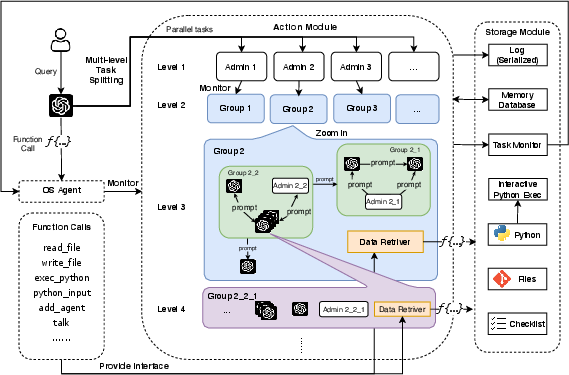
- Admin agent: An agent responsible for overseeing a subtask and managing agents within its group. "The admin agent then generates a group of agents to complete the task."
- AlphaBeta algorithm: A search algorithm that prunes branches in minimax to optimize decision-making in games. "the current ChatGPT API is not capable of developing the AlphaBeta algorithm without errors by itself."
- Boss agent: The top-level agent that decomposes a task into subtasks and assigns them to admins. "a boss agent receives the prompt, divides the task into sub-tasks, and assigns each sub-task to a corresponding sub-task admin."
- Centralized communication: A coordination paradigm where a central agent governs interactions among other agents. "Centralized communication involves a central agent or a group of central agents coordinating the system's communication, with other agents primarily connecting to the central agent."
- Checklist: A structured list maintained by agents to track and verify their actions. "each agent maintains a checklist to track its actions."
- Cosine similarity metric: A measure of similarity between two vectors based on the cosine of the angle between them. "so that the agent can fetch the most similar message into its memory by cosine similarity metric."
- Data retriever: A component that mediates function calls between agent actions and the storage module. "we introduce a data retriever as an interface between action module and storage module."
- Decentralized communication: A peer-to-peer coordination paradigm without a central controller. "Decentralized communication operates on a peer-to-peer basis among agents."
- Embeddings: Vector representations of text or data used for retrieval and similarity search. "The output of each round is encoded using LLMs into embeddings to be stored in the vector database"
- Global mutex lock: A mutual exclusion mechanism used to serialize operations across the system. "All Git operations are serialized using a global mutex lock."
- HEAD (Git): The reference to the latest commit in a Git repository. "merges them to the latest HEAD"
- Hierarchical mechanism: A layered organizational structure for task decomposition and management. "we introduce a hierarchical mechanism: a boss agent receives the prompt, divides the task into sub-tasks"
- Layered communication: Communication organized by hierarchical levels, with interactions across adjacent layers. "Layered communication is organized hierarchically, with agents at each level having distinct roles and each layer interacting with adjacent layers"
- LLM-MA systems: LLM-powered multi-agent systems for cooperative task solving. "LLM-powered multi-agent systems (LLM-MA systems) have been proposed to tackle real-world tasks."
- Message pool: A shared channel where agents publish and subscribe to messages to coordinate. "A shared message pool, as proposed in MetaGPT \cite{hong2023metagpt}, maintains a shared message pool where agents publish and subscribe to relevant messages, boosting communication efficiency."
- Meta-programming: A programming approach where code generates or manipulates other code or workflows. "MetaGPT introduces a meta-programming framework that effectively simulates the software development process"
- OS agent: A supervisory agent that enforces output formats and monitors agent-group progress. "The OS agent is employed to monitor the agent groups' output to ensure they chat in the right format;"
- Publish and subscribe: A messaging pattern where producers publish messages and consumers subscribe to relevant topics. "agents publish and subscribe to relevant messages"
- Sequential pipeline: A linear execution model where steps proceed one after another without parallelism. "these systems utilize a sequential pipeline without considering parallel execution of agents"
- Standard Operating Procedures (SOPs): Predefined instructions dictating how agents should respond to inputs or situations. "their agents mostly follow predefined Standard Operating Procedures (SOPs) that remain unchanged across the whole interaction"
- System-level parallelism: Parallel execution across multiple components or agent groups to improve throughput. "employs system-level parallelism to enhance performance and boost communication."
- Task monitor: A component that verifies outputs, reports to supervisors, and triggers rework when needed. "The task monitor is designed to verify the existence of output files, report their content to the supervising agent, and, if necessary, assign rework to the subordinate agent."
- Temperature (parameter): A control parameter in LLMs that adjusts randomness in sampling. "setting the `temperature' parameter to $0$ to ensure more deterministic responses"
- Vector database: A database optimized for storing and retrieving embeddings using similarity search. "to be stored in the vector database"
- World simulations: Complex scenario simulations using many LLM agents to emulate real-world dynamics. "simulate more complex scenarios, known as world simulations"
Collections
Sign up for free to add this paper to one or more collections.