- The paper's main contribution is a variational framework that treats cyclic organization as the primary target in statistical inference.
- It employs Dirichlet–Hodge diffusion to decompose edge flows into gradient, curl, and harmonic components, achieving robust cycle recovery.
- Applied to neural data, the method significantly reduces variance and reveals reproducible cyclic patterns across subjects.
Motivations and Problem Setting
Classical statistical and machine learning models describing directed interactions (e.g., regression, SEM, graphical models) typically focus on node-level dependencies or pairwise effects. In feedback-dominated networks—such as biological and neural systems—recurrent organization emerges as the dominant motif, with interactions entwined across overlapping cycles. Existing approaches often treat cycles as secondary, inferred from collections of directed edges, making the estimation and comparison of large-scale recurrent organization computationally prohibitive and statistically unstable. This paper proposes a shift to cycle-centric inference: treating cyclic organization as a primary object in statistical analysis and constructing a scalable variational framework enabling statistical operations directly in the space of cycles.
Variational Cycle Inference via Dirichlet–Hodge Diffusion
The core innovation is a variational and topological method wherein directed interactions are encoded as edge flows on a simplicial complex, generalizing pairwise graphs to multi-way relations. Edge flows are evolved under an energy-minimizing dynamical system governed by dissipative Lagrangian dynamics. In the strongly overdamped regime, dynamics converge to the Dirichlet–Hodge diffusion, decomposing the initial interaction flow X into gradient (source–sink), curl (local circulation), and harmonic (persistent cycles) components.
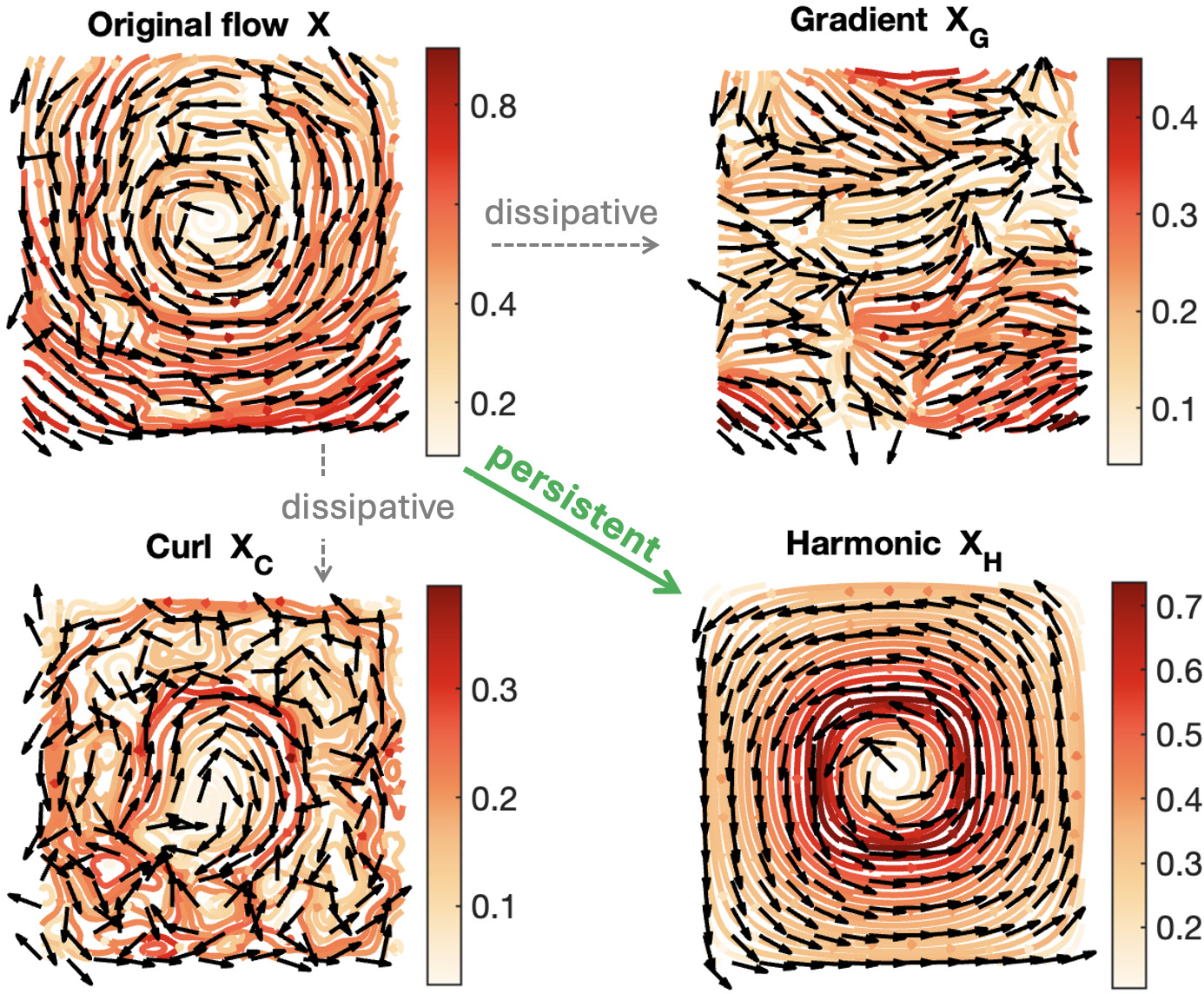
Figure 1: Dirichlet--Hodge diffusion separates edge flows into transient gradient and curl components that decay, and persistent harmonic cycles that encode stable recurrent organization.
This decomposition ensures that only globally consistent cycles, encoded by the harmonic flow XH, persist in the long-time limit. The resulting harmonic subspace ker(Δ1) acts as a vector space of admissible cycles whose dimensionality equals the first Betti number β1 of the complex, offering low-dimensional summary statistics for high-dimensional dynamical systems.
Statistical Operations and Variance Reduction in Cycle Space
Direct enumeration or averaging of cycles across dense or overlapping recurrent networks is prone to instability and can introduce spurious structures. By framing the cycle space as a Hilbert space (i.e., through harmonic flows in ker(Δ1)), the framework supports orthogonal projection, averaging, and comparison of cyclic organization across subjects or time points via linear operations, preserving topological consistency.

Figure 2: Harmonic averaging enhances recurrent cycles shared across networks, avoiding the introduction of spurious cycles.
Orthogonal projection onto the harmonic subspace provides substantial variance reduction. For a random edge flow with isotropic covariance, variance contracts by a factor β1/∣E∣, concentrating the inference in a stable, topologically constrained cycle subspace. In the neural data application, the cycle space dimensionality is only around 8% of the ambient edge space, explaining the observed empirical stability of group-level cyclic statistics.
Synthetic Validation: Robust Recovery of Cyclic Organization
Synthetic experiments construct ground-truth directed flows on cubical complexes containing complex recurrent cycles. Directed time series are simulated via VAR processes driven by these flows. Compared to directed-interaction baselines (Granger, SEM, Bayesian, transfer entropy, etc.), harmonic projection universally improved recovery: baseline cosine similarities with ground-truth cycles remained low (0.02–0.22), but harmonic projected flows achieved 0.79–0.83 for fully observed cycles and 0.72–0.75 even in networks with broken cycles below the noise threshold.
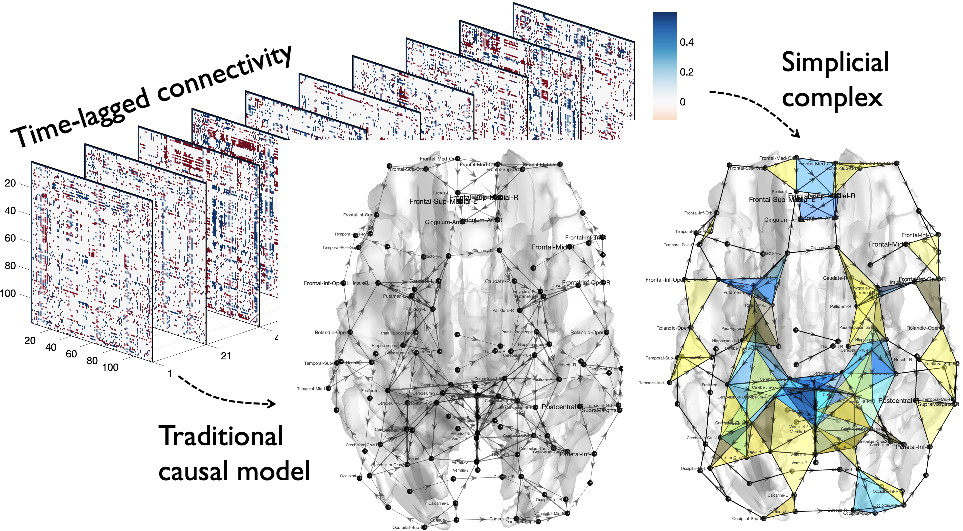
Figure 3: Ground-truth cyclic flows and recovery performance: harmonic projection extracts persistent cycles where baseline methods fail.
Crucially, harmonic projection robustly recovers cyclic organization regardless of noise level or missing edges, demonstrating strong stability and robustness. Thus, the energy-minimizing dynamics filter transient or noisy interactions, isolating the global recurrent structure.
Population-level Analysis of Human Neural Networks
Applied to rs-fMRI data from 400 HCP subjects, the framework demonstrates strong practical utility in large-scale dynamical systems. Raw edge flows derived from time-lagged correlations cancel out under direct averaging due to inter-subject and temporal asynchrony, rendering conventional edgewise analysis ineffective (maximum correlation ∼0.034, Rayleigh p=0.5).
Conversely, harmonic projection yields highly reproducible and statistically significant cyclic organization (p<10−29) in the population mean harmonic flow, with coherent recurrent cycles linking symmetric sensory and motor cortices with midline brain regions.
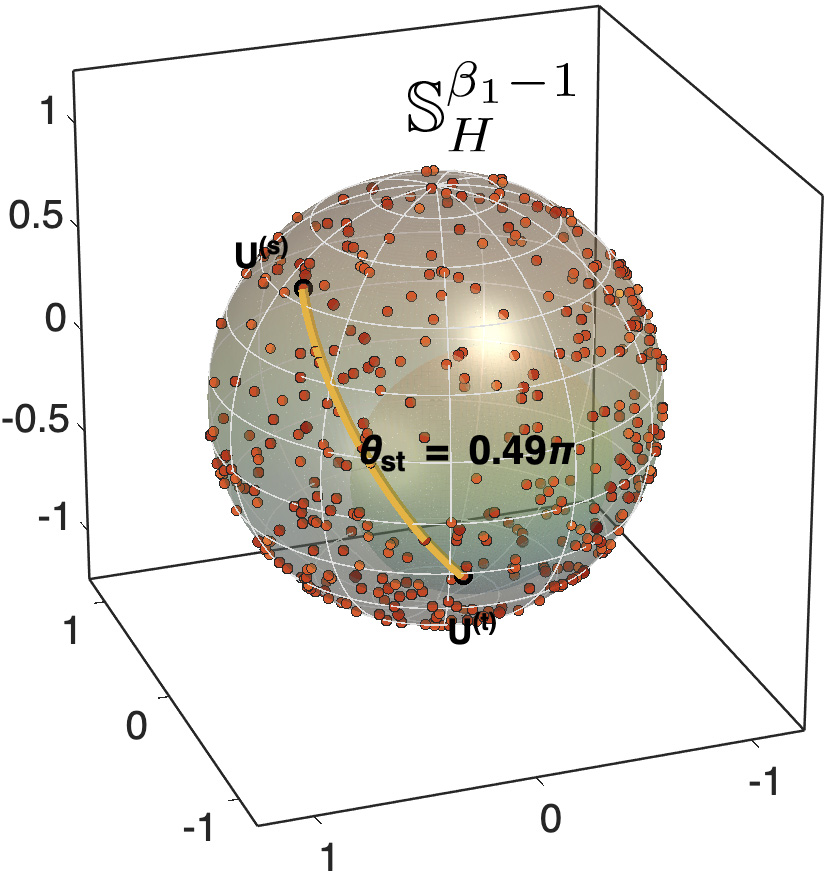
Figure 4: Normalized harmonic flows from 400 subjects concentrate on the harmonic unit sphere, quantifying population alignment of cyclic organization.
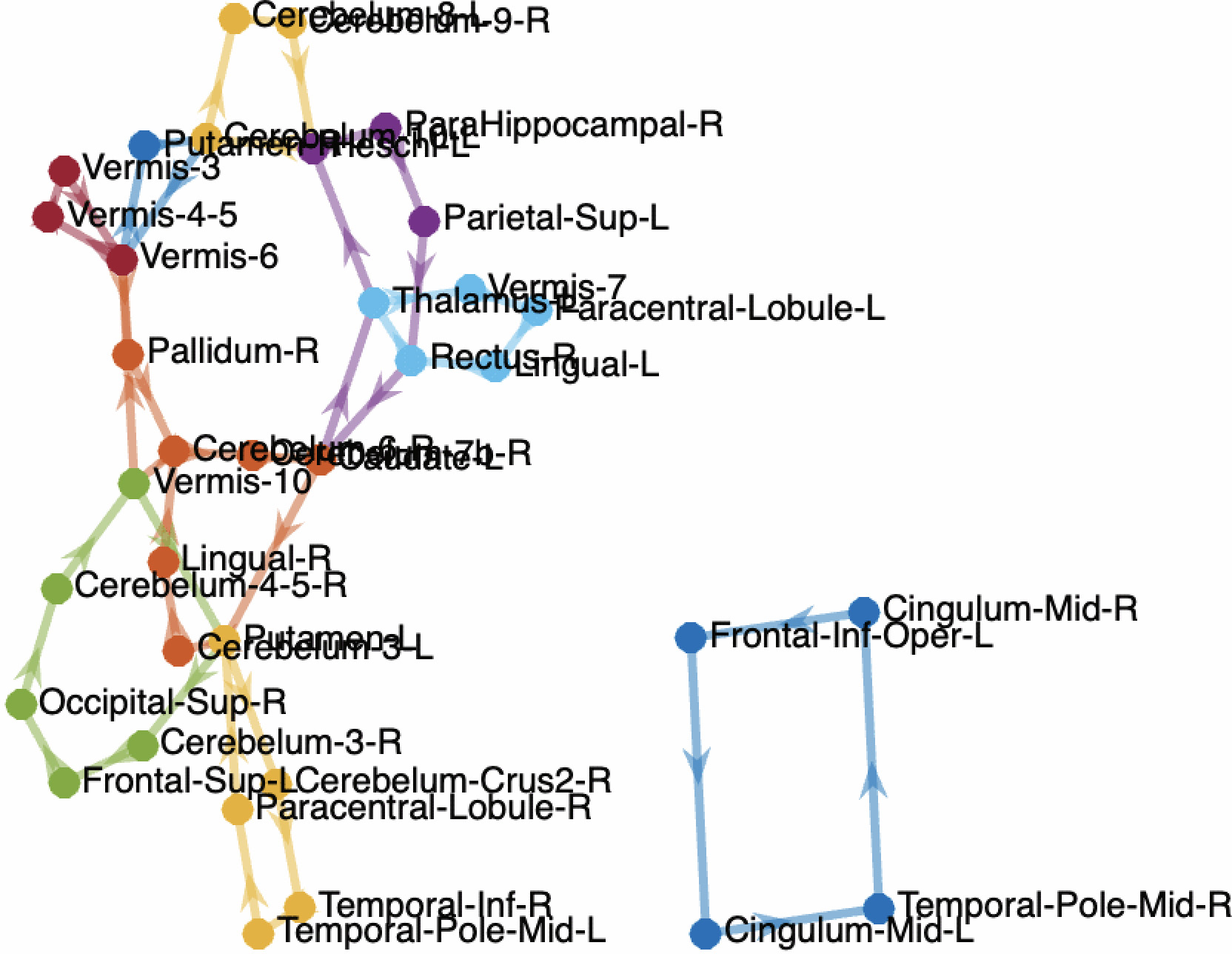
Figure 5: Top 10 cycles repeatedly involve shared brain regions, showing persistent node-level cyclic organization across subjects.
This substantiates the claim that persistent cyclic organization forms an aligned and stable component of large-scale neural dynamics, not detectable by conventional acyclic analyses. The vector space cycle representation enables reliable population-level inference via directional statistics (e.g., Rayleigh tests), leveraging geodesic distances and mean directions for group-level quantification.
Theoretical and Practical Implications
The paper’s framework establishes a mathematically principled method for inferring persistent cyclic organization in high-dimensional directed networks, offering:
- Contradictory assertion: Cyclic organization should be treated as the primary inferential target in feedback-dominated dynamical systems, in contrast to prevailing node-level or acyclic models.
- Strong numerical results: Harmonic projection universally improves cyclic recovery in simulation (mean cosine similarity increase from <0.2 to XH00.8) and reveals statistically significant population-level cyclic coherence in neural networks (XH1).
- Variance reduction: Inference in cycle space is stable, robust, and noise-contracted by an order of magnitude compared to edgewise statistics.
- General applicability: The framework separates persistent cyclic components from transient edgewise fluctuations, with estimator-agnostic input (i.e., any measure for edge flow can be used).
- Averaging and aggregation: Linear operations in cycle space avoid introduction of spurious cycles and support scalable statistical inference in recurrent systems.
Future Directions
The theoretical machinery outlined in the paper opens new avenues for statistical analysis of cyclic organization in diverse domains: brain networks, biological feedback systems, social or economic networks, and any setting where recurrent dynamics dominate. Potential developments include integration with causal inference under cycles, extensions to higher-order simplex flows capturing multi-way feedback, and embedding in machine learning architectures that require cycle-sensitive features. There is also scope for finding optimal population-level representatives or employing cycle space statistics in hypothesis testing about dynamical stability, synchrony, or network transitions.
Conclusion
The vector space formulation for cycles delivers a scalable, mathematically rigorous framework for statistical inference on recurrent organization in directed dynamical systems. By projecting edge flows onto the harmonic subspace via dissipative variational dynamics, the method isolates persistent cycles, substantially improves recovery accuracy, and enables robust population-level inference. Its implications reach beyond current acyclic paradigms, positioning cyclic organization as a foundational construct for analyzing feedback-dominated systems in neuroscience and beyond.