- The paper introduces an exact path-measure formulation of dynamical mean-field theory that circumvents Gaussian closures by using cavity recursions on path probabilities.
- It derives rigorous cavity equations applicable to both directed and reciprocal graphs, effectively capturing the temporal feedback and heterogeneity in sparse networks.
- The work bridges sparse and dense limits through population dynamics and finite-memory closures, offering scalable analysis for complex systems such as neural and ecological networks.
Dynamical Cavity Method for Continuous-Time Complex Systems on Sparse Random Graphs
Overview
The paper "Dynamical cavity method for continuous-time complex systems on sparse random graphs" (2606.08689) develops a comprehensive path-measure-level formulation of dynamical mean-field theory (DMFT) for stochastic, continuous-valued systems with general nonlinear pairwise interactions on sparse random graph ensembles. In contrast to traditional DMFT, which relies on Gaussian closure mechanisms suited for densely connected systems, this work addresses the intrinsic non-Gaussianity, heterogeneity, and sample dependence that arise in sparse networks, where each local field is shaped by finitely many strong inputs.
The formulation is constructed at the level of path probabilities, leading to cavity equations that are exact on trees and, in the thermodynamic limit, capture the locally tree-like structure of sparse random graphs. The theory is general with respect to the pairwise interaction kernel and graph structure, covering both directed and reciprocal/bidirected graphs. For the latter, an imposed-history conditional path kernel is introduced to properly account for temporal feedback generated by reciprocal edges.
The analysis considers stochastic differential equations on a fixed sparse random graph: x˙i(t)=−f(xi(t))+j=1∑NcijJijg(xi(t),xj(t))+hi(t)+ξi(t),
where f specifies self-drift, g encodes pairwise interactions, Jij are quenched couplings, and cij∈{0,1} encodes connectivity. External fields and additive Gaussian noise are included for functional response analysis.
A central innovation is the derivation of explicit path-measure-level cavity recursions for both single-site and cavity (with one neighbor removed) marginals. Exact on trees and asymptotically valid on locally tree-like graphs, these equations do not rely on Gaussian field closure. Instead, they employ message passing over path probabilities, reflecting the temporal structure of the underlying stochastic process.
For a general graph, removing a node decouples its neighbors, yielding recursions for path probability messages. The update for node i's cavity path probability depends on the imposed histories of its neighbors' paths, conditioned on the different action of the graph structure (directional or reciprocal). This is encapsulated by a normalized imposed-history conditional kernel, linking the root path to its neighbors' branches.
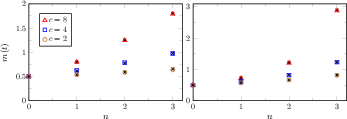
Figure 1: Comparison of direct finite-graph simulations and finite-depth population dynamics for Poissonian degree-distributed undirected graphs, confirming quantitative agreement between both methods for large N.
For fully directed graphs (no reciprocal edges), the dynamical cavity equations reduce to a convolution over incoming neighbor paths, utilizing unconditioned single-site path probabilities—recovering sparse directed DMFT previously derived by alternative means.
In presence of reciprocal/bidirected edges, the imposed history from i re-enters its neighbor's dynamics, necessitating a conditional path kernel that can, for generic g, depend on the trajectory of the neighboring node as well as the root. This subtle structural distinction is essential: it dictates when closure in terms of ordinary observables (e.g., two-time functions) is or is not possible.
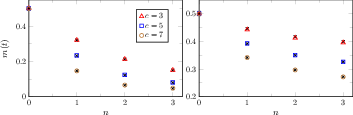
Figure 2: Agreement of direct simulation and population dynamics in regular random graphs for neural and ecological models, across degree and coupling distributions.
Ensemble Laws and Message Measures
Moving to the ensemble level, the primary mathematical object is no longer a single path probability, but rather a law on path probabilities—a population of possible cavity messages, reflecting the randomness inherent in the sparse graph and couplings. The fixed-point equations for these laws retain the hierarchical tree structure of graph neighborhoods in the thermodynamic limit, leading to an explicit, recursively-defined distribution on path-probability messages for both unidirectional and reciprocal edges.
The barycenter (mean measure) of these ensemble laws, due to multilinearity of the update and independence between incoming branches in the tree, obeys a closed self-consistency at the path-measure level—crucially, without the Gaussian or low-dimensional observable closure of traditional DMFT.
The ensemble framework supports not only the mean but also higher moments (e.g., variance) of the random path-probability messages. This enables systematic analysis of disorder-induced fluctuations and concentration phenomena.
Linear-Gaussian Specialization and Observable-Level Closure
To bridge with prior results and for validation, the linear--Gaussian reciprocal case is treated in detail. Here, the imposed-history kernel collapses to a simple additive shift, and the full machinery of operator-valued Volterra equations for means, correlations, and (causal) response functions can be explicitly recovered. This links the present formalism to classical results in kinetic Ising models, Ornstein-Uhlenbeck processes, and recent dynamical cavity analyses for reciprocal graphs [Tarabolo and Dall'Asta, J. Stat. Mech. 2025].
The path-measure recursion translates to (causal, possibly non-symmetric) memory kernels, effective innovation covariances, and explicit formulas for the triplet (m(t),C(t,t′),R(t,t′)). Notably, observable-level closure into a finite set of two-time order parameters is only granted for such additive (or linear) examples; generic nonlinear pairwise kernels can force the description to remain at the path probability level.
Causal Discretization and Population Dynamics
To operationalize the theory and enable comparison with direct simulations, a causal discretization of the continuous-time process is given. The finite-time, discrete causal form casts the update as a Markov chain, preserving the exactness of the cavity construction for any fixed time horizon and step size.
This enables a systematic population dynamics algorithm:
- In fully directed graphs, the unknown is an empirical population of entire trajectories, updated iteratively by sampling neighborhood degrees, couplings, and branch messages.
- For reciprocal graphs, the recursion involves conditional path laws over trees of finite depth ("branch kernel trees"), with the branch history length decreasing by one at each level due to causality.
Comparison shows excellent agreement between this population dynamics implementation and direct simulation for both Poissonian and regular undirected graphs, neural and ecological dynamics, across coupling distributions and degrees. Finite-memory closures (rolling, root-quenched, endpoint-corrected) are introduced for numerical tractability in long-time simulations, each with distinct trade-offs in reproducing exact higher moment behavior.
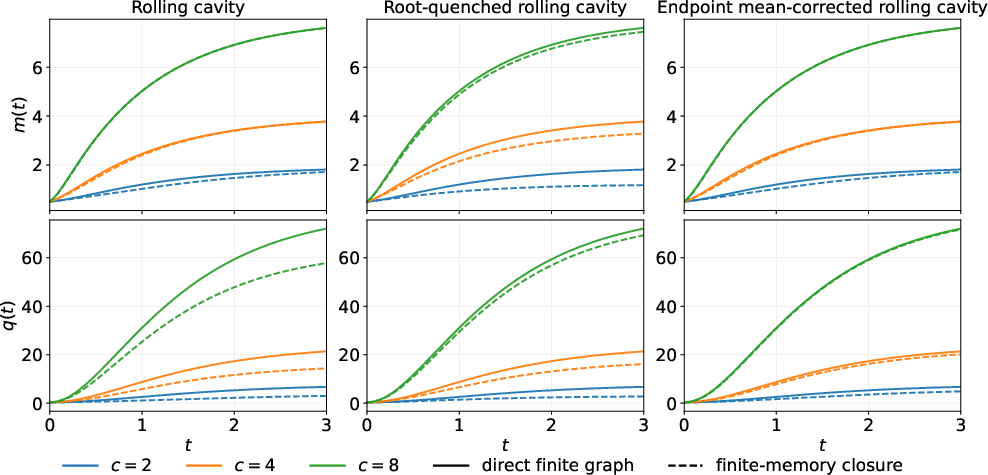
Figure 3: Evaluation of mean and second moment for various finite-memory closures in population dynamics against large-scale direct simulations for an additive-input RNN, with f0.
High-Connectivity Limits and Dense DMFT Connection
The sparse path-measure formulation serves as a systematic basis for taking the large-connectivity (dense) limit. Under coupling scaling, leading-order drift, colored noise, and, for reciprocal graphs, retarded response ("memory") channels are derived explicitly as projections of the sparse equations. However, closure at the level of low-dimensional observables remains a model-dependent property—a path measure may in general not reduce to a self-consistent finite set of scalar/tensor order parameters. This reconciles sparse and dense DMFT as different regimes of a single unified path-measure theory, clarifying when and why Gaussian closure is justified.
Implications and Future Directions
This work resolves several longstanding issues:
- It rigorously identifies the object of closure for sparse stochastic dynamical systems with complex (possibly nonlinear) pairwise interactions: ensemble laws over path-probability messages rather than simple summary statistics.
- The imposed-history conditional kernel formalism clarifies the crucial distinction between directed and reciprocal/bidirected graph structures in the context of dynamic feedback, temporal memory, and possibility of low-dimensional closure.
- It bridges cavity methods, message-passing approaches, and DMFT, allowing future systematic reductions (e.g., TAP-type expansions, memory-augmented DMP) beyond the Gaussian setting.
- The path-measure, population-dynamics, and finite-memory frameworks provide a solid foundation for practical computation in large, sparse, heterogeneous networks—ranging from neural, ecological, to epidemic and social systems.
Prospects include improving numerical efficiency for bidirected kernel populations, developing further approximations for long observation horizons, and automated reductions for specific nonlinear pairwise models exhibiting collective phenomena or glassy dynamics.
Conclusion
The paper establishes a general and rigorous theory of dynamical mean-field closure at the path probability level for continuous-time, stochastic, nonlinear systems on sparse random graphs. By explicitly handling the complexity introduced by sparse, heterogeneous, and reciprocal network structure, it opens avenues for accurate analysis and simulation in settings where Gaussian or observable-level closure is impossible. This advances not only the mathematical foundations of non-equilibrium complex systems but also their practical tractability in computational neuroscience, evolutionary dynamics, and information processing scenarios.