- The paper introduces a physics-grounded post-hoc correction module using phase-aware FSM and Euler-Lagrange gate, improving task success by up to 17 percentage points.
- It presents a dual-branch approach that selectively adjusts actions without retraining, resulting in enhanced trajectory stability and a 10× improvement in jerk robustness.
- Experiments demonstrate that PhysVLA effectively rescues contact-rich failures and generalizes across multiple VLA backbones, with successful hardware transfer on a 6-DoF arm.
PhysVLA: Physics-Grounded Inference for Robust Vision-Language-Action Robotic Manipulation
Motivation and Physics Gap Analysis
Standard vision-language-action (VLA) models for embodied robotic manipulation leverage visual input and natural language prompts to generate end-effector control actions, but fundamentally lack explicit enforcement of physical principles such as rigid-body dynamics, contact constraints, and phase-specific reasoning. Empirical diagnostics on benchmarked policies (e.g., OpenVLA, OpenVLA-OFT) confirm a pronounced "physics gap": memoryless VLA backbones exhibit low success rates (OpenVLA: 36%) while temporal smoothing via chunked memory boosts this figure (OpenVLA-OFT: 92%) but incurs significant computational overhead and still struggles in contact-rich tasks where short-horizon correction is insufficient. Temporal smoothing approaches (uniform EMA) improve trajectory stability but degrade task success, as they fail to distinguish manipulation phases and suppress critical action bursts required during fine contact acquisition and precision placement. This establishes the necessity for phase- and dynamics-aware action correction that operates at inference time without retraining.
PhysVLA Framework Architecture
PhysVLA is a modular, plug-and-play framework designed to wrap any frozen VLA policy πθ at inference, requiring neither fine-tuning nor internal weight access. In each control cycle, PhysVLA intercepts the predicted action aVLA, reads the simulator or physical state, and applies a dual-layered physical correction:
The entire PhysVLA pipeline adds less than $1$ ms to per-step inference, maintaining compatibility with standard high-frequency control cycles and requiring no retraining.
Experimental Results: Task Success, Efficiency, and Generalization
PhysVLA was evaluated across the LIBERO-Spatial suite (10 pick-and-place tasks on a 7-DoF Franka Panda arm), wrapping four backbone paradigms: OpenVLA (single-step AR), OpenVLA-OFT (chunked memory), Force-VLA (force-residual), and Generalist-VLA (flow-matching ensemble). Four inference modes were compared: Baseline, Temporal (EMA), PhysVLA (FSM only), and PhysVLA + EL gate. Aggregate quantitative results are as follows:
- Absolute task success increased by up to 17 pp (OpenVLA: 36 → 53%; Force-VLA: 40 → 53%; Generalist-VLA: 36 → 50%; OpenVLA-OFT: 92 → 95%) with zero per-task regressions.
- Stability improved by up to 19 pp (OpenVLA: 20.1 → 36.8%; Generalist-VLA: 29.9 → 49.2%).
- Trajectory efficiency metrics (smoothness, jerk robustness) showed up to a 10× improvement in cross-simulator sweeps (Robosuite Lift: PhysVLA mean jerk grows only 17% vs Baseline 175% under high-noise trials).
- No retraining or parameter tuning was required; PhysVLA operates entirely backbone- and task-agnostic.
Cross-architecture qualitative comparisons (Figure 2) demonstrate PhysVLA consistently rescues contact-rich failure modes and challenging placements where baseline policies and temporal smoothing degrade responsiveness and fail.
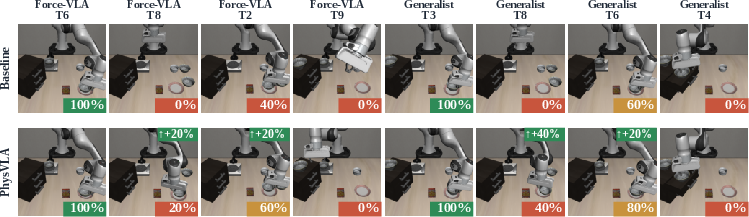
Figure 2: Cross-architecture qualitative comparison on LIBERO-Spatial, with Baseline (top) and PhysVLA (bottom) highlighting strict per-task recoveries.
Real-World Deployment and Hardware Transfer
PhysVLA's composability was validated on a physical Agilex Piper 6-DoF arm performing pick-and-place tasks. Without retraining, PhysVLA raised end-to-end placement success from 45% to 95% over 20 trials, with mean trajectory jerk dropping by a factor of ten. This confirmed the framework's robustness and physical grounding transfers to hardware when the underlying kinematic and inertial models are adequately calibrated.
Implications, Limitations, and Prospective Extensions
PhysVLA establishes a new inference-time correction paradigm for VLA models: treating physics as post-hoc structure injection rather than as a training-time regularizer or controller redesign. This approach is efficient, composable, and does no harm—strictly improving task success with minimal inference overhead. It further demonstrates that phase- and kinodynamic-aware interventions outperform uniform temporal smoothing and are essential for real-world robotic manipulation where physical coherence is critical.
Limitations are primarily linked to model calibration (URDF/XML accuracy) and the 5% correction cap, which is insufficient for sub-centimeter precision requirements or in cases of severe backbone misalignment. PhysVLA does not resolve occluded geometry or deformable target manipulation tasks that require greater integration of physical context within the policy itself.
Future directions include (i) learning phase predicates from visual cues for deformable or occluded geometry, (ii) integrating the dynamics gate as a soft prior during policy training, and (iii) exploiting on-board sensor fusion to source dynamics directly, reducing dependency on simulation accuracy.
Conclusion
PhysVLA delivers physics-aware post-hoc correction for frozen VLA models, bridging the behavioral demonstration-driven gap with structured, conditional enforcement of physical principles. By incorporating phase segmentation and selective dynamics intervention, it achieves notable gains in manipulation success, safety, and efficiency across multiple architectures and benchmarks, including hardware transfer. This design mandates future VLA research to treat inference-time physical grounding as a composable module, enabling practical deployment for embodied agents in real-world manipulation contexts.
(2606.13886)
