HarnessX: A Composable, Adaptive, and Evolvable Agent Harness Foundry
Abstract: AI agent performance depends critically on the runtime harness, comprising the prompts, tools, memory, and control flow that mediate how a model observes, reasons, and acts. Yet today's harnesses remain largely hand-crafted and static: each new model or task still demands bespoke scaffolding, and the rich traces produced during execution are rarely distilled back into systematic improvement. We introduce HarnessX, a foundry for composable, adaptive, and evolvable agent harnesses. HarnessX assembles typed harness primitives via a substitution algebra, adapts them through AEGIS, a trace-driven multi-agent evolution engine grounded in an operational mirror between symbolic adaptation and reinforcement learning, and closes the harness-model loop by turning trajectories into both harness updates and model training signal. Across five benchmarks (ALFWorld, GAIA, WebShop, tau3-Bench, and SWE-bench Verified), HarnessX yields an average gain of +14.5% (up to +44.0%), with gains largest where baselines are lowest. These results suggest that agent progress need not come from model scaling alone: composing and evolving runtime interfaces from execution feedback is an actionable and complementary lever. The complete codebase will be open-sourced in a future release.
Paper Prompts
Sign up for free to create and run prompts on this paper using GPT-5.
Top Community Prompts
Explain it Like I'm 14
What this paper is about (in simple terms)
Think of an AI agent as a smart “brain.” On its own, the brain can read and write, but in real tasks it also needs a setup around it: instructions, tools (like a calculator or a web browser), memory of past steps, and rules for what to do next. This setup is called a harness.
This paper introduces HarnessX, a way to build that setup like Lego and let it improve itself over time. Instead of humans constantly rewriting prompts and code by hand, HarnessX watches what the agent does, learns from its mistakes, safely tries better setups, and keeps the good changes.
What the researchers wanted to achieve
They had a few clear goals:
- Make the agent’s harness modular and swappable, like Lego pieces that click into specific spots, so you can change parts without breaking everything else.
- Let the harness adapt automatically based on real “traces” (detailed logs of what happened during tasks), not just human intuition.
- Avoid common problems when learning from trial-and-error, like:
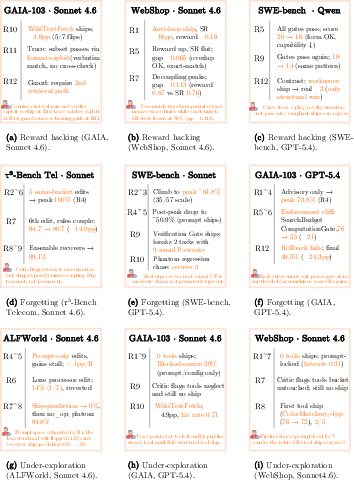
- Cheating the tests (reward hacking),
- Forgetting how to do older tasks while learning new ones (catastrophic forgetting),
- Only making tiny, safe changes and never trying big improvements (under‑exploration).
- Train the harness and the AI model together so they both get better using the same experiences, instead of improving only one and getting stuck.
How the system works (everyday explanation)
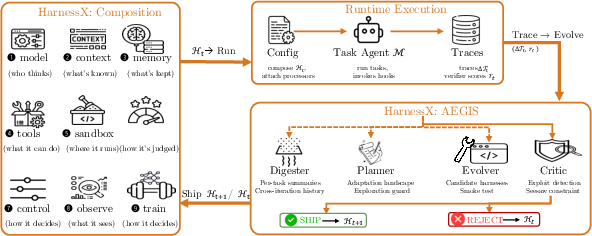
First, picture the harness as a set of typed Lego pieces that fit into specific parts of the agent’s workflow (for example: “before calling the model,” “after getting a tool result,” “at the end of a step”). Each piece is a small processor with a clear job—building the context, choosing tools, saving memory, enforcing safety rules, and so on. Because each piece has a type and a slot, you can swap pieces safely and predictably.
HarnessX then uses a four-part “coach” called AEGIS to evolve the harness using the agent’s own traces:
- Digester: Like a highlight reel editor. It condenses long, messy logs into short summaries that explain what failed, where, and why.
- Planner: Like a strategy coach. It looks at the evidence and maps out possible fixes, from tiny prompt tweaks to bigger changes like adding a new tool or a new control rule.
- Evolver: Like a builder. It creates one or more candidate harness changes (e.g., “insert this tool here,” “replace that prompt there”), plus a short “change manifest” that explains what changed and which tasks should improve.
- Critic: Like a referee. It checks the candidates against the evidence and runs strict, automatic tests. Importantly, changes are only accepted if they don’t break tasks that already worked.
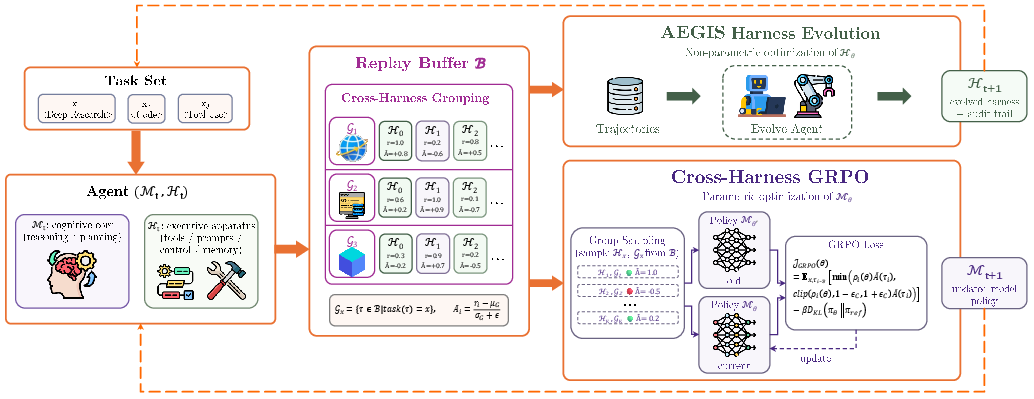
To handle mixed sets of tasks (some very different from others), HarnessX can keep multiple specialized harness variants and route each task to the best one. This prevents “fixes” for one type of task from messing up another type.
Finally, HarnessX closes the loop by training the AI model and evolving the harness together. It stores all attempts and scores in a shared “replay buffer,” so the same experiences teach the harness what to change and train the model how to behave better. That way, the brain and the setup improve hand‑in‑hand.
What they found and why it matters
Across five different test suites (including text-based games, web shopping, a variety pack of questions, and coding bug fixes), HarnessX increased success by about 14.5 percentage points on average, with the biggest jump being 44 points. The biggest gains showed up when starting from weaker agents—meaning better harnesses can help smaller, cheaper models act much more capable.
They also showed:
- On mixed task sets, keeping separate harness variants and routing tasks to the right variant made progress steadier and avoided backsliding.
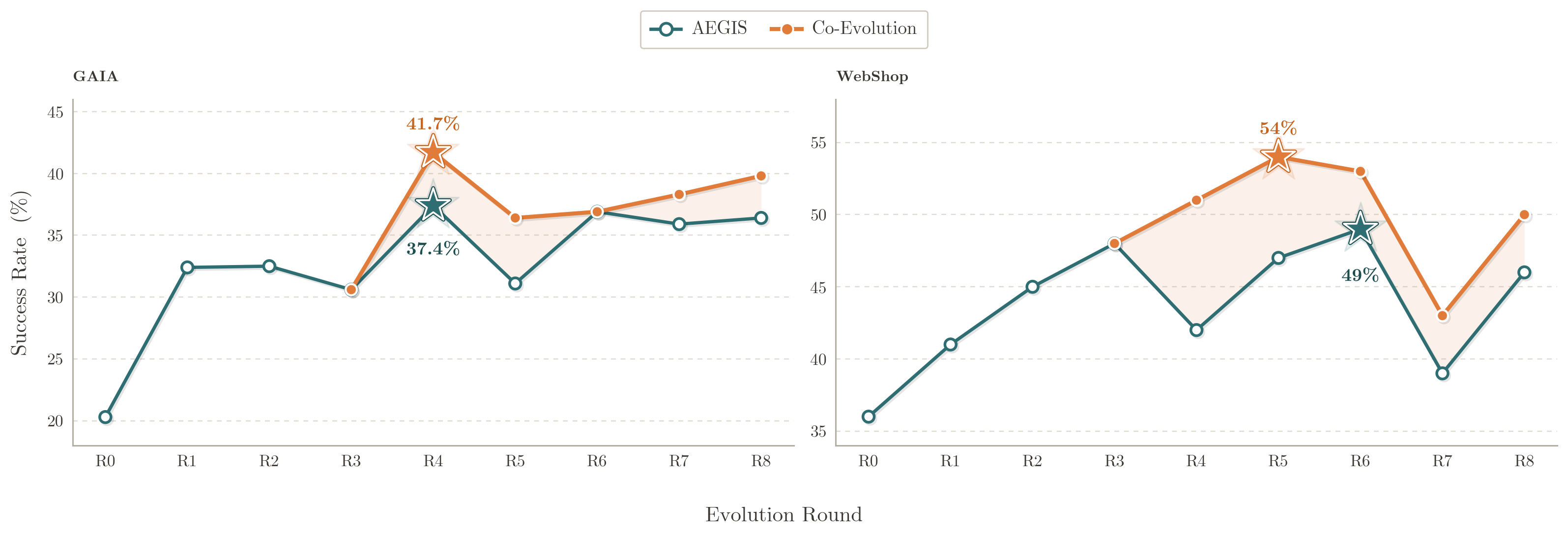
- Training the model together with the harness gave an extra boost (about 4.7 points) beyond evolving the harness alone.
These results suggest we don’t have to rely only on building ever-bigger AI models; making the “body and toolkit” around the model smarter and self-improving is a powerful and practical lever.
Why this is exciting (impact and implications)
- Less manual tinkering: Instead of engineers constantly hand‑editing prompts and code, the system learns from its own runs, proposes improvements, and ships only safe, tested changes.
- Safer and more reliable: Strict checks prevent cheating and stop the system from breaking tasks that already work.
- Better use of smaller models: A stronger harness can close gaps for weaker models, which could make AI systems more affordable and widely usable.
- Faster iteration: Because the model and the harness learn together from the same experiences, progress compounds.
- A new path to AI progress: Beyond scaling model size, evolving the runtime interface (the harness) gives another clear, actionable way to improve real‑world agents.
In short, HarnessX turns the “stuff around the AI brain” into Lego pieces that can be swapped, tested, and evolved automatically—helping agents get better, safer, and faster with the data they already produce while working.
Knowledge Gaps
Knowledge Gaps, Limitations, and Open Questions
Below is a consolidated list of concrete gaps and open questions that are missing, uncertain, or left unexplored, framed to guide follow-on research.
- Formal guarantees: No convergence, stability, or sample-complexity analysis of the “operational mirror” MDP or the AEGIS optimization dynamics (with/without variant isolation).
- Sensitivity to hyperparameters: Unreported effects of α (actionability threshold), patience P, gating criteria, batch size, and variant-pool size K on stability, progress, and token cost.
- Reward hacking robustness: No formal or empirical guarantees that Critic + deterministic gate prevent prompt leakage, verifier gaming, or “format hacks” across diverse verifiers.
- Verifier dependence: Gains are measured with fixed verifiers; robustness to imperfect, biased, or adversarial verifiers (and cross-verifier consistency) is untested.
- Causal attribution: Lacks systematic ablations isolating which dimensions (D1–D9), hooks, or processor edits drive gains; unclear which edit types generalize vs. overfit.
- Stage-level ablations: No controlled ablation of Digester/Planner/Evolver/Critic contributions or their failure modes; unclear when selective invocation helps or hurts.
- Variant isolation policy: Missing details on task clustering, routing policy learning, fork/merge criteria, variant retirement, and guarantees against variant explosion or mode partitioning.
- Cross-variant knowledge sharing: No mechanism to distill or reconcile improvements across variants; risk of duplicated effort and divergence.
- Harness bloat and refactoring: No strategy to prevent complexity creep, dead processors, or redundant tools; lacks automated pruning, simplification, or cost-aware regularization.
- Edit safety beyond type checks: Hook-level type contracts do not prevent semantic conflicts (stateful side effects, race conditions, hidden couplings); needs stronger static/dynamic analysis.
- Tool correctness and security: New tool integrations are only “smoke-tested”; no formal verification, sandbox hardening, supply-chain security, or runtime policy enforcement for side effects.
- Observability at scale: Trace storage, compression fidelity, data retention policies, and cost/latency overheads (e.g., GAIA’s ~10M tokens/round) are not quantified or optimized.
- Privacy and compliance: Unaddressed PII handling, consent, retention limits, and compliance (e.g., GDPR/CCPA) when traces become training signal in co-evolution.
- Real-world non-stationarity: No evaluation under changing tool APIs, web drift, data shifts, or evolving reward functions; needs continual adaptation and rollback strategies.
- Online vs offline adaptation: The system adapts in rounds; feasibility, safeguards, and SLAs for on-the-fly adaptation in production are unaddressed.
- Latency and throughput: No analysis of end-to-end runtime overhead from multi-stage meta-agents, gating, and variant routing in interactive or real-time settings.
- Cost-effectiveness: Absent token/compute accounting for each improvement, marginal returns per evolution round, and comparison to alternative investments (e.g., finetuning only).
- Generalization across domains: Benchmarks are limited; transfer to safety-critical, multi-lingual, multi-modal, or embodied settings and highly long-horizon tasks is untested.
- External validity: No deployments or user studies demonstrating maintainability, operator trust, or debugging experience in real engineering workflows.
- Human-in-the-loop roles: Missing guidance for human review gates, code audits for edits, or policy exceptions; unclear oversight needed to prevent harmful changes.
- Reproducibility: Code not yet released; lack of seeds, exact configs, and deterministic pipelines for LLM sampling undermines replicability.
- Model dependence: Unclear how outcomes vary with different meta-agent LLMs (size, provider) or with weaker/stronger task models; no robustness to model swaps or upgrades.
- Failure taxonomy reliability: Digester’s automated failure categorization may misclassify root causes; needs precision/recall metrics and impacts on Planner quality.
- Seesaw constraint trade-offs: Hard “no regression” gating can stall progress; criteria for temporary regressions, Pareto-front search, or multi-objective gating are unspecified.
- Safety policy enforcement: Control/safety processors are described but not evaluated (looping, overspending, jailbreaks); missing adversarial evaluations and red-teaming.
- Co-evolution mechanics: The cross-harness GRPO specification is incomplete; importance sampling, off-policy corrections, KL anchoring, and bias/variance controls are unspecified.
- Credit assignment in co-evolution: No methodology to disentangle improvements due to harness vs model updates; risks of model overfitting to transient harness conventions.
- Replay buffer staleness: Off-policy training on mixed harness/model trajectories may induce drift; policies for buffer freshness, prioritization, or stratification are not given.
- Catastrophic forgetting (model side): No safeguards that GRPO updates won’t forget behaviors learned under earlier harness variants; lacks continual learning mechanisms.
- Advantage grouping choices: GRPO group construction across harness versions is proposed but not stress-tested; alternatives (per-variant, per-strategy, per-cluster) remain unexplored.
- Safety of automatically generated code: Evolver can introduce processors/plugins; needs static analysis, policy linting, and formal contracts to prevent privilege escalation or data exfiltration.
- Compatibility/interoperability: Migration path from existing agent stacks (LangGraph/AutoGen/etc.), and guarantees when mixing HarnessX processors with third-party components, are not specified.
- Type system rigor: The processor “type” notion is informal (hook/event contracts); lacks a formal language or effects system to reason about shared state, purity, and side effects.
- Evaluation significance: Reported gains lack confidence intervals, seed variance, and stratified reporting (by task difficulty, tool use, or edit class).
- Robust success criteria: For benchmarks with imperfect proxies (e.g., WebShop), success-by-verifier vs success-in-ground-truth alignment is not validated.
- Multimodality: Co-evolution and AEGIS are presented text-first; handling vision/audio/tool UIs, modality-specific traces, and cross-modal verification is open.
- Resource governance: No policies for token budgets per round, hard stops, or budget-aware planning; Planner lacks cost-sensitive objective functions.
- Intervention granularity: Under-exploration defenses are conceptual; quantitative triggers for “structural” vs “incremental” edits and their relative payoffs are unreported.
- Security under adversarial inputs: No red-team evaluation where inputs aim to trigger dangerous tool calls, verifier exploits, or edit proposals that degrade defenses.
- Long-term maintenance: Lifecycle management of processors (versioning, deprecation, schema migration) and backward compatibility across harness iterations are unspecified.
- Ethical implications: Using execution traces for RL raises consent/ownership issues; governance frameworks and opt-out mechanisms are missing.
These points highlight where additional theory, measurements, ablations, safeguards, and broader evaluations are needed to solidify the approach and guide practical deployment.
Practical Applications
Immediate Applications
Below are actionable, deployable-now use cases that leverage HarnessX’s composable harness, AEGIS trace-driven adaptation, deterministic gating, variant isolation, and the co-evolution training bridge. Each bullet names sectors, outlines a concrete product/workflow, and notes key dependencies or assumptions.
- Auto-adaptive code assistants for bug fixing and refactoring (Software Engineering; SWE-bench-like)
- What: IDE/CLI plugins that evolve prompts, tools, and control flow from execution traces to steadily improve pass rates on unit tests and tasks.
- How: Processors at
before_model/after_toolfor tool orchestration; AEGIS to propose prompt/tool changes; deterministic gate to block regressions; replay buffer + GRPO to fine-tune smaller models. - Dependencies: Test-based verifiers, trace instrumentation, access to an LLM for the meta-agent and (optional) RL fine-tuning, CI/CD for gated rollout.
- E-commerce shopping and content agents (Retail/E‑commerce; WebShop-like)
- What: Browsing, product comparison, and cart/checkout helpers that auto-add or tune tools (search, scraping, summarization) based on trace evidence.
- How: Tool registry management (D4), context assembly edits (D2), variant isolation for category-specific behaviors, gate to prevent regressions on previously solved flows.
- Dependencies: Stable web APIs or headless browsers, deterministic task verifiers (success criteria), observability pipeline.
- Web RPA and back-office process automation (Operations/IT; RPA)
- What: Agents that execute multi-step workflows across SaaS/legacy systems and evolve harness components (retry policies, tool inputs, safety rules) from failure traces.
- How: Processors for control/safety (D7), Digester for failure categorization, Planner for structural edits beyond prompts, deterministic gate for regression-proof rollouts.
- Dependencies: Tool wrappers for enterprise APIs, permissioning/sandboxing, replayable verifiers (synthetic or business KPIs).
- Customer support triage and drafting (CX/Helpdesk)
- What: Case routing, reply drafting, and knowledge-base grounded responses that tune prompts/memory policies to reduce escalations and increase first-contact resolution.
- How: Context assembly (D2) and memory (D3) processors; AEGIS to adapt retrieval prompts and tool selection; seesaw constraint to protect solved intents.
- Dependencies: KB/retrieval tooling, verifiers (policy adherence, tone, accuracy), data governance for PII.
- Agent observability and debugging suite (MLOps/Platform)
- What: Drop-in observability that compresses traces into actionable summaries (failure types, implicated components) and links changes to outcomes.
- How: Digester + Tracer (D8) with per-task histories and change manifests; dashboards for failure heatmaps and shipped/rejected edits.
- Dependencies: Hook-based logging, storage for trace stores, lightweight UI or BI integration.
- Safe agent release engineering (DevOps/SRE for agents)
- What: Canary deploys of harness edits with deterministic gating (no-regression “seesaw” checks), automatic rollback, and audit-ready manifests.
- How: Critic + deterministic acceptance gate; typed substitution algebra for safe insertion/removal; harness diffing and normalization.
- Dependencies: Regression suites/fixtures, traffic splitting, artifact store for manifests and harness versions.
- Multi-variant routing for heterogeneous workloads (Platforms/Cloud)
- What: Maintain a small pool of harness variants and route tasks to the best-performing variant per cluster to prevent cross-task interference.
- How: Variant isolation and ensemble routing; per-variant seesaw constraint; routing service that uses historical per-task success rates.
- Dependencies: Task clustering/signatures, routing layer, metrics store.
- Prompt/context auto-optimization as a managed service (Software/Consulting; Academia/Industry)
- What: An AEGIS-powered service that iteratively improves prompts, tool descriptions, and context assembly for existing agents with trace-based justifications.
- How: Planner to explore beyond local edits; Evolver to generate typed manifests; Critic/gate to enforce safety.
- Dependencies: Access to traces, fixed evaluators/verifiers, integration adapters for LangChain/LangGraph/AutoGen-style agents.
- Toolchain and plugin governance (Software Platforms)
- What: A console to add/remove tools, specify approval processors, and enforce singleton-group constraints to avoid conflicts.
- How: D4 tool ecosystem with type-safe substitution; metadata-driven composition rules; smoke tests for new tools/processors.
- Dependencies: Standardized tool schemas (I/O contracts), sandbox providers, QA harness.
- Training smaller, cheaper models with the training bridge (AI/Model Engineering)
- What: Use shared replay buffers and cross-harness grouping to perform GRPO updates on smaller LMs that internalize harness strategies, lowering inference cost over time.
- How: Co-evolution loop; per-task advantage baselining across harness versions; KL-anchored clipped updates.
- Dependencies: RL infrastructure, rights to train, a fixed/verifiable reward, compute budget.
- Educational tutoring and task coaching (Education)
- What: Tutors that adapt prompts, memory, and tool usage per learner/task, with variant isolation for different subjects or skill levels.
- How: D2/D3 processors for curriculum-aware context/memory; gate-backed evolution to avoid regressions on mastered skills.
- Dependencies: Assessment verifiers, content/tool integrations, privacy/consent for student data.
- Robotics simulation and home-automation planning (Robotics/IoT; ALFWorld-like)
- What: Sim/virtual-environment agents that evolve tool policies and control strategies for planning tasks; transfer best variants to real or digital twins.
- How: D4 tool wrappers to simulators; AEGIS-guided structural edits; variant isolation for task families (navigation vs. manipulation).
- Dependencies: Simulator APIs, safety verifiers, sim-to-real validation pipeline.
- Enterprise knowledge assistants with adaptive memory (Knowledge Management)
- What: Org-wide assistants that learn when/how to store and recall cases, FAQs, and prior resolutions without model retraining.
- How: Memory processors (D3) and context editors (D2) evolved from trace evidence; gating to prevent forgetting effective retrieval patterns.
- Dependencies: RAG stack, data retention/DSAR compliance, internal taxonomy.
Long-Term Applications
The following use cases require additional research, scaling, standardization, or ecosystem maturity before broad deployment.
- Self-evolving enterprise agent platforms (Cross-industry)
- What: Organization-wide Harness Foundry that continuously evolves departmental agents under shared governance and replay buffers.
- Dependencies: Company-wide verifiers/KPIs, standardized processor APIs, change-control boards and automated audits.
- Regulator-grade change control and auditability (Healthcare/Finance/Government)
- What: Formalized change manifests, deterministic gates, and trace archives accepted as compliance artifacts for safety-critical agents.
- Dependencies: Standards bodies’ guidance, audit tooling, provably robust verifiers, model/harness provenance tracking.
- Processor marketplace and harness interchange standards (Software Ecosystems)
- What: A public ecosystem of typed processors (tools, memory, control policies) with compatibility guarantees across frameworks.
- Dependencies: Community-agreed hook/typing specs, security scanning/signing of processors, versioning norms.
- Automated tool synthesis and maintenance (Software Tooling)
- What: Evolver generates and refines tool wrappers/skills from traces, with smoke tests and gates, reducing manual integration effort.
- Dependencies: Verified code generation, sandboxing, dynamic analysis, tool-onboarding workflows.
- On-device and edge co-evolution (Mobile/IoT/Embedded)
- What: Lightweight variants of AEGIS and GRPO that adapt harnesses and fine-tune small models locally under privacy constraints.
- Dependencies: Efficient tracing/compression, tiny RL updates, federated aggregation, energy-aware scheduling.
- Safe real-world robotic agents (Robotics)
- What: Harness evolution for planning/control combined with safety gates and certified verifiers for physical-world execution.
- Dependencies: High-fidelity simulators, risk-aware verifiers, certification frameworks, fail-safe actuation.
- Curriculum co-evolution for model training (AI Labs)
- What: Use evolving harness variants to create naturally-progressing task curricula, improving sample efficiency and robustness.
- Dependencies: Stable cross-harness advantage estimation at scale, curriculum schedulers, large replay buffers.
- Continuous compliance and audit mining from traces (GRC)
- What: Automated issue detection (data leakage, prompt injection, policy drift) from evolving trace stores with triage and remediation proposals.
- Dependencies: Policy encodings as verifiers, scalable log analysis, workflows for enforcement and retraining.
- Personal digital assistants that self-specialize (Consumer/Daily Life)
- What: Per-user harness variants that learn preferences, tools, and safety rules over time with local gates to prevent regressions in core tasks.
- Dependencies: On-device storage, privacy-preserving observers, user-consented verifiers (e.g., satisfaction signals).
- Full-stack agent A/B/N experimentation platform (Platforms/Analytics)
- What: Unified experimentation that treats harness edits as first-class variants with per-task metrics, routing, and long-horizon optimization.
- Dependencies: Experiment design tooling, counterfactual logging, budgeted exploration policies.
- Open trace benchmarks and governance for agent research (Academia/Consortia)
- What: Public, anonymized trace stores with change manifests to benchmark adaptation methods and study failure modes (reward hacking, forgetting).
- Dependencies: Data-sharing agreements, de-identification pipelines, community verifiers and leaderboards.
- Interop with model-generated dynamic workflows (Model Providers/Frameworks)
- What: Combine session-time dynamic scripts with persistent, trace-optimized harness evolution for compounding gains.
- Dependencies: Stable interfaces between runtime scripts and persistent harness stores, conflict resolution strategies.
- Systematic safety research via Critic and gating telemetry (Safety/Red Teaming)
- What: Use Critic outcomes and rejected edits to study exploitation attempts and harden verifiers and gates across domains.
- Dependencies: Shared taxonomies of failure/exploit types, controlled testbeds, cross-org sharing frameworks.
Notes on Feasibility and Assumptions
- Model access and quality: AEGIS relies on an LLM meta-agent for Digester/Planner/Evolver/Critic; gains are larger on weaker task models but depend on reliable meta-reasoning.
- Verifiers and rewards: Fixed, trustworthy verifiers are critical to prevent reward hacking and enable cross-harness GRPO; domain-appropriate success criteria must be available.
- Observability: Comprehensive, structured trace capture is a prerequisite for diagnosis, adaptation, and auditability.
- Type-safe composition: The substitution algebra and processor typing/hook contracts underpin safe evolution; adopting similar patterns in existing frameworks may require engineering.
- Compute and budget: Evolution and co-evolution consume tokens/compute; variant isolation reduces regressions but adds evaluation overhead.
- Governance and compliance: Deterministic gating and manifests support compliance, but regulated settings will require additional assurances (provenance, approvals, monitoring).
- Data privacy/security: Trace storage and tool use must comply with privacy/security requirements; sandboxing and policy processors are needed in sensitive domains.
- Code availability: The paper indicates open-sourcing in a future release; near-term implementations may adopt the principles within existing agent stacks (e.g., LangGraph/AutoGen) until a reference codebase is released.
Glossary
- AEGIS: A trace-driven, multi-agent engine for evolving harnesses with structured observability and auditing. "On top of this substrate, we introduce AEGIS, an observability-driven and auditable harness adaptation engine."
- Adaptation landscape: A Planner-constructed map of failing tasks, implicated components, and candidate edit types to guide exploration. "The Planner receives the Digester's output ... and constructs an adaptation landscape: which tasks are failing, what edits have been attempted, which components are implicated, and which edit types (prompt, tool, processor, configuration) remain untried."
- ALFWorld: A benchmark for evaluating agents in simulated household tasks. "Across five benchmarks (ALFWorld, GAIA, WebShop, -Bench, and SWE-bench Verified)"
- Builder algebra: The typed operation system that ensures edits to the harness are type-safe and compositional. "The builder algebra guarantees type-safety (every candidate satisfies hook-type contracts and processor-composition rules) but not behavioral safety"
- Catastrophic forgetting: An RL pathology where improvements on some tasks degrade performance on others. "standard RL pathologies (reward hacking, catastrophic forgetting~\cite{kirkpatrick2017overcoming}, under-exploration~\cite{ladosz2022exploration}) become concrete design risks."
- Change manifest: An explicit specification of edited components, intended effects, and expected impacts accompanying each candidate harness edit. "Each candidate carries a change manifest: the edited components, the intended behavioral effect, and the tasks expected to improve or regress."
- Co-evolution: Jointly improving the harness and the model in the same loop to break isolated optimization ceilings. "co-evolution yields an additional +4.7\% over harness-only evolution (Section~\ref{sec:exp-coevolution})."
- Critic: The stage that evaluates candidate edits against evidence and defends against reward hacking before deterministic gating. "The Critic defends against reward hacking; the deterministic gating layer defends against catastrophic forgetting."
- Deterministic gate: A rule-based acceptance layer that ships or rejects candidate edits based on hard checks (e.g., regressions). "A deterministic gate ships or rejects the candidate edit."
- Digester: The stage that compresses raw traces into structured, per-task summaries with failure categories and evidence. "The Digester compresses each task's traces into a structured per-task summary: binary outcome, failure category (if any), implicated component identifiers, and supporting evidence excerpts."
- Ensemble routing: A variant isolation mechanism that routes tasks to specialized harness variants to avoid cross-task interference. "We term this mechanism Ensemble routing."
- Evolver: The stage that generates typed, code-level harness edits and candidate configurations from the adaptation landscape. "The Evolver produces typed builder edits with explicit change manifests"
- FIFO eviction: A buffer policy that retains recent trajectories by evicting older ones first. "FIFO eviction keeps restricted to recent rounds."
- GAIA: A heterogeneous benchmark used to evaluate broad agent capabilities. "Across five benchmarks (ALFWorld, GAIA, WebShop, -Bench, and SWE-bench Verified)"
- GRPO (Group Relative Policy Optimization): A policy optimization method that computes group-relative advantages across trajectories. "We adopt Group Relative Policy Optimization (GRPO)~\cite{shao2024deepseekmath}."
- Hook contracts: Per-hook type and mutability constraints enforced by the run loop to prevent invalid edits. "The run loop validates hook contracts after each invocation: a violation (e.g., modifying a read-only field) raises an exception immediately rather than silently propagating corrupted state."
- Hook points: Lifecycle events where processors attach to intercept or transform execution (e.g., before_model, after_tool). "As listed in Table~\ref{tab:hook-points}, processors attach to one of eight hook points emitted by the run loop."
- KL anchor: A regularization term that stabilizes GRPO updates by anchoring to a fixed reference policy. "and take a clipped policy-gradient step with a KL anchor to the fixed reference."
- MDP (Markov Decision Process): The formalization used to map harness evolution onto states, actions (edits), and rewards. "We formalize harness evolution as an MDP over symbolic artifacts."
- Meta-agent: The single LLM-driven controller that orchestrates Digester, Planner, Evolver, and Critic stages. "A single meta-agent drives all four stages (Digester, Planner, Evolver, Critic)"
- Observability layer: The instrumentation that records complete execution traces, model calls, and tool interactions. "the observability layer records each episode as a complete trace , capturing every model turn, tool call, and tool result."
- Off-policy training: Learning from trajectories generated by earlier models or harnesses via a shared buffer. "and characterize off-policy training over the shared buffer, the property that lets model RL run at no additional rollout cost (Section~\ref{sec:coevolution-offpolicy})."
- Operational mirror: The conceptual mapping between RL constructs and symbolic harness evolution. "grounded in an operational mirror between symbolic adaptation and reinforcement learning"
- Pass@2: A metric reporting whether a task is solved within two attempts. "A single iteration on GAIA (103 tasks, pass@2) generates 10M tokens of raw traces"
- Planner: The stage that builds the adaptation landscape to prevent under-exploration and encourage structural edits. "The Planner constructs an adaptation landscape spanning both incremental and structural changes"
- Processor: A typed atomic component that consumes and yields events at a hook to implement behavior. "Every per-step behavior in HarnessX is implemented as a processor, an object satisfying the protocol async def process(self, event: Event) -> AsyncIterator[Event]."
- Replay buffer: A shared store of rewarded trajectories used for both harness evolution and model RL. "a shared replay buffer that closes the loop between harness evolution and model training."
- Reward hacking: Exploiting the reward signal or verifier without truly solving the task. "Reward hacking~\cite{guo2025deepseek} exploits loopholes in the reward signal without genuine task completion."
- Seesaw constraint: A gating rule that forbids shipping edits which regress any previously solved tasks. "enforcing the seesaw constraint: the candidate must not regress any previously solved task recorded in ."
- Singleton group: A mutual-exclusion class that ensures at most one processor of a given group is present. "_singleton_group names a mutual-exclusion class, ensuring at most one processor per group"
- Slot resources: Shared singleton infrastructure (e.g., tool registry, tracer) referenced by processors. " is a fixed set of orthogonal slot resources: tool registry, tracer, workspace, sandbox provider, and plugin list."
- Smoke test: A quick instantiation-and-run check required for newly introduced processor code. "must also provide a smoke test confirming that the processor instantiates and runs on synthetic input without raising exceptions."
- Substitution algebra: The composition mechanism for assembling typed harness primitives into configurations. "HarnessX assembles typed harness primitives via a substitution algebra"
- SWE-bench Verified: A benchmark for code-oriented agent evaluation with verification. "Across five benchmarks (ALFWorld, GAIA, WebShop, -Bench, and SWE-bench Verified)"
- τ3-Bench: A benchmark denoted with the Greek letter tau used in agent evaluations. "Across five benchmarks (ALFWorld, GAIA, WebShop, -Bench, and SWE-bench Verified)"
- Tool ecosystem: The set of tools available to the agent and policies governing tool invocation. "tool ecosystem (D4) controls which tools the agent can invoke"
- Variant isolation: Maintaining multiple harness variants and routing tasks to avoid cross-task regressions. "An optional variant-isolation strategy prevents cross-task interference on heterogeneous benchmarks."
- Verifier: A fixed scoring component that maps traces to scalar rewards for consistent evaluation. "A fixed verifier scores each trace into a scalar reward ."
- WebShop: A benchmark environment for web-based shopping tasks. "Across five benchmarks (ALFWorld, GAIA, WebShop, -Bench, and SWE-bench Verified)"
Collections
Sign up for free to add this paper to one or more collections.