- The paper identifies that short recurrent cycles critically boost the computational utility of RNNs in solving complex Boolean functions.
- It introduces Catalog and Approximation matrices to systematically map network architectures to their function performance, revealing non-monotonic connectivity effects.
- Augmenting architectures with sparsely connected interneurons rescues computational capacity in large networks, offering practical insights for efficient design.
Structural Design Principles Underlying the Computational Capacity of Recurrent Neural Networks
Introduction
The paper "Identifying structural design principles shaping the computational abilities of recurrent neural networks" (2606.23874) investigates how the topological properties of recurrent neural networks (RNNs) determine their capacity to compute diverse Boolean functions. By systematically cataloging the computational abilities of RNNs with varying architectures, the study bridges a gap between network structure and learned function, offering new insights into the design principles that govern computational expressivity in finite neural circuits. The analysis extends from exhaustive enumeration in small networks to sampling-based evaluation in larger systems, emphasizing the functional consequences of motifs like short recurrent cycles and the role of interneurons.
Mapping the Space of Architectures and Functions
A central methodological advance in the paper is the construction of Catalog and Approximation matrices that pair network architectures with Boolean functions, quantifying both perfect computation (Utility) and approximation capability (Accuracy).
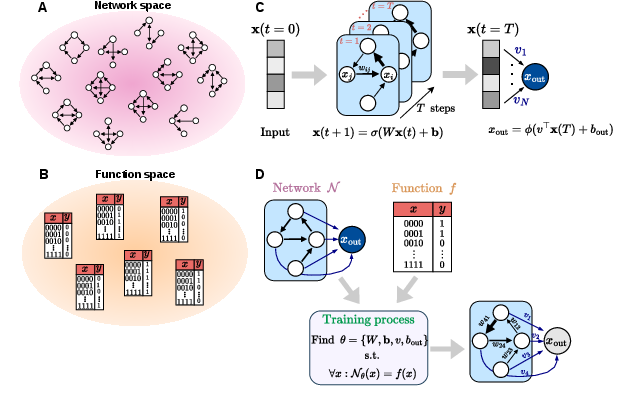
Figure 1: Mapping the space of network architectures and Boolean functions, illustrating exhaustive enumeration for small networks (N=4).
This exhaustive mapping reveals significant heterogeneity: most network architectures struggle to compute the majority of Boolean functions, and most functions are intrinsically hard, reflecting the exponential complexity of the mapping f:{0,1}N→{0,1}.
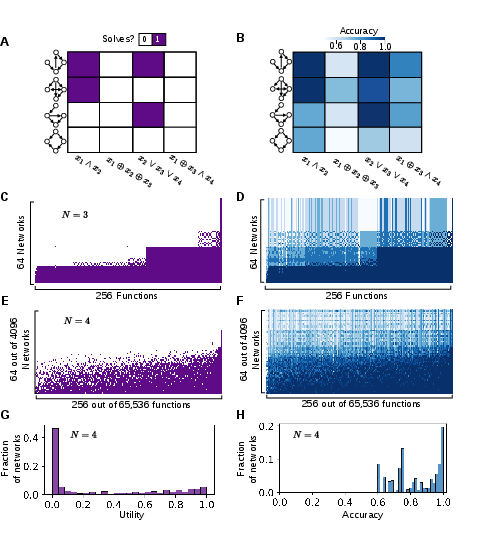
Figure 2: Catalog and Approximation matrices demonstrate wide variation in network functional capacity, with a minority of architectures exhibiting high Utility and widespread poor performance in most others.
Structural Motifs and Functional Expressivity
A key finding emerges from hierarchical analyses of network classes based on their connectivity maps. The study organizes networks into equivalence classes (up to node permutations), visualizing their relationship in tree-like structures where adding connections increases class density.
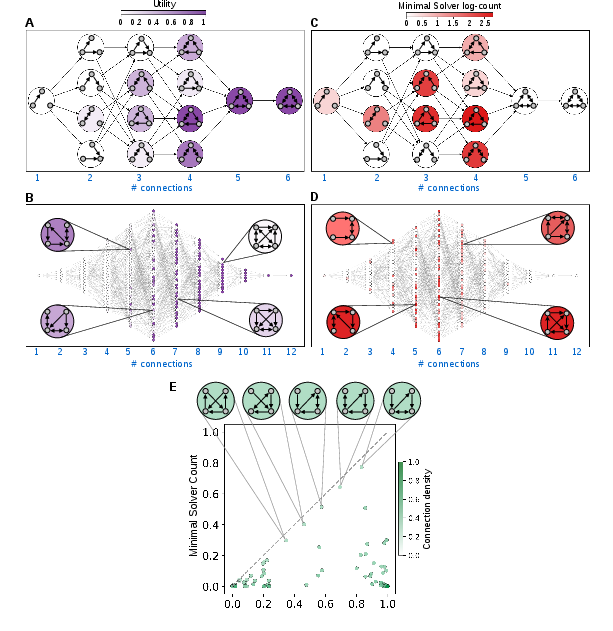
Figure 3: Hierarchical organization elucidates non-monotonic effect of connection count; local recurrent cycles (2- and 3-cycles) correspond to high Utility and structural minimality for solving specific Boolean functions.
Short cycles are central: network classes containing recurrent 2- and 3-cycles are often minimal solvers for function classes. These motifs constitute structurally irreducible solutions—removing any connection disrupts the ability to compute certain functions. Monotonic increases in connectivity do not guarantee increased Utility, highlighting that local architecture, not global density, dominates computational power.
Predictive Structural Features
To quantify the relationship between topology and capacity, the study examines structural predictors of Utility. Distributions of network performance against connection count, number of short cycles, and sink nodes reveal that a small set of structural statistics, particularly short cycles, account for most of the variance in computational ability.
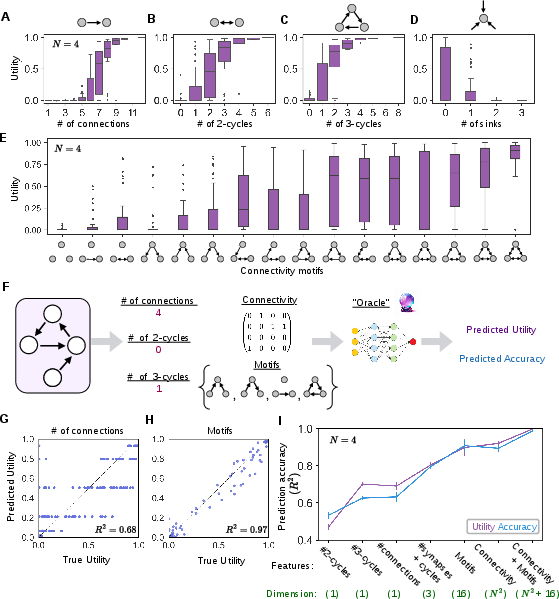
Figure 4: Utility and Accuracy are strongly predicted by the presence of short cycles; motif-based features used in multilayer perceptrons yield near-perfect prediction of network capacity, outclassing connection count alone.
Combining connection density with counts of 2-cycles and 3-cycles achieves predictive accuracy comparable to exhaustive motif decomposition or full connectivity matrices, indicating that computational ability is encoded in a low-dimensional space defined by local features.
Scaling to Large Networks and the Role of Interneurons
In large networks, the prevalence of architectures capable of computing arbitrary functions decreases precipitously. Randomly constructed networks sampled from the Erdős–Rényi model fail to achieve significant approximation in function space as N increases.
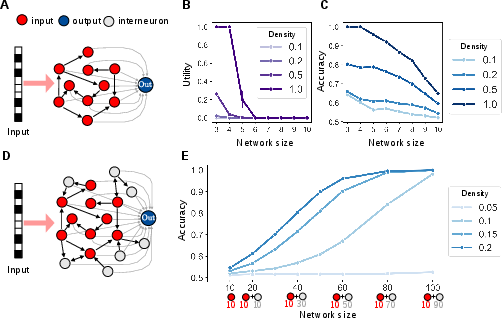
Figure 5: Computational Utility collapses in large networks without architectural augmentation; the introduction of sparsely connected interneurons substantially restores functional capacity.
Augmenting networks with interneurons—modeled after biological circuits—dramatically improves performance across all connectivity regimes, even in sparse graphs.
Functional Role of Cyclic Motifs in Random Ensembles
Analysis of random graph ensembles further reinforces the functional necessity of cyclic architecture. Networks sampled from ensembles with abundant short cycles (Erdős–Rényi, enriched 3-cycles) outperform acyclic counterparts (DAGs, input-expanding DAGs, reachability-matched acyclic graphs) in mean approximation accuracy, a result that persists across a wide parameter range.
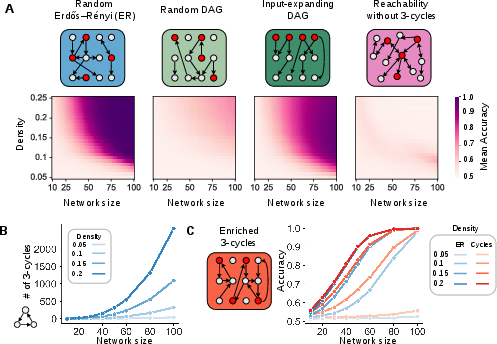
Figure 6: Random ensemble heatmaps (mean accuracy) demonstrate the superiority of networks containing short recurrent cycles over acyclic controls, with cycles-enriched networks showing statistically significant gains in sparse regimes.
Critically, reachability-enhanced acyclic models, matched for information propagation length, remain inferior, establishing that cycles contribute more than just signal propagation—they embed essential computational memory and feedback.
Activation Functions and Self-Connections
Supplementary analyses indicate negligible differences between networks utilizing Sigmoid and ReLU activations for computational ability. However, networks with self-connections exhibit improved Utility, emphasizing the relevance of architectural flexibility in practical implementations.
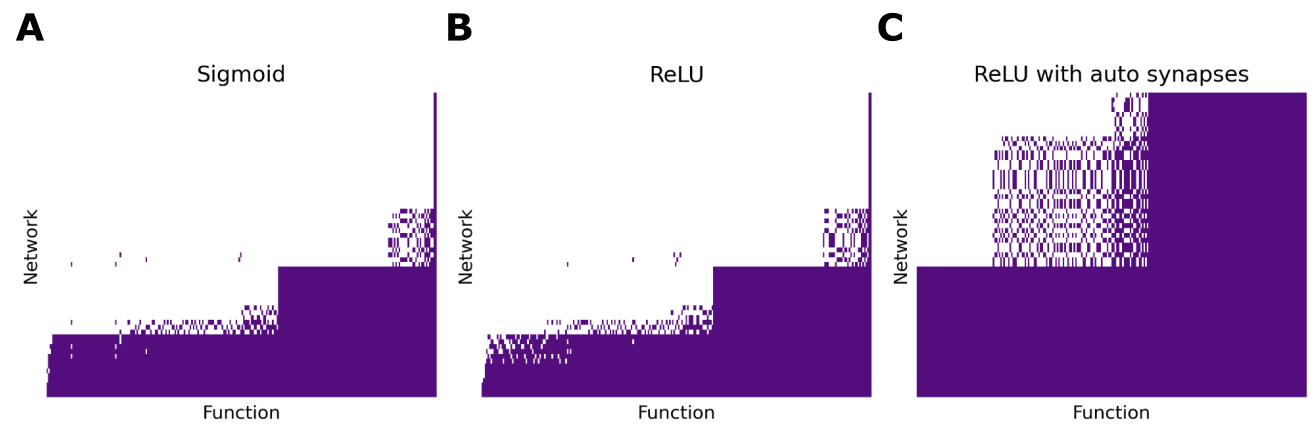
Figure 7: Catalog matrices comparing Sigmoid, ReLU, and self-connected networks reveal improved performance for architectures allowing self-loops, independent of activation type.
Implications and Future Directions
The findings articulate that local recurrent motifs (short cycles) are structural design principles enabling high computational capacity in finite RNNs. These principles suggest avenues for architectural optimization in both biological and artificial settings. Practical implications include the design of RNNs for resource-constrained environments and exploration of topological augmentation (e.g., interneurons, cycle enrichment) for enhanced expressivity.
On a theoretical level, the results motivate further exploration of motif-based structure–function mappings, rigorous analytical derivations linking connectivity and computation, and extensions to larger N, more diverse activation regimes, and longer-run recurrent dynamics (T≫3). Evolutionary approaches or task-driven architectural selection could yield networks with novel motifs that further expand computational power.
Conclusion
This paper systematically characterizes the structure–function relationship in RNNs, demonstrating that computational expressivity is governed by local recurrent motifs, particularly cycles of length two and three. Short cycles, rather than connection density alone, serve as minimal architectures for complex Boolean computation. The introduction of sparsely connected interneurons and cycle enrichment in large networks rescues computational performance, providing a biologically plausible and mathematically robust framework for designing networks with high functional diversity in finite resource constraints. These results establish new directions for both empirical and theoretical investigations linking topology, dynamics, and computation in neural circuits.