Harnessing cortical geometry, wiring, and function as inductive biases for recurrent neural networks
Abstract: How the wiring and functional organization of cortex shape recurrent computation remains a central question in both neuroscience and machine learning. Here, we leverage data released through the Machine Intelligence from Cortical Networks (MICrONS) program--a functional connectomics resource spanning multiple areas of mouse visual cortex, in which dense calcium imaging is co-registered with high-resolution electron microscopy reconstruction from the same animal--to build biologically grounded recurrent neural networks. Using neuronal spatial coordinates, anatomical connectivity, and function-derived relationships from nearly 12,000 coregistered excitatory neurons, we initialize recurrent weights and impose communication-aware spatial constraints during learning. Across three cognitive decision-making tasks, networks constrained by cortical structure and function consistently outperform baseline and partially constrained models. Functional weight initialization provides the largest gain, while real spatial embedding yields robust additional improvements across conditions. These biologically grounded networks also develop low-entropy, modular, and small-world organization, and retain strong performance even when recurrence is restricted to positive weights. Together, our results show that the machinery of cortex--its geometry, wiring, and functional structure--can be harnessed as a powerful inductive basis for building recurrent networks that learn more effectively while converging toward key organizational principles of biological computation.
Paper Prompts
Sign up for free to create and run prompts on this paper using GPT-5.
Top Community Prompts
Explain it Like I'm 14
Simple Summary of the Paper
This paper asks a big question: can we build better learning machines by copying how the brain is built and how it works? The authors use real data from mouse brain tissue to design and train special computer brains called recurrent neural networks (RNNs). They show that when these RNNs start with “hints” taken from real brain layout, wiring, and activity, they learn faster, perform better on thinking tasks, and end up organized in brain-like ways.
What Were the Researchers Trying to Find Out?
In plain terms, they wanted to know:
- Do RNNs learn better if we give them smart starting points taken from real brains, instead of starting from random settings?
- Which brain-inspired hints help the most: the actual positions of neurons (geometry), how easily signals can travel through the network (wiring/communication), or how neurons tend to fire together (function)?
- Do these hints also make the learned network structure look more like a real brain’s—organized into useful “neighborhoods” and efficient pathways?
- Are these benefits still there even if we make the RNN’s job harder (for example, forcing all connections to be positive, like using only excitatory signals)?
How Did They Do It?
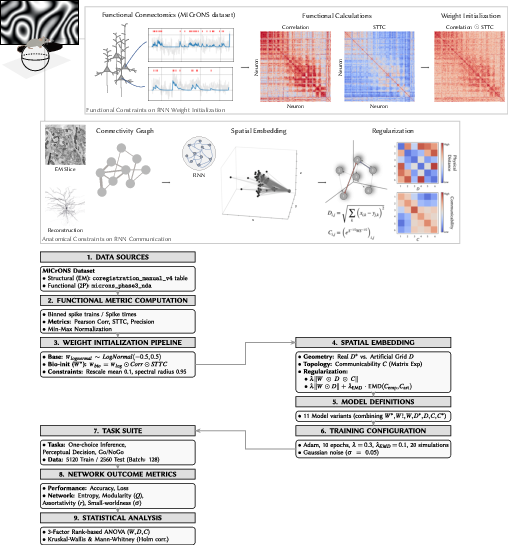
The team used a rich brain dataset called MICrONS. It has three crucial pieces for thousands of real neurons in mouse visual cortex: where each neuron sits in space (geometry), which neurons connect to which (wiring), and how they co-activate during activity (function).
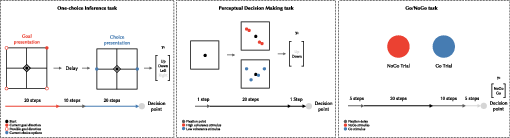
They built families of RNNs that differed only in whether they used one, two, or all three of these brain-based hints. Then they trained each version on three decision-making tasks (like choosing a direction based on evidence, or deciding to act or not). This let them see which hints mattered most.
Here are the three brain-inspired “hints,” explained simply:
- Functional weight start: Instead of starting the RNN’s internal connections randomly, they used patterns from real neurons’ activity—who tends to fire with whom—to set the initial strengths. Think of it like giving the network a head start based on which brain cells “hang out” together during real activity.
- Real spatial layout: They placed the RNN’s units at the same coordinates as real neurons. During training, the network was gently encouraged to prefer shorter, cheaper “wires,” similar to how the brain saves space and energy. Picture building roads mostly between nearby neighborhoods to avoid expensive highways everywhere.
- Communicability: They added a rule that rewards connection patterns that make communication through the network easier and more efficient, based on the real wiring. This is like designing streets so that people can get from one place to another quickly, with only a few turns.
They compared 11 variations of these ideas across three tasks and many training runs to make sure the results were reliable.
What Did They Find?
The key results can be summed up in a few clear points:
- The brain-based RNNs learned better. Models that used actual brain activity to set their starting connections, real neuron positions, and communication-aware rules did best across all tasks. In short, copying the brain’s “blueprint” helped.
- The biggest boost came from functional initialization. Starting the RNN’s internal connections using real neuron co-activity was the most helpful single ingredient. It’s like starting a puzzle with several pieces already connected in the right places.
- Real geometry added a reliable extra push. Placing units where the real neurons are (and gently discouraging long, costly connections) gave additional, steady improvements.
- Communicability helped in a task-dependent way. Making it easier for signals to flow through the network gave smaller, more situation-specific gains on top of the first two hints.
- Robust even under tougher rules. When the researchers forced the RNN to use only positive (excitatory) connections—making learning harder—randomly started networks failed. But networks that began with brain-based functional patterns still learned very well. This shows the “smart start” really stabilizes learning.
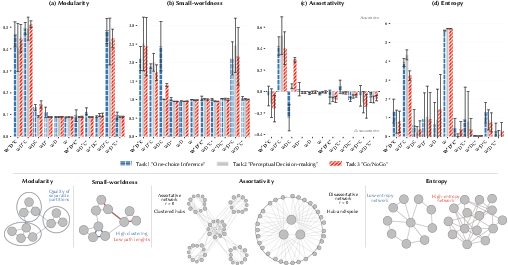
- The networks ended up more brain-like. After training, the best models had:
- Lower entropy: less messy, more organized connection patterns.
- Higher modularity: clear “neighborhoods” of units working together, like specialized teams.
- Small-world structure: strong local clustering plus short routes across the whole network, so information travels quickly without needing lots of long roads.
Interestingly, different hints nudged the networks toward slightly different “shapes” of organization. There wasn’t just one perfect brain-like layout—there were several efficient, structured options.
Why It Matters
This study shows that using real brain data as “inductive biases” (smart starting hints and gentle rules) makes artificial networks learn better, faster, and more reliably—without making them bigger or more complicated. That’s good news for:
- Artificial intelligence: Better performance and stability by guiding learning with brain-inspired blueprints, not just more layers or parameters.
- Neuroscience: It highlights which parts of brain organization most help computation. Here, activity-based relationships (who fires with whom) mattered most, with real geometry adding a strong assist.
Looking ahead, these ideas could help build AI systems that are both powerful and efficient, and could also help scientists test which brain features are truly necessary for intelligent behavior. Future steps include adding more cell types (like different kinds of inhibitory neurons), testing more complex tasks, and exploring other brain regions.
Knowledge Gaps
Knowledge gaps, limitations, and open questions
Below is a focused list of what remains missing, uncertain, or unexplored, framed as concrete, actionable directions for future work.
- Generalization across animals and contexts: Validate the inductive benefits using multimodal datasets from different animals, cortical areas, behavioral states, and stimulus ensembles (MICrONS is one animal/visual cortex under specific stimuli).
- Task–prior alignment: Test whether performance gains persist when the functional prior comes from a context mismatched to the downstream task (e.g., non-visual tasks with visual-cortex-derived priors) versus task-aligned priors.
- Causality vs correlation: Replace correlation/precision-based priors with causal functional estimators (e.g., time-lagged Granger causality, transfer entropy, partial directed coherence) and compare their impact on learning and topology.
- Anatomical initialization: Directly initialize recurrent weights from EM-derived anatomical connectivity/synapse strengths and compare to function-derived initialization and hybrids (weighted combinations).
- Inhibitory neurons and Dale’s law: Incorporate inhibitory populations and enforce neuron-wise sign constraints to test whether the advantages of priors hold in realistic E/I-balanced, Dale-constrained RNNs.
- Laminar and cell-type structure: Inject layer-specific, pathway-specific, and cell-type-specific priors (e.g., laminar distance penalties, type-specific connectivity motifs) and quantify their distinct effects on learning and topology.
- Conduction delays and biophysics: Model distance-dependent transmission delays, heterogeneous time constants, and synaptic kinetics to assess whether spatial priors still help when temporal biology is explicit.
- Scaling behavior: Systematically vary network size (from hundreds to many thousands of units) to test how performance/topology and computational cost scale with the number of nodes drawn from the cortical substrate.
- Sample-efficiency and convergence: Report learning curves (epochs to target accuracy, data required, wall-clock/compute) to substantiate claims of “learn more effectively” beyond end-point accuracies.
- Stronger baselines: Compare against orthogonal/spectral-radius-tuned RNNs, low-rank and structured RNNs, gated architectures (LSTM/GRU), and modern recurrent alternatives to isolate the unique contribution of cortical priors.
- Hyperparameter sensitivity: Map performance/topology as a function of regularization strengths (λ terms), sparsity levels, and communicability parameters to establish robustness bands and optimal regimes.
- Prior noise robustness: Inject controlled noise/missingness into coordinates, connectivity, and functional matrices to quantify degradation curves and identify which prior components are most fragile.
- Mechanistic characterization of priors: Analyze which statistics of function-derived weight matrices (eigenvalue spectra, motif counts, low-rank structure, community scaffolds) causally drive the observed benefits.
- Alternative communicability formulations: Compare direct communicability and EMD variants to other graph-theoretic constraints (e.g., effective resistance, navigability/greedy routing, Katz/PageRank centrality, path transitivity) and identify which best predict learning gains.
- Wiring cost realism: Replace Euclidean distance penalties with biophysically grounded wiring-economy models (axon path length in tissue, branching costs, volume constraints) and test effects on topology/performance.
- Dynamics–topology link: Perform dynamical systems analyses (fixed-point structure, attractor geometry, Lyapunov spectra, manifold dimensionality) to mechanistically link emergent topology to computation.
- Interpretability and causal roles: Conduct lesion/perturbation analyses of modules/hubs to map learned communities onto task variables and quantify causal contributions of topological features.
- OOD and distribution shift: Evaluate robustness to input distribution shifts, noise, and adversarial perturbations to test whether cortical priors improve generalization beyond the training distribution.
- Transfer and continual learning: Pretrain with cortical priors on one task and fine-tune on others to assess whether priors facilitate rapid transfer, reduce forgetting, or enable multi-task performance.
- Temporal functional structure: Go beyond pairwise, zero-lag statistics by incorporating lag-specific and stimulus-locked functional relationships; compare static vs time-resolved priors.
- Field selection biases: Quantify how node subsampling strategies, field-of-view selection, and region heterogeneity affect outcomes; test stratified sampling that preserves cortical mesoscale structure.
- Fair capacity comparisons: Ensure parameter-matched comparisons (effective degrees of freedom under regularization) to rule out capacity differences as drivers of performance gaps.
- Control graph ensembles: Use degree/weight-preserving random graph controls and coordinate-scrambled surrogates (beyond grid controls) to isolate the unique contribution of real cortical geometry/wiring.
- Sign-constrained optimization: Move beyond positive-only tests and enforce realistic neuron-wise signs; evaluate whether functional priors still stabilize training under strict Dale constraints.
- Spiking implementations: Port the approach to spiking RNNs with surrogate gradients to test whether cortical priors confer similar benefits under event-based dynamics and neuromorphic constraints.
- Energy/latency trade-offs: Measure energy proxies and latency (e.g., path lengths with delays) to test whether cortical priors yield efficiency benefits aligned with wiring economy principles.
- Multi-area models: Build multi-area recurrent models with inter-areal connectivity and delays to examine whether priors help coordinate distributed computation across cortical areas.
- Regularization schedule: Explore curriculum/scheduling of spatial/communicability regularization during training (e.g., annealing) to balance early exploration and late structural consolidation.
- Prior–data mismatch tolerance: Systematically vary the degree of mismatch between cortical priors and the task (e.g., shuffled coordinates/connectivity at controlled fractions) to chart performance–mismatch curves.
- Beyond correlation/precision/STTC: Benchmark additional functional estimators (e.g., copula-based dependence, partial correlations with sparsity penalties, information-theoretic measures) under identical pipelines.
- Reproducibility across datasets: Replicate with other functional connectomics resources and mesoscale imaging datasets to test whether the identified hierarchy of priors (function > geometry > communicability) generalizes.
Practical Applications
Immediate Applications
Below are actionable ways to use the paper’s findings and methods today. Each item includes suggested sectors, potential tools or workflows, and key assumptions/dependencies.
Software and Machine Learning
- Bio-inspired recurrent initialization for sequence models (RNNs/GRUs/SSMs)
- What: Initialize recurrent weights from function-derived statistics (e.g., correlation or precision matrices) computed on domain data to improve convergence, data efficiency, and robustness.
- Sectors: Software, finance (time-series), energy (load forecasting), speech/ASR, forecasting/operations research.
- Tools/products/workflows:
- A “bio_init” module for PyTorch/Keras that takes a correlation/precision matrix and maps it to initial recurrent weights; optional permutation control (W!) to preserve weight distribution if mapping is not one-to-one.
- Incorporate positive-only recurrence when needed (non-negative weight constraints), leveraging the paper’s observed robustness with biological initialization.
- Use the authors’ codebase as a reference implementation: github.com/neurovium/CorticalBlueprintRNN.
- Assumptions/dependencies:
- You can compute a stable correlation/precision matrix from pretraining or unlabeled data that reflect useful functional dependencies.
- The domain’s functional relationships are sufficiently stationary to serve as priors.
- RNNs or stateful sequence models are appropriate for the task.
- Spatially embedded RNN layer for locality-aware learning
- What: Assign units 2D/3D coordinates (real or proxy) and penalize long-range communication during training to encourage sparse, modular, small-world connectivity.
- Sectors: Software, IoT/edge analytics, embedded AI, AR/VR streaming, cyber-physical systems.
- Tools/products/workflows:
- A reusable SpatialRNN layer with distance-aware regularization (as in seRNNs), adaptable to known sensor layouts or topographic maps.
- Training recipe: standard optimizer + additive distance penalty term + optional pruning based on learned sparsity.
- Assumptions/dependencies:
- A meaningful spatial embedding is available (e.g., sensor locations, chip floorplan, topology of a plant/process).
- Compute budget permits distance-regularization terms during training.
- Communicability-based regularization for recurrent/graph networks
- What: Add regularization based on a communication metric (e.g., matrix exponential communicability) of an underlying domain graph to refine learned topology.
- Sectors: Software, network analysis, logistics, operations.
- Tools/products/workflows:
- A CommunicabilityRegularizer module that penalizes edges that reduce communication efficiency relative to a reference graph; alternative EMD-based regularizer if distributions are the design target.
- Assumptions/dependencies:
- You can define or estimate a domain-relevant graph (e.g., grid topology, road network, system interconnects).
- Communicability computation (or approximation) is tractable for your graph size.
Edge AI and IoT
- Energy-efficient streaming analytics via locality and sparsity
- What: Deploy spatially constrained, sparse RNNs that exploit sensor layouts to reduce long-range “wiring,” lowering compute/memory access and improving battery life.
- Sectors: Energy (smart meters), manufacturing (condition monitoring), consumer IoT, wearables.
- Tools/products/workflows:
- Workflow: compute sensor-to-sensor distances → initialize sparse/local connectivity → apply distance/communicability regularizers → train and prune → deploy on microcontrollers/NPUs.
- Assumptions/dependencies:
- Sensor locations or topology are known.
- Target hardware benefits from locality (e.g., on-chip memory hierarchies).
Robotics and Control
- Data-efficient, stable controllers with inductive priors
- What: Use function-derived initialization and spatial constraints to train recurrent controllers that learn faster and remain robust under constraints.
- Sectors: Robotics (manipulation, locomotion), autonomous vehicles, industrial automation.
- Tools/products/workflows:
- Controller design pattern: RNN initialized from functional priors collected in simulation or from demonstrations; map physical joint/sensor positions to spatial embedding; apply distance penalties.
- Assumptions/dependencies:
- You can collect sequences (sim/demo) to estimate functional relationships.
- Spatial embedding reflects the robot’s morphologies (link/sensor positions).
Healthcare and Neurotechnology
- Function-informed initialization for neural decoders
- What: Seed RNN-based decoders for BCI, seizure prediction, or neural signal analysis using functional connectivity derived from patient recordings (e.g., EEG/MEG/fMRI).
- Sectors: Healthcare, neurotech, digital health.
- Tools/products/workflows:
- Pipeline: preprocess signals → compute correlation/precision matrices → initialize decoder’s recurrent weights → optional positive-weight constraint for interpretability or stability → task-specific fine-tuning.
- Assumptions/dependencies:
- Sufficient quality and quantity of patient-specific recordings.
- Regulatory and privacy compliance for clinical data usage.
Education and Research
- Teaching modules and reproducible labs
- What: Integrate cortical priors into ML curricula and lab exercises to demonstrate inductive biases and topology-performance relationships.
- Sectors: Academia, training programs, corporate ML upskilling.
- Tools/products/workflows:
- Use the paper’s open code to replicate ablations; compare W*/W!/baseline; visualize modularity/small-worldness vs. accuracy.
- Assumptions/dependencies:
- Access to GPUs/CPUs for training; ability to compute basic graph metrics.
Long-Term Applications
These directions are promising but require additional research, scaling, data availability, or engineering.
General-Purpose “Cortical Prior” Frameworks
- AutoML for inductive-bias discovery and transfer
- What: Automated systems that infer beneficial spatial embeddings, functional initializations, and communicability targets from domain data and optimize them jointly with architecture.
- Sectors: Software, MLOps, enterprise AI.
- Tools/products/workflows:
- A plug-in for AutoML platforms that searches over correlation vs. precision priors, spatial embeddings, and regularization strengths to balance accuracy, sparsity, and compute.
- Assumptions/dependencies:
- Scalable estimation of functional dependencies at large model sizes.
- Standardized APIs for graph computations within ML frameworks.
Neuromorphic and Hardware-Software Co-Design
- Wiring-economy-aware placement and routing for on-chip RNNs
- What: Map spatially embedded RNNs to accelerators with locality-optimized interconnects, exploiting wiring economy to reduce energy and latency.
- Sectors: Semiconductors, edge AI hardware.
- Tools/products/workflows:
- EDA extensions that co-design network topology with chip layout (e.g., tile-local clusters with sparse long-range links mimicking small-world structure).
- Assumptions/dependencies:
- Hardware support for sparse/dynamic connectivity; CAD tooling maturity.
- Co-optimization between training-time regularizers and inference-time placement.
- Non-negative or sign-constrained analog/digital implementations
- What: Deploy positive-weight (or sign-limited) recurrent networks in hardware where sign constraints simplify design (e.g., certain analog crossbars or constrained weights for stability).
- Sectors: Neuromorphic computing, embedded systems.
- Tools/products/workflows:
- Training with positive-only recurrence and biological initialization; mapping to non-negative hardware primitives.
- Assumptions/dependencies:
- Hardware with performance benefits under sign constraints; calibration methods to manage dynamic ranges.
Human Connectome-Informed Foundation Models
- Pretraining recurrent/state-space backbones from human functional/structural data
- What: Use population-level functional/structural connectomes to pretrain general recurrent backbones for downstream tasks with improved data efficiency.
- Sectors: Healthcare AI, general AI research, cognitive technologies.
- Tools/products/workflows:
- Build a “connectome backbone” library (analogous to vision backbones) where weight statistics and topology reflect human cortical networks.
- Assumptions/dependencies:
- High-quality, large-scale multimodal human datasets; methods to reconcile inter-subject variability.
Personalized Clinical Models and Neuroprosthetics
- Patient-specific priors for closed-loop neurostimulation and BCI
- What: Tailor decoders or controllers using a patient’s connectome-derived functional priors for faster adaptation and better stability.
- Sectors: Clinical neuroengineering, precision medicine.
- Tools/products/workflows:
- Workflow: acquire patient data (EEG/MEG/fMRI/intracranial) → derive priors → initialize RNN/controller → closed-loop tuning.
- Assumptions/dependencies:
- Reliable per-patient measurement pipelines, longitudinal stability of priors, clinical validation and regulatory approval.
Robustness, Interpretability, and Safety Research
- Topology-aware robustness and interpretability studies
- What: Investigate whether modular/small-world recurrent topologies reduce failure propagation, improve fault tolerance, or enhance interpretability.
- Sectors: AI safety, regulated industries (finance/healthcare/transport).
- Tools/products/workflows:
- Controlled evaluations linking graph metrics (modularity, small-worldness, assortativity, entropy) to robustness benchmarks and interpretability tools.
- Assumptions/dependencies:
- Empirical validation is needed; the present paper did not test adversarial robustness or interpretability directly.
Policy, Standards, and Data Ecosystems
- Standards for multimodal connectomics in AI development
- What: Encourage datasets combining structure, function, and geometry (like MICrONS) with governance frameworks for sharing and benchmarking.
- Sectors: Science policy, public research infrastructure.
- Tools/products/workflows:
- Policy guidelines and consortia for responsible collection, curation, and sharing of multimodal brain data; benchmark suites for bio-inspired inductive biases.
- Assumptions/dependencies:
- Sustainable funding, privacy/ethics frameworks, and community consensus on benchmarking metrics.
In summary, the paper’s key takeaways translate into immediately deployable practices—functional-initialization modules for RNNs, spatial/communicability regularization, and positive-only recurrent training—and open longer-term avenues in hardware co-design, connectome-informed pretraining, and personalized neurotechnology. Feasibility hinges on the availability and quality of functional/statistical relationships in the target domain, the existence of meaningful spatial embeddings or graphs, compute for graph metrics, and validation on large-scale, domain-specific tasks.
Glossary
- Assortativity: A network property describing the tendency of nodes to connect to others with similar degree; positive values indicate hub-to-hub connectivity, negative values indicate hub–periphery patterns. "Assortativity further differentiated the topological regimes."
- Brain-inspired artificial intelligence: AI approaches that draw architectural or algorithmic principles from the brain’s structure and function. "brain-inspired artificial intelligence"
- Communicability: A graph-theoretic measure of ease of information transfer between nodes accounting for all paths, not just shortest paths. "communicability"
- Communicability-based regularization: A training penalty that biases learned connections according to a graph’s communicability structure. "communicability-based regularization (C or C*)"
- Co-registered: Different data modalities aligned to the same biological units (e.g., neurons) so their measurements can be jointly analyzed. "co-registered with high-resolution electron microscopy reconstruction"
- Connectome-constrained modeling: Modeling approaches that directly incorporate measured neural connectivity (the connectome) to restrict or guide network dynamics. "recent connectome-constrained modeling studies suggest"
- Earth Mover’s Distance (EMD): A distance metric between probability distributions interpreted as minimal “work” to transform one distribution into another; used here to compare communicability distributions. "Earth Mover's Distance (EMD)-based regularization over communicability distributions."
- Electron microscopy reconstruction: High-resolution anatomical mapping of neuronal structures and synapses using electron microscopy. "high-resolution electron microscopy reconstruction"
- Empirical cumulative distribution function (ECDF): The cumulative distribution computed directly from data samples, used here to resample initialization weights. "empirical cumulative distribution function (ECDF)"
- Entropy (network/weight organization): A measure of disorder or heterogeneity in the distribution of weights; lower entropy indicates more structured connectivity. "Entropy analysis revealed three distinct regimes of weight structure."
- Excitatory-only regime: A constraint where recurrent weights are forced to be positive, mimicking purely excitatory recurrent connections. "mimicking an excitatory-only regime"
- Functional connectomics: The integration of structural connectivity with measurements of neural activity to link wiring and function. "a functional connectomics resource"
- Functional initialization: Initializing network weights using statistics derived from measured neural activity (e.g., correlations or precision), rather than random values. "Functional weight initialization provides the largest gain"
- Graph-theoretic metrics: Quantitative measures from network science (e.g., modularity, small-worldness, assortativity) used to characterize learned connectivity. "evaluated using graph-theoretic metrics that capture complementary aspects of network organization."
- Holm-corrected post hoc comparisons: A multiple-comparisons procedure that sequentially adjusts p-values to control family-wise error after omnibus tests. "Holmâcorrected post hoc pairwise comparisons"
- Hub–periphery organization: A network pattern where highly connected nodes (hubs) preferentially connect to many low-degree nodes rather than to other hubs. "hub--periphery organization"
- Inductive bias: Prior structural or statistical assumptions built into a model that guide learning toward certain solutions. "inductive biases for recurrent neural networks"
- Kruskal–Wallis: A nonparametric statistical test for comparing medians across multiple groups. "KruskalâWallis statistics"
- Machine Intelligence from Cortical Networks (MICrONS): A multimodal dataset linking neural activity, anatomical connectivity, and spatial position in mouse visual cortex. "Machine Intelligence from Cortical Networks (MICrONS)"
- Modularity: A measure of how strongly a network partitions into communities with dense internal and sparse inter-community connectivity. "Modularity quantifies the extent to which the network partitions into densely connected communities with relatively sparse inter-community links."
- Neuro-AI: An interdisciplinary area where neuroscience insights inform AI model design and vice versa. "neuro-AI"
- Permutation control: A control condition that preserves a distribution (e.g., of weights) while shuffling assignments to disrupt structured relationships. "permutation control derived from W*"
- Positive-only recurrent weights: A constraint limiting recurrent connections to nonnegative values, restricting network dynamics and learning. "positive-only recurrent weights"
- Precision matrix: The inverse of the covariance matrix; highlights putative direct statistical dependencies by conditioning on all others. "replacing the correlation matrix with the precision matrix"
- Small-worldness: A network feature combining high local clustering with short global path lengths relative to random graphs. "Small-worldness captured an additional distinction between biologically constrained and weaker-control variants."
- Spatial embedding: Assigning network units to positions in physical or Euclidean space to reflect or exploit geometric constraints. "real spatial embedding yields robust additional improvements across conditions."
- Spatial regularization: A training penalty that incorporates spatial relationships (e.g., distances) to bias learned connectivity. "shape spatial regularization during learning."
- Spatially embedded recurrent neural networks (seRNNs): RNNs whose units are placed in space and trained under spatial costs, promoting biologically plausible structure. "spatially embedded recurrent neural networks (seRNNs) demonstrated that assigning recurrent units positions in Euclidean space and penalizing long-range communication yields sparse, modular, and small-world architectures"
- STTC: The Spike Time Tiling Coefficient; a measure of spike train synchrony used here to build functional weight priors. "STTC matrices"
- Two-photon calcium imaging: An optical technique for recording neural activity by measuring calcium-dependent fluorescence in vivo. "two-photon calcium imaging"
- Wiring economy: The principle that neural circuits minimize wiring cost (e.g., total axonal length) while maintaining computational efficiency. "are shaped by wiring economy"
- Wiring motifs: Recurrent structural patterns of connectivity (e.g., feedforward, feedback, convergent motifs) used as building blocks in circuits. "branching patterns and wiring motifs"
Collections
Sign up for free to add this paper to one or more collections.