- The paper introduces geometric stability, measured by split-half rank correlations of representational dissimilarity matrices, as a novel framework distinct from traditional centroid analyses.
- It demonstrates that geometric stability, unlike temporal stability or decoding accuracy, uniquely predicts trial-by-trial behavioral coupling in neural recordings.
- Empirical results from neuropixels and olfactory data underscore circuit dependence and the role of recurrent excitation in stabilizing neural population codes.
Geometric Stability of Neural Population Codes: Regional Variation, Behavioral Relevance, and Circuit Dependence
This study introduces geometric stability as a self-consistency axis of neural population codes, orthogonal to traditional measures of temporal stability and decoding accuracy. While centroid preservation has dominated prior analyses of representational reliability, the paper formalizes geometric stability via split-half rank correlation between representational dissimilarity matrices (RDMs) extracted from independent trial subsets. The Shesha metric, S, is conceptualized as the Spearman correlation between vectorized pairwise cosine distance matrices for two trial splits, operationalizing the reproducibility of the representational geometric structure rather than summary statistics such as centroids or decoding axes.
Crucially, geometric stability captures the reliability with which a population’s relational structure is conveyed to downstream circuits on a trial-by-trial basis. The metric manifests empirical dissociation from both centroid drift (temporal stability) and mean decoding accuracy, establishing it as a functionally distinct framework for high-dimensional population analysis.
Empirical Results: Regional Variation and Dissociation from Temporal Stability
Neuropixels recordings from murine cortex during a visual discrimination task (Steinmetz et al., 2019) revealed significant regional variation in geometric stability. Across 229 area-session observations spanning 68 regions, striatum displayed highest geometric stability (mean Sˉ=0.44) and lowest centroid preservation, whereas hippocampus exhibited the inverse—high temporal stability ($0.94$) but minimal geometric stability ($0.19$). Temporal drift and geometric stability hierarchies are nearly orthogonal (Figure 1).
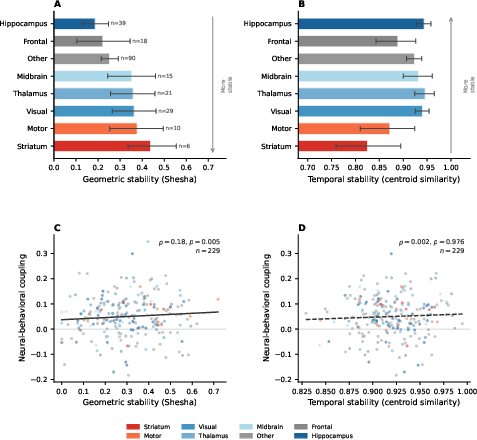
Figure 1: Geometric stability predicts neural-behavioral coupling; centroid drift does not.
This inversion is not a consequence of analytic artifact—the dissociation holds for raw split-half RDM correlations, preceding metric-specific choices. Such findings indicate that neuron-level reorganizations do not necessarily degrade population-level geometric reliability, and that summary drift metrics are insufficient to capture fine-grained behavioral coupling.
The study demonstrates that geometric stability predicts trial-by-trial neural-behavioral coupling (ρ=0.18, p=0.005), whereas centroid drift and decoding accuracy fail to do so (ρ=0.002, p=0.976 and ρ=0.01, p=0.88, respectively). It is the reproducibility of relational geometry—not merely the maintenance of mean states or information content—that constrains downstream computation and behavior. Geometric stability, as captured by Shesha, reflects transmission fidelity across inter-area subspaces and supports robust behavioral engagement independent of session averages.
Circuit-Level Mechanisms: Recurrent Coupling and the Attractor Model
Data from the olfactory hierarchy (Bolding & Franks, 2018) are directionally consistent with geometric stability’s dependence on circuit architecture. Recordings from piriform cortex with recurrent excitatory connections silenced (TeLC) and from olfactory bulb show a monotonic hierarchy: OB < TeLC PCx < Control PCx. Although sample sizes preclude confirmatory inferences, the predicted ordering supports the attractor network hypothesis.
A computational rate network model with sparse feedforward input and swept recurrent coupling further demonstrates that recurrence amplifies split-half RDM consistency via pattern completion. Increasing recurrent excitation drives Shesha monotonically upward (Sˉ=0.440, Sˉ=0.441), confirming circuit-level predictions (Figure 2).
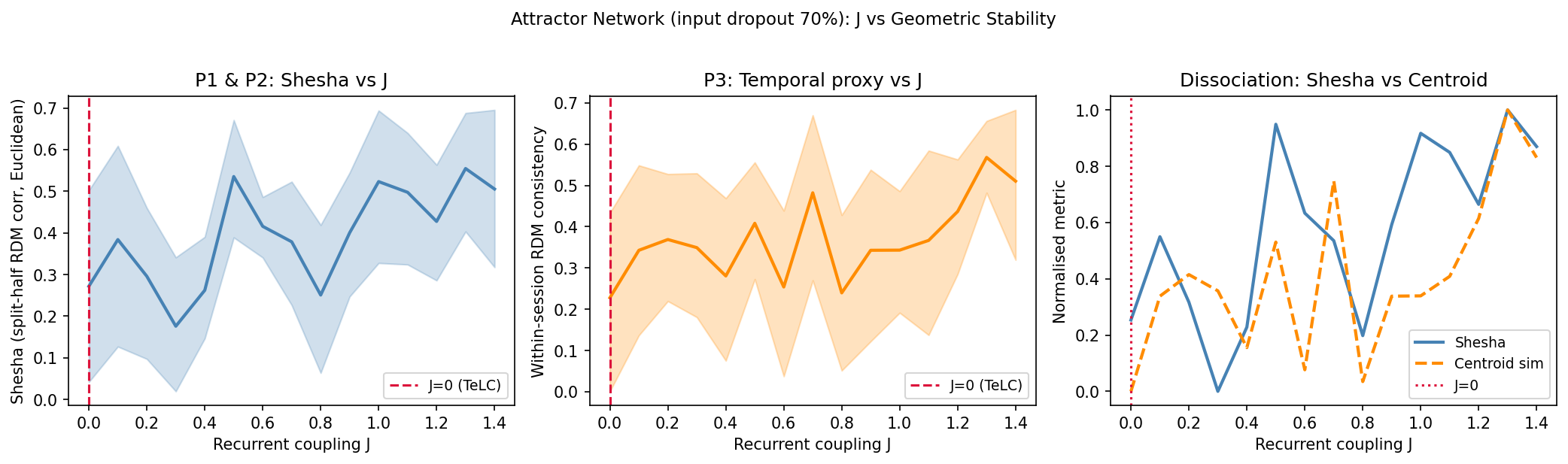
Figure 2: Recurrent coupling increases geometric stability via pattern completion in a rate network model.
The model links biological anatomy and computational logic: recurrent dynamics stabilize the geometric configuration of population responses against input dropout, producing reliable representations for downstream processing. Temporal proxies respond differently to recurrence, reinforcing the geometric-temporal dissociation.
Theoretical Implications and Relations to Prior Work
These findings integrate and extend recent accounts of drift geometry, attractor dynamics, and recurrent stabilization. Prior studies (Keinath et al., 2022; Schoonover et al., 2021; Deitch et al., 2021) show that neuron-level drift does not necessarily compromise population-level geometry. The Shesha metric quantifies this within-session reliability, complementing drift measures and decoding-based frameworks. Wagner et al. (2026) show that recurrent symmetry stabilizes attractor manifolds in hippocampal prediction networks, and Morales et al. (2025) demonstrate learning-induced stabilization of piriform geometry. The present work formalizes these principles using reproducibility metrics, and provides direct circuit-level evidence for geometry stabilization via recurrent coupling.
Notably, geometric stability and transfer performance are dissociable in both biological and artificial systems, suggesting that the reproducibility of relational structure and information content constitute independent axes with distinct implications for computation and learning.
Limitations and Future Directions
Several constraints delimit the study. The olfactory and visual datasets differ in task, technology, and species; sample sizes in the TeLC manipulation are limiting. Shesha is a global metric, unable to localize instability within subspaces or stimulus pairs. Between-area variation in geometric stability may depend predominantly on sensory drive strength when circuit architecture is uncontrolled, as recurrence gradients do not predict Shesha outside controlled olfactory circuits.
Future work should pursue reversible circuit manipulations, higher-powered experiments, and localized geometric analyses. Extension of the geometric stability framework to artificial networks and cross-species comparisons may further elucidate general principles relating representational reliability, learning dynamics, and downstream computation.
Conclusion
The paper establishes geometric stability as a distinct, circuit-dependent property of neural population codes, separable from temporal drift and decoding performance. Regional hierarchies in geometric stability invert those of centroid preservation, and only geometric stability predicts trial-by-trial behavioral coupling. Recurrent excitatory connectivity amplifies geometric reliability via attractor dynamics, providing a circuit-level mechanism for robust population representation. The paradigm has broad implications for understanding population code transmission, reliability, and computations in both biological and artificial networks.