Hierarchical Global Attention (HGA)
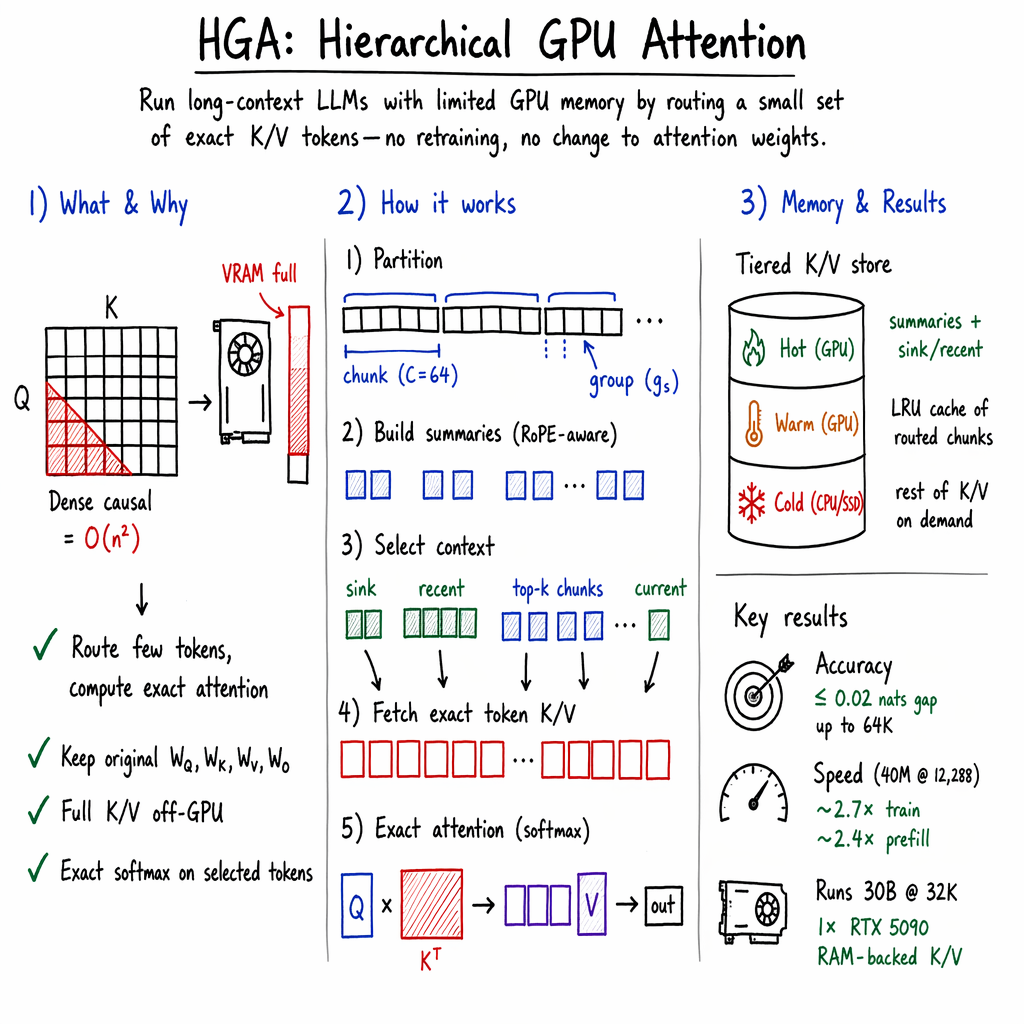
Abstract: Hierarchical Global Attention (HGA) is a drop-in replacement for dense causal attention in pretrained long-context transformers. HGA preserves the original checkpoint parameters: the pretrained $W_Q$, $W_K$, $W_V$, and $W_O$ projections remain unchanged, no calibration parameters are introduced, and no retraining is required. Applied to Qwen3-30B-A3B-Instruct-2507-FP8 on a single RTX~5090 (32GB), the patched model runs out of the box at a 64K-token context, where token-level K/V storage is not feasible on this hardware. Unlike previous sparse-attention methods, HGA performs hierarchical two-level routing. It first retrieves relevant chunks using compact RoPE-aware summaries and then refines the selection by routing only the most relevant groups before performing exact token-level attention. This hierarchical retrieval significantly reduces the number of fetched tokens while preserving exact attention over the retrieved token set, making RAM- and NVMe-backed storage practical. The full historical token K/V resides in host RAM or NVMe storage, while only a small routed working set is transferred to GPU memory during attention. Consequently, GPU memory consumption depends primarily on model weights and the routed working set rather than on the total context length. Across all tested context lengths (4K - 64K tokens), routed attention remains within approximately $0.01$--$0.02$ nats of dense attention while the sparsity used is just about 3%. These results suggest that the approximation introduced by hierarchical routing is small, and that the remaining quality gap is likely dominated by long-context positional encoding rather than by the routing algorithm itself.
Paper Prompts
Sign up for free to create and run prompts on this paper using GPT-5.
Top Community Prompts
Explain it Like I'm 14
What is this paper about?
This paper introduces a way to make big LLMs handle very long pieces of text on regular gaming/workstation GPUs without retraining the model or changing its learned knowledge. The method is called Hierarchical Global Attention (HGA). It decides which past parts of the text are worth looking at in detail, fetches only those, and then uses the model’s normal attention exactly on the real tokens it fetched. That makes long contexts practical while keeping accuracy almost the same as the usual, expensive way.
What questions are the authors asking?
- Can we plug in a smarter “which tokens to look at” system into existing models (no retraining, no new weights) so they can handle long documents on limited GPU memory?
- Can we fetch far fewer past tokens but still compute the final attention exactly on the real tokens we did fetch?
- Can we store most of the past information in normal computer memory (or even on SSD) and only bring small, relevant pieces to the GPU when needed?
- Will this keep quality close to the original model and also make training or inference faster?
How does their method work? (In simple terms and analogies)
Imagine you’re writing an essay and need to constantly look back at your notes:
- The classic way (dense attention) is like spreading every page of your notes across your desk all the time. It’s accurate, but you quickly run out of desk space (GPU memory) as your notes grow.
- HGA is like having a librarian:
- RoPE-aware twist: The model uses a positional trick called RoPE (like giving each token a special “angle” so the model knows where it is). The summaries are built in a way that respects these angles, so comparisons stay meaningful even across long texts.
- 3) Two-step routing (the librarian’s search):
- Step A (find shelves): For the current chunk you’re reading, the librarian compares its query to all chunk summaries and picks the most relevant chunks (like choosing the right shelves in a library).
- Step B (find sections): Inside those chosen chunks, it can optionally look at group summaries to pick only the most relevant groups (like specific sections on the shelf).
- 4) Exact reading on real pages: After picking chunks/groups, the model fetches the real token data from those places and runs normal softmax attention, exactly as usual, but only over that selected set. No fake “summary tokens” are used in the final result—only the actual tokens.
- 5) Smart memory: Most past tokens’ information (keys/values) stays in your computer’s RAM or even on SSD. The GPU only holds:
- The model’s weights,
- A small always-visible window around the current place,
- The compact summaries,
- And the small set of “routed” tokens just selected by the librarian.
- This keeps GPU memory usage roughly constant, even as the context gets very long.
Because nearby tokens often need the same old information (like a whole paragraph referring to the same earlier section), the selected “working set” gets reused, which saves time and memory.
What did they find, and why does it matter?
Here are the highlights, explained simply:
- Drop-in and no retraining: They keep the model’s original attention weights (Q, K, V, O) exactly as is. You can “patch” an existing large model and run it immediately.
- Much longer contexts on a single GPU: They ran a 30B-parameter model (Qwen3-30B FP8) with long contexts (e.g., 32K–64K tokens) on a single 32GB GPU by keeping most past tokens off the GPU and fetching only what’s needed.
- Accuracy stays very close: Across 4K–64K token contexts, the difference from full dense attention is tiny (about 0.01–0.02 in a standard loss measure). In plain terms, the model’s quality is almost unchanged even though it attends to only a small fraction (around 3–12%) of the past tokens.
- Strong retrieval: On a “needle in a haystack” test at 64K tokens, the method found the hidden fact 100% of the time in their runs, showing it can grab the right information from far back.
- Faster training and prefill (on a smaller model): On a 40M-parameter test model, training was about 2.7× faster and prefill about 2.4× faster at a long sequence length, thanks to working with fewer tokens each step.
- Stable and correct: When they expose everything (no routing), their system exactly matches standard attention, and chunked vs. vectorized runs line up to tiny numerical noise—good signs that the method is sound.
Why this matters: It makes long-context LLMs realistic on common hardware. You get near-dense quality without needing massive GPU memory, opening the door to handling entire books, long chats, large codebases, and big reports.
What’s the bigger impact?
- Practical long documents: Tools like question answering over long files, multi-chapter reasoning, or complex coding sessions become more feasible on a single GPU.
- Lower costs: Serving or fine-tuning long-context models can be done with less GPU memory and often faster throughput, which saves money.
- Works with existing models: Because no retraining is required, organizations can immediately benefit from longer contexts without rebuilding their models.
The authors also noticed that the small remaining gap to dense attention might come from positional encoding limits (how models handle very large positions), not from the routing itself. That hints at future gains from better long-range position handling.
Final thoughts and future directions
HGA shows that:
- You can keep exact, high-quality attention over a carefully chosen subset of tokens,
- You can store most history off-GPU and only fetch what you need,
- And you can do it without changing the model’s original learned weights.
Next steps could include:
- Better positional methods to reduce the last bit of quality gap,
- Adaptive routing that spends more or less “attention budget” depending on how uncertain the model is,
- Lightly learned summaries for even smarter routing,
- Broader testing on real-world tasks like long-document QA, code generation, and beyond 64K tokens.
Overall, HGA is a practical, plug-in upgrade that makes long-context transformers much more usable in the real world.
Knowledge Gaps
Knowledge gaps, limitations, and open questions
Based on the paper, the following concrete gaps remain unresolved and can guide future research:
- Lack of comprehensive downstream evaluation: no systematic benchmarks on long-context QA, summarization, code understanding, multi-document retrieval, or multilingual tasks; results rely mostly on validation loss and a 3-case needle-in-a-haystack (NiAH) test.
- Missing comparisons to strong baselines: no head-to-head quality and speed comparisons against MInference, PagedAttention (vLLM), Longformer/BigBird, or other content-based routers under matched hardware, batch sizes, and context lengths.
- Limited context scale in experiments: empirical results stop at 64K tokens; no measurements at 128K–262K+ despite Qwen3’s advertised capacity, and no evidence for scaling behavior at 128K–1M contexts.
- Throughput and latency characterization is incomplete: TTFT is high due to current PyTorch/Triton fallback; no detailed profiling of prefill/decode TPS, end-to-end latency, or overlap of compute with CPU↔GPU/NVMe I/O across batch sizes.
- Sensitivity of routing hyperparameters is unstudied: no ablations of chunk size (C), top-k budgets (K_c, K_g), sink/local windows (F, L), or group size (g_s) across models and contexts; no guidance on robust defaults or automatic tuning.
- Chunk-shared routing trade-offs are unclear: sharing routed sets across all queries in a chunk may underserve “minority” queries; no fallback mechanism or per-query refinement analysis to prevent missed dependencies.
- Mixed-RoPE summary design lacks specification and ablation: the high/low frequency split criterion, thresholds, and per-layer/per-head settings are unspecified; no study of robustness across RoPE variants (e.g., YaRN, NTK-aware RoPE) or very high positions.
- Positional-encoding hypothesis is untested: the claim that remaining quality gap is dominated by positional encoding rather than routing is not validated; the proposed modulo-64K RoPE experiment is described but results are not reported.
- No formal error guarantees: there is no bound on attention approximation error induced by subset selection, no precision/recall analysis of routed retrieval, and no worst-case/adversarial failure characterization.
- Very-long-context routing table management is undeveloped: indexing/capping strategies are suggested but not specified or evaluated (e.g., memory footprint, build/update costs, latency under dynamic appends).
- Storage/I/O path not quantified: no measurements for host RAM vs NVMe-backed K/V (bandwidth, IOPS, latency), overlap with compute, prefetch efficacy, or sensitivity to PCIe speeds and NUMA placement.
- Multi-GPU/distributed readiness is unaddressed: no design or evaluation for tensor/model/pipeline parallelism, MoE expert-parallel with cross-device routing, or cross-device movement of routed chunks/summaries.
- Training regime coverage is limited: only a short 0.6B model fine-tune at 4K context is shown; no long-context fine-tuning results, no convergence-speed vs dense comparisons, and no study of gradient flow when many relevant tokens are “cold.”
- Architectural generality is not validated: applicability beyond GQA/MoE causal decoders (e.g., standard MHA, MQA, encoder–decoder, bidirectional attention, cross-attention) remains untested.
- Quantization interactions are unclear: only FP8 Qwen is shown; the impact of different quantization schemes (e.g., INT4/8 K/V and summaries) on routing quality and numerical stability is not evaluated.
- Group-level vs chunk-level routing trade-offs are unexplored: no comparative analysis of quality, VRAM, I/O, and latency overheads for group vs chunk opening, nor criteria to choose between them per layer or task.
- VRAM cache policy lacks analysis: the bounded LRU “warm” cache has no ablation for size, eviction behavior, or prefetch heuristics; cache hit rates and their impact on latency/throughput over long sessions are not reported.
- Fixed sink/local windows may be suboptimal: no sensitivity study of sink/local window sizes or adaptive policies that react to content or uncertainty; risk of missing dependencies near window boundaries is unquantified.
- Robustness to difficult inputs is unknown: no tests on adversarial prompts, highly repetitive content that may collide in routing space, code-mixed or noisy text, or cross-lingual settings.
- Summary maintenance during training is unspecified: how summaries are recomputed with training-time effects (dropout, norm variations), associated overhead, and gradient implications are unreported.
- Integration with modern kernels is pending: how to incorporate FlashAttention-3, DeepGEMM (SM120), and fused kernels for lower TTFT without sacrificing routing flexibility remains open.
- Privacy and serving considerations are not discussed: storing full historical K/V in RAM/NVMe raises persistence, encryption, and multi-tenant isolation questions for production systems.
- Decoding dynamics and search strategies are unevaluated: impact on beam search, nucleus sampling, and exposure bias under routed attention (versus dense) is not assessed.
- Evaluation metrics are narrow: beyond cross-entropy and NiAH, there is no analysis of factuality, hallucination, long-range reasoning, or human evaluation of quality trade-offs.
- Learned vs parameter-free routing remains open: the paper hints at trainable summaries but does not propose a compatible, minimally invasive learning protocol or quantify expected gains.
- Interaction with MoE routing is uncharacterized: the co-dependence of expert selection and token routing (bandwidth contention, load balancing, coupled errors) is not evaluated.
- Memory stability under long sessions is unknown: allocator fragmentation, VRAM headroom heuristics, and stability over hours-long generation with variable-length sequences are not reported.
- Variance and reproducibility are not quantified: no confidence intervals, seed sensitivity, or document-to-document variance on loss gaps and routing recall.
- Failure detection and recovery mechanisms are absent: no runtime signals to detect missed critical tokens and no on-demand escalation strategies (e.g., temporarily increasing K_c/K_g).
- Streaming/online scenarios are unevaluated: behavior when processing endless streams (summary staleness, compaction policies, incremental reindexing) is not studied.
- Interoperability with serving stacks is open: how HGA composes with vLLM/PagedAttention, schedulers, and heterogeneous batching for production inference remains untested.
- Pretraining from scratch with HGA is unexplored: whether training with hierarchical routing yields better-aligned key spaces and reduces dependence on positional extensions is unknown.
Practical Applications
Immediate Applications
The items below translate HGA’s findings into deployable, concrete use cases with sector links, potential tools/workflows, and feasibility notes.
- Bold application names indicate the primary deliverable. Each item includes sector tags, suggested tools/workflows/products, and assumptions/dependencies that affect feasibility.
- Where relevant, items highlight how HGA’s exact-token routing with RAM/NVMe-backed K/V and small loss gaps enable deployment on commodity GPUs.
- Results assume pretrained checkpoints with RoPE and GQA/MQA/MoE compatibility, as described in the paper.
- Run long-context LLMs on a single 24–48 GB GPU using RAM/NVMe K/V paging
- Sector: software, cloud/edge AI, enterprise IT
- What: Serve Qwen3-30B-like models at 32K–64K contexts on a 32 GB card by routing exact tokens and keeping full K/V in host RAM or NVMe, transferring only a small working set to VRAM.
- Tools/Workflow: HGA attention wrapper as a drop-in module; tiered K/V store with LRU VRAM shard cache; RoPE-aware chunk summaries; Triton-fused kernels where available; integration with existing inference servers (e.g., a vLLM/TGI plugin adapter).
- Assumptions/Dependencies: PCIe/NVMe bandwidth sufficient for routed fetches; pinned memory + efficient DMA; model uses RoPE and GQA-compatible projections; small quality gap (~0.01–0.02 nats) acceptable; ops must tune chunk size, top-k chunks/groups, sink/local windows.
- Enterprise document and contract intelligence at 32K–64K context on on-prem hardware
- Sector: legal, compliance, insurance, government
- What: End-to-end review of large contracts, policy manuals, e-discovery batches, claim files without dense K/V in VRAM.
- Tools/Workflow: Batch prefill of long documents with HGA; “sink” for document headers/TOCs; “recent” for current section; chunk-level content routing for distant references; audit logs for routed chunks; cache-hit monitoring dashboard.
- Assumptions/Dependencies: Data residency requires on-prem CPU RAM storage; predictable latency acceptable (TTFT may be higher for long prefills); governance on memory paging/security.
- Source code assistants that attend to whole repositories without heavy vector databases
- Sector: software engineering, DevOps
- What: Repository-scale analysis/refactoring/summaries where HGA routes to relevant files/functions at chunk/group level and performs exact attention on routed tokens.
- Tools/Workflow: Repo ingestion into 64-token chunks; per-chunk RoPE summaries; “always-visible” sinks for key project files (e.g., build files, top-level README); IDE plugin calling an HGA-backed server; optional RAG fallback.
- Assumptions/Dependencies: PCIe/NVMe I/O doesn’t bottleneck navigation; chunk-level summaries preserve enough semantics to route long dependencies; modest quality gap acceptable.
- Conversational systems with long dialog memory on a single GPU
- Sector: customer support, call centers, CRM
- What: Maintain multi-session history (tens of thousands of tokens) while controlling VRAM via routed working sets; exact-token attention over selected prior turns.
- Tools/Workflow: Always-visible first turns (identity/auth); recent window for immediate context; chunk routing for mid-history issues; LRU cache for high-reuse sessions; memory hygiene and PII scrubbing in RAM store.
- Assumptions/Dependencies: Stable cache hit rates for common session patterns; privacy controls for RAM/NVMe storage; acceptable latency for long-history prefill.
- Financial report analysis and forecasting over long filings
- Sector: finance, accounting, IR/ESG
- What: 10-K/10-Q analysis spanning 20–60K tokens with selective routing to footnotes, historical sections, and cross-references.
- Tools/Workflow: Chunk-index by section headings; deterministic sinks for key sections (MD&A, risk factors); chunk routing for cross-ref lookups; exact attention over fetched tokens to compute answers.
- Assumptions/Dependencies: RoPE extrapolation quality is adequate within target context; domain-specific prompts validated; regulatory compliance for on-prem processing.
- Privacy-preserving on-prem healthcare summarization and coding
- Sector: healthcare
- What: Summarize long EHR timelines and clinician notes (de-identified or on-prem) without full K/V in VRAM.
- Tools/Workflow: Store token K/V in encrypted system RAM; deterministic sinks for demographics/problem list; routing to long-tail history; per-patient shard cache; exact-token attention for cited evidence.
- Assumptions/Dependencies: HIPAA/GDPR controls for RAM/NVMe storage; auditability of routed segments; clinical validation of long-context PE settings.
- Academic long-context training/inference on budget GPUs
- Sector: academia, non-profit labs
- What: Train/fine-tune small-to-mid models and run long-context inference with linear-in-n routing cost and RAM-backed K/V.
- Tools/Workflow: Copy-only checkpoint conversion; HGA for prefill and train-time attention; per-experiment knobs (C, top-k) to trade speed/accuracy; reported 2.72× train-step speedup at 12K tokens (40M model).
- Assumptions/Dependencies: Availability of Triton/torch.compile; reproducible correctness tests (router full coverage ≈ SDPA); tasks tolerate slight loss gap.
- Knowledge management for individuals/SMBs on consumer GPUs
- Sector: daily life, SMB IT
- What: Personal assistants that ingest and reason over large notebooks, PDFs, and email archives locally.
- Tools/Workflow: Desktop app using HGA-backed runtime; index as chunk summaries; configurable sinks for calendars/inbox; RAM/NVMe K/V with auto-shrunk VRAM cache; privacy-first settings.
- Assumptions/Dependencies: User has 16–32 GB GPU and ample system RAM/NVMe; UI communicates prefill latency; safe handling of local data.
- Long-context QA pipelines with reduced reliance on external retrieval
- Sector: search, enterprise knowledge, education
- What: Replace or complement RAG with in-context routing over full documents, lowering vector-store complexity for single-document tasks.
- Tools/Workflow: Ingest entire doc; HGA routing for mid-context recall; exact token attention for answer grounding; optional hybrid (first-pass RAG, second-pass HGA).
- Assumptions/Dependencies: For corpora-level search, RAG still needed; HGA shines when the full target doc(s) can be in the prompt.
- Energy- and cost-aware LLM serving
- Sector: energy, sustainability, IT finance
- What: Cut VRAM-bound scaling costs by shifting memory to cheaper CPU RAM/NVMe and linearizing transfer/attention cost per block.
- Tools/Workflow: Autoscaling policies based on routed token budget; power monitoring; token budget caps per tenant; cache hit-rate telemetry.
- Assumptions/Dependencies: PCIe/NVMe contention management; predictable budgets for SLA planning.
- Forensics and e-discovery over long logs/transcripts
- Sector: cybersecurity, legal, compliance
- What: Analyze hours of transcripts or long audit logs by routing to critical time windows and actors.
- Tools/Workflow: Deterministic sinks for headers/actors; routing to relevant windows; exact-token grounding of outputs; chain-of-custody logging for routed segments.
- Assumptions/Dependencies: Proper time-chunking and summary fidelity; admissibility requires reproducibility of routing decisions.
- Time-series narrative analysis for operations
- Sector: manufacturing, energy grid ops, robotics
- What: Combine long operational narratives/logs with selective routing to anomaly windows while keeping memory fixed on GPU.
- Tools/Workflow: Chunk by event/time; sinks for start/end and known markers; adaptive top-k per step as load varies; RAM store for full token K/V.
- Assumptions/Dependencies: Tokenization strategy preserves temporal markers; NVMe bandwidth for spikes during incident analysis.
Long-Term Applications
These opportunities require additional research, scaling, productization, or ecosystem integration.
- Adaptive routing budgets conditioned on uncertainty and task signals
- Sector: software platforms, cloud AI
- What: Dynamically allocate larger routed working sets when model uncertainty or retrieval difficulty is high, smaller when confident.
- Tools/Workflow: Uncertainty estimators (entropy, variance across heads); budget controller; per-layer routing policy.
- Assumptions/Dependencies: Additional compute for signals; scheduler stability; guardrails to avoid regressions.
- Learned routing summaries compatible with pretrained checkpoints
- Sector: core ML research, model providers
- What: Lightweight, trainable summary representations (e.g., adapters) that improve routing fidelity while keeping exact-token output attention.
- Tools/Workflow: Small auxiliary heads trained on retrieval objectives; distillation from dense attention traces; layer-wise summary learning.
- Assumptions/Dependencies: Training data with long-context supervision; ensure no degradation of base model; avoid large param overhead.
- Standardized HGA integration in inference servers
- Sector: AI infra (vLLM, TGI, Triton Inference)
- What: Native HGA routing and tiered K/V store interfaces (paging, pinning, cache policies), exposed as server configs.
- Tools/Workflow: Memory managers with hot/warm/cold tiers; KV-paging over PCIe/NVLink; profiling and cache hit-rate stats; autoscaling hooks.
- Assumptions/Dependencies: Community adoption; careful interoperability with PagedAttention; robust fallbacks to dense for short prompts.
- Cluster-scale disaggregated K/V over networked memory
- Sector: cloud providers, hyperscalers
- What: Serve long contexts by fetching routed chunks from remote RAM tiers (RDMA/NVMe-oF) while keeping VRAM budgets small.
- Tools/Workflow: Memory servers; RDMA-aware stores; prefetchers for predicted routes; SLA-aware queueing.
- Assumptions/Dependencies: Low-latency fabric; congestion control; security/isolation for multi-tenant K/V.
- Co-design with positional encoding for ultralong contexts
- Sector: model R&D (foundation model labs)
- What: Jointly refine RoPE/YaRN or alternative PEs and HGA routing (e.g., index wrapping, per-frequency rules) to minimize the remaining gap.
- Tools/Workflow: PE ablations; position remapping; layer-wise routing PE alignment; training at 128K–1M contexts.
- Assumptions/Dependencies: Large-scale training budgets; benchmarks tying gains to PE vs. routing.
- Task-aware routing (code, math, biomedical)
- Sector: software, education, healthcare/biomed
- What: Domain priors inform sinks and routing scores (e.g., function boundaries in code, section headings in papers, ontology tags in biomed).
- Tools/Workflow: Heuristic or learned priors for chunk scoring; structured chunking; multi-view summaries (symbolic + key space).
- Assumptions/Dependencies: Domain parsers; evaluation suites per vertical; maintain “no retrain” drop-in property where possible.
- Training curricula that exploit HGA for efficient long-context pretraining
- Sector: model training, academia
- What: Pretrain with HGA from the start (or mid-course) to reduce attention cost; progressively increase route budgets/context.
- Tools/Workflow: Curriculum schedules for chunk size and top-k; mixed dense/routed layers; monitoring for exposure bias.
- Assumptions/Dependencies: Careful stability checks (no causality leaks); reproducible gains vs. dense.
- Hybrid HGA + RAG systems with joint relevance optimization
- Sector: enterprise search, assistants
- What: First-stage retrieval narrows documents; HGA provides second-stage in-context exact-token attention, jointly tuned for end-task metrics.
- Tools/Workflow: Dual-optimizer for retriever and router; feedback from answer grounding to routing thresholds; observability across both stages.
- Assumptions/Dependencies: Additional complexity; need for datasets with provenance annotations.
- Regulatory and procurement guidance for cost-efficient, privacy-preserving LLMs
- Sector: public sector, policy, compliance
- What: Best practices to meet privacy (on-prem RAM), cost (CPU RAM/NVMe), and environmental goals using HGA-backed serving.
- Tools/Workflow: Reference architectures; compliance checklists for RAM/NVMe encryption and access control; SLAs for latency vs. cost.
- Assumptions/Dependencies: Acceptance of small quality gap; standardized audits of routing logs.
- Explainable routing and debuggability tools
- Sector: MLOps, safety
- What: Visualize which chunks/groups were routed, why, and how this affected outputs; detect misses and adjust budgets.
- Tools/Workflow: Per-token routing heatmaps; cache hit analysis; tracing of summary scores; A/B knobs for top-k and sink windows.
- Assumptions/Dependencies: Overhead of instrumentation; privacy-safe logging.
- Edge and robotics long-horizon planners with selective memory
- Sector: robotics, IoT
- What: Use HGA to keep long-horizon state/action traces accessible on-device with small VRAM footprints; exact attention over routed episodes.
- Tools/Workflow: Event-aware chunking; sinks for safety-critical states; adaptive route budgets during anomalies.
- Assumptions/Dependencies: Real-time constraints; deterministic latency bounds; integration with control stacks.
Notes on Common Assumptions and Dependencies
- Model compatibility: Works best with pretrained checkpoints that use RoPE and GQA/MQA/MoE; original W_Q/K/V/O kept unchanged.
- Hardware/I/O: Adequate CPU RAM or NVMe bandwidth; pinned memory; PCIe/NVLink throughput; LRU cache sizing to maintain hit rates.
- Latency: Prefill through very long contexts can be sequential and slow; batching and kernel fusion (Triton/DeepGEMM) mitigate but must be engineered.
- Quality: Observed loss gaps (~0.01–0.02 nats) are small; positional encoding may dominate residual error at ultralong contexts; task validation remains essential.
- Safety/Privacy: RAM/NVMe K/V stores must be encrypted and access-controlled; routing logs can become sensitive metadata.
- Tuning: Chunk size (C), top-k chunks/groups, sink/local windows, and “always-hot” chunks are key knobs for trade-offs among accuracy, latency, and cost.
Glossary
- A-shape: A fixed sparse attention pattern (from MInference) where initial and local tokens are always visible. "This is related to the A-shape idea used by MInference, where initial sink tokens and local tokens are always visible, but HGA adds a top- recall path over the remaining chunks using the pretrained key space~\cite{minference}."
- attention sinks: Always-visible early tokens or chunks that stabilize attention and provide global context. "A configurable number of first chunks is always visible as attention sinks."
- causal attention: Attention restricted to past tokens only, enforced by a causal mask. "Hierarchical Global Attention (HGA) is a drop-in replacement for dense causal attention in pretrained long-context transformers."
- chunk: A fixed-length block of consecutive tokens used as the unit for routing and storage. "The sequence is divided into chunks of fixed length ; the current implementation uses ."
- chunk key summary: A compact aggregated key representation for a chunk used in the first routing stage. "a chunk key summary for the first routing stage;"
- chunk--group routing: A two-level retrieval scheme that first selects chunks and then selects groups within them. "The latest chunk--group routing strategy further reduces the routed token budget while preserving validation quality, and successfully combines with DCA and YaRN on long-context retrieval tasks."
- Content-based middle routing: Routing that scores content similarity in the middle context (excluding fixed first/last windows). "Content-based middle routing."
- exact token-level attention: Computing attention exactly over the original tokens after routing has selected a subset. "and then refines the selection by routing only the most relevant groups before performing exact token-level attention."
- FP8 quantization: Using 8-bit floating point to represent model weights/activations for memory and speed efficiency. "FP8 quantization, and native 262K context support~\cite{qwen3card}."
- GQA (Grouped-query attention): An attention variant where multiple query heads share the same key/value heads. "Grouped-query attention (GQA) shares key/value heads across groups of query heads~\cite{gqa}."
- group key summaries: Aggregated key representations at the group level within a chunk for the second routing stage. "group key summaries for the second routing stage where group routing is enabled;"
- group-level routing: Selecting only the most relevant groups (subsets within chunks) before exact attention. "with group-level routing at 1.9\% sparsity."
- HGA (Hierarchical Global Attention): The proposed hierarchical, exact-token routing mechanism that replaces dense attention without retraining. "Hierarchical Global Attention (HGA) is a drop-in replacement for dense causal attention in pretrained long-context transformers."
- K/V cache: Stored keys and values from previous tokens used to compute attention efficiently. "the dense K/V cache that must remain in accelerator memory."
- KV heads: The number of key/value heads (possibly fewer than query heads under GQA). "GQA with 32 query heads and 4 KV heads"
- LRU cache: A least-recently-used caching strategy to keep frequently reused routed chunks in GPU memory. "a bounded LRU cache keeps frequently reused chunks resident."
- MoE (Mixture-of-Experts): A model architecture that activates a subset of expert sub-networks per token. "official model card describes this model as a 30.5B-parameter MoE with 3.3B activated parameters"
- Needle-in-a-Haystack: A retrieval evaluation protocol that hides a unique fact in a long context and checks exact recall. "Needle-in-a-Haystack at 64K tokens"
- PagedAttention: A K/V cache management approach (introduced by vLLM) to improve long-context serving efficiency. "vLLM introduced PagedAttention for efficient K/V cache management~\cite{vllm}."
- prefill: The initial full-sequence pass to populate the K/V cache before autoregressive decoding. "sequential blocked prefill at 64 tokens per step"
- RAM-backed inference: Storing the full historical K/V in host RAM and transferring only routed subsets to GPU. "a tiered K/V storage abstraction for RAM-backed inference, in which full historical token K/V lives in host RAM while only a bounded working set occupies VRAM"
- RMSNorm: Root Mean Square Layer Normalization used on Q/K projections in transformers. "the original projections and Q/K RMSNorm modules are kept by reference."
- RoPE (Rotary Position Embeddings): Positional encoding that rotates query/key dimensions by position-dependent angles. "Rotary position embeddings (RoPE) rotate query and key dimensions by position-dependent angles~\cite{rope}."
- RoPE-aware summaries: Routing summaries constructed to remain comparable under RoPE’s positional rotations. "It first retrieves relevant chunks using compact RoPE-aware summaries and then refines the selection by routing only the most relevant groups before performing exact token-level attention."
- SDPA (Scaled Dot-Product Attention): The standard attention mechanism using scaled dot products and softmax. "routed attention must reproduce dense causal SDPA"
- sparsity: The fraction of total tokens actually attended to (lower means fewer tokens fetched/attended). "the sparsity used is just about 3\%."
- Tiered K/V Store: A storage design that splits K/V into hot (device), warm (VRAM cache), and cold (CPU) tiers. "Tiered K/V Store"
- topk chunks: Selecting the top-k most relevant chunks to open per step according to routing scores. "topk chunks & 16 routed middle chunks per step"
- Triton: A GPU programming system used here for fused kernels that accelerate routed attention. "a Triton-fused implementation runs faster for training and faster for prefill at 12K tokens."
- TTFT: Time To First Token, a latency metric for generation start. "TTFT (s)"
- vectorized prefill: A batched/parallelized prefill that matches dense SDPA when coverage is full. "Vectorized prefill, full token-level coverage vs.\ causal SDPA"
- VRAM: On-GPU memory used for model weights, hot windows, summaries, and the routed working set. "VRAM is dominated by model weights, hot first/recent windows, chunk summaries, and the currently routed working set."
- W_Q, W_K, W_V, W_O: The query, key, value, and output projection matrices in transformer attention. "the pretrained , , , and projections remain unchanged"
- YaRN: A method for extending the effective RoPE context window of pretrained models. "YaRN~\cite{yarn} and related methods extend the effective RoPE context window of pretrained models."
Collections
Sign up for free to add this paper to one or more collections.