- The paper’s main contribution is an inference pipeline that uses selective reasoning activation and reference-frame disambiguation to improve spatial task performance.
- It employs a forced '<think>' prompt and task-specific post-prompts, yielding an 83.8% success rate on complex compatibility queries.
- The study contrasts fine-tuning with prompt-based methods, demonstrating that tailored prompt engineering preserves general reasoning ability in embodied AI.
Selective Reasoning Activation and Reference-Frame Disambiguation for Embodied Spatial Reasoning: An Analysis of RoboSpatialBrain
Introduction
This essay reviews the methodological advances and experimental findings presented in "Technical Report of RoboSpatial Challenge at CVPR 2026: Selective Reasoning Activation and Reference-Frame Disambiguation for Embodied Spatial Reasoning" (2606.31645). The RoboSpatialBrain system, constructed upon RoboBrain2.5-8B-NV, targets the persistent gap in spatial reasoning for embodied AI, particularly under the demanding RoboSpatial-Home benchmark. By introducing inference-time techniques—prompt-based reasoning activation and explicit reference-frame redirection—the paper demonstrates substantial improvements in the spatial reasoning capabilities of vision-LLMs (VLMs), reporting a leading 80.9% overall success rate in the RoboSpatial Challenge.
System Architecture and Inference Pipeline
RoboSpatialBrain leverages the embodied-task pre-training of RoboBrain2.5-8B-NV to ensure strong spatial grounding and scene understanding. The system introduces an inference pipeline that allocates spatial queries into three distinct categories: context, compatibility, and configuration. Context and compatibility queries trigger an additional post-prompt and a forced > prefix, eliciting deliberate reasoning, while context queries further utilize a reference-frame redirection module to distinguish between camera-centric and object-centric perspectives. Configuration queries bypass these augmentations and are routed directly to the base model.
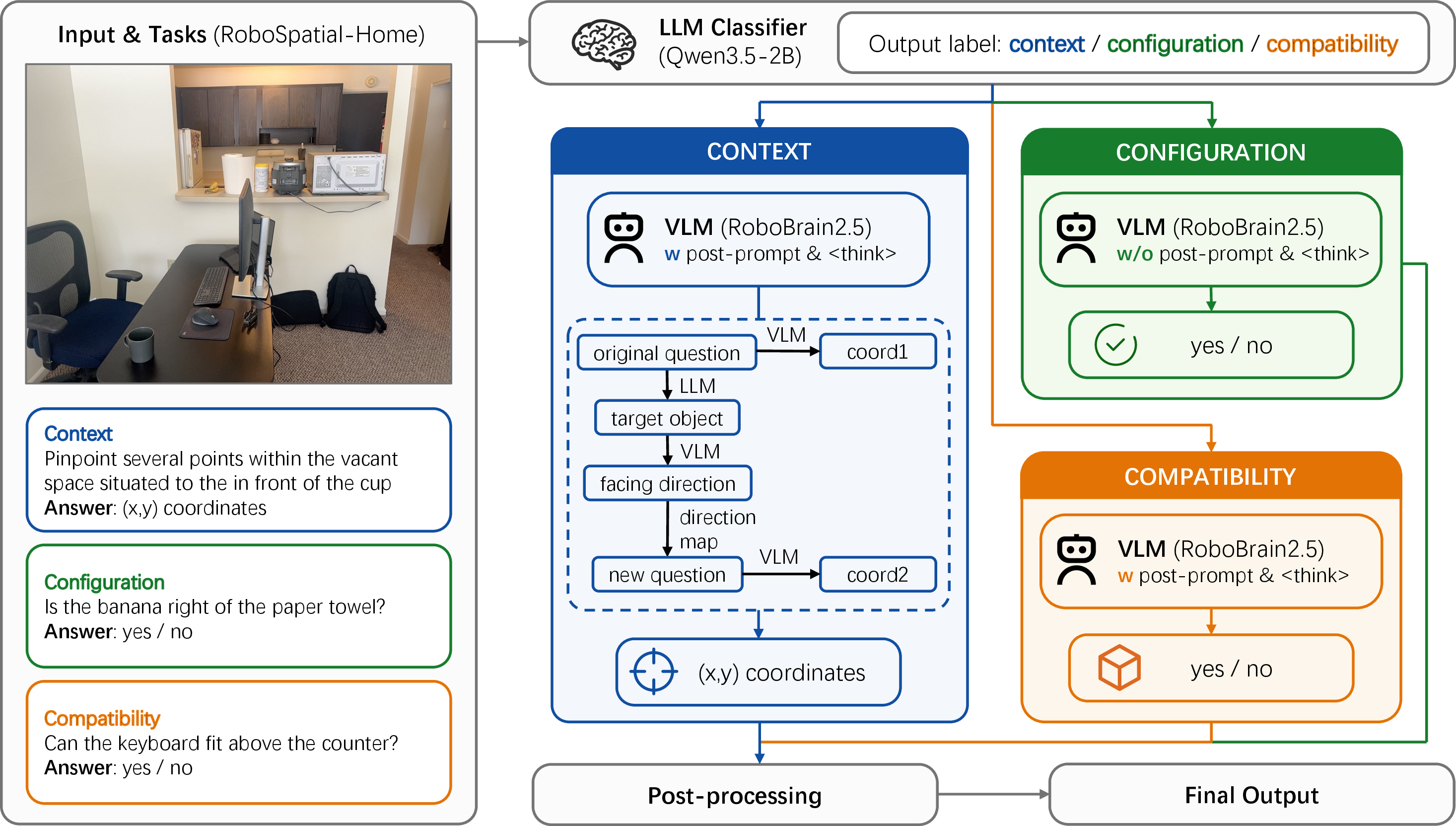
Figure 1: Overview of the RoboSpatialBrain inference pipeline, illustrating the selective activation of deliberate reasoning and reference-frame disambiguation based on query type.
This modular pipeline enables dynamic adaptation of model behavior to the unique demands of each task type, providing a robust foundation for downstream spatial reasoning.
Selective Reasoning Activation via Prompt Engineering
Spatial reasoning tasks in the RoboSpatial-Home benchmark are stratified by cognitive demand: context and compatibility tasks are classified as "reasoning-required," while configuration tasks are "reasoning-free." Imperatively, the model's reasoning capacity is selectively activated for high-reasoning tasks through a forced <think> prefix and task-specific post-prompts. Although RoboBrain2.5 does not natively support explicit chain-of-thought, the inclusion of a <think> prefix reliably improves performance on reasoning-intensive queries. This effect is likely attributable to latent reasoning-format priors inherited from Qwen3-VL, as evidenced by substantial gains on compatibility tasks—most notably, a success rate increase from 40.0% to 83.8% (+43.8 percentage points) upon the joint use of the post-prompt and <think> prefix, establishing a clear causal link between reasoning activation and performance for complex spatial tasks.
Reference-Frame Disambiguation for Contextual Queries
A central technical challenge in embodied spatial reasoning arises from reference-frame ambiguity. VLMs preferentially adopt a camera-centric interpretation, whereas human spatial language often encodes object-centric references. RoboSpatialBrain empirically demonstrates that disambiguation between these frames is critical for precise spatial predictions.
To address this, the system implements an inference-time redirection pipeline: a lightweight LM (Qwen3.5-2B) extracts the referenced object, RoboBrain2.5 is prompted to identify its facing direction, and context queries are programmatically rewritten from object-centric to camera-centric language leveraging a precomputed direction mapping. Results from both query versions are merged to yield the final prediction. This mechanism yields consistent performance improvements across all prompt configurations, confirming the necessity of explicit frame disambiguation for generalizable spatial reasoning.
Impact of Fine-Tuning versus Prompting
The report rigorously analyzes the trade-off between supervised fine-tuning and prompt-based reasoning elicitation. Fine-tuning with compatibility-task data constructed solely from EmbodiedScan elicits significant gains under primitive inference settings (e.g., no post-prompt or <think>), with a +27.6pp improvement at 1,000 steps. However, under optimal prompt-based reasoning activation, fine-tuning degrades performance, producing a −12.4pp drop relative to the base model with joint post-prompt and <think> activation. This indicates that limited-domain supervised fine-tuning can induce catastrophic forgetting and diminish general reasoning ability, an outcome consistent with prior research [luo2023empirical]. These experiments underscore the importance of training data diversity and suggest that prompt-based interventions yield robust task-specific advances without compromising general model competency under constrained training conditions.
Implications and Future Directions
Practically, RoboSpatialBrain's inference-time interventions offer a versatile alternative to task-specific finetuning for deployed embodied AI agents, enabling on-the-fly adaptation to diverse spatial query types. The system's selective reasoning activation and explicit frame disambiguation represent operationally efficient strategies that are immediately portable to other VLM-based robotics systems, especially those built on architectures inheriting reasoning-format priors.
Theoretically, these findings reinforce the necessity of both reasoning elicitation and linguistic disambiguation for high-fidelity spatial understanding in embodied contexts. They further motivate the design of instruction protocols and representation interfaces that expose and control reasoning modalities within large-scale vision-language architectures.
Looking forward, the authors advocate for the construction of more diverse, high-quality spatial datasets—potentially leveraging resources like ScanNet++—to enable future fine-tuning regimes that bolster both in-distribution and out-of-distribution performance. Further research into architectural mechanisms for explicit reference-frame awareness, as well as native support for chain-of-thought reasoning in spatial tasks, constitute promising directions for advancing embodied spatial intelligence.
Conclusion
RoboSpatialBrain demonstrates that inference-time prompt engineering and reference-frame disambiguation can substantially enhance the spatial reasoning capabilities of strong VLMs in embodied benchmarks. By aligning model behavior with task-specific cognitive demands and resolving linguistic ambiguities without costly fine-tuning, the approach achieves state-of-the-art results on RoboSpatial-Home. The work delineates clear best practices for embodied spatial reasoning, while revealing open challenges in robustly extending these gains to richer spatial domains and more diverse data sources.