Adapting Generalist Robot Policies with Semantic Reinforcement Learning
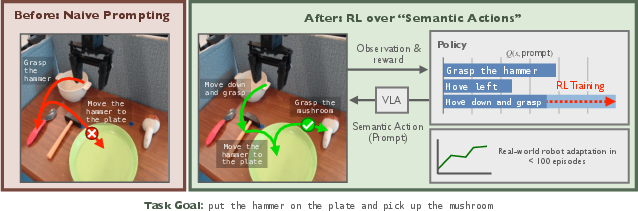
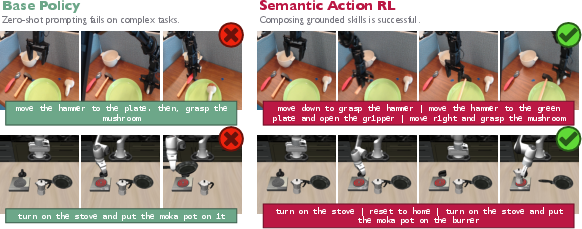
Abstract: Generalist robot policies learn a diverse repertoire of behaviors from large-scale pretraining. In principle, this makes them excellent priors for downstream adaptation via reinforcement learning (RL). In practice, however, standard RL methods leveraging this prior optimize directly over robot actions, requiring the base policy's action distribution to be close to that of a performant policy from the start. This assumption breaks down for complex or long-horizon tasks that fall outside the pretraining distribution. Our key insight is that, for sufficiently expressive generalist policies, language prompts are an effective alternative space for learning to solve such tasks: modulating language inputs elicits skills already within the policy's repertoire, which can be composed to solve tasks beyond its zero-shot capabilities. We propose Semantic Action Reinforcement Learning (SARL), which learns to optimize this prompt space through online interaction, treating the generalist policy as a controllable skill prior. Importantly, leveraging pretrained skills rather than learning new ones from scratch yields structured, semantically meaningful exploration and highly efficient online improvement, and learning to modulate prompts through experience grounds them in induced real-world behaviors for robust task-solving. Across real-world settings and simulated benchmarks, we show SARL unlocks fundamentally new capabilities -- adapting VLA behavior to solve complex, long-horizon tasks -- and significantly outperforms existing approaches for improving robot behavior in deployment.
Paper Prompts
Sign up for free to create and run prompts on this paper using GPT-5.
Top Community Prompts
Explain it Like I'm 14
What’s this paper about?
This paper is about a new way to help robots learn to do complex, multi-step tasks by changing the words we say to them, instead of trying to change their tiny motor movements. The authors work with “generalist” robot models called VLAs (Vision–Language–Action models). These are robots that can see, understand short text instructions, and act. The big idea: use reinforcement learning (RL) to learn which language prompts (short instructions) make the robot do the right things, and in what order. The method is called SARL (Semantic Action Reinforcement Learning).
What questions are the researchers asking?
The paper focuses on three simple questions:
- Can a robot learn new, complicated tasks faster if it learns which words to use, instead of learning every small arm movement from scratch?
- Is learning over “prompts” (short instructions) better than classic RL methods that adjust the robot’s low-level actions directly?
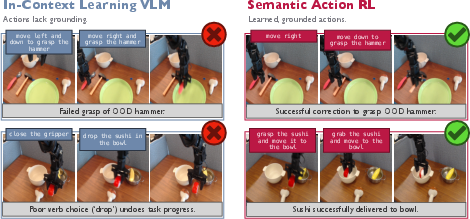
- Is learning prompts with RL better than just asking a large vision-LLM (VLM) to guess the next instruction?
How did they do it? (Methods in everyday language)
Think of controlling a robot like guiding a friend:
- Old way: You tell your friend exactly how to move every muscle (“move your wrist 3 cm, rotate 10 degrees”).
- New way in this paper: You tell your friend simple steps in plain language (“open the fridge,” “grab the egg,” “move right,” “let go”). Your friend already knows how to do these basic things.
Here’s how SARL works:
- Use a pre-trained VLA robot model
- This robot has practiced many basic skills during training and can follow simple written instructions pretty well.
- Treat words as “actions”
- Instead of choosing joint angles for the robot’s arm, the RL system chooses a short instruction (a “prompt”) like “move down,” “grasp,” or “place on plate.” The VLA turns that prompt into the actual arm movements.
- Learn by trial and error (reinforcement learning)
- The system tries different prompts, sees what happens, and gets a score (reward) when it makes progress toward the goal.
- Over time, it learns which prompts work best in each situation. Internally, it learns a “value” (called a Q-value) for each possible prompt in a given state—basically, a score for “how good is this instruction right now?”
- Keep the choices manageable with a helper model
- The space of all possible sentences is enormous. So a vision-LLM (VLM) suggests a small set of candidate instructions that seem reasonable for the current situation (for example, 32–100 options).
- The RL system then picks among these candidates and updates its knowledge based on results.
- Grounding the words in real behavior
- Crucially, the system doesn’t just pick words that sound good; it learns what each instruction actually makes the robot do in the real world. That way, if “pick up the hammer” accidentally makes the robot grab a spoon, it learns to avoid that phrase and use a more grounded instruction like “move right” then “grasp.”
In short: SARL learns which short, simple instructions to use—and in what sequence—to make the robot complete long, tricky tasks.
What did they find, and why does it matter?
Main takeaways:
- It works on hard, multi-step tasks
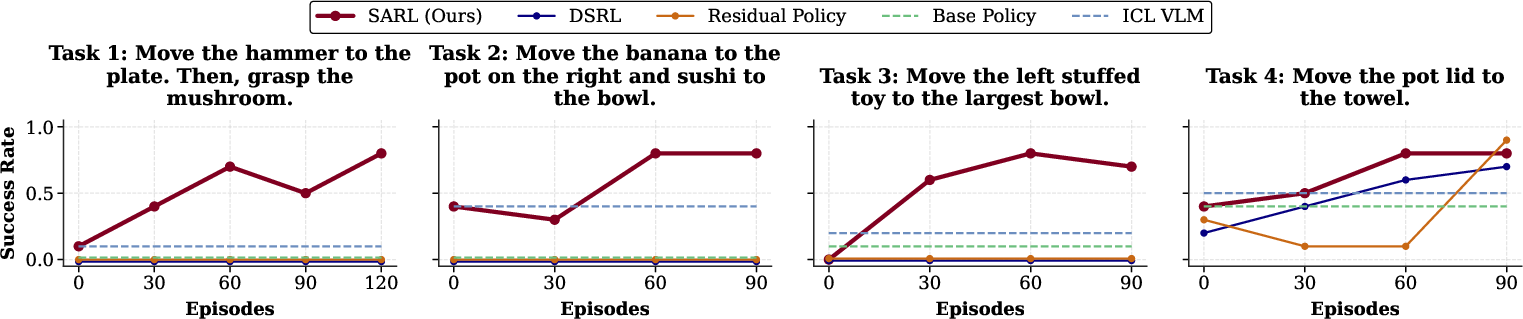
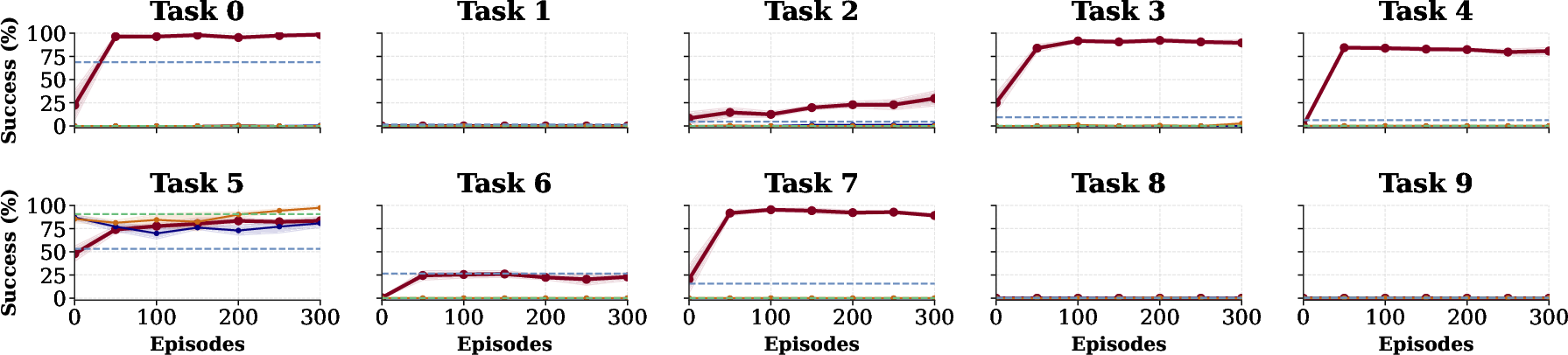
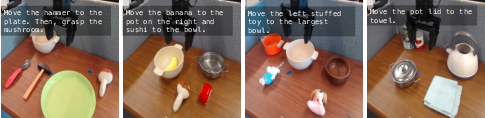
- In both simulation (the Libero-10 benchmark) and on a real table-top robot (WidowX), SARL helped the robot go from almost never succeeding to succeeding much more often, often within 60–100 practice episodes.
- Examples of multi-step tasks include things like moving one object somewhere, then picking up another object, and placing it—steps that are easy for people but tough for robots to get right in sequence.
- Better than action-level RL
- Competing methods that try to tweak the robot’s low-level motions (like Residual RL or diffusion-policy steering) struggled when the robot’s original behavior was far from correct. They could only make small fixes to an already decent behavior.
- SARL doesn’t get stuck this way, because it explores different instructions that unlock different pre-trained skills the robot already has, finding new behaviors that action-tweaking methods can’t reach.
- Better than just asking a LLM to pick prompts
- A VLM can suggest reasonable-sounding instructions and even break a big goal into steps (decomposition), but it doesn’t know how the VLA will actually move in the real world (grounding).
- SARL learns this grounding over many trials and picks instructions that truly cause the right physical behavior, not just ones that “sound right.”
Why this matters:
- Faster, safer learning: By reusing skills the robot already knows, the robot explores in a smarter, more meaningful way rather than flailing around with random motor commands.
- Practical deployment: Robots can adapt on the job to tasks that weren’t in their original training data by learning which words steer their existing skills best.
- New capability: This approach unlocks long-horizon (many-step) tasks that were previously out of reach for in-the-field improvement methods.
What’s the impact and what’s next?
- Implications:
- Using language as the “action space” is a powerful, human-friendly way to teach robots. It combines the flexibility of human instructions with the precision of learned skills.
- This approach can be combined later with traditional action-level fine-tuning for even more improvement.
- Limitations:
- Speed: Involving a VLM to suggest candidate prompts can slow things down.
- Dependence on good base models: This works best when the robot’s VLA already knows many basic skills and follows language well.
- Future directions:
- Make it faster by relying less on VLMs during deployment (e.g., letting the learned value function generalize to new prompts).
- Train even better generalist robot models that respond more reliably to language, making this method even more powerful.
In simple terms: The paper shows that teaching robots by learning the right words to say—step by step—is a smart, efficient way to get them to handle complicated tasks in the real world.
Knowledge Gaps
Knowledge gaps, limitations, and open questions
The paper proposes learning over a VLA’s language-prompt “semantic action” space via RL, but leaves several important aspects unspecified or unexplored. The following concrete gaps can guide future research:
- Missing algorithmic specification: the method’s name is absent throughout and several symbols (e.g., “P_{\text{sem}}(s' \mid s,\ell)A^tV^t(s') = \mathbb{E}_{\ell' \sim \pi(\cdot\mid s')}[Q(s',\ell')]QQ(s,\ell)Q(s,\ell)\tauQQ(s,\ell)$.
- Credit assignment across multi-step decompositions: no mechanism (e.g., hierarchical options, learned subgoal rewards, or temporal abstractions with termination) is presented to improve long-horizon credit assignment beyond standard TD learning.
- Combining semantic- and action-space steering: the paper hypothesizes potential complementarity but does not evaluate joint optimization or switching policies (e.g., prompt selection plus residual corrections).
- Reset and reproducibility details: in simulation a “reset-to-home” command is added; real-world object reset procedures, human interventions, and their impact on data collection and reproducibility are not described.
- Robustness to language noise: the effect of typos, ambiguous references, or out-of-grammar prompts on both VLM proposal and VLA execution is not evaluated.
- Theoretical grounding: there is no analysis of when semantic action RL should be more sample-efficient than action-space RL, nor conditions under which restricting to VLM-proposed prompts preserves optimality or bounds regret.
- Scalability to richer interaction modalities: only textual language is considered; whether richer semantics (e.g., programmatic skill APIs, sketch-based goals, or structured scene references) lead to better grounding is not explored.
- Evaluation breadth: four real-world tasks and Libero-10 may not reflect broader deployment challenges (e.g., dynamic scenes, deformables, multi-object dependencies, bimanual manipulation); broader benchmarks and ablations are needed.
- Ablations on key components: the contribution of each ingredient (demonstration seeding, VLM restriction, caching, softmax temperature, reward shaping) is not dissected through controlled ablations.
- Robust prompt-to-behavior mapping: while the paper claims “grounding,” it does not quantify stability/variance of induced behaviors per prompt across trials or scenes, nor mechanisms to detect and avoid high-variance prompts.
- Practical deployment costs: compute budgets, wall-clock training time, and operator overhead (resets, safety supervision) are not reported, limiting assessment of real-world practicality.
Practical Applications
Summary
The paper introduces a deployment-time adaptation method for generalist robot policies—treating the language prompt of a vision-language-action (VLA) model as a semantic action space and optimizing it via online reinforcement learning (RL). By learning a semantic Q-function over candidate prompts (optionally proposed by a vision-LLM, VLM), the system composes grounded, short-horizon skills into reliable, long-horizon behaviors, achieving rapid real-world improvement in under 60–100 episodes and outperforming action-space RL baselines. This “semantic RL over prompts” enables efficient, structured exploration while leveraging the pretrained behavioral priors of VLAs.
Below are practical applications, organized by immediacy, with sector links, potential tools/products/workflows, and key dependencies/assumptions.
Immediate Applications
The following applications can be piloted with current VLA/VLM stacks, modest engineering, and standard robotic safety practices in controlled environments.
- Adaptive warehouse picking and packing
- Sectors: logistics, e-commerce, retail fulfillment
- What: Learn reliable multi-step routines (e.g., identify bin → grasp → place → verify → reset) by optimizing prompt sequences for out-of-distribution items and layouts.
- Tools/products/workflows: “Semantic Prompt Controller” ROS 2 node; VLM-based candidate prompt generator; event-based success detectors (barcode/weight/vision); prompt cache per SKU; replay-buffer logging.
- Assumptions/dependencies: Pretrained VLA that can follow grounded motor primitives; simple reward signals (e.g., success classifier); safe exploration constraints; reliable reset-to-home skill.
- Fast changeovers in light manufacturing cells
- Sectors: manufacturing, electronics assembly, contract manufacturing
- What: Reconfigure assembly tasks by learning prompt sequences (e.g., “align,” “insert,” “tighten”) from a few language-guided demos plus online RL, reducing downtime and expert programming.
- Tools/products/workflows: Skill library of grounded action prompts; human-in-the-loop reward annotation for first episodes; digital work-instruction ingestion to seed prompts.
- Assumptions/dependencies: Repeatable fixturing; deterministic failure detection (vision/torque); base VLA trained on similar pick/place/align skills.
- Lab automation task stitching
- Sectors: biotech, chemistry, clinical labs
- What: Compose pipetting/transport/incubation steps into robust long-horizon protocols under real-world variability (e.g., plate offsets, labeling noise).
- Tools/products/workflows: Protocol-to-prompt compiler; “reset-to-home” and homing vision fiducials; episode schedulers to respect dwell times; audit logs of prompt sequences.
- Assumptions/dependencies: Clear success proxies (liquid level/weight/vision checks); sterile/safety constraints; on-prem compute for privacy.
- Back-of-house hospitality and retail
- Sectors: food service, hotels, supermarkets
- What: Restocking, table clearing, tray sorting with learned prompt decompositions accounting for clutter and novel packaging.
- Tools/products/workflows: Shared “prompt recipes” per venue; confidence-triggered human override; continuous learning during off-hours.
- Assumptions/dependencies: Robust grasp/motion skills in the VLA; facility-wide safety gates; sufficient sensing (RGB-D).
- Home assistance routines with supervised adaptation
- Sectors: consumer robotics, elder care (non-medical)
- What: Teach-and-try workflows where users voice simple steps (“move right,” “grasp cup”) and the robot learns which phrasing reliably works in their home.
- Tools/products/workflows: Tablet/voice UI for prompt selection; caregiver-provided sparse rewards; per-household prompt cache and rollback.
- Assumptions/dependencies: Supervised operation during training; safe-force limits; constrained task zones.
- Inspection and light maintenance
- Sectors: utilities, facilities management, energy (non-hazardous)
- What: Prompt-level control for visually-guided inspections (e.g., read gauge → photograph label → wipe lens → retry) in varied sites.
- Tools/products/workflows: Vision-based success/failure classifiers; automatic “retry and reposition” prompt templates; semantic Q-function service running on an edge device.
- Assumptions/dependencies: Connectivity or on-edge VLM; reliable autonomy envelope; device-safe surfaces.
- Robotics R&D and education
- Sectors: academia, corporate research labs
- What: Benchmarking long-horizon adaptation; studying semantic MDPs; comparing prompt-level RL vs action-level RL; data-efficient online adaptation protocols.
- Tools/products/workflows: Open-source SARL reference; Libero/Bridge-like task suites; standardized logging of prompts, rewards, and outcomes.
- Assumptions/dependencies: Access to generalist VLAs; reproducible reward functions; evaluation harnesses.
- Low-cost demonstration collection and dataset expansion
- Sectors: robotics platforms, data providers
- What: Rapidly collect grounded prompt-action-result triples by steering the VLA with language, lowering expert teleoperation cost.
- Tools/products/workflows: Operator UI for approving successful steps; automatic segmentation into “semantic actions”; dataset packaging for future pretraining.
- Assumptions/dependencies: VLA capable of reliable short-horizon behaviors; simple success heuristics.
- No-code “teach-by-telling” robot programming
- Sectors: SMB manufacturing, makerspaces, education
- What: Natural language programming with automatic prompt optimization and caching per task.
- Tools/products/workflows: Drag-and-drop task graph where nodes are learned prompts; built-in verifier that rejects unsafe or ineffective instructions; rollback mechanisms.
- Assumptions/dependencies: Clear stop/estop policies; baseline skill set in the VLA; on-device logging.
- Governance-ready traceability for language-driven robots
- Sectors: compliance, safety, insurance
- What: Turn on full prompt audit trails (prompt, timestamp, sensor frame, reward) for post-hoc analysis and incident review.
- Tools/products/workflows: Prompt ledger; red-team playbooks that perturb prompts; minimum viable KPI set (success rate, time-to-success, unsafe-event rate).
- Assumptions/dependencies: Data retention policies; privacy controls; integration with existing quality systems.
- Sim-to-real with minimal on-site tuning
- Sectors: robotics integrators
- What: Pretrain on simulated long-horizon templates (Libero-like) and adapt on-site in tens of episodes by optimizing prompts instead of actions.
- Tools/products/workflows: Simulation “prompt curriculum” exporter; on-site quickstart adaptation kit; reset-to-home controller.
- Assumptions/dependencies: Reasonable sim2real visual/motion fidelity; stable success detectors.
- OEM SDK: “Semantic Action Layer” for VLA stacks
- Sectors: robotics platform vendors, VLA providers
- What: Offer SARL as a drop-in adapter (candidate generation, semantic Q-learning, prompt cache, safety filters).
- Tools/products/workflows: C++/Python SDK, ROS 2 nodes, cloud/edge variants; integration with residual/action-space controllers as fallbacks.
- Assumptions/dependencies: Stable VLA API; hardware-agnostic interfaces; latency budgets.
Long-Term Applications
These require further advances in VLA breadth, safer exploration, verifiers, scaling to open-world settings, or regulatory maturation.
- General-purpose household robots orchestrating multi-room chores
- Sectors: consumer robotics
- What: Robust, personalized routines (laundry, tidying, dishwashing) learned via semantic RL, adapting to new layouts and objects.
- Tools/products/workflows: Continual learning with on-device VLM; privacy-preserving logs; federated improvements.
- Assumptions/dependencies: Stronger VLAs with broader skill repertoires; reliable success detectors; long-horizon credit assignment at scale; safety certification.
- Clinical and elder-care assistance (non-invasive tasks)
- Sectors: healthcare
- What: Room prep, fetching supplies, non-contact support; careful prompt-level safety verifiers and auditability.
- Tools/products/workflows: RL gated by verifier models and safety shields; hospital IT integration; clinician-in-the-loop approvals.
- Assumptions/dependencies: Rigorous validation; HIPAA/privacy; medical device compliance; robust failure recovery.
- Flexible collaborative assembly from text work orders
- Sectors: advanced manufacturing, automotive, electronics
- What: Convert digital work instructions into candidate prompt graphs, learn reliable execution sequences across SKUs and variants.
- Tools/products/workflows: Digital twin alignment; cross-embodiment prompt transfer; automatic error recovery sequences.
- Assumptions/dependencies: High-fidelity simulation; standardized component representations; strong visual reasoning.
- Construction site manipulation and logistics
- Sectors: construction
- What: Handling variable materials, staging, tool handovers using learned prompt strategies in unstructured sites.
- Tools/products/workflows: On-site adaptation windows; safety zones; integration with BIM models for context-aware prompts.
- Assumptions/dependencies: Weather/lighting robustness; rough-terrain mobility; advanced perception.
- Agricultural harvesting and tending with crop-specific policies
- Sectors: agriculture
- What: Learn field- and crop-specific prompt sequences (approach, assess ripeness, grasp, stow), adapting to growth stages/occlusions.
- Tools/products/workflows: Multimodal reward (vision, force, spectroscopy); seasonal continual learning; fleet-wide prompt sharing.
- Assumptions/dependencies: Tactile/force feedback; robust outdoor perception; low-latency edge compute.
- Multi-robot mobile manipulation fleets with semantic coordination
- Sectors: logistics, manufacturing, retail, smart buildings
- What: Multi-agent semantic RL coordinating prompt-level plans (handoffs, staging, sequenced tasks).
- Tools/products/workflows: Centralized dispatcher that assigns prompt subgoals; inter-robot communication protocols; shared verifiers.
- Assumptions/dependencies: Scalable multi-agent RL; conflict resolution; formal task allocation.
- Regulatory frameworks for language-conditioned robots
- Sectors: policy, standards
- What: Certification regimes that test long-horizon prompt sequences; required logging, prompt replay, and safety verification before deployment.
- Tools/products/workflows: Standardized long-horizon test suites; incident reporting schemas; third-party evaluation services.
- Assumptions/dependencies: Consensus on metrics (success, safety, recoverability); public benchmarks; auditor accreditation.
- Education at scale: teach-by-language curricula
- Sectors: education, workforce development
- What: Classroom kits where students co-design prompt recipes and evaluate grounded behaviors, learning RL concepts hands-on.
- Tools/products/workflows: Low-cost arms/carts; sandboxed tasks; teacher dashboards showing semantic Q-values and policy improvement.
- Assumptions/dependencies: Affordable hardware; safe classroom operation; curated, age-appropriate tasks.
- Marketplace of verified “prompt recipes”
- Sectors: software, platforms, integrators
- What: Share and monetize validated prompt graphs for common tasks (e.g., lab plate handling, picker workflows) with versioning and provenance.
- Tools/products/workflows: Recipe packaging format; verifier scores; compatibility tags (embodiment, sensors).
- Assumptions/dependencies: IP/licensing norms; cross-embodiment generalization; trust and safety ratings.
- Formal safety verification for semantic actions
- Sectors: safety engineering, insurance
- What: Learned prompt-action verifiers that reject unsafe commands and guarantee bounds on contact forces or exclusion zones.
- Tools/products/workflows: Constraint solvers integrated with the prompt policy; risk-aware RL objectives; counterfactual testing.
- Assumptions/dependencies: Mature verifier models; reliable state estimation; interpretable logs.
- On-device, low-latency VLM/VLA stacks
- Sectors: edge AI, embedded systems
- What: Fully local candidate generation and prompt selection to meet real-time constraints and privacy requirements.
- Tools/products/workflows: Quantized/accelerated models; hardware-aware schedulers; intermittent cloud sync for updates.
- Assumptions/dependencies: Efficient foundation models; energy budgets; thermal design.
- Hybrid control stacks combining semantic- and action-space RL
- Sectors: robotics platforms
- What: Semantic RL for high-level sequencing plus residual/action-space controllers for precision, improving accuracy and safety margins.
- Tools/products/workflows: Arbitration policies; shared rewards and verifiers; unified logging across layers.
- Assumptions/dependencies: Robust interfaces between layers; stability analysis; consistent reward shaping.
Cross-cutting assumptions and dependencies
- Pretrained VLA with sufficiently broad, language-inducible skills; the approach leverages existing priors rather than learning low-level skills from scratch.
- Feasible reward signals (binary success, heuristic detectors, vision classifiers) and safe exploration envelopes (force limits, guarded moves, human-supervision during early episodes).
- Reliable resets and “reset-to-home” primitives to recover from failures and enable stable online learning.
- VLM availability to propose candidate prompts initially; over time, the learned semantic Q-function may reduce or eliminate the need for frequent VLM calls.
- Latency and compute budgets compatible with in-the-loop VLM/VLA inference; may require edge accelerators or batching.
- Safety, privacy, and compliance considerations for data logging and deployment, especially in regulated sectors (healthcare, food, chemical, public spaces).
- Organizational readiness for continuous improvement workflows (logging, A/B evaluations, prompt audits, rollback).
Glossary
- Action prior: A prior distribution or inductive bias over plausible actions provided by a pretrained policy that guides exploration or control. "leverages VLAs as controllable action priors"
- advantage conditioning: A technique that conditions a policy on estimated advantages to bias action selection toward higher-value behaviors. "augmenting the VLA with ``advantage conditioning''"
- Behavioral cloning: A supervised learning method that trains a policy to imitate expert demonstrations by mapping observations (and optional language) to actions. "Behavioral cloning then trains a language-conditioned policy"
- denoising process: The iterative procedure in diffusion/flow models that transforms noise into actions or trajectories, which can be steered during inference. "steering the VLA's denoising process (when the VLA is a flow or diffusion model)"
- diffusion model: A generative model that learns to reverse a noise-adding process to produce samples (e.g., actions) and can be guided at inference. "flow or diffusion model"
- discount factor: A scalar in [0,1] that exponentially down-weights future rewards in reinforcement learning returns. " the discount factor"
- expected discounted reward: The objective in RL that sums future rewards with exponential discounting under a policy. "maximizes the expected discounted reward"
- flow model: A generative model that transforms simple base distributions to complex ones via invertible mappings, applicable to action generation. "flow or diffusion model"
- grounding: The alignment between symbolic (e.g., language) instructions and the actual physical behaviors they induce in the environment. "lack grounding"
- hierarchical RL: A framework where higher-level policies select subgoals or skills for lower-level controllers to execute, improving long-horizon learning. "hierarchical RL"
- in-context learning (ICL): A capability of large models to adapt behavior based on examples provided in the input context without weight updates. "via in-context learning (ICL) over interaction history."
- latent-noise space: The noise/input space of a diffusion policy that can be manipulated to steer generated actions. "latent-noise space steering"
- long-horizon: Describing tasks that require many sequential decisions or stages to achieve a goal, often challenging for RL and planning. "complex, long-horizon tasks"
- Markov decision processes (MDPs): Formal RL frameworks defined by states, actions, transitions, rewards, and a discount factor. "Markov decision processes (MDPs)"
- online RL: Reinforcement learning that updates policies using data collected during live interaction with the environment. "an online RL loop"
- out-of-distribution (OOD): Inputs or commands outside the training data distribution, where model behavior is unreliable. "out-of-distribution (OOD)"
- Q-function: The expected discounted return from taking an action in a state and following a policy thereafter. "We define the -function as"
- replay buffer: A memory of past transitions used to stabilize and improve sample efficiency in off-policy RL. "replay buffer "
- Residual RL: An approach that learns corrective action residuals added to a base policy to improve performance. "Residual RL"
- reward shaping: Modifying the reward signal to provide additional guidance and accelerate learning without changing the optimal policy. "reward shaping"
- semantic action: A high-level, language-based command treated as an action that a VLA translates into low-level controls. "treats the language prompt of a VLA as a ``semantic action''"
- semantic exploration: Exploration constrained to semantically meaningful behaviors (e.g., language-induced skills) rather than raw action space. "efficient semantic exploration"
- semantic MDP: An induced decision process where actions are language prompts executed via a VLA, producing transitions in the original environment. "the corresponding induced ``semantic MDP''"
- semantic priors: Prior knowledge encoded in pretrained models about meaningful behaviors and task semantics that guide decision-making. "encode powerful semantic priors"
- skill prior: A prior over reusable behaviors or skills encoded in a pretrained policy, used to simplify learning new tasks. "controllable skill prior"
- softmax distribution: A probability distribution obtained by exponentiating and normalizing scores (e.g., Q-values) to sample actions. "softmax distribution induced by their -values"
- state abstraction: The design or learning of compact state representations that preserve decision-relevant information for RL. "state abstraction design"
- temporal-difference (TD) backups: Bootstrapped updates that adjust value estimates using targets formed from immediate rewards and next-state values. "temporal-difference (TD) backups"
- transition function: The dynamics mapping from current state and action to a distribution over next states in an MDP. "the transition function"
- vision-language-action models (VLAs): Policies that condition on visual observations and language commands to produce robot actions. "vision-language-action models (VLAs)"
- vision-LLMs (VLMs): Models that jointly process images and text, used here to propose candidate language commands. "vision-LLMs (VLMs)"
- zero-shot: Performing a task without task-specific training or fine-tuning, relying solely on pretrained capabilities. "zero-shot capabilities"
Collections
Sign up for free to add this paper to one or more collections.