End-to-End Parametric Portfolio Policies for Cross-Asset Futures Timing: When Do AI Models Beat Simple Rules?
Published 1 Jul 2026 in q-fin.ST, q-fin.PM, and q-fin.TR | (2607.00475v1)
Abstract: Timing-based tilts across asset classes can drive much of the risk and return of a diversified cross-asset portfolio. The standard approach forecasts returns and then optimizes weights. We instead study an end-to-end AI-based policy that maps market states directly to portfolio weights, and we then ask when this one-step modeling approach outperforms simple rules-based strategies. We train these policies on the sixteen most liquid CME futures, where an edge is unlikely to be due to illiquidity, using a differentiable Sharpe ratio loss function, and we benchmark them against equal weighting, risk parity, and time-series momentum. The learned policies rank above the rules on the pooled cross-asset portfolio and in several sub-asset classes, but not uniformly. In gross terms, an LSTM and a transformer-based architecture perform comparably out-of-sample, but diverge when we consider transaction costs. The transformer generates the stronger learned policy, trades far less than the LSTM, and matches or exceeds equal weighting through moderate cost.
The paper demonstrates that end-to-end AI models can yield Sharpe ratios comparable to simple rule-based strategies in cross-asset futures timing.
It employs neural architectures like transformers and LSTMs that map raw returns directly to portfolio weights using differentiable Sharpe ratio objectives.
Results underscore that modest performance gains hinge on transaction cost robustness and asset-class-specific evaluations rather than complex feature engineering.
End-to-End Portfolio Policies for Cross-Asset Futures: Benchmarking AI Allocation Versus Simple Rules
Context and Motivation
Systematic allocation across asset classes is central to global-macro and managed-futures strategies, yet timing these allocations remains empirically difficult. Standard practice relies on two-step pipelines: forecast returns, then optimize weights according to means and covariances. However, this approach is acutely sensitive to the quality of forecasts and the notorious instability of weights under estimation error. The paper "End-to-End Parametric Portfolio Policies for Cross-Asset Futures Timing: When Do AI Models Beat Simple Rules?" (2607.00475) directly interrogates the practical value-add of end-to-end AI allocation policies—those which map raw market states straight to portfolio weights, trained using differentiable portfolio-level objectives—benchmarked against robust rules like equal weighting, risk parity, and time-series momentum.
The work is positioned as a rigorous, practitioner-oriented test of end-to-end allocation under realistic constraints: the universe covers the sixteen most liquid CME futures, thereby eliminating illiquidity as a confounding driver of outperformance. The outcome sought is not the demonstration of architectural novelty or new methods, but a critical evaluation of whether the additional complexity of deep learning models is substantively justified in real-world cross-asset allocation.
Data and Problem Hardness
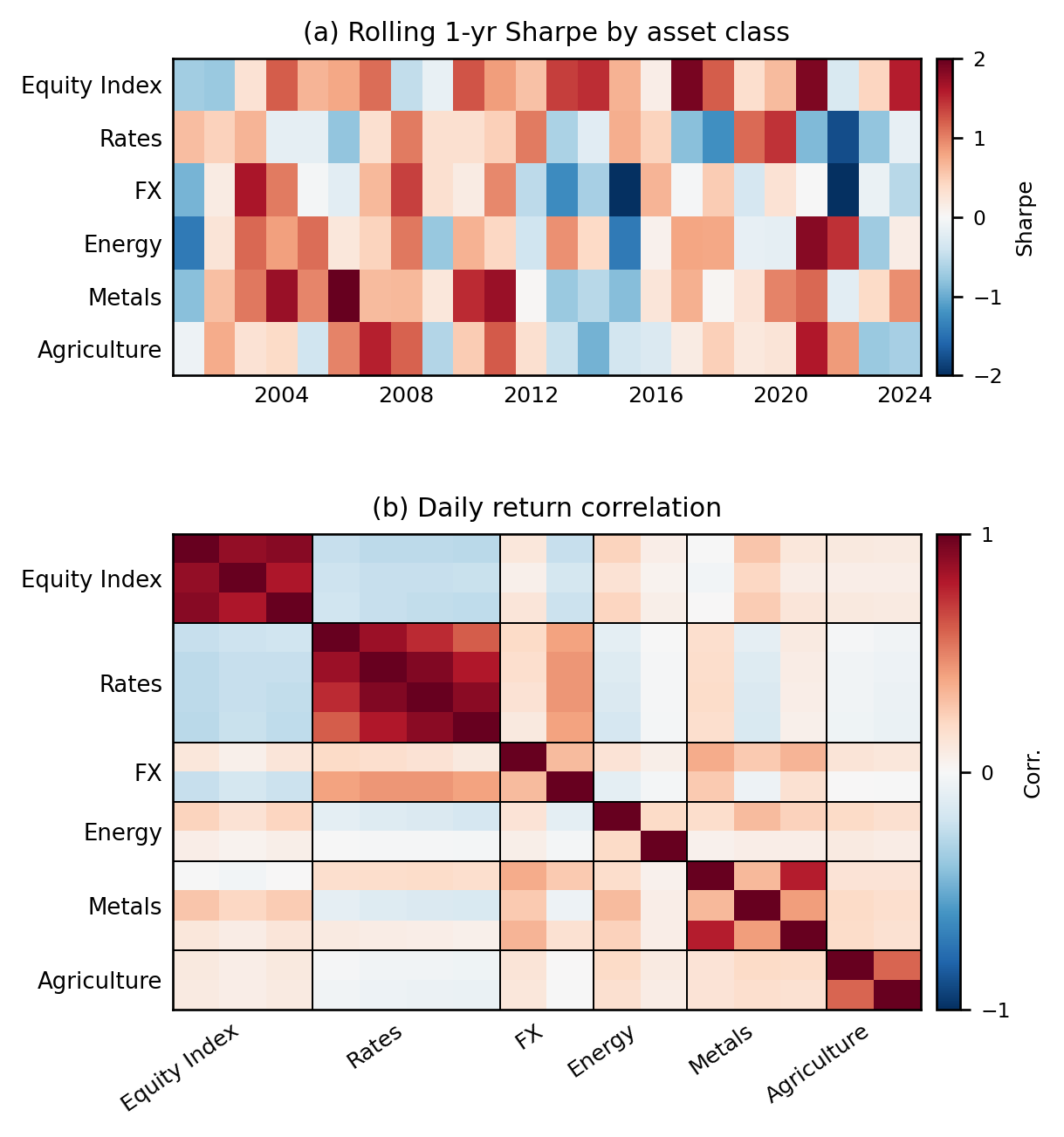
The dataset involves daily returns on sixteen highly liquid CME futures contracts spanning six major asset classes from 2001 to 2024. Liquidity screens filter out any non-tradable contracts, yielding a universe reflective of genuine investment capacity rather than hypothetical backtests inflated by illiquidity premia. A distinctive property of this dataset is the temporal and cross-sectional complexity: Sharpe ratios for asset-class portfolios shift sign year-to-year due to sharp, nonstationary regime changes, and contract-level return correlations are high within asset classes (mean $0.67$) but nearly orthogonal across classes (mean $0.05$).
Figure 1: Time-varying Sharpe ratios by asset class and the correlation structure of contract returns highlight significant nonstationarity and cross-asset orthogonality.
Feature engineering encompasses basic return history and interpretable signals—trend, lagged autocorrelation, Hurst exponent, higher moments, realized volatility, and pairwise correlation—across multiple lookback horizons. However, in out-of-sample tests, these engineered features showed limited transferability, so most results use the cross-section of daily contract returns as the state input for policies.
Methodology: Differentiable End-to-End Policy Training
The core modeling approach aligns with the literature on policy function approximation and task-based optimization: neural architectures (LSTM, transformer) parameterize a function mapping input states to scoring vectors, which are converted via a signed-softmax layer to legal, dollar-neutral long/short portfolio weights. The loss function is the negative Sharpe ratio of the resulting portfolio series, fully differentiable for gradient-based policy optimization:
LSharpe(θ)=−V[RP,t(θ)]E[RP,t(θ)]
Optionally, a turnover penalty can be integrated into the objective to account for trading costs:
The transformer model architecture leverages Time2Vec embeddings for temporal signal extraction, multi-head self-attention layers for both cross-time and cross-asset dependencies, and a causal masking mechanism to ensure proper information flow. Regularization via seed-averaging and early stopping is essential due to seed-sensitivity and overfitting risks.
In-Sample Diagnostics
Within walk-forward windows, both LSTM and transformer architectures exhibit sufficient capacity to fit the training data and even overfit without appropriate regularization. In-sample negative Sharpe loss declines smoothly, and overfitting manifests as a typical divergence between training and validation Sharpe. Most engineered features improve in-sample fit but do not translate to stable out-of-sample gains, rationalizing the focus on raw returns.
Out-of-Sample Results: Efficacy, Robustness, and Attribution
Out-of-sample evaluation uses a strict expanding-window design with blockwise retraining, and all strategies are compared on matched timeframes in each universe. The key empirical findings are:
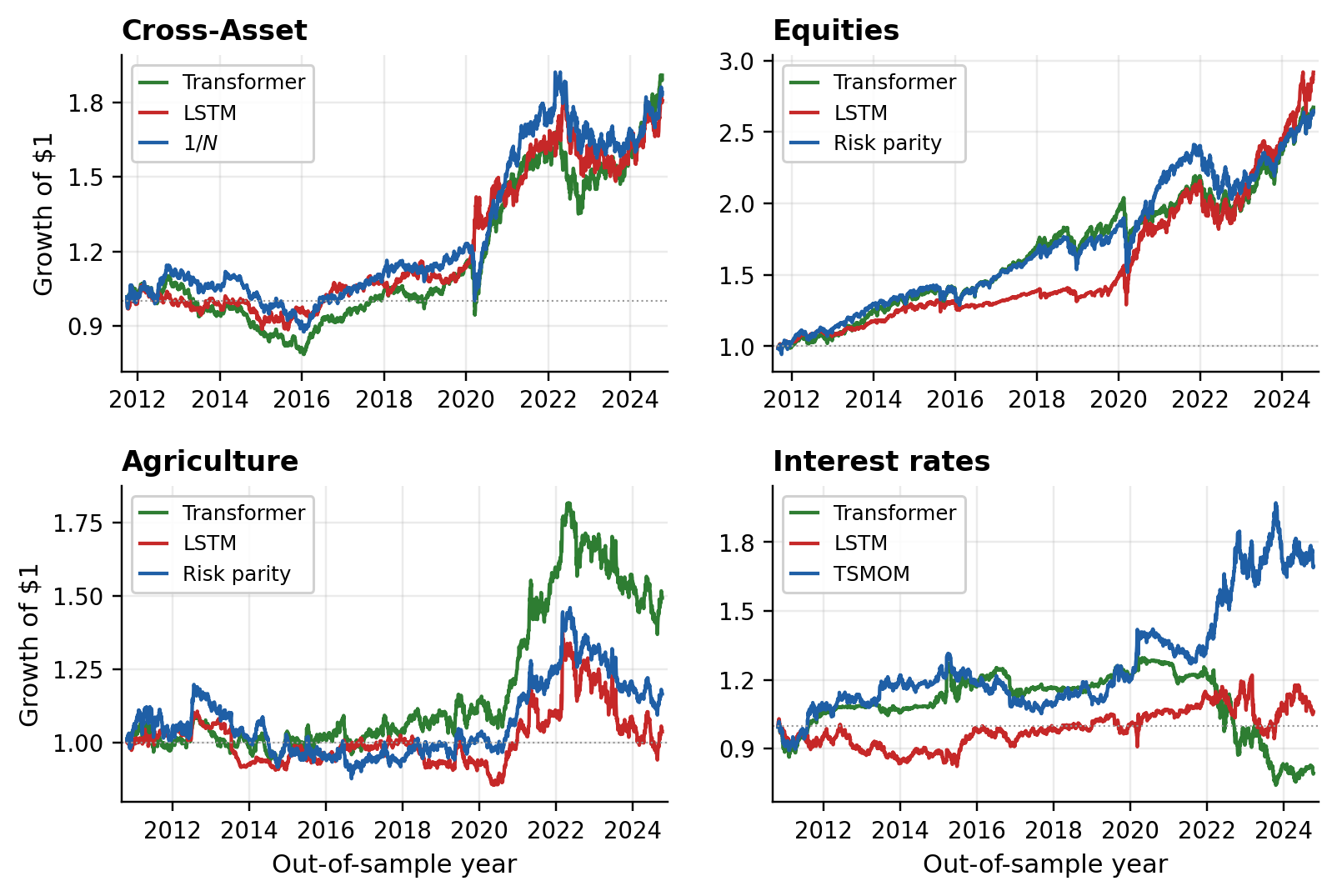
Performance rankings depend strongly on asset class. The transformer policy is top-ranked in cross-asset, metals, and agriculture universes; LSTM edges ahead in equities; simple rule-based TSMOM dominates in interest rates and FX; equal weighting performs best in energy.
Magnitude of improvement is modest. In the cross-asset portfolio, the transformer's Sharpe ratio (0.55) only marginally exceeds equal weighting (0.52), with the bootstrap probability of outperformance at 0.59.
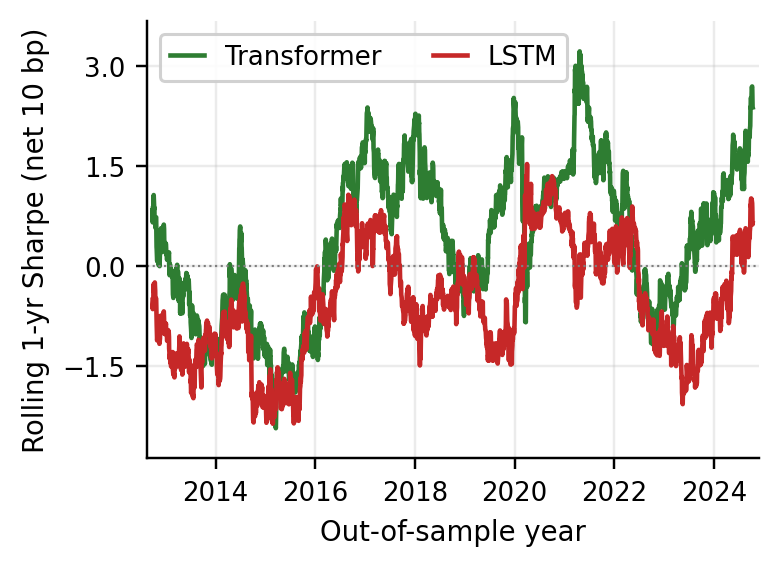
Turnover effects are pronounced. LSTM policies tend to high turnover (0.07–0.17 per day), which erodes returns after transaction cost adjustment. Transformer turnover is consistently lower (≈0.02), and its net Sharpe is robust to cost increments up to 10 bp—unlike the LSTM which degrades rapidly.
Figure 2: Volatility-normalized cumulative returns indicate competitive performance of learned models in cross-asset, equity, and agriculture, with TSMOM leading in rates.
Transaction cost robustness is architecture-dependent. At a representative 2 bp cost rate, the transformer retains nearly its full Sharpe advantage, whereas the LSTM’s Sharpe drops from 0.50 (gross) to 0.33 (net).
Figure 3: Rolling one-year net Sharpe for the cross-asset portfolio under realistic transaction costs, showing superior cost-robustness of the transformer relative to LSTM.
Attribution analysis suggests limited "alpha." Regression-versus-benchmark decomposition shows that, in the equity-index sleeve, most of the transformer’s performance comes from market beta rather than residual timing alpha. The LSTM achieves a statistically significant alpha, but only in equities, and only before cost adjustment.
Complexity beyond seed-averaged transformers is not rewarded. Mixture-of-experts, per-class tuning, or additional feature engineering do not reliably improve out-of-sample or cost-adjusted performance beyond the simple averaged transformer model.
Why Cross-Asset Timing with End-to-End ML Remains Difficult
Several technical factors constrain signal extraction and model improvement over robust benchmarks:
The liquid universe removes illiquidity alpha, thinning exploitable signals.
Sharpe optimization in trending markets can yield “risk-efficient beta” exposure rather than genuine market-neutral alpha.
Single-asset-class sleeves (2–4 contracts) provide insufficient cross-section for meaningful learning.
The benchmarks (equal weight, risk parity, TSMOM) are persistent, regime-agnostic rules that are empirically effective over long horizons.
Together, these realities explain the observed regime- and asset-class-dependence of strategy rankings, the narrow magnitude of improvement by even the best learned allocations, and the difficulty in extracting translatable alpha across asset classes.
Practical and Theoretical Implications
The study’s main lessons emphasize the necessity of asset-class-specific and cost-aware evaluation when considering AI allocation. Establishing superiority over robust benchmarks such as equal weighting requires not only statistical separation but economic and cost-robust enhancement. The work also provides empirical support to the claim that, at least for daily trading on liquid cross-asset universes, simple architectures with judicious regularization suffice; further model complexity or feature engineering does not guarantee improved generalization. Attribution analyses reveal that, even when AI policies generate sizable Sharpe ratios, this may be due to capturing risk premia rather than discovering non-trivial timing skill.
Theoretical development in AI-based allocation should focus on modeling frameworks better suited to high-dimensional, regime-dependent signals, and perhaps involve meta-learning or unsupervised regime-adaptation. Practically, extensions to higher-frequency data or broader, less-liquid universes (with appropriate safeguards) represent promising directions where AI policy complexity might add incremental value.
Conclusion
This rigorous study delivers a conservative, well-calibrated assessment of end-to-end parametric portfolio policies for cross-asset futures timing. The results show that transformer-based allocation is competitive—occasionally top-performing—relative to strong simple-rule baselines, particularly after accounting for transaction costs due to its low turnover. However, the improvement is context-dependent, limited in size, and often accrues more from risk-efficient market exposure than from residual timing alpha.
The main implication for researchers and practitioners is that while end-to-end AI policies can be valuable tools, their deployment must be justified against robust, well-understood benchmarks, critically evaluated for cost and overfitting, and interpreted with careful attribution analysis. Future development should prioritize model robustness, regime-adaptive learning, and integration of allocative signals across broader and deeper asset universes.