- The paper introduces RCL to preserve evidence-use profiles in multimodal models, ensuring both answer retention and grounded evidence.
- The methodology employs counterfactual interventions to quantify channel reliance and applies a reliance preservation loss to mitigate evidence drift.
- Empirical results show up to an 80% reduction in hidden forgetting and dominant evidence flips while maintaining high answer accuracy.
Hidden Forgetting in Continual Multimodal Learning: From Answer Retention to Grounding Preservation
Introduction and Motivation
Continual learning in multimodal LLMs (MLLMs) is critical for real-world deployments where models must adapt across evolving domains, tasks, and input distributions. However, typical continual learning (CL) evaluation practices primarily focus on answer accuracy—whether the model retains the ability to produce correct outputs on old tasks after adaptation. This answer-centric paradigm overlooks a subtle, yet consequential, failure mode: a model may retain the correct answers through adaptation, while silently changing the underlying evidence channels it uses, effectively “forgetting” how to ground its answers in appropriate visual, textual, or other multimodal evidence structures. This form of “hidden forgetting” undermines robustness, interpretability, and trustworthiness in multimodal reasoning.
To address this, the paper "Hidden Forgetting in Continual Multimodal Learning: When Accuracy Survives but Grounding Fails" (2607.02020) introduces and formalizes the phenomenon of "hidden evidence-use forgetting." The work proposes Reliance-Constrained Continual Learning (RCL), a method that constrains evidence-use drift independently of answer-level retention—effectively guaranteeing not only that a model produces the right answers, but also that it preserves the behavioral pathways (evidence reliance profiles) originally used to produce those answers.
Diagnosis of Hidden Forgetting
The authors begin by empirically demonstrating the decoupling between answer retention and evidence-use preservation in standard, replay-free CL settings for MLLMs. Through a carefully controlled pilot study spanning eight sequential multimodal tasks (including visual reasoning, VQA, OCR, and document QA), they observe that substantial evidence-use drift occurs even when answer accuracy is largely maintained.
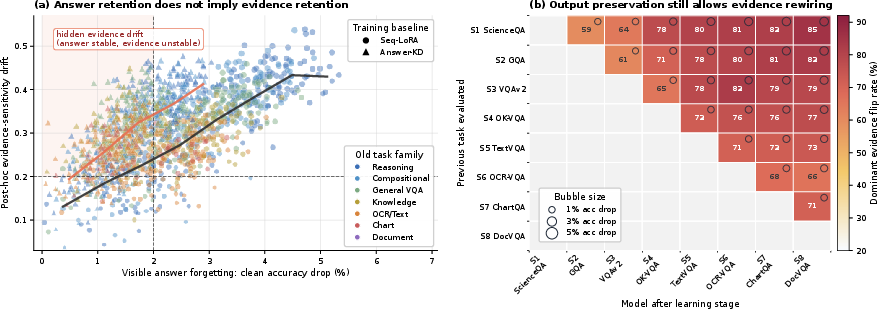
Figure 1: Evidence-use drift is often weakly correlated with answer forgetting; output distillation can mask substantial shifts in dominant evidence channels supporting unchanged answers.
The diagnostic protocol relies on post-hoc channel ablations to quantify an evidence-use vector, measuring the sensitivity of model predictions to selectively suppressing each evidence channel. Results clearly show that accuracy preservation via distillation (Answer-KD) only weakly regularizes evidence-use behavior. For several transitions—especially those involving OCR, chart, and document reasoning—a large fraction of examples manifest minimal accuracy drop but substantial changes in the evidence channel supporting the answer.
The RCL Framework
To counter hidden evidence-use forgetting, the RCL framework is proposed. At each adaptation stage, the previous model checkpoint is frozen as a behavioral reference. For each input example, both the frozen (teacher) and the updated (student) model are probed with counterfactual interventions: perturbations that selectively suppress available evidence channels (visual regions, OCR tokens, chart elements, text, etc.). The change in model behavior upon such interventions quantifies the model's reliance on each channel, forming a reliance vector. RCL explicitly constrains the current model to preserve these teacher reliance profiles in addition to answer-level and output-distribution retention.
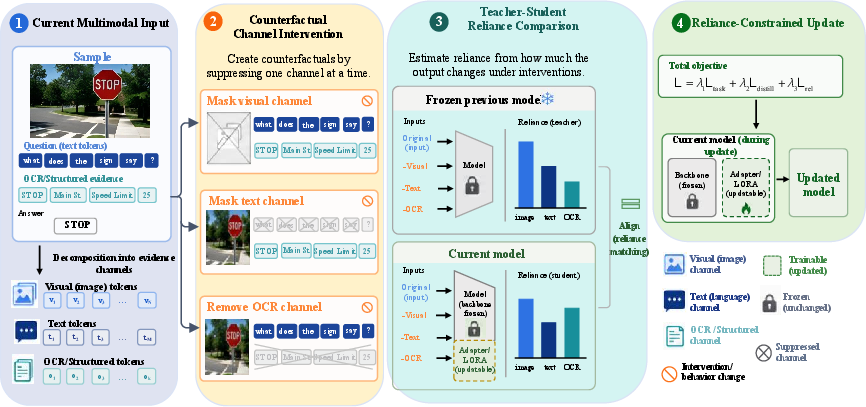
Figure 2: RCL constructs counterfactual interventions to assess and preserve channel-level reliance profiles while optimizing task and prediction retention objectives during continual adaptation.
Technically, the training objective combines (1) the standard task loss for the current stage, (2) a prediction distillation term for output preservation from the frozen checkpoint, (3) a reliance preservation loss based on the Jensen–Shannon divergence between teacher and student reliance vectors for available channels, and (4) an adapter-regularization term.
Empirical Analysis
Main Results and Diagnostics
Empirical results across CoIN, COAST, MCITlib, and an evidence-sensitive stream strongly indicate that hidden forgetting is prevalent in conventional replay-free and parameter-regularization CL protocols—even those using strong output distillation or parameter isolation. RCL substantially mitigates this. On the evidence-sensitive stream, RCL reduces the hidden forgetting rate (HFR) and dominant evidence flip (DEF) by up to 80% compared to answer-distillation baselines, while increasing grounded channel retention (GCR) for structured evidence types (OCR, chart, document).
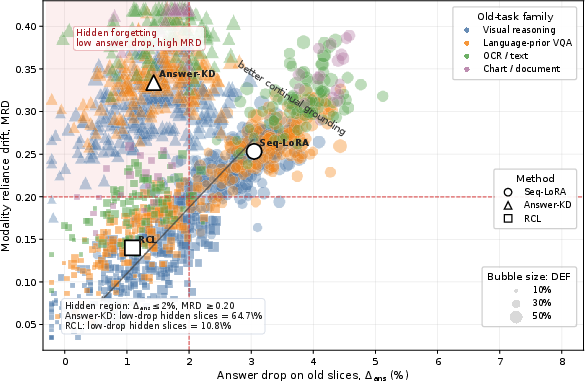
Figure 3: Many answer-preserved transitions still show large evidence-use drift and dominant-channel flips; RCL cuts these rates by a large margin.
Notably, answer-level retention is shown to be a poor indicator of genuine robustness when language priors or task-induced shortcuts are available—the very scenarios where grounding is most critical.
Ablation Studies
Ablation experiments confirm that removing the reliance loss (Lrel) in RCL leads to significant increase in MRD and DEF, indicating that output distillation alone cannot guarantee evidence-use preservation. The reliance preservation constraint is thus necessary for robust grounding permanence.
Pareto Analysis
Given that counterfactual reliance estimation introduces non-trivial training overhead due to additional forward passes (though no inference-time cost), the authors analyze the cost-performance curve. They show that a minimal setting—one targeted intervention per channel—already yields strong gains and that random interventions or untargeted regularization are insufficient.

Figure 4: Relative to training cost, RCL significantly improves the HFR–cost trade-off; its default configuration sits near the Pareto frontier for accuracy and reduced hidden forgetting.
Channel Transition and Shortcut Drift
Analysis of dominant evidence channel transitions—via Sankey diagrams—shows that under standard output distillation, a significant fraction of examples originally supported by OCR, chart, or document channels flip to language-prior reliance post-adaptation. RCL sharply reduces such shortcut-oriented flips.

Figure 5: Sankey visualization of dominant-channel transitions, revealing marked reductions in shortcut flips (e.g., to language priors) under RCL.
Implications and Future Directions
Theoretical Implications
This work exposes a previously underappreciated dimension of continual learning failure in MLLMs: answer-level metrics obscure actual grounding drift, especially when shortcut opportunity is high. Theoretically, it argues for a shift from output-centric evaluation to evidence-reliance- and process-level evaluation in adaptive multimodal systems. The RCL formulation is general: by matching reliance profiles via explicit causal intervention, it connects continual learning with causal diagnostic tools, enabling explicit control of where the information supporting predictions comes from across training stages.
Practical Implications
For practitioners, these findings suggest that CL pipelines in multimodal systems—particularly those used in high-stakes applications where system trustworthiness depends on answer grounding (e.g., document analysis, medical imaging, legal review, educational assistants)—should include explicit mechanisms for evidence-use preservation rather than relying on accuracy or output stability alone. RCL presents a parameter- and compute-efficient, replay-free solution that integrates seamlessly with standard PEFT protocols and backbones.
Future Directions
Possible directions for further research include: extension of reliance-preservation to richer evidence structures (beyond basic channels), scaling to longer continual streams and additional modalities (e.g., video, audio), integration of reliance constraints with safety, fairness, or privacy objectives, and development of improved or more granular counterfactual intervention strategies. The hidden forgetting diagnostic framework also invites wider use as a standard evaluation tool in the CL literature.
Conclusion
The paper demonstrates that standard accuracy-based continual learning protocols for MLLMs can substantially underestimate true forgetting by neglecting evidence-use drift. It introduces a precise formulation of hidden evidence-use forgetting and an effective method, RCL, to maintain both answer retention and stable grounding. Through rigorous diagnostics and strong empirical results, the work establishes preserving the “how” of multimodal reasoning—not just the “what”—as essential for robust continual adaptation in AI systems.