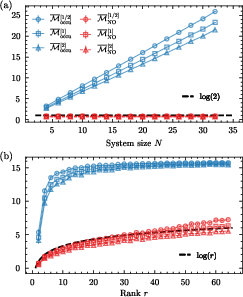
- The paper introduces a convex resource-theoretic framework for quantifying fermionic non-Gaussianity using covariance matrices.
- It defines occupation number and natural-orbital participation entropies that bound resource costs for state preparation and simulation.
- Numerical benchmarks in random circuits and many-body models illustrate the measures’ applicability in diagnosing quantum resource requirements.
Computable Resource Measures of Fermionic Non-Gaussianity: A Technical Synthesis
Introduction and Context
Fermionic non-Gaussianity (FNG), also referred to as fermionic "magic," encapsulates the complexity in simulating interacting fermionic quantum systems. While entanglement has traditionally been associated with the classical intractability of quantum states, efficient simulation is still possible for classes such as stabilizer and fermionic Gaussian states (FGSs). Beyond these, the introduction of non-Gaussian resources—states and operations that break the Gaussian structure—provides avenues for universal quantum computation with fermions. Quantitatively and operationally characterizing fermionic non-Gaussianity, especially in a computationally efficient and resource-theoretically rigorous fashion, remains a substantial challenge.
Convex Resource Theory and Measure Construction
The core contribution of this work is a robust convex resource-theoretic formulation for FNG. The set of free states is the convex hull of FGSs; the free operations are Gaussian protocols with feedforward (adaptive Gaussian operations, classical processing allowed, but restricted to classically simulable operations). Within this framework, the fundamental problem is the definition and computation of monotonic resource measures—functions that remain non-increasing under free operations.
Two central families of measures are developed, both computable from the covariance matrix Γ derived from the $2$-point Majorana correlators. These are:
- Occupation Number Entropies occu[α]: Tsallis-α entropies of the shifted and rescaled Williamson eigenvalues rj of Γ, representing the spectrum of single-particle occupation numbers.
- Natural-Orbital Participation Entropies NOPE[α]: Participation (R\'enyi) entropies of the state’s amplitudes in the natural-orbital (NO) basis, defined by the eigenbasis of Γ.
These measures are constructed to be operationally meaningful—occu[α] lower bounds the resource (non-Gaussian gate) cost for state preparation, while NOPE[α] bounds the cost of classical simulation via expansion over an orthonormal Gaussian basis.
Technical Properties and Operational Consequences
Occupation Number Entropies
For an $2$0-mode pure state,
$2$1
where $2$2 denotes normalized Tsallis entropy for the binary distribution composed from the $2$3th pair of occupation numbers.
- For $2$4, this reduces to the von Neumann entropy of the unique FGS with the same covariance matrix as $2$5, and coincides with the relative entropy of fermionic non-Gaussianity.
- For $2$6,
$2$7
Natural-Orbital Participation Entropy
Defined as the minimized R\'enyi entropy in the natural-orbital basis,
α1
where α2 is any FGU that brings α3 to Williamson normal form.
- The measure quantifies the state’s spread in a basis where Gaussian states are computationally simple.
- α4 upper-bounds the classical simulation cost, since only α5 orthonormal FGSs are needed for a faithful expansion. For α6, it bounds the Gaussian rank; for α7, the Gaussian extent.
- The occupation number entropy and NOPE are related by inequalities (α8).
Special Cases and Exact Computability
- For stabilizer states, the spectrum of α9 is constrained. Both rj0 and rj1 reduce to integers reflecting the Gaussian nullity and the rank of the state in the NO basis, respectively.
- In translationally invariant systems, the occupation number entropy density rj2 can be computed via momentum-resolved block diagonalization. In gapped systems, finite-size and finite-correlation-length effects yield exponentially fast convergence to the thermodynamic limit.
Numerical and Analytical Applications
Random Circuit and Interacting Many-Body Examples:
- SWAP-doped Circuits: Under brickwall or random circuit architectures, rj3 increases (diffusively or exponentially) and saturates, with the growth rate and steady state tied to the locality and non-Gaussian gate rate.
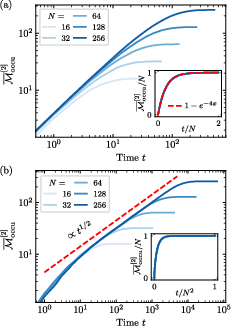
Figure 2: Time evolution of the averaged occupation number entropy rj4 in various random circuit scenarios, showing scaling and saturation rates.
- Bond-Modulated XXZ Model: Across phase transitions, rj5 and rj6 densities show kinks and variation in subleading corrections, serving as diagnostics for critical behavior and distinguishing trivial, SPT, and critical phases.
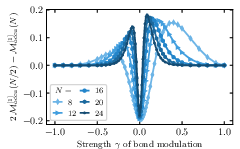
Figure 3: The subleading term of the occupation number entropy in the bond-modulated XXZ model evidences exponential convergence in gapped phases and distinct critical behavior at the transition.
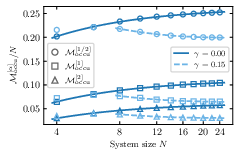
Figure 4: Convergence of the occupation number entropy density rj7 with system size for various interaction regimes, supporting analytic expectations for finite-size scaling.
Theoretical and Practical Implications
- Resource Estimation: The introduced measures enable the quantitative analysis of FNG as a resource for universal computation, bridging Gaussian matchgate circuits to systems requiring magic state injection and gate synthesis complexity.
- Classical Simulability: Since rj8 effectively upper bounds the minimal number of FGSs needed for a given accuracy, it positions the natural-orbital basis as a benchmark for basis optimization and truncation in variational algorithms, quantum chemistry, and many-body simulation.
- Complexity and Quantum Phase Diagnostics: The extensive scaling and critical-point singularities in these measures link quantum complexity notions to condensed-matter transitions and quantum information resource frameworks.
- Mixing, Robustness, and Experimental Relevance: rj9 has Lipschitz continuity with respect to trace distance, facilitating robust experimental assessment under noise and finite sampling. Single-copy measurement protocols require only polynomial overhead.
Prospects for Further Investigation
- Mixed-State Extensions: The existence of efficiently computable mixed-state monotones in the full convex theory remains open, but practical witnesses based on covariance matrices may be constructed, leveraging recently proposed approaches for nonstabilizerness.
- Operator and Heisenberg Formulation: Extending non-Gaussianity to operators may connect to recent advances in operator entanglement and nonstabilizerness, potentially unifying resource-based complexity measures in the Heisenberg picture.
- Basis Optimization: Characterizing when the natural-orbital basis achieves or approximates the minimal participation entropy—especially in large, correlated systems—links directly to DMRG, coupled-cluster, and quantum chemistry methods.
- Long-Range Resource Structure: As with recent works on long-range stabilizer and nonstabilizer resources, analogous classifications for FNG in terms of circuit depth and topological encoding are an open field.
Conclusion
This work achieves a unification of computability, operational relevance, and resource theory for fermionic non-Gaussianity. By leveraging the structure of the covariance matrix and its Williamson normal form, the authors introduce measures that are not only theoretically grounded as monotones under Gaussian protocols but also amenable to efficient computation in practical many-body settings. These results supply the field with essential tools for benchmarking, simulating, and understanding the resource content of fermionic quantum systems across condensed-matter physics, quantum information, and quantum chemistry.