- The paper presents a unified review of VLA models mapping visual input and language to structured actions for both bimanual manipulation and aerial robotics.
- It details four architectural paradigms—autoregressive, diffusion-based, flow matching, and hybrid models—showing flow matching as superior for low-latency, high-dimensional control.
- The review emphasizes the use of action chunking and cross-embodiment pretraining combined with RL-based fine-tuning to improve real-world robustness and generalization.
Vision–Language–Action Models for Bimanual and Aerial Robotics: A Comprehensive Technical Review
Introduction and Scope
This review systematically analyzes Vision–Language–Action (VLA) models as a unified paradigm for highly generalizable, semantics-aware robotic control across two demanding domains: bimanual manipulation and unmanned aerial robotics. The paper formalizes the VLA policy as mapping between camera images, natural-language instructions, and proprioception to structured action outputs. It surveys 183 works from 2017–2026, covering architectural taxonomies, model design, training protocols, action representations, cross-modal coordination, and emerging research trajectories. The review is technically anchored in the thesis that both domains—precisely coordinated multi-arm manipulation and tightly-coupled aerial navigation/manipulation—share core computational bottlenecks addressable by advances in VLA modeling, action chunking, and cross-modal generalization.
VLA Architectures and Action Generation
The analysis provides a structured taxonomy of VLA policies, identifying four main actionable families:
- Autoregressive models: Adapt VLMs with discretized action token heads. While directly leveraging LLM pretraining, they suffer from cumulative quantization bottlenecks and sequential decoding latency, particularly deleterious for high-DOF bimanual systems.
- Diffusion-based models: Generate continuous actions via iterative denoising, capturing multimodal action distributions critical for complex manipulations, but introduce prohibitive inference latency at scale (typically K=50–$100$ denoising steps).
- Flow matching models: Utilize continuous normalizing flows (notably π0) to transform noise into smooth action chunks, supporting high-frequency (50–100 Hz) and high-dimensional (e.g., H=50 steps, da=16 for dual-arm) joint-space predictions with substantially reduced latency compared to diffusion models.
- Hybrid designs: Integrate discrete and continuous action heads, routing categorical and continuous actions through multi-headed architectures, shown to outperform homogeneous models on mixed-mode tasks.
The review emphasizes that flow matching has emerged as superior for high-dimensional, high-correlation bimanual and aerial manipulation—enabling smooth generation and coordination beyond the reach of older autoregressive and vanilla diffusion heads.
Action Representations and Control Frequency
A central insight is the universal adoption of action chunking: instead of single-step control, VLAs predict sequences of actions as "chunks," amortizing VLM inference and preserving temporal coherence. Flow and diffusion models leverage this via denoising/flow processes, producing open-loop plans with increased robustness. Modern VLAs favor chunk horizons of H=50–$100$, corresponding to 1–2s of motion at 50 Hz, capturing entire manipulation primitives or flight maneuvers.
Models like FAST introduce learned action tokenization using VQ-VAE, compressing high-dimensional chunks into compact token sequences, mitigating the combinatorial explosion of naively discretized action spaces. Bidirectional decoding extends action chunking, supporting tasks where intermediate trajectories are underconstrained.
Bimanual Manipulation: Coordination, Data, and Training
Bimanual tasks—folding, assembly, handovers—are used as a demanding testbed for VLA coordination and generalization. Three coordination strategies are delineated: joint action spaces (for highly coupled moves), hierarchical decomposition (separating roles for each arm or subtask), and leader–follower paradigms (for asymmetric tasks). The review reports that joint action space modeling via flow matching is uniquely effective for tightly coupled tasks; autoregressive models either fail to learn nontrivial synchrony or suffer from inference-scale-up issues.
Data availability and diversity are crucial. The review discusses cross-embodiment pretraining (OXE, DROID) as foundational, but highlights that task-specific fine-tuning or RL from autonomous practice (RECAP) is required for state-of-the-art results. For example, π0∗ achieves 10–40% higher success rates over pure imitation (2607.06706). Data collection throughput is bottlenecked by teleoperation hardware (ALOHA, UMI), leading to the adoption of hybrid human demonstration and autonomous self-practice loops.
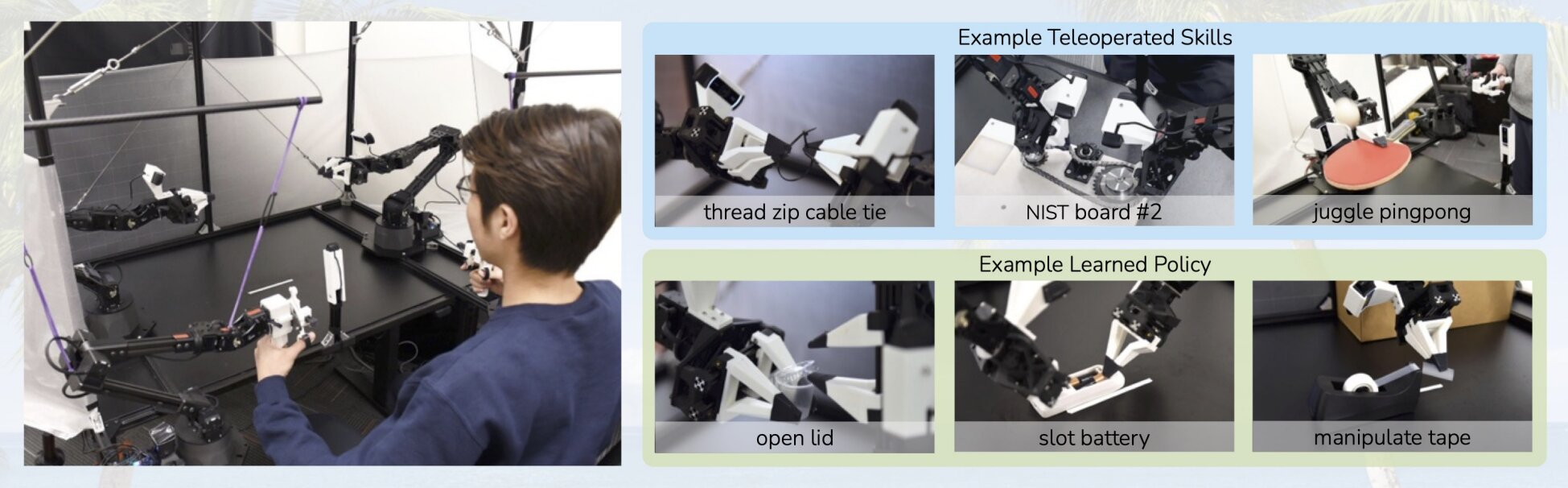
Figure 2: The ALOHA bimanual teleoperation platform for data collection underpinning progress in bimanual VLA models.
Performance on contact-rich, deformable, and long-horizon tasks has surpassed 90% using flow-based VLAs, with hierarchical models and memory augmentation providing robust multi-minute execution in open-world settings.
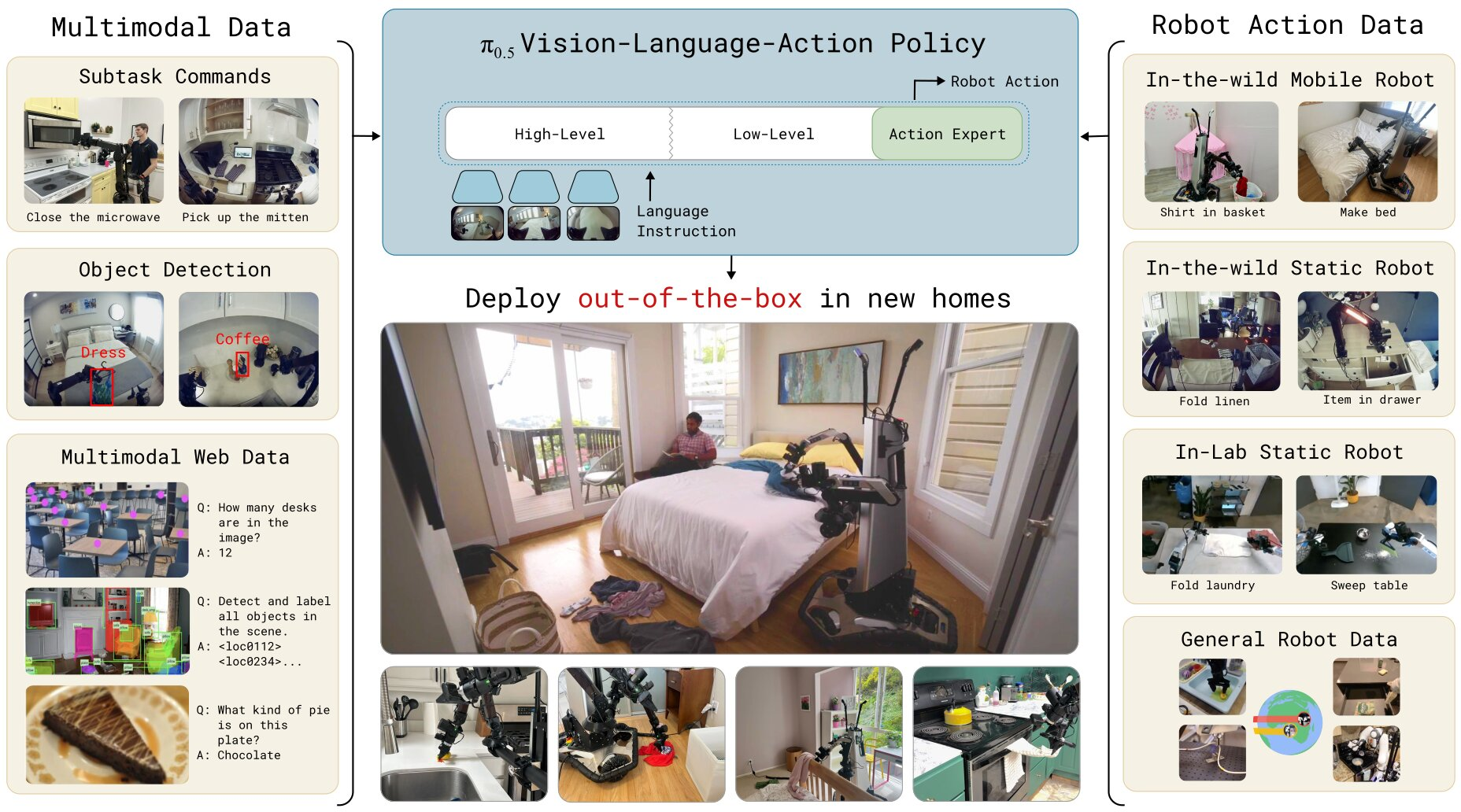
Figure 4: Real-world deployment of π0.5 in unstructured home environments, using hierarchical VLA decomposition for open-vocabulary tasks.
Aerial Robotics: Language-Guided Flight and Manipulation
The review documents the architectural and methodological transfer from manipulation to drones: chunked, continuous action generation for flight control, language grounding for navigation and inspection, and flow/diffusion heads for generating smooth, stable trajectories under tight latency constraints (100 Hz).
Notably, fully actuated aerial manipulators with onboard arms (e.g., Flying Hand) leverage the same ACT-based chunked policy learned for bimanual systems, confirming codebase and action-space transferability.
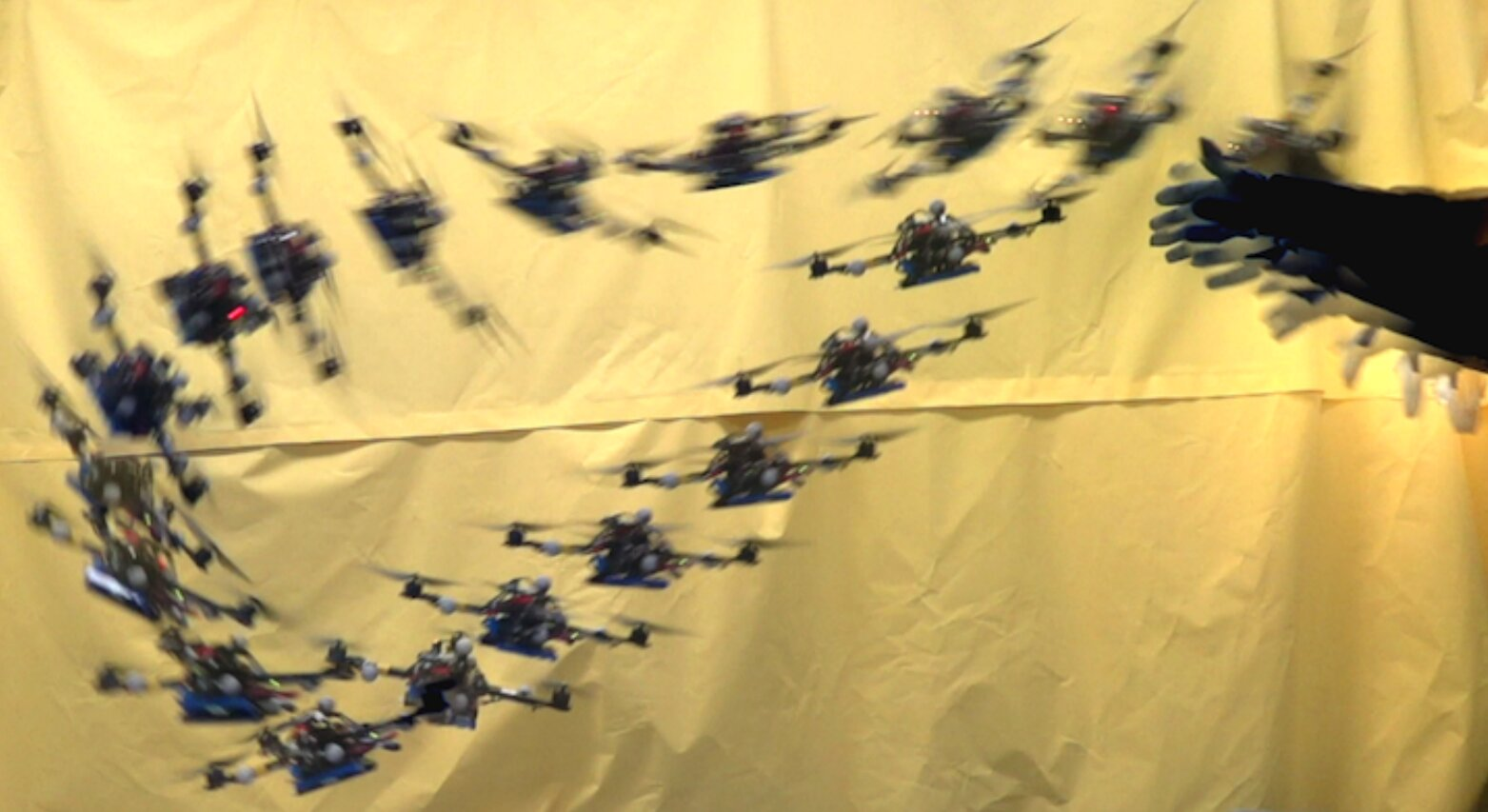
Figure 6: RL-trained quadrotor policy enabling recovery from aggressive disturbances, exhibiting real-time inference rates suitable for physical deployment.
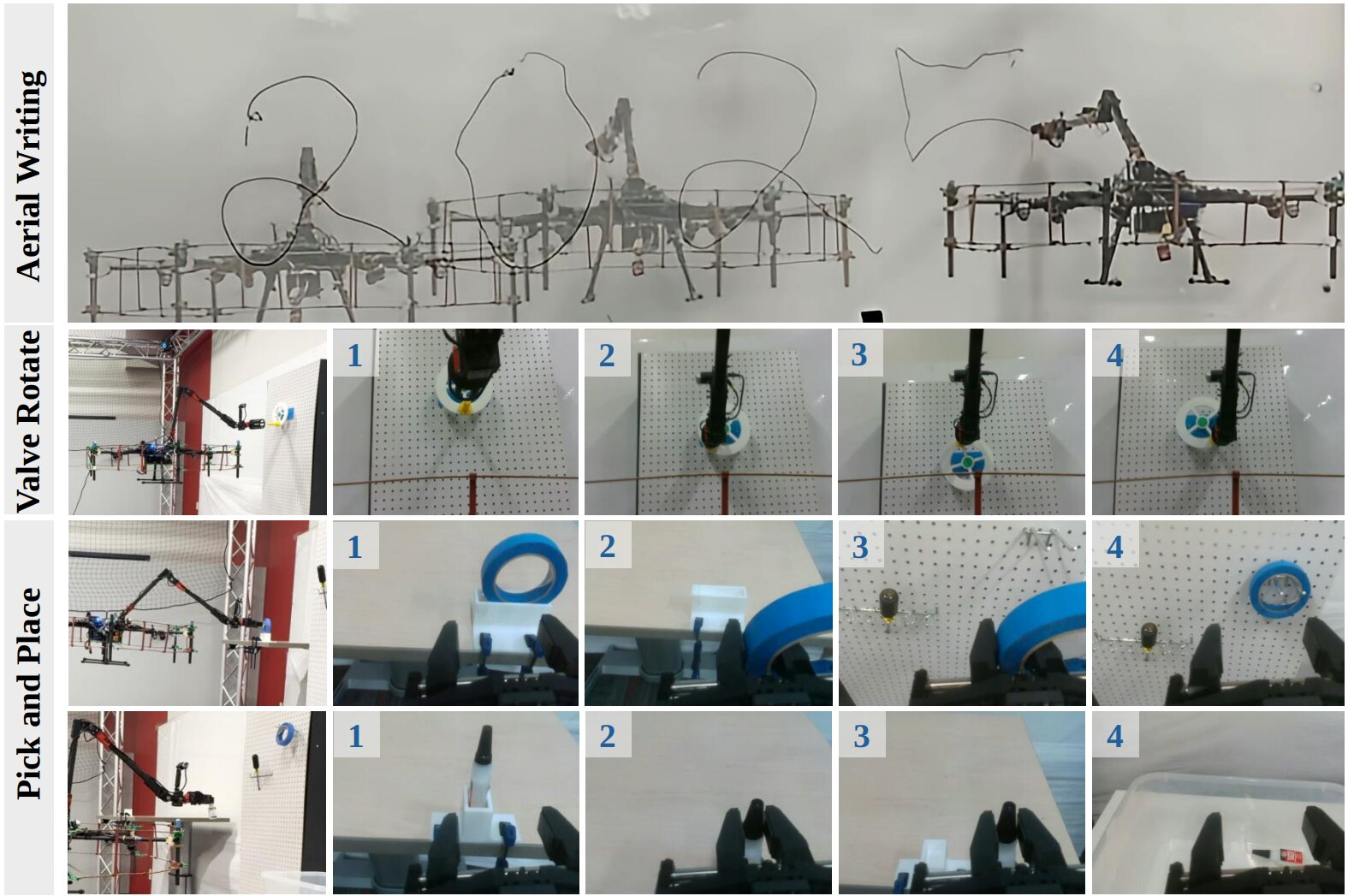
Figure 1: Flying Hand hexarotor performing manipulation tasks with a 4-DOF arm, demonstrating direct transfer of action chunking methods from bimanual to aerial robotic systems.
Language-conditioned navigation (AerialVLN, UAV-VLA) applies VLMs to map visual and semantic observations to waypoints and flight plans. End-to-end VLAs for drones (CognitiveDrone, DroneVLA, AIR-VLA) are emerging, and the review underscores their reliance on continuous, chunked action generation for viable real-world performance.
Training Protocols and Data Strategy
The review asserts that training dynamics are as decisive as architectural innovations. The default pipeline involves: (1) VLM pretraining on web-scale data; (2) cross-embodiment pretraining on diverse multi-task robot datasets; (3) fine-tuning on target embodiment/task; (4) optional RL-based autonomous practice (RECAP/RAMP). Co-training and data mixing mitigate catastrophic forgetting and enhance generalization. Memory and world-model-augmented VLAs enable lookahead planning, retrospective correction, and improved data efficiency for long-horizon tasks.
Autonomous data collection in the RECAP framework is highlighted as the critical technique for pushing performance beyond demonstration quality in both bimanual and aerial domains.
Generalization, Language Grounding, and Industrialization
A particular focus is the interplay of vision, language, and embodiment generalization. Cross-embodiment transfer, supported by universal action tokenization and VLM pretraining, enables few-shot deployment on new hardware morphologies. Hierarchical architectures (Hi Robot, π0.5) demonstrate open-ended instruction following, robust error correction, and environment generalization.
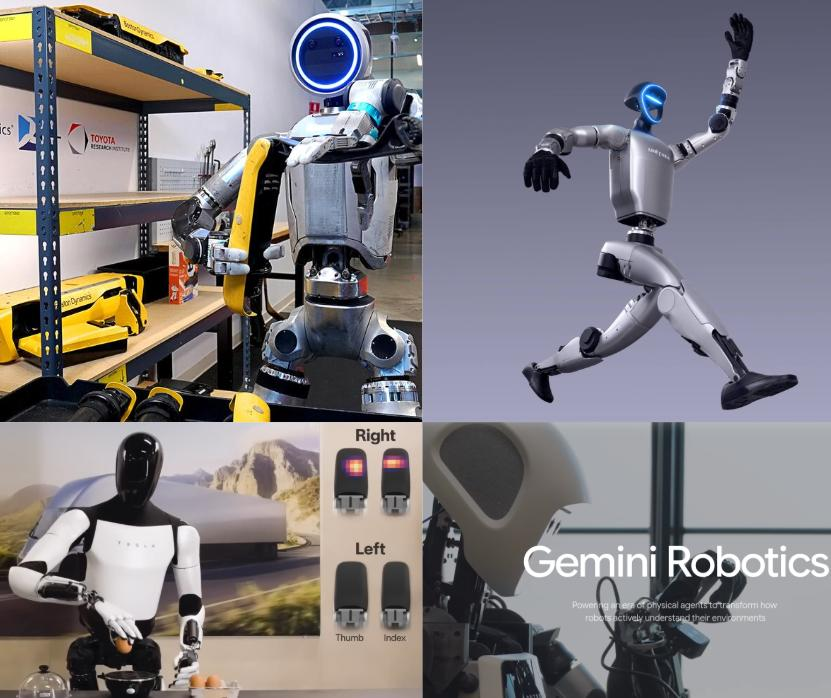
Figure 3: Examples of industrial VLA-powered humanoid robots, including systems by Boston Dynamics and Google DeepMind integrating advanced VLMs for dexterous manipulation.
The review details the industry convergence on dual-system designs: a slow, cloud-based reasoning module for semantics and planning, and a fast, local action decoder for low-latency continuous control. Continuous self-improvement pipelines and video-as-action world models are established as the state-of-the-art in production deployments.
Open Challenges and Future Directions
Fourteen explicit research directions are articulated, including:
- Standardized benchmarks for bimanual tasks
- Force-aware, dexterous, and multimodal sensing integration
- Real-time model compression and hardware–software co-design for low-latency execution
- Data efficiency and sim-to-real alignment for bimanual contact and deformable manipulation
- Compositional skill libraries and open-ended memory
- Interpretable, safety-certified architectures for human-proximate and collaborative contexts
- End-to-end VLA policies for drone control with multi-agent and cross-modal extension
Conclusion
The review substantiates that VLA systems have become the dominant computational and systems paradigm for both bimanual manipulation and aerial robotics, driven by architectural advances in continuous, chunked action generation, and strategic exploitation of cross-modal data. Flow-matching action heads, hierarchical reasoning, memory integration, and RL-based continual improvement define current technical best practices. The synthesis of these developments across embodied domains points toward increasing policy generality, real-world robustness, and scalable deployment, but full realization requires addressing benchmarking, safety, efficiency, and sim-to-real transfer challenges.
The framework outlined in this review is likely to inform the next phase of development in robotics foundation models, with implications for distributed fleets, multi-modal embodied intelligence, and autonomous production systems.