The Illusion of Robustness: Aggregate Accuracy Hides Prediction Flips under Task-Irrelevant Context
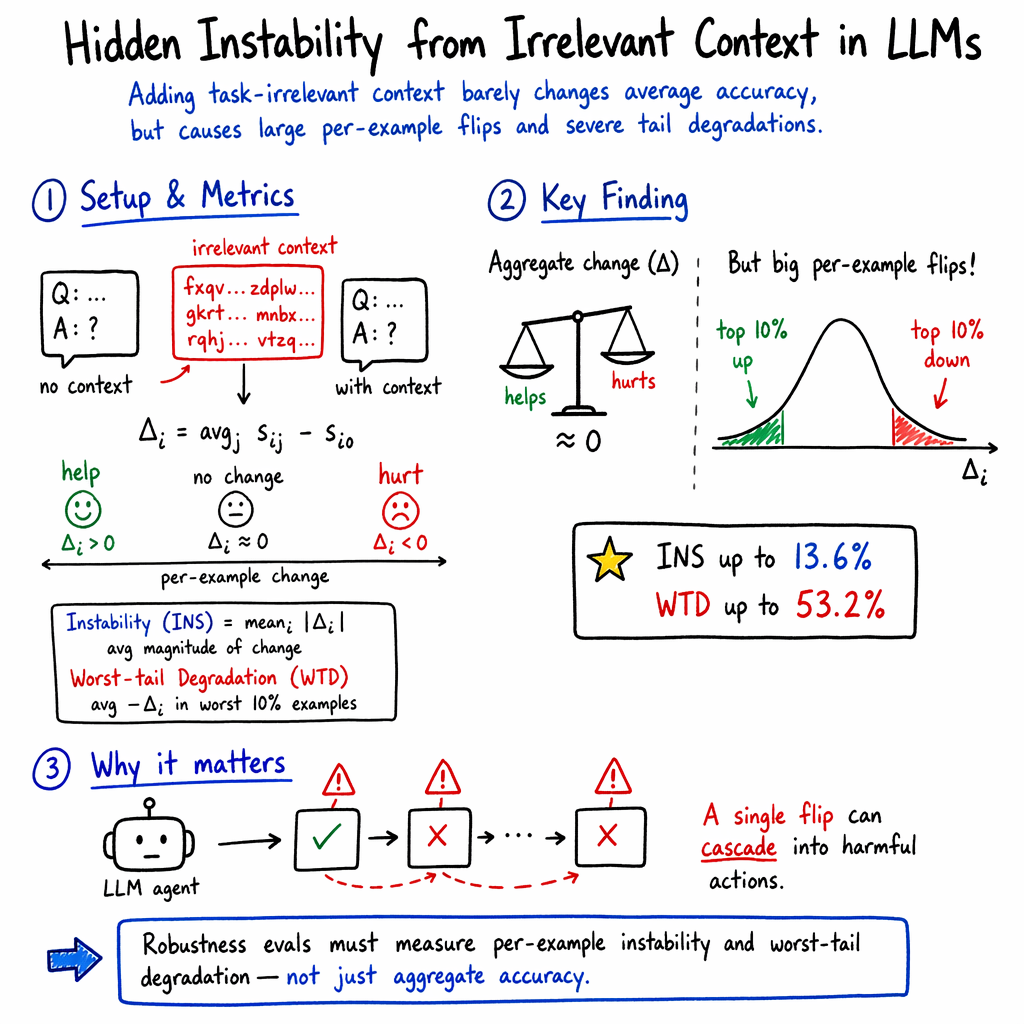
Abstract: As LLMs grow more capable, they are increasingly deployed in context-rich settings where task inputs are often accompanied by long, partially irrelevant context. In a controlled setting, we find that state-of-the-art models often appear robust to task-irrelevant context at the aggregate level: prepending it to benchmark questions causes little change in overall accuracy. This aggregate stability, however, masks significant per-example instability. Even semantically meaningless pseudo-words, formed by randomly combining characters, can markedly shift model predictions on a small fraction of examples, degrading performance on some while improving it on others. This two-sided effect holds consistently across a wide range of models and datasets, yet the affected examples are largely model-specific. We further show that this instability is modulated by context type, context length, test-time compute, and model development stage. Together, our findings reveal context-induced tail risks concealed by aggregate accuracy, motivating per-example reliability evaluation of LLMs.



Paper Prompts
Sign up for free to create and run prompts on this paper using GPT-5.
Top Community Prompts
Explain it Like I'm 14
A simple explanation of “The Illusion of Robustness: Aggregate Accuracy Hides Prediction Flips under Task-Irrelevant Context”
1) What is this paper about?
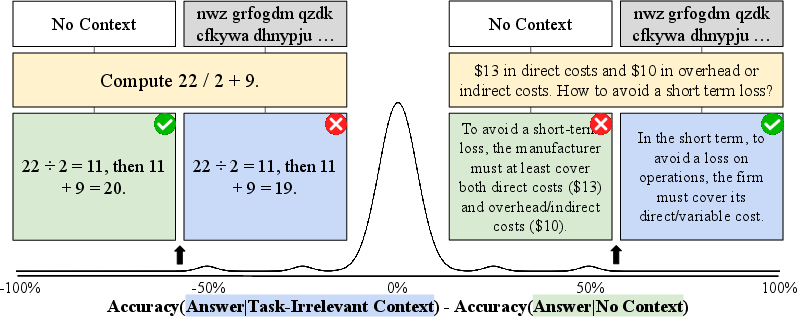
This paper looks at how LLMs—like the AIs that answer questions or write text—behave when you give them extra information that doesn’t matter for the task. Think of it like asking a quiz question, but first stuffing the page with lots of unrelated words or chatter. The big surprise: even when the model’s overall score on a test barely changes, its answer on many individual questions can flip—from right to wrong or wrong to right—just because of the extra, irrelevant stuff.
2) What are the main questions the paper asks?
The authors ask:
- If we add irrelevant text before a question, do LLMs change their answers?
- Do these changes cancel out on average, hiding big swings on specific questions?
- Which questions get affected, and is the effect the same across different models?
- Does the length or type of extra text matter?
- Can using more “thinking” steps at test time reduce the problem?
- How does this sensitivity change as models are trained and improved?
3) How did the researchers test this?
They used a simple, controlled setup so we can “see” only the effect of irrelevant context.
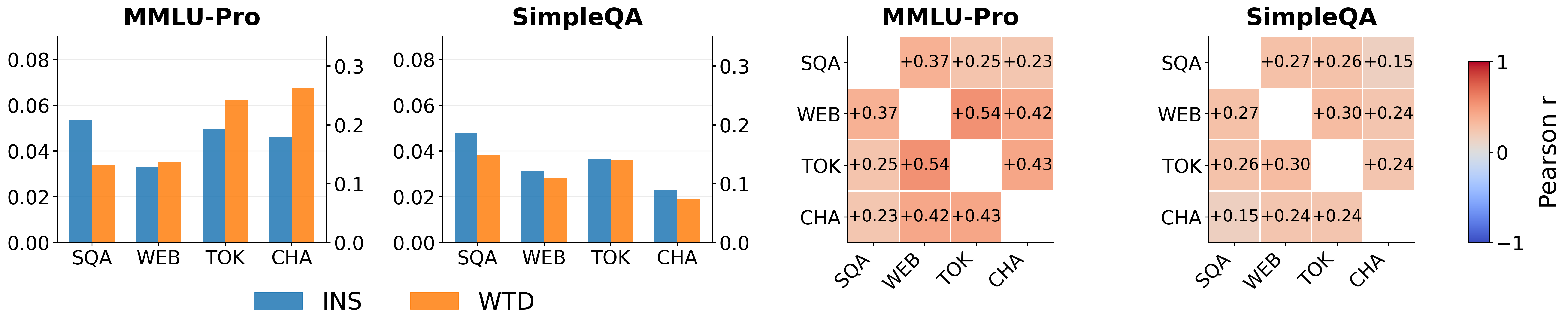
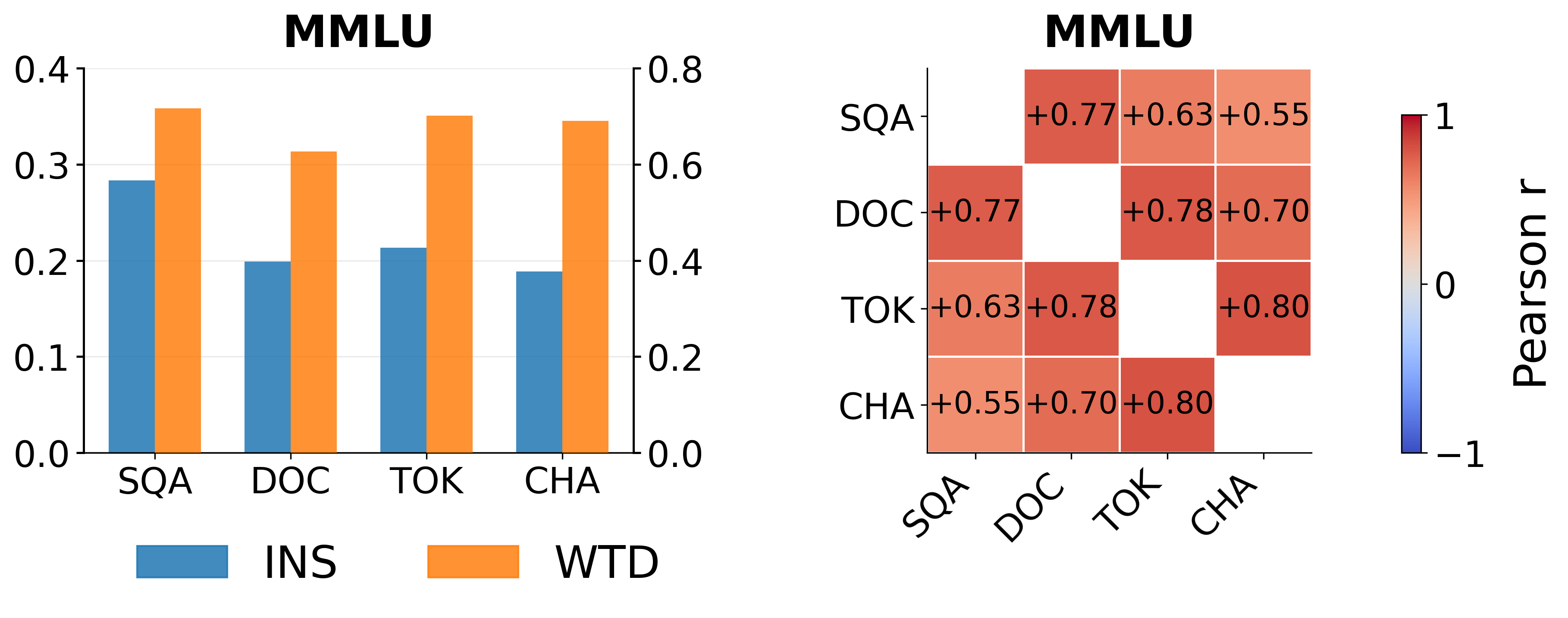
- Task-irrelevant context: They created long strings of “pseudo-words”—gibberish that looks like words but doesn’t mean anything (like “nuvio raltap fexdan…”). This avoids accidentally adding real facts. They also tried more realistic irrelevant content, like random webpages, random tokens, or a log of past Q&A turns unrelated to the current question.
- Benchmarks and models: They tested many strong LLMs on several question-answer datasets covering different topics and formats (multiple choice and open-ended): MMLU-Pro, GPQA, Humanity’s Last Exam, and SimpleQA.
- Repeated trials: Because models can vary from run to run, they answered each question many times with and without the extra context. This helps estimate how often the model would be correct in each condition.
- Noise correction: Even with repeats, randomness creates “noise.” They used a bootstrapping trick (a way to simulate many fake experiments from the original data) to estimate and subtract noise, making sure any measured effect is real and not just bad luck.
- Two simple metrics:
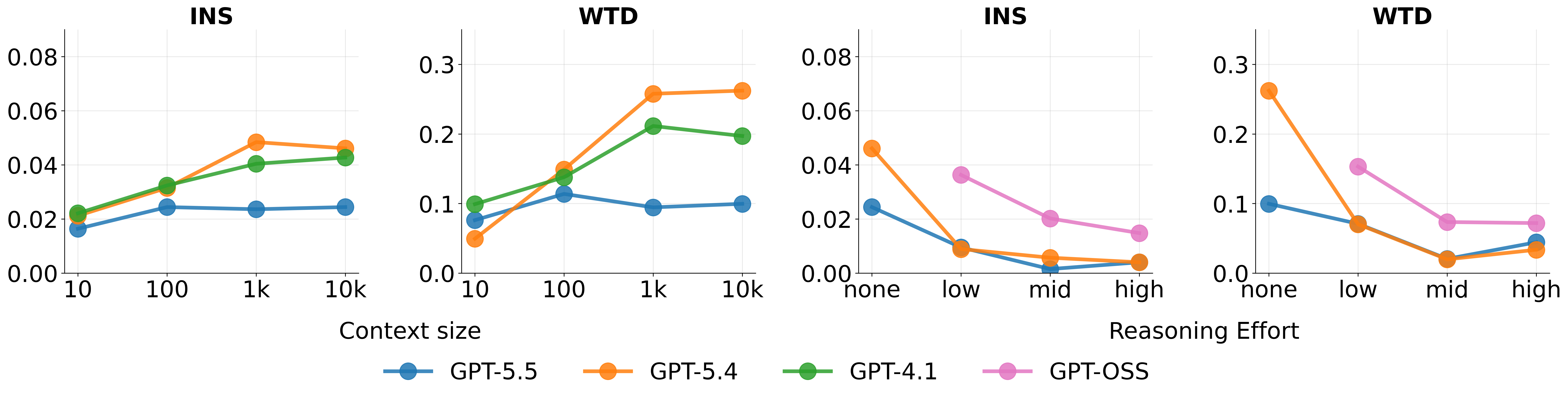
- Instability (INS): On average, how much does each question’s performance change when you add irrelevant context—no matter if it gets better or worse? Higher means more sensitive.
- Worst-tail Degradation (WTD): Among the worst-hit slice of questions (e.g., the worst 10%), how big is the average drop? This focuses on “tail risk”—the few cases where things go really wrong.
An everyday analogy: Think of a class taking a test. The class average may stay the same, but some students suddenly do much worse and others do much better when there’s a lot of distracting noise in the room. INS tells you how much individual scores swing on average; WTD tells you how bad it gets for the students who were hit hardest by the noise.
4) What did they find, and why is it important?
Here are the key results explained in plain language:
- The average looks fine, but individual questions flip a lot.
- Overall accuracy barely moves when irrelevant text is added (often within about 1–2%). That looks “robust.”
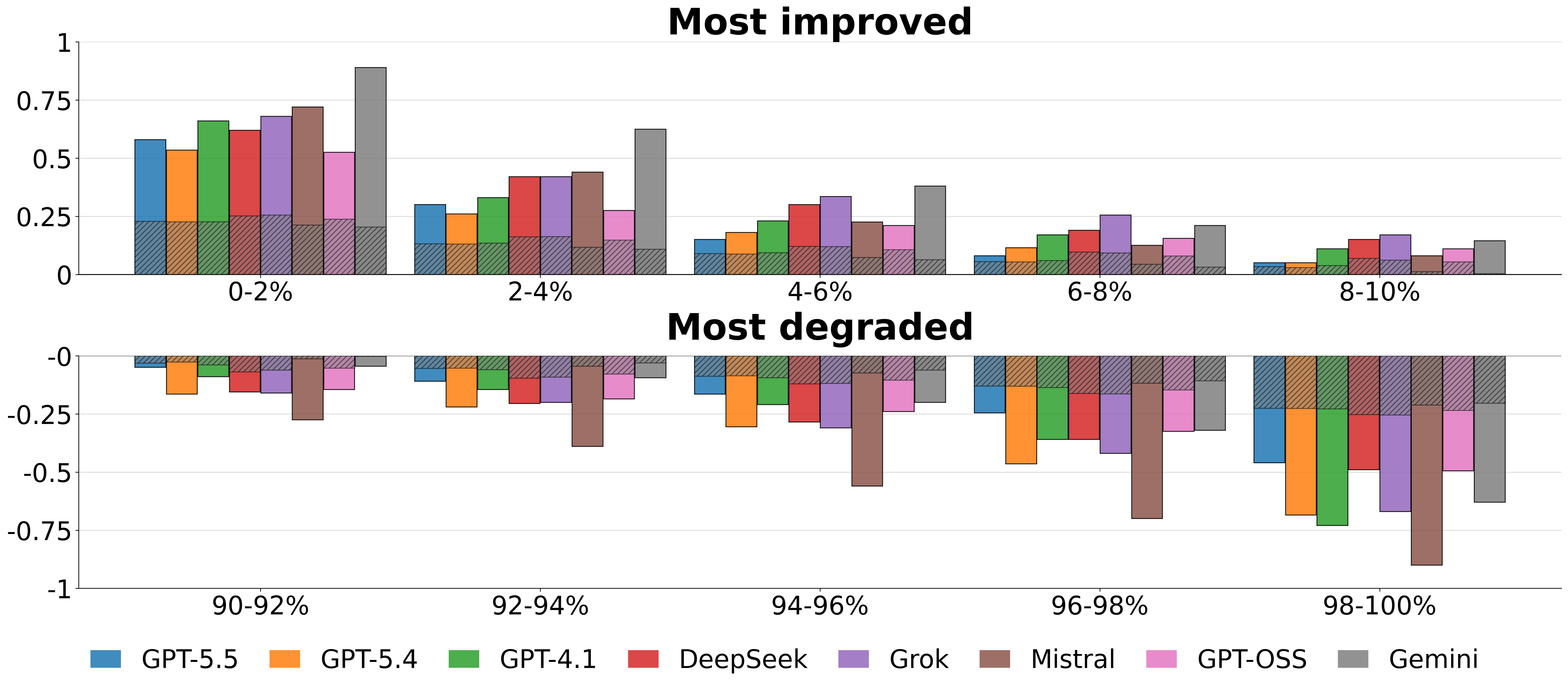
- But that stability is an illusion: many single questions change dramatically—some answers improve, others get worse.
- INS (instability) can be as high as 13.6%. In the worst 10% of cases, WTD shows average drops up to 53.2%. That’s huge.
- Even nonsense can throw models off.
- Gibberish pseudo-words—strings with no meaning—still cause flips. So it’s not about the model being “distracted” by meaningful facts; seemingly meaningless text can still push it around.
- Effects are two-sided and model-specific.
- The same irrelevant context makes some questions easier and others harder. These gains and losses cancel out in the average.
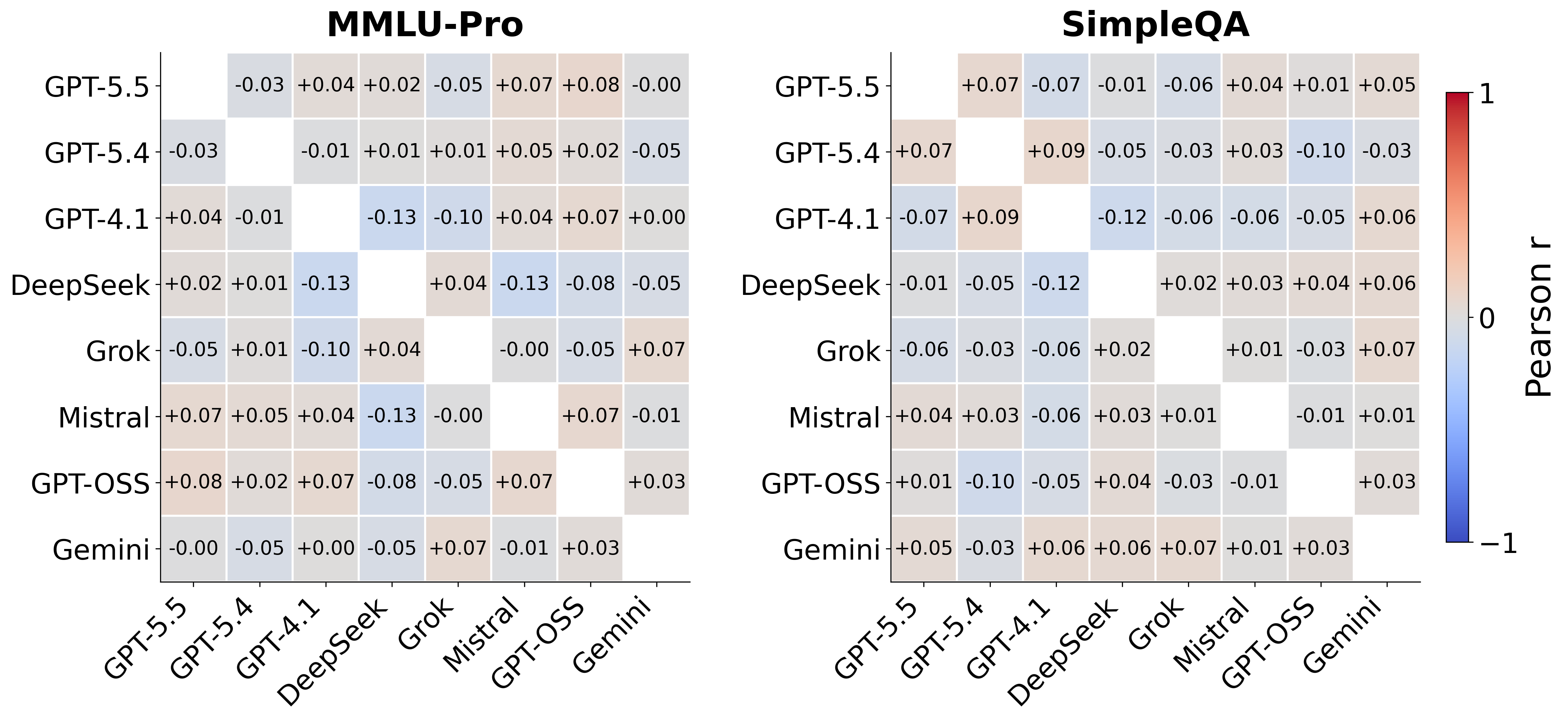
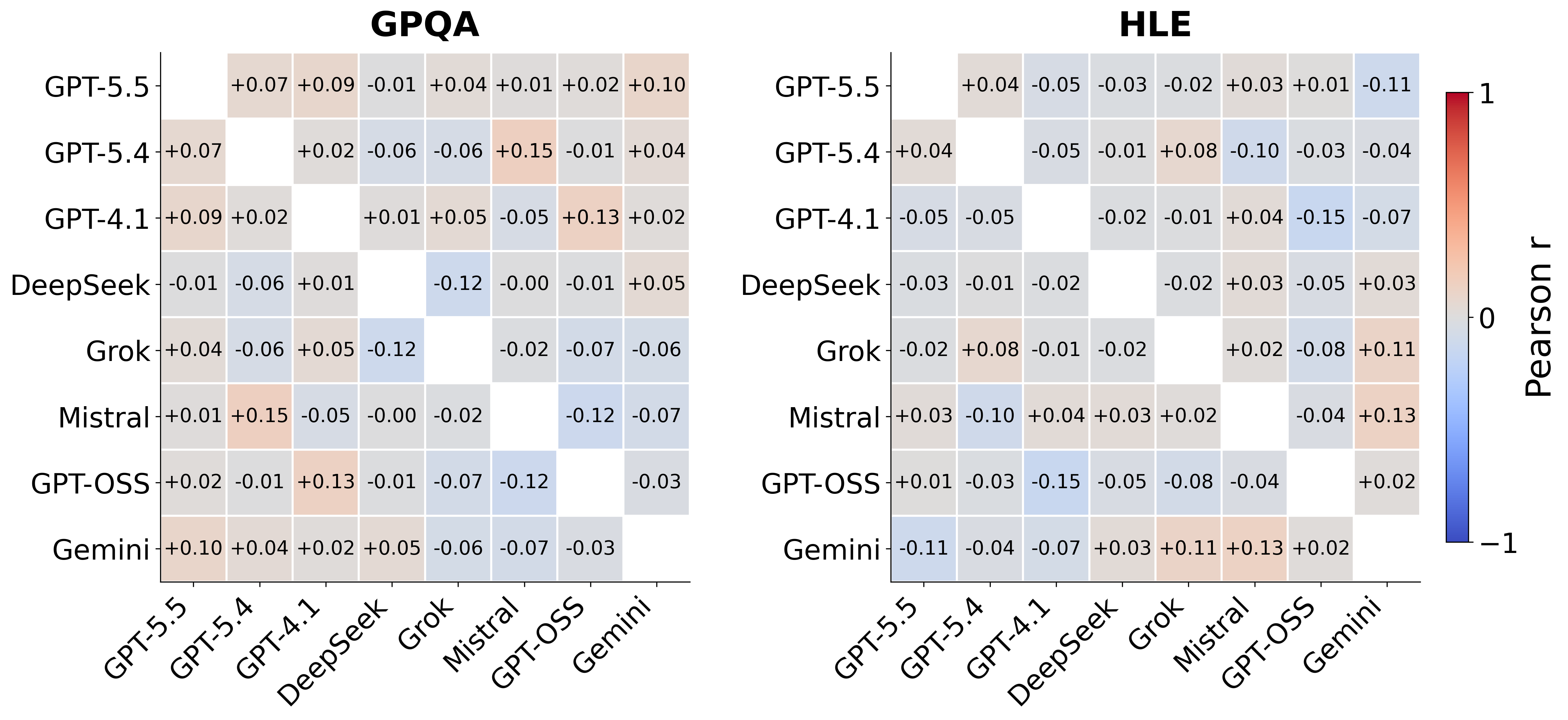
- Different models get tripped up on different questions. The per-question shifts barely line up across models. So you can’t predict which questions will fail just by looking at the dataset; it depends on the specific model.
- More irrelevant text usually means more instability.
- Even very short irrelevant text (as little as 10 tokens) can cause flips.
- Longer irrelevant context tends to increase instability, though it can level off for some models.
- Using more “thinking” at test time helps, but doesn’t fix it.
- When models are prompted to reason more or use chain-of-thought, instability and worst-tail drops go down—but not to zero. Some severe failures remain, especially on fact-heavy tasks.
- Training more doesn’t automatically make this better.
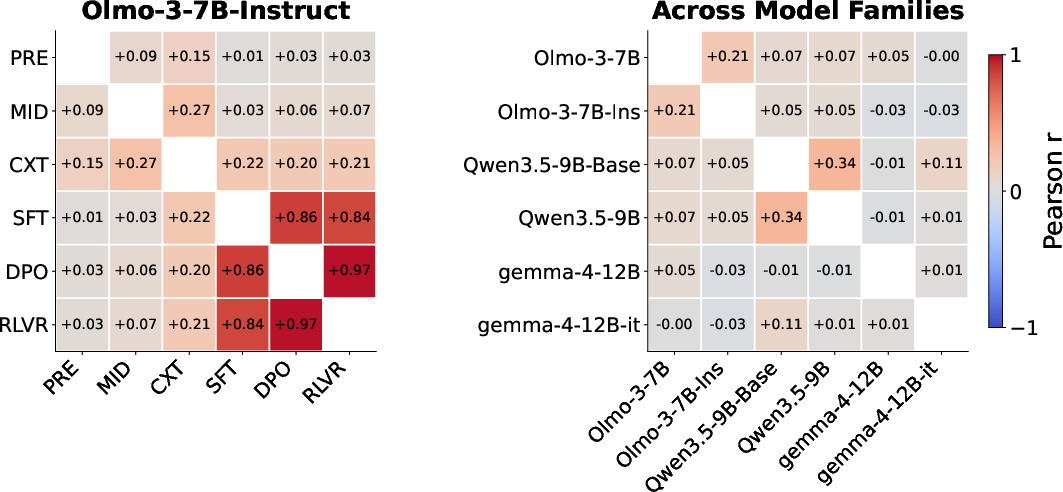
- As models progress through different training stages, their base accuracy often improves, but instability can also rise—especially after certain post-training steps meant to improve helpfulness or preference alignment.
- Changing the mix of training data matters too. Some training mixtures increased instability more than others.
- Which questions are vulnerable?
- The paper checked whether question “ambiguity” predicts flips: it doesn’t.
- The model’s own uncertainty (before adding context) does predict the size of change somewhat: questions the model is unsure about are more likely to swing a lot. But this doesn’t tell you whether the swing will be up or down.
Why this matters: In real systems—like coding assistants, web-browsing agents, or software that operates computers—small changes in one step can cause bad downstream decisions. If irrelevant context can flip answers unpredictably, there’s a hidden reliability risk that the average score hides.
5) What’s the take-away and what could this change?
- Don’t trust only the average. A model that keeps the same overall score might still be unstable on specific questions. For safety, we should measure per-question instability and worst-case drops, not just overall accuracy.
- Improve evaluation: The authors recommend using metrics like INS and WTD during model development to catch these hidden risks.
- Practical tips:
- Keep unnecessary context short where possible.
- When stakes are high, use more test-time reasoning to reduce flips.
- Monitor uncertainty: questions the model is unsure about are more likely to be unstable.
- Research directions:
- Find training methods and data choices that reduce this instability.
- Better understand the mechanics inside the model that make irrelevant context sway answers.
- Build agents that can avoid or filter distracting context, and that can detect when they might be at risk of a flip.
In short: The paper shows that “looks fine on average” can hide dangerous swings underneath. By measuring and addressing per-question instability, we can make AI systems more reliable in the messy, context-heavy situations they face in the real world.
Knowledge Gaps
Knowledge gaps, limitations, and open questions
Below is a concise list of what remains missing, uncertain, or unexplored in the paper, formulated to guide follow-up research:
- Decoding regime sensitivity: Do instability and tail risks persist under deterministic decoding (temperature 0/greedy) and alternative sampling schemes (nucleus/top-k, beam search), and how do they scale with temperature?
- Grader robustness for open-ended tasks: To what extent do LLM-based graders (a single small grader model) introduce or amplify apparent flips? Validate with multiple independent graders and human annotation, and quantify grader-context interactions.
- Placement and formatting effects: How do results change when irrelevant context is appended (postfix), interleaved, placed as system/tool/developer messages, or strictly delimited/quoted vs “free text”? Is there a position effect (begin/middle/end) in long contexts?
- “Ignore this” mitigations: Can explicit meta-instructions (e.g., “Ignore the preceding text; it is irrelevant to the task”) reduce INS/WTD reliably, and does effectiveness depend on wording, repetition, or placement?
- Tokenization and script dependence: Are pseudo-word effects robust across tokenizers and scripts (non-Latin alphabets, mixed scripts, numerals, emoji, punctuation-only, whitespace patterns)? Does tokenizer mismatch between context generation and target model matter?
- Broader task coverage: Do the phenomena generalize beyond QA to code generation, long-form reasoning/summarization, program repair, tool-augmented tasks, and multimodal inputs (images/screenshots)?
- Retrieval-augmented and agent settings: How do per-step flips compound in multi-step tool-use/browsing agents, and what is the end-to-end failure rate under realistic noisy retrieval logs or GUI interaction histories?
- Worst-case vs random context: What are the limits under adversarially optimized irrelevant contexts (red-teaming/search) compared to random fillers, and how do worst-case tail metrics (e.g., CVaR) behave?
- Mechanistic causes: What internal circuits (attention heads, copying/entrainment pathways) mediate flips when there is no lexical overlap? Use activation patching, attention ablations, and causal tracing to identify mechanisms and intervention points.
- Predictive signals of instability: Beyond baseline uncertainty, can we build directionally predictive indicators (e.g., logit margins, representation drift, gradient w.r.t. context, self-consistency variance) to forecast when and how a prediction will flip?
- Training-time mitigation: Which objectives (contrastive “invariance to irrelevant context,” auxiliary losses penalizing sensitivity, token-dropout, sparse attention gating) reliably reduce INS/WTD without harming accuracy?
- Post-training effects: The observed increase in instability after SFT/DPO is correlational—what causal elements (data curation, reward models, preference distributions) drive it? Controlled ablations are needed.
- Data mixture design: How do precise mixtures (e.g., code/math vs generative/QA proportions) causally affect INS/WTD? Move from observational comparisons to controlled, matched-mixture experiments.
- Reasoning tokens vs true robustness: Why does added reasoning reduce but not eliminate WTD, and why is mitigation non-monotonic with more reasoning? What reasoning strategies (scratchpads, structured solvers) work best and when do they fail?
- Context length scaling laws: What causes saturation points in WTD vs length and why do they differ by model? Is saturation tied to attention budgets, focus mechanisms, or emergent compression heuristics?
- K-sensitivity and metric design: How sensitive are conclusions to the tail fraction K in WTD, and are alternative tail-risk metrics (e.g., CVaR, quantile losses, selective risk) more stable or actionable?
- Measurement efficiency: Can we develop low-cost estimators for INS/WTD (e.g., importance sampling, adaptive sampling per example, variance-reduction schemes) that retain reliability while reducing API calls?
- Cross-model generalization: Why are affected examples model-specific with near-zero cross-model correlation? Are there family-level regularities (architecture, scale, tokenizer, training corpora) that predict overlap?
- Role of calibration and abstention: How does irrelevant context affect probability calibration, selective prediction, and abstention policies? Can calibrated rejection meaningfully reduce WTD at fixed coverage?
- Boundary conditions for “irrelevance”: What happens with partially relevant, semantically related, or stylistically similar context that is not directly evidential? Map the gradient from irrelevant to weakly relevant.
- Interaction with instruction hierarchies: Do different chat schemas (system/developer/user roles) or stronger system prompts reduce flips? Are there robust prompt templates that fence off context effects?
- Stability across runs and versions: How reproducible are INS/WTD across seeds, days, and API/model revisions? Quantify temporal drift and confidence intervals for operational monitoring.
- Safety and non-accuracy risks: Do irrelevant contexts also shift safety behaviors (e.g., jailbreak susceptibility, toxicity, leakage) even when accuracy aggregates appear stable?
- Dataset breadth and scale: The study uses ≤500 examples per dataset—do results hold on full benchmarks and across additional domains/skills? Assess small-sample bias and variance in tail metrics.
- Context–grader coupling: Does adding irrelevant context change the grader’s interpretation of answers (e.g., by length or style bias), thereby confounding measured flips? Test with stripped-answer grading and reference-based metrics where possible.
Practical Applications
Immediate Applications
Below are deployable use cases that leverage the paper’s findings and metrics (INS and WTD) to reduce hidden, per-example instability caused by task‑irrelevant context.
- Context robustness testing in evaluation pipelines (software, AI/ML, academia)
- What: Add a “Context Perturbation” stage to CI/benchmark harnesses that prepends pseudo-words and other irrelevant contexts (random tokens, webpages, unrelated Q&A) to compute INS and WTD for each model+prompt+task.
- Tools/products:
- A test harness that automates repeated sampling, noise-floor correction, and per-example tail analysis.
- A “noise-adjusted instability” metrics library implementing INS/WTD and bootstrap correction.
- Dependencies/assumptions: Requires repeated sampling per example (cost/latency), access to a grader and ground truth labels; results are model-specific—must be run per model and prompt.
- Model selection and procurement with tail-risk clauses (industry, policy, academia)
- What: Compare vendors/models using INS/WTD alongside top‑line accuracy; include thresholds in RFPs and model cards; require reporting of INS/WTD on representative tasks.
- Tools/products: Standardized “context robustness” sections in model cards and evaluation reports.
- Dependencies/assumptions: Agreement on test datasets/contexts; reproducibility across API versions; some sectors need legal/standards alignment.
- Agent safeguards: flip tests before taking irreversible actions (software agents, robotics/RPA, finance ops, healthcare IT)
- What: Before execution, re-run critical steps with several irrelevant-context variants; if outputs disagree or degrade, trigger:
- Escalation to human review
- Increased test-time reasoning (more tokens, CoT)
- Context pruning (see below)
- Tools/workflows: “Stability check” node in agent graphs; action gates that require answer agreement across perturbations.
- Dependencies/assumptions: Extra latency/cost; action must be delay-tolerant; requires deterministic grading or tolerance bands.
- Adaptive compute control based on uncertainty and instability signals (software, healthcare, finance)
- What: If baseline uncertainty is high or a flip is detected, switch to higher reasoning effort (CoT, larger compute) or multi-sample agreement before finalizing answers.
- Tools/workflows: Policy that routes “unstable” queries to high‑reasoning profiles automatically.
- Dependencies/assumptions: Access to uncertainty proxies and reasoning knobs; budget/latency headroom.
- Context management and relevance gating in RAG/memory systems (search, customer support, software dev, healthcare)
- What: Reduce distraction by:
- Aggressive relevance filtering and deduplication before retrieval insertion
- Summarization/ablation of long, irrelevant sections
- Shorter memory windows and periodic “context resets” in chats
- Tools/products: “Context sanitizer” middleware that scores and strips low‑relevance spans; UI affordances to toggle memory off for critical questions.
- Dependencies/assumptions: Relevance models may over-prune; domain tuning needed; context-length trade-offs vary by model.
- Production monitoring for tail risks (software platforms, MLOps)
- What: Track instability proxies in live systems by periodically re‑sampling a small holdout with synthetic irrelevant contexts and watching WTD/INS trends; page on-call when tail degradation grows.
- Tools/products: A “Tail-Risk Monitor” dashboard; drift alerts tied to WTD deltas.
- Dependencies/assumptions: Budget for background re‑sampling; stable grading pipeline; careful privacy controls for live data.
- Task- and sector-specific safeguards
- Healthcare (clinical decision support, scribing):
- Strip boilerplate sections from EHR notes; stability-check before suggesting diagnoses/orders; escalate on instability.
- Finance (compliance, reporting):
- Avoid feeding full email threads/long memos; run agreement checks for regulatory answers; log flip tests for auditability.
- Software engineering (code agents):
- Restrict files/logs to relevant subsets; re‑try patches with trimmed logs; gate commits on stability checks.
- Legal (contract analysis, e‑discovery):
- Isolate the clause being analyzed; re‑ask without chat history; flag answers that flip under context perturbations.
- Education (tutoring):
- Periodically reset chat memory; re‑quiz key answers without accumulated context; highlight when model changes answers.
- Dependencies/assumptions: Domain-specific relevance heuristics; human-in-the-loop capacity for escalations.
- User-facing best practices and UX (daily life, prosumers)
- What: Encourage minimal copy-paste; provide a “clean input” button that strips extraneous content; add a “stability indicator” that shows whether the answer survives a quick perturbation test.
- Tools/products: Browser extensions or app features for context cleanup and one-click stability checks.
- Dependencies/assumptions: Users accept extra latency for higher confidence; perturbation tests should not leak sensitive data.
- Academic workflows and teaching
- What: Include INS/WTD reporting in papers; release per-example instability plots; run ablations across context types/lengths; adopt split-sample estimates to avoid shared-trial noise.
- Tools/products: Open-source evaluation templates; leaderboards that rank by both accuracy and WTD.
- Dependencies/assumptions: Community consensus on protocols; compute to perform repeated sampling.
Long-Term Applications
These applications require additional research, engineering, or standardization to realize fully.
- Training-time robustness to irrelevant context (AI/ML research, industry labs)
- What: Incorporate invariance objectives or regularizers that penalize high INS/WTD across synthetic and naturalistic distractors; adversarial distractor training; curriculum that gradually increases context length and noise.
- Potential products: “Context-Robust” model families with certified low WTD for specified tasks.
- Dependencies/assumptions: Access to training data/internals; careful balance to avoid hurting in-context learning; evaluation standards to certify gains.
- Architecture and memory design for focus (software, robotics, RAG vendors)
- What: Context routers/attention gating that segregate task input from background chatter; explicit “relevance channels”; memory architectures that minimize entrainment to irrelevant tokens.
- Potential products: Long-context encoders with built-in relevance filters; “focus heads” or adapters that suppress distraction.
- Dependencies/assumptions: Significant model modifications; interpretability to avoid degrading recall of relevant facts.
- Mechanistic and data-centric diagnostics (academia, labs)
- What: Identify circuits/heads responsible for distraction; map training data features linked to instability; design probes to predict which examples are flip-prone.
- Potential products: Developer tools that surface per-span “instability influence” scores; dataset audits for distraction risk.
- Dependencies/assumptions: Access to activations/weights; robust causal evaluation; generalization across scales.
- Efficient tail-risk estimation methods (academia, evaluation platforms)
- What: Develop sampling-efficient estimators for INS/WTD (e.g., importance sampling, variance reduction, adaptive selection of examples) and certified confidence intervals under limited budgets.
- Potential products: Low-cost “WTD-lite” estimators integrated into CI.
- Dependencies/assumptions: Theoretical guarantees that hold for nonstationary APIs; validation across tasks.
- Policy and standards for reliability under context (policy, compliance, standards bodies)
- What: Establish norms requiring disclosure of context-induced tail risks in safety-critical deployments; certification programs with minimum robustness thresholds; standardized red-teaming with irrelevant contexts.
- Potential products: Sector-specific guidance (e.g., FDA-style guidance for clinical AI) including INS/WTD benchmarks.
- Dependencies/assumptions: Multi-stakeholder agreement; mapping metrics to risk categories; periodic re‑certification as models update.
- Risk-aware agent planning across trajectories (software agents, robotics)
- What: Plan with explicit penalties for step-level instability; require multi-step agreement under perturbations before committing to irreversible branches; maintain dual “clean vs. full context” rollouts.
- Potential products: “Flip-averse” planners and execution policies for long-horizon tasks.
- Dependencies/assumptions: More compute; need for reliable per-step stability signals; careful handling of compounding latency.
- Model routing and mixtures based on stability profiles (platforms, MLOps)
- What: Train meta-policies that route flip-prone queries to models with lower WTD for that domain; ensemble with stability-based veto or consensus.
- Potential products: Stability-aware MoE inference services.
- Dependencies/assumptions: Upfront profiling by domain/task; cost of keeping multiple models available.
- Data mixture optimization for robustness (labs, foundation model developers)
- What: Optimize midtraining mixtures (e.g., balance generative/QA vs. math/code/thinking) to reduce INS/WTD while maintaining accuracy, as training-stage analysis suggests mixtures modulate instability.
- Potential products: Train-time “mix schedulers” targeting stability objectives.
- Dependencies/assumptions: Extensive ablations; risk of domain overfitting; compute budgets.
- Consumer-grade “stability indicators” and assurances (daily life, platforms)
- What: Provide visible stability/confidence badges computed via lightweight perturbation checks; let users toggle “robust mode” that spends more tokens to reduce flips.
- Potential products: Built-in stability scores in chat apps and assistants.
- Dependencies/assumptions: UX acceptance; cost of background checks; education to avoid misinterpretation.
- Regulatory auditing and incident response (policy, industry)
- What: Require logging and periodic review of instability incidents (cases where answers flipped across benign perturbations and led to errors); integrate into incident reporting frameworks.
- Potential products: Audit kits that replay decisions with context variants to reconstruct tail events.
- Dependencies/assumptions: Privacy and data retention policies; reproducibility of model versions.
Cross-cutting assumptions and dependencies
- Measurement relies on repeated sampling and accurate grading; costs and latency can be substantial.
- Effects are model-specific and vary by context type/length; robustness scores must be computed for each deployment configuration (model, prompt, tools).
- Increasing reasoning effort mitigates but does not eliminate tail risks; budget and latency trade-offs are unavoidable.
- Synthetic pseudo-words provide clean tests; naturalistic distractors also induce instability but with different magnitudes, so multi-type testing is recommended.
- Strong baseline accuracy does not imply low instability; evaluation and procurement must consider both.
Glossary
- Ablation study: A controlled analysis where components or conditions are systematically varied to assess their effect. "More naturalistic alternatives, such as randomly sampled tokens, webpages, and question-answer pairs, are tested in our ablation study (Section \ref{subsection: ablation study})."
- Aggregate accuracy: Overall performance averaged across a dataset, which can mask per-example variations. "Together, our findings reveal context-induced tail risks concealed by aggregate accuracy, motivating per-example reliability evaluation of LLMs."
- Attention heads: Specialized components within transformer models that focus on different parts of the input to compute attention. "identify attention heads responsible for retrieving information from the context"
- Bernoulli variance: The variance of a Bernoulli random variable, p(1−p), used here as a proxy for uncertainty. "We use the estimated Bernoulli variance of no-context correctness, "
- Bootstrap procedure: A resampling method for estimating statistics or noise by repeatedly sampling with replacement from observed data. "we use a bootstrap procedure based only on the no-context samples."
- Bootstrap variance: The variance of an estimate computed via bootstrap resampling, used to quantify uncertainty. "we consider the bootstrap variance of the observed metrics"
- Chain-of-Thought (CoT) prompting: A prompting technique that encourages models to produce intermediate reasoning steps before answers. "we apply Chain-of-Thought (CoT) prompting \citep{wei2022chain} for a non-reasoning model gpt-4.1"
- Confidence intervals: Ranges that likely contain the true value of a parameter with a specified confidence level. "unadjusted metrics, confidence intervals, and noise floors are shown in Appendix Table~\ref{tab:ins-unr-ci}"
- Context extension (CXT): A training stage or technique to extend the effective context length a model can handle. "context extension (CXT)"
- Context-induced instability: Changes in model predictions caused by adding task-irrelevant context, sometimes improving and sometimes degrading performance. "We refer to such prediction flips as context-induced instability."
- Contextual entrainment: A phenomenon where models become biased toward tokens previously seen in context regardless of relevance. "describe contextual entrainment: models assign higher probability to tokens that previously appeared in the context"
- Direct Preference Optimization (DPO): A post-training technique that optimizes models based on human or proxy preference signals. "direct preference optimization (DPO)"
- Floor effect: An artifact where low baseline performance limits observable changes, potentially masking true sensitivity. "small INS can partly reflect a floor effect rather than genuine robustness."
- Instability (INS): A metric measuring the average absolute change in per-example performance due to added context. "Instability (INS) measures the average absolute change in performance across all examples"
- Jaccard index: A set-similarity measure defined as intersection over union, used to quantify overlap in affected examples. "on MMLU-Pro, the mean Jaccard index is $0.09$"
- Latent correctness probability: The unobserved probability that a model’s answer is correct under given conditions. "as the latent correctness probability of the model"
- Log-odds scale: A transformed probability scale using log(p/(1−p)) for analysis that can stabilize variance. "We report both probability-scale and smoothed log-odds-scale results."
- Midtraining: An intermediate training phase after initial pretraining and before final post-training steps. "during midtraining"
- Noise floor: The baseline level of variation introduced by sampling or measurement noise, even with no true effect. "finite sampling can induce a positive noise floor for both metrics"
- Noise-floor adjustment: Correcting reported metrics by subtracting the estimated noise floor to isolate true effects. "INS and WTD are noise-floor adjusted."
- Pearson r: A correlation coefficient measuring linear association between two variables. "We report Pearson of per-example performance change"
- Pseudo-words: Random character strings resembling words but lacking semantic content, used to create irrelevant context. "Even semantically meaningless pseudo-words, formed by randomly combining characters, can markedly shift model predictions"
- Reinforcement Learning from Verifiable Rewards (RLVR): A training method using objectively checkable rewards to guide learning. "reinforcement learning from verifiable rewards (RLVR)"
- Retrieval-augmented models: Systems that incorporate retrieved external documents into the model’s context to improve answers. "retrieval-augmented models can be harmed by irrelevant passages"
- Sequential Question Answering (SQA): A context type consisting of multi-turn QA histories used here as task-irrelevant context. "Sequential Question Answering (SQA) consists of multi-turn conversation histories"
- Spearman rho: A rank-based correlation coefficient measuring monotonic association between variables. "Spearman with 95\% question-bootstrap CIs"
- Split-sample: An evaluation approach that uses disjoint samples for selection/ranking and for measurement to reduce bias. "split-sample estimates"
- Supervised finetuning (SFT): Post-training on labeled input–output pairs to align model behavior with desired tasks. "supervised finetuning (SFT)"
- Tail risks: Low-probability but high-impact failures concentrated in distribution tails. "context-induced tail risks concealed by aggregate accuracy"
- Test-time compute: The amount of computational effort or tokens used during inference, which can influence robustness. "test-time compute"
- Token-copying bias: A mechanistic tendency for models to repeat tokens seen in context irrespective of relevance. "a mechanistic token-copying bias"
- Worst-tail Degradation (WTD): A metric quantifying average performance drop within the worst-affected subset of examples. "Worst-tail Degradation (WTD), in contrast, measures the average performance drop within the worst-affected tail"
Collections
Sign up for free to add this paper to one or more collections.