SeeSE3: Emergence of 3D Space in Vision Features
Abstract: In this paper, we ask whether vision foundation models construct representations that reflect the intrinsic properties of 3D Euclidean space. Unlike previous works that probe 3D awareness of vision features by regressing image-centric quantities such as depth or normals, we investigate the relation between the structure of the space of visual features and the group of Euclidean transformations $SE(3)$. We propose a set of probes to evaluate this relation from both topological and geometric perspectives: a mutual neighborhood metric that measures the alignment between feature neighborhoods and spatial topology, and a Poincaré Adapter to test the linear accessibility of the geometry of camera motion from latent displacements in static scenes. We show that self-supervised vision models, which, in principle, have not been trained with direct 3D supervision or active agency, possess latent subspaces that are remarkably strongly correlated with three-dimensional Euclidean space, when probed correctly. Building on this insight we propose a new class of "Latent-Space Navigation" techniques that perform visual odometry and localization purely in the latent space, bypassing the need for explicit 3D reconstruction.
Paper Prompts
Sign up for free to create and run prompts on this paper using GPT-5.
Top Community Prompts
Explain it Like I'm 14
SeeSE3: Emergence of 3D Space in Vision Features — A simple explanation
What is this paper about?
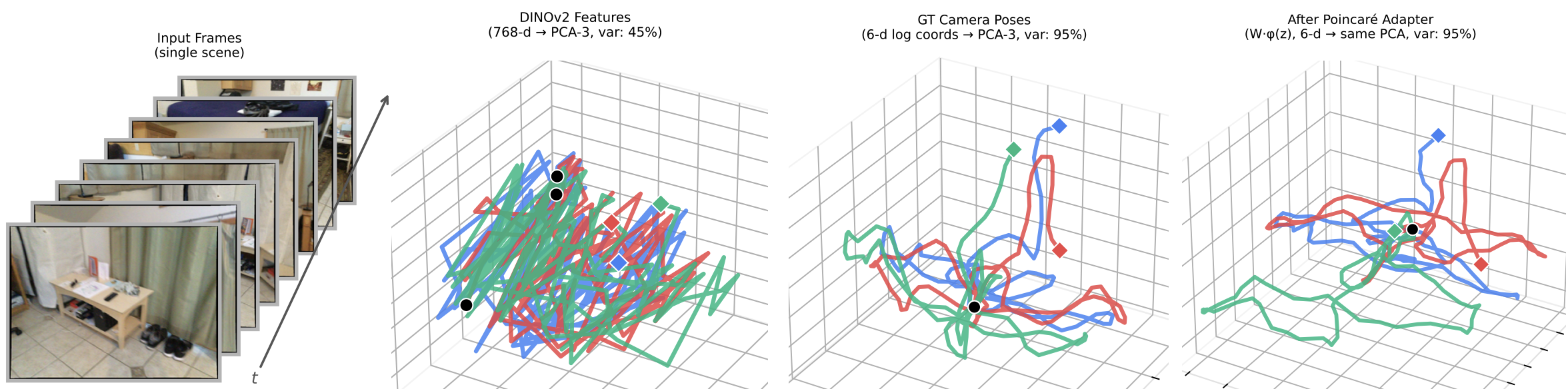
This paper asks a big question: can today’s vision AI models, just by looking at pictures or videos, quietly learn how 3D space works? In other words, do the “internal numbers” these models compute about images already line up with how a camera actually moves in the real world (moving forward/back, left/right, up/down, and rotating)? The authors show that, with a small helper tool, many popular vision models do contain a hidden map of 3D space.
What questions did the researchers ask?
The paper focuses on three easy-to-understand questions:
- Do the model’s features (its internal representation of images) keep nearby views of the same scene close together, like a good map would?
- Is there a small, simple “coordinate system” hiding inside the model that matches the 6 basic ways a camera can move in 3D (3 for translation, 3 for rotation)?
- Can we use this hidden structure to do useful things, like figuring out how the camera moved between two photos—and even “move around” a scene using only the model’s features, without building a full 3D map?
How did they test this?
To keep things fair, they used videos of static scenes (rooms and indoor spaces where stuff doesn’t move), so any changes between frames come from the camera moving, not objects moving.
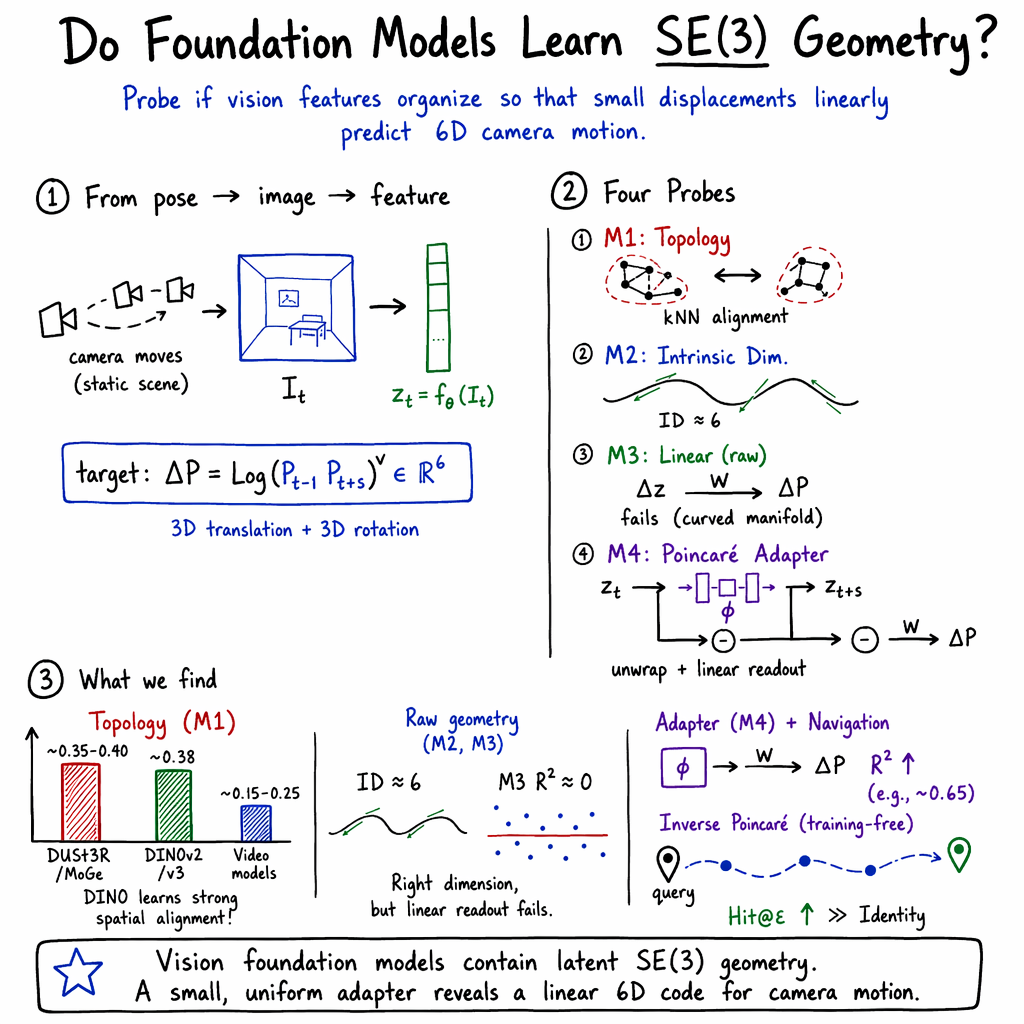
They then compared the model’s feature space to the real-world camera motion space. Here’s how, in plain terms:
- Topology check (neighborhood test):
- Idea: If two camera positions are close in the real room, the model’s features for those images should also be close.
- How: They compared “nearest neighbors” in two worlds:
- The physical world (camera poses in 3D)
- The model’s world (image features)
- If the neighbor lists match well, the model’s features preserve the shape of the scene.
- Dimensionality check (how many “knobs” are needed):
- In 3D, a camera has 6 “degrees of freedom” (3 move + 3 rotate).
- They estimated how many degrees of freedom the model’s feature manifold behaves like locally. A number close to 6 means the model’s representation might be aligned with real camera motion.
- Linear motion test (simple arithmetic for motion):
- They tried to predict the camera’s movement between two frames using only the difference between the two feature vectors and a simple linear layer (like a basic recipe).
- Result: Raw features were too “curvy”—this simple trick didn’t work well on its own.
- The Poincaré Adapter (the key tool):
- Think of the model’s feature space like a curled-up rubber sheet. The adapter is a small neural network that “unrolls” this sheet so that small moves in the scene correspond to straight, simple moves in the feature space.
- It’s “Siamese,” meaning the same adapter is applied to each image feature separately, then it subtracts them to get a clean motion signal.
- After this unrolling, a simple linear layer can translate feature differences into a 6-number motion vector (how much the camera moved and rotated).
They tested this on several datasets of indoor scenes (like ScanNet, ARKitScenes, TUM RGB-D, 7 Scenes, 12 Scenes) and across many modern vision models (such as DINOv2, DINOv3, V-JEPA, and geometry-focused models like DUSt3R).
What did they find?
- Nearby views line up:
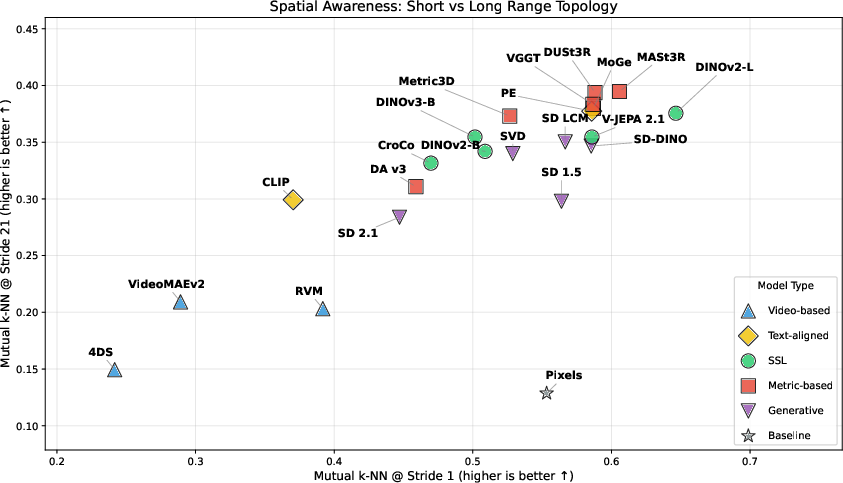
- Many models keep the neighborhood structure of the physical world: if two camera views are close in real space, their features tend to be close too. Self-supervised image models like DINOv2/DINOv3 did especially well here.
- The feature space is curved but fixable:
- Raw features don’t directly give a nice flat 3D/6D coordinate system for motion. But with the small Poincaré Adapter, the authors could “unroll” the feature space so that a simple linear readout maps feature changes to real camera motions quite accurately.
- Rotations are easier than translations:
- The models consistently captured camera rotations more reliably than how far the camera moved. That’s because rotation effects depend mostly on the image geometry itself, while translation depends on scene depth, which varies a lot and is trickier to infer.
- It scales and generalizes:
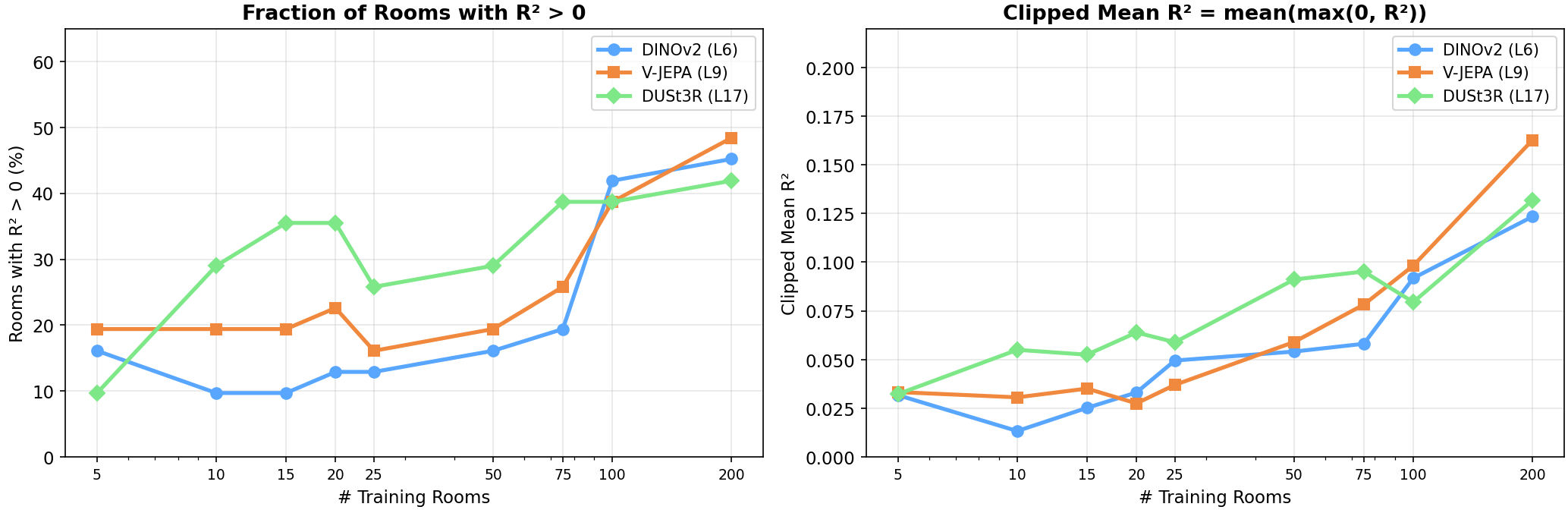
- Training the adapter on more rooms helped it generalize better to new rooms it hadn’t seen before.
- Some datasets (with cleaner poses and denser captures) made the task easier; noisy or sparse captures made it harder.
- Latent-space navigation works:
- The authors tried “moving” in the model’s feature space based only on a desired camera displacement (no 3D reconstruction).
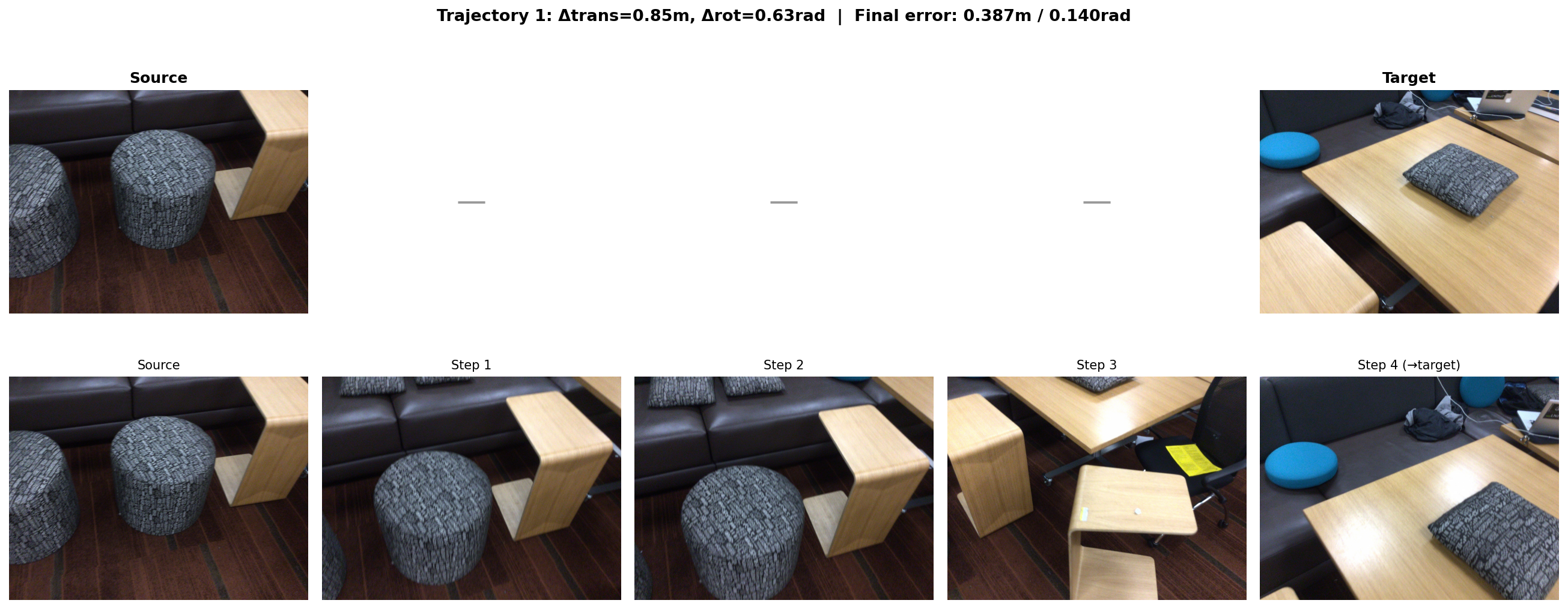
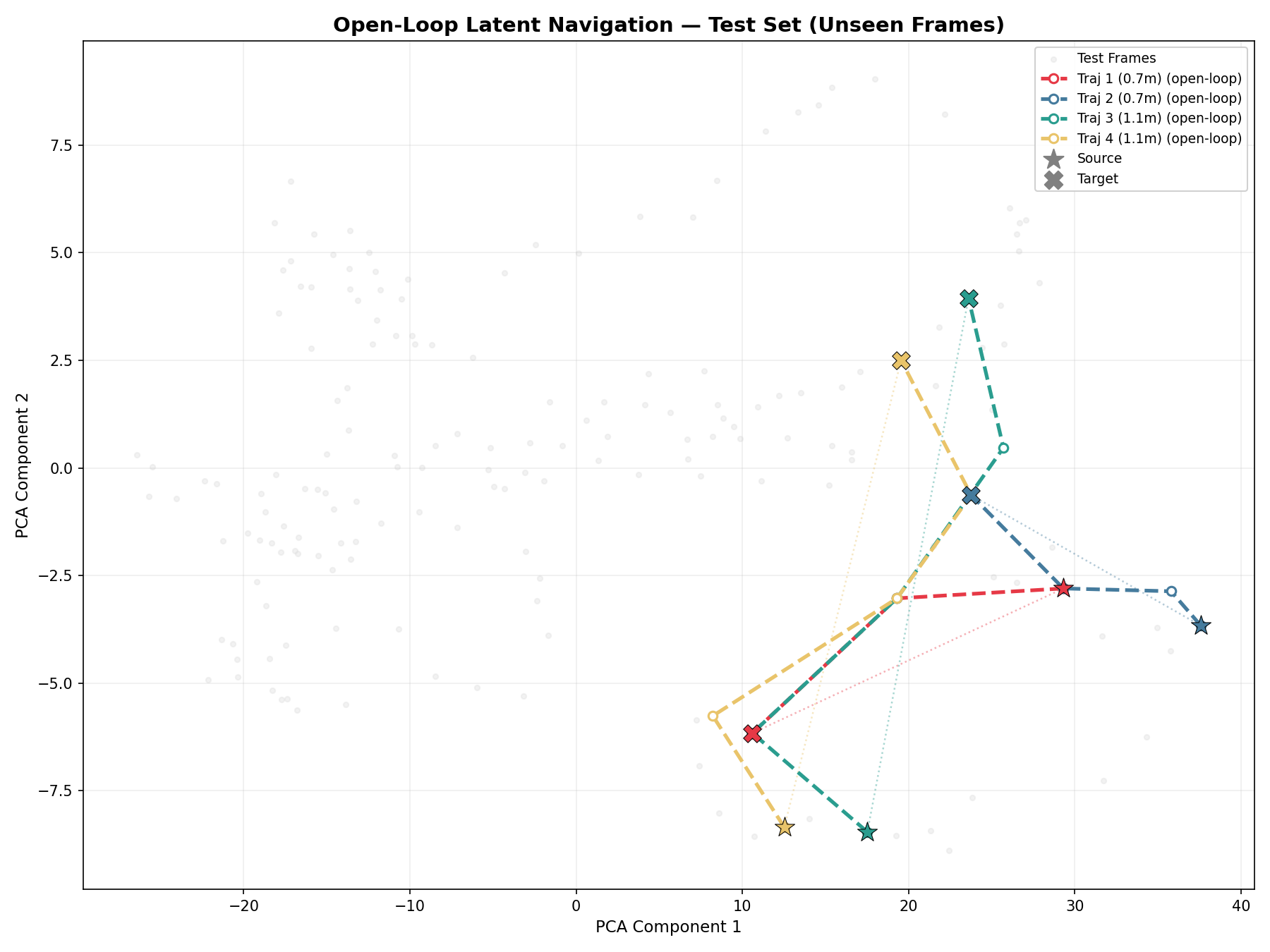
- Using the unrolled features and a simple mathematical inverse, they could predict where the next feature should be and retrieve the right image from a large set, often landing in the correct spatial neighborhood.
- This even worked in multi-step “walks” across a scene, showing that simple vector arithmetic in the adapted feature space can trace plausible paths.
Why is this important? It shows that modern vision models, trained without explicit 3D labels or robot actions, still learn a strong sense of 3D structure just by watching. That’s a big step toward simpler, faster tools for navigation and 3D understanding.
What does this mean going forward?
- For AI and robotics:
- Robots or AR devices could estimate motion or navigate using lightweight operations in feature space, avoiding heavy, slow 3D reconstruction pipelines in many cases.
- This could make on-device navigation faster and more energy-efficient.
- For science and learning:
- The result challenges the idea that you must move and act to learn space. These “motionless” models seem to develop a usable internal “space sense” from passive observations.
- It connects to how brains might “straighten” complex inputs into simpler internal codes for motion and space.
- Limitations and next steps:
- The study focuses on static scenes. Real life has moving objects. Can the same approach separate “my movement” from “other things moving” in dynamic scenes?
- Translation magnitude is still harder—better handling of real-world scale and depth would help.
In one sentence
The paper shows that many vision models quietly learn a hidden, consistent 3D coordinate system, and with a small adapter, we can unlock it to read camera motion and even “navigate” in feature space—no explicit 3D maps required.
Knowledge Gaps
Knowledge gaps, limitations, and open questions
Below is a concise, actionable list of what remains missing, uncertain, or unexplored in the paper, organized to guide future research.
- Dynamic scenes and nonrigid motion: The study is restricted to static scenes; it does not address how to disentangle “changes of position” (camera motion) from “changes of state” (scene dynamics), occlusions, or nonrigid deformations. Design probes and adapters that handle moving objects and jointly factor scene- and camera-induced changes.
- Outdoor and diverse environments: Evaluation focuses on mostly indoor datasets (ScanNet, ARKitScenes, TUM, 12/7 Scenes). Generalization to outdoor, cluttered, low-texture, or adverse conditions (nighttime, weather, HDR) is untested.
- Camera intrinsics and sensor variation: Robustness to changes in focal length, field of view, lens distortion, rolling shutter, and different camera models (including mobile vs. DSLR) is not analyzed. Quantify how intrinsics variability affects linearization and learn adapters that are intrinsics-aware or intrinsics-invariant.
- Metric scale and translation magnitude: Translation magnitude is identified as hard and confounded with depth (1/Z) and scale ambiguity; no method is proposed to reliably recover metric scale without priors. Explore scale priors (object size statistics), cross-baseline training, or weak metric cues to resolve absolute translation.
- Global non-commutativity and atlas construction: The adapter linearizes local neighborhoods in SE(3), but residual errors from non-commutativity and curvature remain. Develop multi-chart (atlas) or group-aware adapters with explicit transition functions between charts and evaluate their effect on long paths and composition.
- Chart validity radius and curvature quantification: The radius within which the latent manifold is approximately linear is not measured. Estimate curvature and chart validity as a function of stride, pose extent, scene depth, and texture; adaptively select or switch charts during navigation.
- Pose supervision dependency: The Poincaré Adapter is trained with ground-truth relative poses. Devise self-supervised or weakly supervised training (e.g., cycle-consistency, epipolar constraints, time-reversal symmetries, equivariance losses) to learn φ and W without pose labels.
- Online and streaming adaptation: Ridge refit per room improves results but assumes access to room-specific supervision. Develop online, unsupervised adaptation for streaming scenarios with no ground-truth pose, and assess stability and drift.
- VO/SLAM integration and drift management: Latent-space navigation is shown via retrieval metrics, but there is no full VO/SLAM evaluation (drift over long trajectories, loop closure, relocalization). Benchmark against classical and learned VO/SLAM on pose error curves, drift accumulation, and loop-closure robustness.
- Uncertainty and ambiguity: The method outputs point estimates of ΔP; multimodal ambiguities (e.g., symmetries, repetitive textures) are not modeled. Introduce probabilistic adapters that capture uncertainty or multiple hypotheses, and evaluate calibration.
- Sensitivity to pose noise: Dataset pose noise strongly affects success rates (e.g., single-scan ARKitScenes). Quantify robustness to noisy/biased poses and explore noise-aware training objectives or joint denoising of supervision.
- Token- and layer-level analysis: While layer sweeps are done, the paper does not dissect which tokens (CLS vs patch) encode SE(3) subspace or how representation locality affects geometry. Provide token-wise attributions and analyze spatial token configurations vs global pooling.
- Architectural dependence: Results are reported for several backbones but do not systematically compare architectural factors (patch size, depth, receptive fields, CNN vs ViT) on emergent SE(3) structure. Conduct controlled architecture ablations.
- Augmentation effects in pretraining: The ablation suggests data scale matters, but the role of specific augmentations (e.g., crop, perspective jitter, color) that simulate camera motion is unclear. Precisely quantify which augmentations promote SE(3)-aligned subspaces.
- Video models underperformance: Video encoders (e.g., VideoMAE, RVM, 4DS) show lower topological alignment. Investigate why temporal modeling entangles context with motion and whether architectural or objective changes (e.g., motion-equivariant objectives) improve spatial homogeneity.
- Cross-scene axis consistency: The learned 6D subspace basis is arbitrary up to a linear transform; the paper does not assess whether the axes align consistently across different rooms. Develop methods to align or canonicalize axes across scenes/environments.
- Robustness to photometric changes: The approach is not evaluated under strong illumination changes, exposure shifts, or sensor noise. Test and develop photometric-invariant adapters and training strategies.
- Multi-sensor and multi-modality: Only monocular RGB features are tested. Explore whether adding depth, events, IMU, or stereo improves linearization and scale recovery, and how to fuse modalities in φ and W.
- Global absolute pose recovery: The method predicts relative twists and does not provide a strategy for integrating them into drift-free absolute trajectories or globally consistent maps. Explore integration with loop closure and graph optimization in latent space.
- Evaluation metrics beyond M1–M4: Intrinsic dimensionality (M2) is not discriminative; linear readout (M3) is too strict; M1 mutual k-NN is coarse. Incorporate stronger group-equivariance tests (e.g., composition/commutator checks), persistent homology for topology, and geodesic distance preservation metrics.
- Explainability of the 6D subspace: The paper does not analyze how the rows of W correspond to interpretable axes of rotation and translation, or whether they factor cleanly across content. Provide visualizations and diagnostics tying latent directions to pixel-space flows.
- Capacity vs generalization of the adapter: Adapter capacity is swept, but minimal capacity required for reliable linearization and its impact on overfitting/generalization is not characterized. Map out capacity–performance tradeoffs and regularization strategies.
- Cross-camera and cross-dataset generalization: Zero-shot generalization improves with more rooms within ScanNet; transfer across datasets with different capture rigs and statistics is not reported. Evaluate cross-dataset and cross-camera transfer and identify failure modes.
- Long-horizon, closed-loop control: Navigation is evaluated via nearest-neighbor retrieval rather than control in real or simulated environments. Test closed-loop policies (with relinearization and measurement updates) in embodied settings and quantify sample efficiency benefits.
- Handling reflective/transparent surfaces and symmetries: Scenes with mirrors, glass, or repeated structures challenge pose disambiguation; the method’s behavior in such cases is unknown. Design targeted benchmarks and adaptation strategies for these edge cases.
- Joint learning of intrinsics and extrinsics: The SE(3)-only assumption neglects intrinsics variation; an extended group that includes intrinsics (or noncentral camera models) is unexplored. Investigate simultaneous latent linearization over SE(3) × K.
- Scale of training for adapters: Scaling curves up to 200 rooms do not saturate, but it is unknown whether performance plateaus at larger scales or with more diverse data. Conduct larger-scale studies and characterize scaling laws for geometric emergence.
- Self-consistency under composition: The adapter is not explicitly tested for compositional consistency (i.e., φ(z3) − φ(z1) ≈ [φ(z3) − φ(z2)] + [φ(z2) − φ(z1)] in pose space). Add composition tests and penalties to enforce group structure.
- Practical deployment considerations: Computational cost, latency, and memory footprint of φ and W (per frame and per navigation step) are not reported. Profile and optimize for on-device or real-time use.
Practical Applications
Practical Applications of “SeeSE3: Emergence of 3D Space in Vision Features”
This paper shows that modern vision foundation models (especially self-supervised ones like DINOv2/v3) contain a decodable subspace aligned with the 6D geometry of SE(3). A lightweight Siamese “Poincaré Adapter” nonlinearly “unrolls” vision features so that relative camera motion becomes linearly accessible, enabling visual odometry, relocalization, and latent-space navigation without explicit 3D reconstruction. Below are actionable applications and their dependencies.
Immediate Applications
- Lightweight visual odometry in static indoor environments
- Sectors: robotics, AR/VR, mobile, warehousing
- Tools/workflows: integrate a frozen DINOv2 encoder + trained Poincaré Adapter + linear readout W to output 6D pose deltas from consecutive frames; ROS2 node for VO
- Assumptions/dependencies: static scenes, accurate poses for training the adapter, stable intrinsics, moderate viewpoint change; strongest on indoor datasets with clean bundle-adjusted poses (e.g., 12-Scenes)
- Camera relocalization and loop closure via latent retrieval
- Sectors: SLAM/mapping, robotics, AR platforms
- Tools/workflows: build an index of adapted features; retrieve closest pose via nearest-neighbor in adapted space; use Hit@ε as quality gate
- Assumptions/dependencies: trained adapter for the backbone/layer; static environments; domain match between training rooms and deployment site
- Privacy-preserving localization without explicit maps
- Sectors: policy, enterprise, smart buildings, healthcare facilities
- Tools/products: “mapless” localization service operating directly in adapted latent space (no mesh/point cloud persisted)
- Assumptions/dependencies: static scenes; trust boundary ensures features not invertible to images; policy review for latent-data retention
- Low-compute, on-device pose change estimation
- Sectors: mobile/edge AI, drones, consumer AR
- Tools/workflows: on-device inference using a compact encoder layer + small MLP adapter + linear projection W; bypass heavy 3D reconstruction
- Assumptions/dependencies: model quantization/acceleration; reliable feature extraction on device; adapter trained for the chosen layer
- Rotation-dominant tasks (e.g., video stabilization, head-tracking refinement)
- Sectors: media/cameras, AR/VR
- Tools/workflows: exploit strong rotation decodability to stabilize footage or refine IMU-based estimates
- Assumptions/dependencies: rotation components decode more robustly than translation magnitude; static or near-static backgrounds
- Dataset and model diagnostics for spatial awareness (M1–M4 probes)
- Sectors: academia, applied ML, platform model evaluation
- Tools/products: “PoseProbe” library to compute mutual k-NN alignment (M1), intrinsic dimensionality (M2), linear equivariance (M3), and adapter-based SE(3) decodability (M4); layer sweep utilities
- Assumptions/dependencies: access to sequences with ground-truth or high-quality poses; consistent preprocessing
- Outlier rejection and dynamic-object masking for VO
- Sectors: robotics, surveillance
- Tools/workflows: flag regions or frames where adapted feature deltas are not explainable by SE(3) prediction residuals; downweight or mask them in VO
- Assumptions/dependencies: mostly-static scenes; thresholds tuned per domain
- Rapid prototyping in Navigation World Models and Visual Navigation Models
- Sectors: robotics, simulation, autonomy R&D
- Tools/workflows: use adapter to linearize pose-displacement supervision; plug into existing VNM/NWM training loops to simplify pose-conditioning
- Assumptions/dependencies: adapter trained on similar domains; sequences with reliable relative poses
- Photo/video library retrieval by desired camera motion
- Sectors: consumer software, creative tools
- Tools/workflows: user specifies a desired ΔP; compute inverse Poincaré step (g + W†ΔP) and retrieve matching frames
- Assumptions/dependencies: albums/sequences with sufficient overlap and static content; pre-extracted adapted features
- Plugin for existing SLAM stacks
- Sectors: robotics software, mapping vendors
- Tools/products: “Latent VO” module offering pose priors for RANSAC/ICP or fallback when feature matching fails; improves robustness in texture-poor scenes
- Assumptions/dependencies: calibration with existing modules; adapter training on representative environments
Long-Term Applications
- Latent-space SLAM: global mapping without explicit 3D reconstruction
- Sectors: robotics, AR cloud, digital twins
- Tools/workflows: stitch multiple local linear “charts” (MoE adapters) into a global latent atlas; closed-loop correction in feature space
- Assumptions/dependencies: multi-chart consistency, drift control, robust chart selection; substantial research on global consistency
- Dynamic-scene disentanglement (camera vs. object motion)
- Sectors: autonomous driving, service robotics, sports analytics
- Tools/workflows: factor residuals not explained by SE(3) to infer independently moving objects; couple with tracking/segmentation
- Assumptions/dependencies: extended formulation beyond static scenes; supervisory signals or self-supervised constraints for dynamics
- Outdoor and adverse-condition navigation (cross-domain generalization)
- Sectors: automotive, drones, defense
- Tools/workflows: domain-adaptive adapters; scale-aware priors for translation magnitude; sensor fusion with IMU/LiDAR
- Assumptions/dependencies: larger and more diverse training data; robustness to weather/lighting and wide-baseline views
- Embodied agents with latent planners
- Sectors: household robotics, warehouse automation
- Tools/workflows: plan multi-step paths by composing W†ΔP increments in latent space; integrate with policy learning and actuation
- Assumptions/dependencies: closed-loop control and re-localization to limit drift; safety-certified behaviors
- Medical AR navigation and guidance
- Sectors: healthcare (surgical navigation, endoscopy)
- Tools/workflows: use adapter-aided SE(3) estimation to stabilize viewpoints, register instruments, or guide along latent paths
- Assumptions/dependencies: rigorous validation, domain-specific pretraining, regulatory approval; challenging dynamics and non-rigid tissues
- Privacy-by-design localization standards and compliance tooling
- Sectors: policy, govtech, enterprise security
- Tools/products: guidelines and audit tools for “no 3D map persistence” pipelines; red-teaming latent inversion risk
- Assumptions/dependencies: standardized tests for leakage; consensus across stakeholders and regulators
- Hardware acceleration for latent navigation
- Sectors: semiconductors, edge AI
- Tools/workflows: NPU kernels for chosen vision encoder layers + small MLP adapter; low-power SE(3) inference blocks
- Assumptions/dependencies: stable model/layer choices; co-design with quantization-friendly adapters
- SE(3)-aware NeRF and reconstruction acceleration
- Sectors: 3D content, digital twins, VFX
- Tools/workflows: initialize or regularize pose estimation in NeRF pipelines via adapters; reduce BA iterations and training time
- Assumptions/dependencies: tight coupling with reconstruction losses; generalization to complex, non-Lambertian scenes
- Multi-camera rig calibration and sensor fusion in feature space
- Sectors: robotics, AR devices, industrial inspection
- Tools/workflows: align adapters across cameras to a common SE(3) subspace; fuse ΔP from multiple streams for robustness
- Assumptions/dependencies: cross-sensor feature harmonization; careful handling of intrinsics/extrinsics and timing
- Education and research tooling on emergent spatial structure
- Sectors: education, academia
- Tools/products: interactive labs demonstrating M1–M4, Lie algebra targets, and latent navigation; benchmarks for emergent geometry
- Assumptions/dependencies: open datasets with accurate poses; accessible pretrained encoders and adapters
- In-store and facility navigation with dynamic crowds
- Sectors: retail, smart buildings, airports
- Tools/workflows: combine latent SE(3) navigation with dynamic-object handling and map services to guide users without explicit 3D maps
- Assumptions/dependencies: robust dynamic-scene disentanglement; large-scale deployment and maintenance; privacy compliance
Common Assumptions and Dependencies Across Applications
- Static-scene assumption underpins the strongest results; dynamic-scene handling requires extensions (residual modeling, segmentation, or multi-hypothesis adapters).
- Accurate camera poses are needed to train adapters and W; generalization improves with the number and diversity of training rooms.
- Choice of encoder and layer matters; self-supervised image models (e.g., DINOv2) and intermediate layers often work best; video encoders may be less stable for global spatial alignment.
- Translation magnitude decoding is sensitive to depth and scale; metric priors, sensor fusion, or domain-specific calibration may be necessary.
- Camera intrinsics and consistent preprocessing materially affect performance; domain shift (lighting, FOV, motion blur) degrades decodability.
- Compute constraints: feature extraction dominates cost; adapters are lightweight but still require careful on-device optimization for real-time use.
Glossary
- Axis-angle: A parameterization of 3D rotation using an axis of rotation and a rotation magnitude (angle). "3 rotational velocities (axis-angle)"
- Bundle adjustment: A joint optimization that refines camera poses and 3D structure to achieve globally consistent geometry. "datasets with clean bundle-adjusted poses"
- Camera-to-world pose: The rigid transformation that maps coordinates from the camera frame to a global/world frame. "where is the camera-to-world pose at time "
- Closed-form: An explicit, non-iterative solution that can be computed directly via a formula. "closed-form latent visual navigation"
- Euclidean transformations: Rigid motions in Euclidean space consisting of rotations and translations. "the group of Euclidean transformations "
- Homogeneous coordinate system: A coordinate representation in which transformations become linear and consistent across space. "construct a homogeneous coordinate system, where changes of pose become linear."
- Intrinsic Dimensionality (ID): The effective number of degrees of freedom of data lying on a manifold, estimated locally. "We estimate the Local Intrinsic Dimensionality using MLE and Two-NN estimators."
- Isomorphic: Structurally equivalent in a way that preserves operations or relations between two mathematical objects. "captures the geometry of , or, more precisely, whether it is isomorphic to "
- Jacobian: The matrix of first-order partial derivatives describing the local linear behavior of a transformation. "whose Jacobian has rank~6"
- Latent Space Navigation: Moving through a scene by operating directly in feature (latent) space rather than reconstructing 3D geometry. "we apply our approach to Latent Space Navigation."
- Lie algebra: The vector space of infinitesimal generators of a Lie group; for rigid motions, corresponds to . "the Lie Algebra "
- Linear equivariance: A property where transformations in input space correspond to linear transformations in representation space. "we recover strong linear equivariance."
- Matrix logarithm: The operation that maps a Lie group element to its Lie algebra element, linearizing group composition locally. "using the matrix logarithm:"
- Mixture-of-Experts (MoE): An architecture with multiple specialized subnetworks whose outputs are combined by a gating mechanism. "Mixture-of-Experts (MoE) architecture"
- Mutual k-NN alignment: A metric that measures how similarly two spaces (e.g., feature and pose) organize local neighborhoods. "We use the mutual -nn alignment metric"
- Nearest-neighbor retrieval: Selecting items by finding the closest example under a distance metric in a representation space. "we perform a nearest-neighbor retrieval task."
- Non-commutativity: A property of operations where the order of application affects the result. "non-commutativity of $\SE(3)$"
- Novel View Synthesis: Generating images of a scene from new camera viewpoints not seen during training. "in the context of Novel View Synthesis"
- Open-loop integration: Executing a sequence of predicted steps without feedback corrections from outcomes. "due to the open-loop integration"
- Poincaré Adapter: A lightweight adapter network that “unrolls” feature space to make pose-induced changes linear. "We call the network a ``Poincaré Adapter,''"
- Poincaré Task: The problem of whether a motionless observer can infer 3D spatial structure from passive visual input. "The Poincaré Task:"
- Pseudo-inverse: The Moore–Penrose generalized inverse used to invert linear mappings in a least-squares sense. "where is the pseudo-inverse of the linear projection weights."
- Ridge-Refit: Re-estimating a linear mapping with ridge (L2-regularized) regression on new data for adaptation. "Ridge-Refit (fitting only the linear mapping component of on the test room, given a frozen adapter)"
- SE(3) (Special Euclidean group): The group of 3D rigid-body transformations combining rotations and translations. "reflects the special Euclidean group of Euclidean transformations"
- Siamese (architecture): A two-branch network with shared weights applied to separate inputs for comparative tasks. "a lightweight Siamese MLP adapter "
- Tangent space: The linear space of infinitesimal displacements at a point on a manifold or Lie group. "isomorphic to the tangent space of "
- Tangent vector: A vector in the tangent space representing an infinitesimal transformation or displacement. "its tangent vector "
- Topological alignment: The agreement between neighborhood structures across two spaces, such as feature and pose spaces. "Topological Alignment (Metric M1)."
- Twist coordinates: The 6D vector representation (3 rotational, 3 translational) of an element of . "6D twist coordinates"
- Vee operator: The mapping from a matrix in a Lie algebra to its vector of coordinates. "the vee operator"
- Visual odometry: Estimating a camera’s motion from visual inputs alone. "perform visual odometry and localization purely in the latent space"
Collections
Sign up for free to add this paper to one or more collections.