GLM-5: From Vibe Coding to Agentic Engineering
This presentation explores GLM-5, a breakthrough large language model that transitions from simple code generation to autonomous end-to-end engineering. With 744 billion parameters and novel architectural innovations including DeepSeek Sparse Attention and asynchronous reinforcement learning infrastructure, GLM-5 achieves frontier performance while maintaining extreme computational efficiency. The model demonstrates decisive advantages in real-world coding tasks, multi-turn agentic reasoning, and long-context understanding, establishing new benchmarks for open-weights models and demonstrating that efficient architectural design combined with robust agent training can rival proprietary systems in complex engineering domains.Script
What if your coding assistant could do more than autocomplete—what if it could architect, debug, and deploy entire applications autonomously? GLM-5 represents a paradigm shift from prompt-driven code generation to true agentic engineering, where models operate as independent software developers across complex, real-world codebases.
Let's examine how GLM-5 achieves this transformation through architectural breakthroughs.
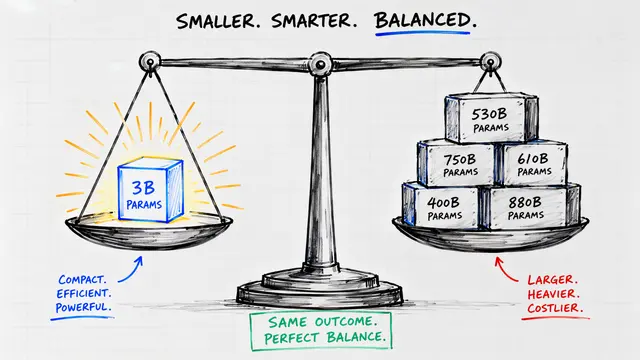
Building on this foundation, the architecture deploys 744 billion total parameters with only 40 billion active at inference time. The DeepSeek Sparse Attention mechanism uses dynamic content-based selection to preserve long-range dependencies without the typical memory explosion, enabling the model to process up to 200,000 tokens efficiently.
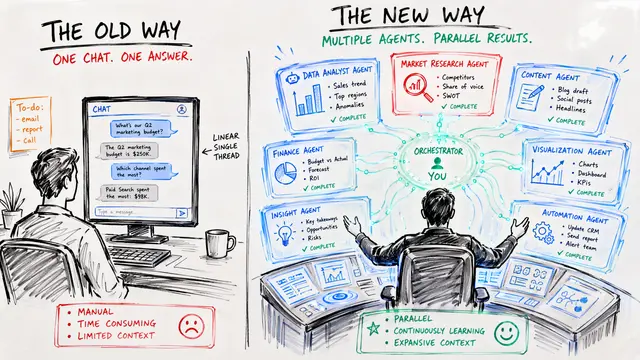
This contrasts sharply with traditional approaches. Where vibe coding produces isolated code snippets from direct prompts, GLM-5 orchestrates complete engineering workflows—analyzing requirements, generating multi-file solutions, testing outputs, and iteratively refining until functional correctness is achieved.
The model's capabilities emerge from a carefully orchestrated training pipeline.
The training begins with 28.5 trillion tokens, progressively extending context windows while upsampling agentic and code-centric data. The breakthrough lies in the asynchronous reinforcement learning system, which separates trajectory rollouts from model optimization, enabling scalable multi-task agent training without the synchronization bottlenecks that plague traditional approaches.
The results speak for themselves. GLM-5 achieves competitive or superior performance relative to frontier proprietary systems including GPT-4, Claude Opus, and Gemini across diverse evaluation domains. Particularly notable are the gains in agentic tool use and real-world coding tasks, where the model demonstrates a roughly 20 percent improvement over its predecessor and establishes new records for open-weights models.
In practical deployment scenarios, GLM-5 demonstrates robust agentic capabilities. The model achieves a score of 50 on the Artificial Analysis Intelligence Index version 4, incorporating 10 challenging evaluations. The Agent-as-a-Judge pipeline automatically builds, launches, and interactively validates generated projects, ensuring functional correctness beyond simple syntax checking.
A critical innovation addresses the context management problem inherent in multi-turn agentic scenarios. As agent traces accumulate, naive approaches either hit memory limits or degrade performance through indiscriminate truncation. GLM-5 employs hierarchical context folding with a hybrid policy that keeps recent interactions while selectively discarding redundancy, improving BrowseComp accuracy from 55 percent to nearly 76 percent.
The broader implications are profound. GLM-5 demonstrates that open-weights models equipped with sparse attention, asynchronous training infrastructure, and robust context management can rival proprietary systems in real-world engineering. The work establishes that efficient architectural choices unlock both performance and deployability, with deployment costs reduced by half through optimization for diverse hardware ecosystems.
GLM-5 redefines what's possible when efficiency meets autonomy, transforming language models from code generators into true engineering partners. To explore the technical details and benchmark results, visit EmergentMind.com.