Why Agentic Theorem Provers Work
This presentation explores groundbreaking research that explains why AI-powered theorem provers succeed in practice despite the theoretical impossibility of proof search. The authors introduce statistical provability theory, showing how structured problem distributions, rather than worst-case scenarios, enable practical success. We'll examine how they model theorem proving as a time-bounded decision process and reveal the key mechanisms that make modern mathematical reasoning systems work.Script
Theorem proving is theoretically impossible to solve in the general case, yet AI systems are proving mathematical theorems with startling success. This paradox sits at the heart of modern mathematical reasoning, and this paper finally explains why.
The authors noticed something remarkable: while worst-case complexity theory predicts failure, real-world theorem provers built from language models and verification systems are actually working. Something fundamental was missing from our understanding.
Their insight changes how we think about the problem entirely.
Instead of asking whether a proof exists in principle, the authors ask: what's the probability of finding it with limited computation? They formalize theorem proving as a Markov Decision Process where each state represents current proof obligations and each action is a possible next step.
This creates a sharp contrast. Classical complexity assumes adversarial problem distributions and infinite time. Statistical provability embraces the structure in real mathematical problems and the reality of computational budgets—capturing what actually happens when researchers use these systems.
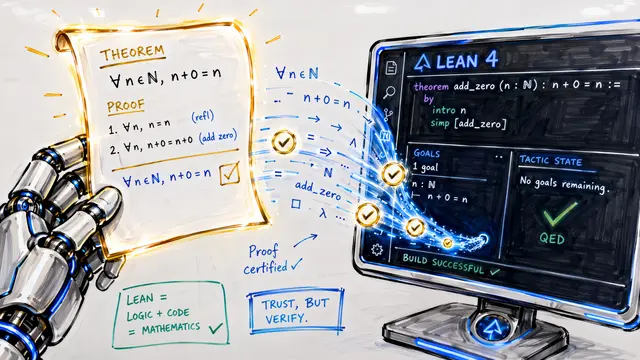
The authors show that effective policies can be computed and validated. Bellman equations characterize optimal proof strategies, while Bellman inequalities provide certificates proving an algorithm will succeed with sufficient probability. The verifier's feedback is not just validation—it actively structures the search space.
They validated the theory empirically, showing that success probability correlates with the statistical structure they predicted. Retrieval mechanisms and score-guided search algorithms like beam search perform as the theory suggests—efficiently when problem distributions are favorable, struggling when they're adversarial.
The theory admits its boundaries honestly: adversarial settings still defeat these systems. But for real-world mathematics—where problems arise from structured domains, not random generation—statistical provability explains observed success and provides a roadmap for systematic improvement.
The deepest insight is this: agentic theorem provers succeed not by solving an impossible problem, but by recognizing that the problem researchers actually face is fundamentally different from the one classical theory warned us about. They work because mathematics itself has structure, and that structure is learnable.
Statistical provability theory transforms theorem proving from a logical impossibility into a statistical opportunity—revealing why intelligence, even artificial, can discover proofs that pure computation cannot guarantee. Visit EmergentMind.com to explore this paper further and create your own research video.