- The paper introduces a human-centered LLM-Agent User Interface (LAUI) that uses natural language dialogue to dynamically enhance user-system interactions.
- It demonstrates adaptive configuration through practical illustrations like the Flute X GPT, which tailors complex processes for novice users.
- The study discusses implications and future research directions to streamline onboarding and improve efficiency in diverse application areas.
Human-Centered LLM-Agent User Interface: A Detailed Summary
The paper "Human-Centered LLM-Agent User Interface: A Position Paper" (2405.13050) articulates the conceptual framework and implications of deploying LLMs as agents in user interfaces. The authors propose an innovative interaction model where the LLM not only mediates between a user and the underlying system but actively assists in optimizing user interactions by learning user needs and adapting system interfaces accordingly.
Introduction
The primary thesis of this work is the conception of an LLM-Agent User Interface (LAUI). LAUIs transcend the conventional Graphical User Interfaces (GUIs) by embedding LLMs, thereby enhancing user-system interaction through natural language dialogues. With LAUIs, users can benefit from an interface that not only fulfills direct commands but also engages in iterative dialogues that clarify user intentions, proposing workflow adjustments that align with emerging user needs and the system’s potential.
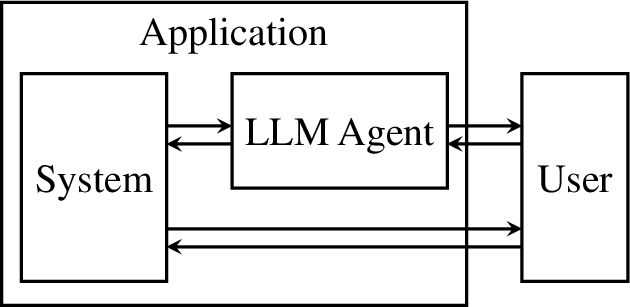
Figure 1: The LLM agent serves as the interface between the underlying system and the user. The LLM agent together with the system forms the application.
In traditional systems, although LLMs enable new modalities of interaction, their operational scope remains limited to executing user-defined commands without dynamically optimizing those commands based on user preferences or contextual understanding. The paper posits that LAUIs should allow for a seamless blend of user input and system capability exploration, thus allowing novice users to effectively leverage complex systems without prior proficiency.
Flute X GPT: A Practical Illustration
A concrete application exemplifying LAUI is the Flute X GPT system, which integrates an LLM agent within a music tutoring setup that includes both software and hardware components. This system highlights the promise of LAUIs by providing an interactive, real-time learning experience for flute beginners. The LLM agent in this context helps dynamically configure and customize the learning environment, offering a flexible and responsive educational tool that factors in user feedback and learning pace.
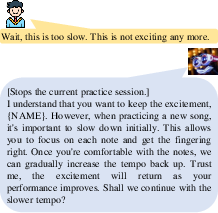
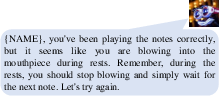
Figure 2: From the scripted trial.
Flute X GPT showcases functionalities such as real-time haptic feedback, adaptive tempo synchronizations, error detection and correction, and interactive visual cues. The system configures and adjusts its teaching strategies based on user-musician interactions, offering a tailored educational path without a predefined manual of user actions.
The paper extends the discussion to articulate a broader formulation of LAUIs by outlining the potential for LLMs to interface directly with system APIs, bypassing typical GUI constraints. This capability allows for more robust user engagement because the LLM can explore and generate configurations of the system that would not be feasible through standard GUI operations alone.
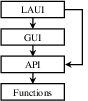
Figure 3: Three layers of abstraction on top of the underlying system. From API, to GUI, and to LAUI, each layer provides a friendlier abstraction.
An emergent workflow enabled by LAUIs suggests a paradigm where systems do not demand deep user expertise. Instead, systems operate with an initial understanding of the user's goals, iterating the interaction processes which foster user satisfaction and achievement.
Implications and Future Directions
The implications of LAUIs are significant across various sectors where user interaction with systems needs to be as seamless and intuitive as possible without extensive learning curves. This approach can radically reduce onboarding times and errors due to user unfamiliarity. Incorporating LAUIs in fields like education, professional training, and health services can democratize access to sophisticated tools, allowing users to focus more on the objectives rather than navigating complex systems.
The paper encourages continued exploration into refining these interfaces, emphasizing research into improving agent learning algorithms and incorporating proactive user feedback loops. There is an open call for the development of standards and benchmarks that gauge the efficacy of LAUIs in dynamic environments.
Conclusion
In conclusion, the paper assembles a compelling argument for the widespread adoption of LLM-Agent User Interfaces. By realigning the focus from user adaptation to system adaptability, there is the potential to transform human-computer interaction. Future research and development should harness these capabilities to craft intelligent, intuitive interfaces that accommodate diverse user needs without traditional constraints, truly realizing the potential of LLM-driven innovation in interactive system design.
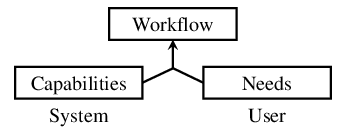
Figure 4: The workflow is jointly decided by the user's needs and the system's capabilities. Conventionally, the user has to learn the system to devise workflows. In contrast, LAUI can learn the user and propose workflows.