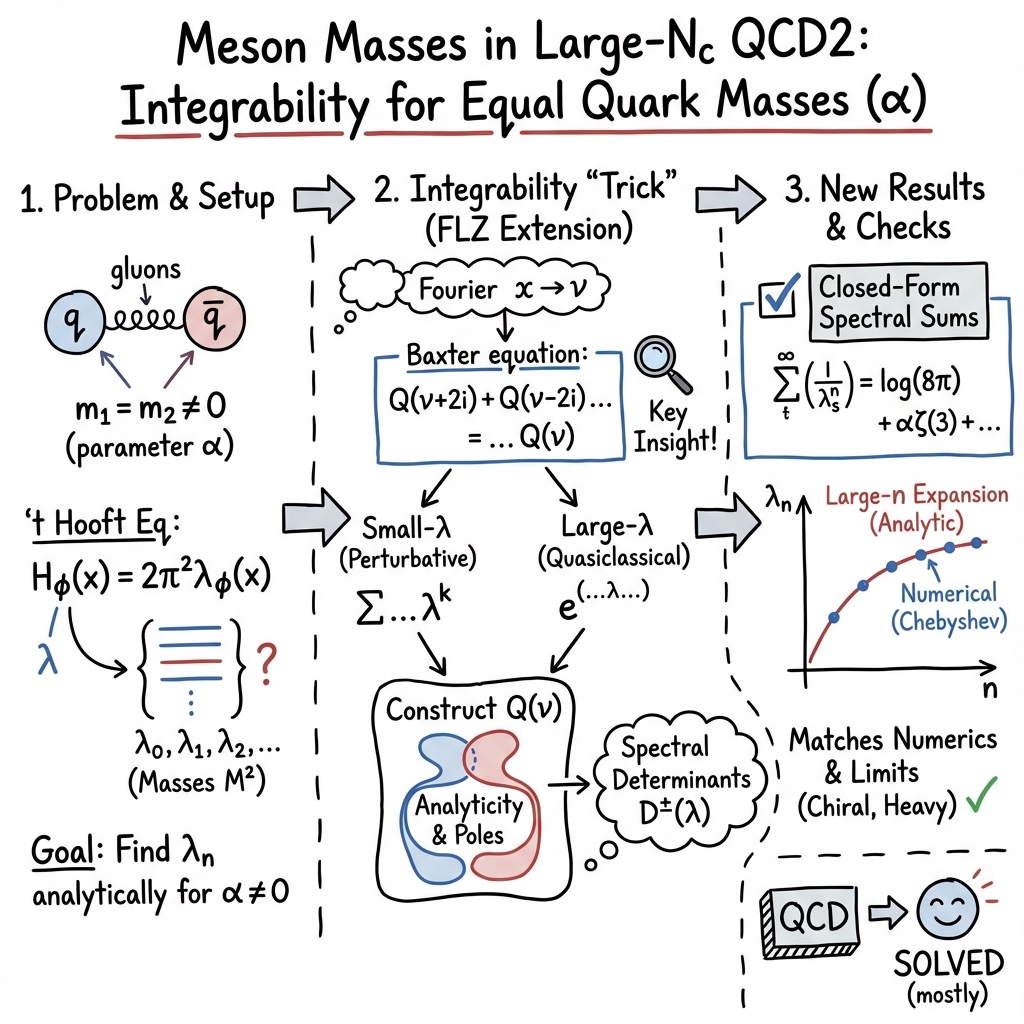
- The paper systematically generalizes FLZ techniques to compute the meson spectrum by reformulating 't Hooft’s equation as a Baxter TQ equation.
- It provides explicit analytic spectral sums and high-order large-n expansions that precisely reproduce numerical eigenvalues in different quark mass regimes.
- The study bridges integrable methods with QCD phenomenology, deriving relations like the GMOR and clarifying chiral and heavy quark limiting behaviors.
Analytical Study of Meson Mass Spectrum in QCD2 't Hooft's Model
Introduction
The 't Hooft model—QCD in 1+1 dimensions with an SU(Nc) gauge group and Nf massive fundamental fermions—serves as one of the archetypal exactly solvable large-Nc gauge theories exhibiting confinement. In this work ["Meson mass spectrum in QCD2 't Hooft's model" (2409.11324)], the authors systematically generalize analytic techniques pioneered by Fateev, Lukyanov, and Zamolodchikov (FLZ) to address the full meson spectrum for arbitrary but equal quark masses. Their approach emphasizes both analytical spectral sum evaluations and asymptotic expansions for high excited states.
Theoretical Framework and Integral Equations
The model considers the double scaling limit: Nc→∞ with g2Nc fixed, reducing dynamics to planar diagrams and rendering bound state (mesonic) spectra important. The essential step for extracting physical masses of mesons is the reduction of the Bethe-Salpeter equation to an integral eigenvalue problem—'t Hooft's equation—for the light-cone wavefunction ϕ12(x). The eigenvalues λn correspond to squared meson masses via Mn2=2πg2λn.
The authors focus on the sector where quark and antiquark masses are equal, parameterized by a single real α.
Mapping to Baxter's TQ Equation and Integrability
A principal technical advance is the rigorous reformulation of 't Hooft's equation as a Baxter TQ equation. This equivalence emerges through a Fourier transform—specifically, a Mellin-type transform with variable 21log1−xx. The resulting functional equation relates the analytic solution spaces of both the original integral equation and the integrable structure, characterized by the Baxter TQ difference equation in the spectral parameter.
Quantization conditions are imposed via analyticity and polynomial growth constraints on the Q-functions, which in turn relate to spectral determinants whose zeros are the physical meson masses.
An essential result is the demonstration that the symmetric and anti-symmetric solutions of the inhomogeneous TQ equation (with quantization relaxed) yield analyticity properties in λ directly connected to the expansion in spectral sums.
Analytical Results: Spectral Sums and Large-n Expansions
Spectral Sums
The paper provides explicit analytic determinations for several spectral sums, defined as G±(s)=n=0∑∞(λ2n+δ±)−s, with δ+=0 and δ−=1. Closed-form expressions are achieved for low values of s, encompassing intricate functions of α and involving polylogarithms, ζ-functions, and nontrivial integrals. Notably, for s=1, the sums are regularized to remove divergences from the dominant linear asymptotics of λn at large n.
In both the chiral limit (α→−1) and the heavy quark regime (α→∞), the analytic formulas asymptote to previously known results, confirming both the validity and internal consistency of the methods. Numerical support (with errors at the 10−3−10−7 level) is provided for a wide range of parameters.
Large-n Expansion
Using the semi-classical (quasi-classical, WKB) method, the authors construct systematic asymptotic expansions for large excitation numbers n. The recurrence for the quantization condition is achieved via analytic continuation of the spectral determinant and extracting the phase of oscillatory terms obtained from the TQ equation. Higher order corrections in $1/n$ are pushed beyond the previous state of the art, with explicit polynomials in logarithms appearing at each subleading order.
In the physical regime, these results precisely reproduce the numerical eigenvalues for n>1 at extremely high precision.
Limiting Cases and Relations to QCD Phenomenology
In the chiral limit, the lowest meson mass vanishes as expected, and the even spectral sums diverge, paralleling spontaneous chiral symmetry breaking. The Gell-Mann–Oakes–Renner (GMOR) relation is derived explicitly in this controlled setting, matching the vacuum condensate calculations and connecting ultraviolet and infrared physics in QCD2.
For α→∞ (heavy quark limit), all spectral sums except s=1 vanish, indicating that low-lying states decouple and the spectrum accumulates at the threshold. These results are in agreement with heavy-light effective theory limits and prior semiclassical expansions.
Technical Innovations and Methodological Advances
Critical technical features of the paper include:
- The generalization of the FLZ analytical strategy for arbitrary α by reconstructing analytic Q-functions tailored to the endpoint behavior determined by nonzero quark mass.
- The extension of the quantum Wronskian and spectral determinant analysis, facilitating connections between TQ difference equations and transcendental eigenvalue quantization conditions.
- Introduction of modified ansätze for Q-functions to properly accommodate nontrivial branching (for α=0), resolving previously overlooked issues in analytic structure.
- Systematic and rigorous verification of analytic formulas against numerical solutions obtained by Chebyshev polynomial discretization of the integral operator.
Implications and Future Directions
Practical Implications: The analytic methods enable accurate and rapid estimates of meson mass spectra in large-Nc, 1+1d QCD for arbitrary quark masses, avoiding costly full numerical diagonalization.
Theoretical Implications: By cementing the connection between 2D QCD and integrable structural analysis—specifically the Baxter TQ equation—this work enriches the integrability paradigm even for nontrivial quantum gauge theories. The resonance with the ODE/IM correspondence underscores the deep link between spectral problems arising in quantum field theory and quantum integrable systems.
Further Developments: The techniques outlined here may be extensible to cases with nondegenerate quark masses (α1=α2), to large but finite Nc (going beyond the planar limit), and to more general kernels relevant in other light-cone quantized models. The analytic and algebraic structures elucidated may further clarify the emergence of quasi-integrability in higher-dimensional theories and the role of Baxter operators or Q-systems in strongly coupled gauge dynamics.
Moreover, explorations of the analytic structure of spectral sums viewed as complex functions of α open potential connections to non-unitary field theories and, potentially, complex saddle points relevant for large-order behavior.
Conclusion
This work achieves a comprehensive analytic treatment of the meson mass spectrum in large-Nc QCD2 with arbitrary but equal quark masses by generalizing the integrability-based approach of FLZ. Through systematic transformation to the Baxter TQ framework, derivation of spectral sums, and high-order large-n expansions, it provides both precise practical tools for spectrum calculation and conceptual advances in the integrable theory of gauge models. These results bridge integrable system perspectives and strongly coupled quantum field theory, highlighting the enduring utility and versatility of analytic approaches grounded in integrability.