Published 14 May 2009 in hep-th, hep-ph, and math-ph | (0905.2280v2)
Abstract: We study 't Hooft's integral equation determining the meson masses M_n in multicolor QCD_2. In this note we concentrate on developing an analytic method, and restrict our attention to the special case of quark masses m_1=m_2=g/\sqrtπ. Among our results is systematic large-n expansion, and exact sum rules for M_n. Although we explicitly discuss only the special case, the method applies to the general case of the quark masses, and we announce some preliminary results for m_1=m_2.
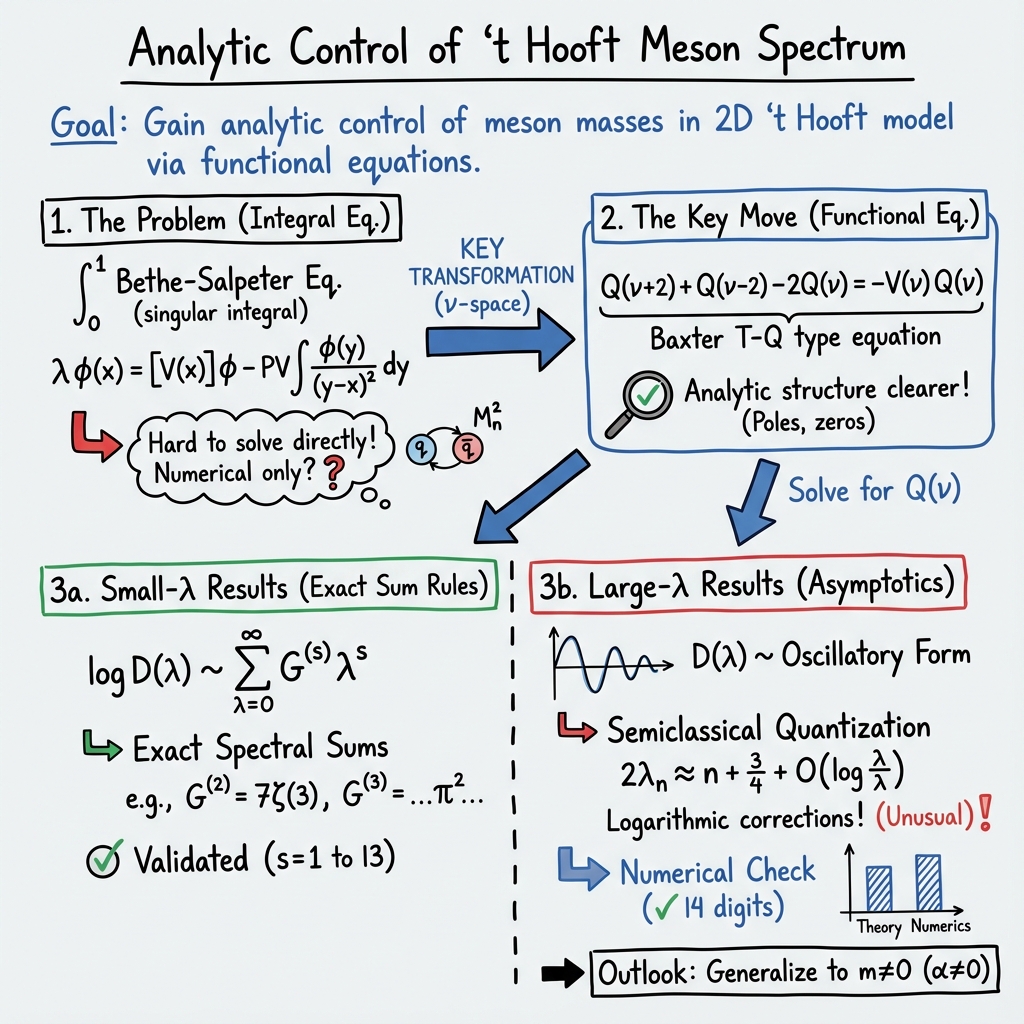
The paper introduces an analytic approach to solve the Bethe-Salpeter equation for meson masses in a two-dimensional QCD framework.
It presents a systematic semiclassical expansion with unconventional logarithmic corrections and derives exact spectral sum rules.
The study lays the groundwork for extending these analytic methods to explore mesonic interactions with complex parameters in confining theories.
Analysis of Mass Spectrum in 't Hooft's 2D Meson Model
Introduction
The research paper "On mass spectrum in 't Hooft's 2D model of mesons" (0905.2280) conducts a meticulous study of the mass spectrum of mesons contained within 't Hooft's two-dimensional quantum chromodynamics (QCD) framework, specifically focusing on the multi-color limit. The model, due to its reduced complexity in two dimensions, provides an exact solution for meson masses, derived from the Bethe-Salpeter equation, which reduces to a singular integral equation. The paper presents an analytic methodology in addressing this integral equation, specifically considering the case where both quark masses are set equal to m1=m2=g/π. Through this approach, it introduces systematic semiclassical expansions and formulates exact sum rules regarding the meson masses Mn.
Methodology and Findings
In the paper, it is highlighted that conventional numerical methods have previously provided solutions to the integral equation, as noted in past studies. However, this research emphasizes the need for an analytic approach to uncover deeper characteristics of the eigenvalues λn, treating them as functions of complex parameters α1 and α2. The core advancement presented is the semiclassical expansion expressed as
2λn=n+43−3π6(n+43)32+…
This expansion includes unconventional logarithmic terms, distinct from classical WKB expansions, and is complemented by exact expressions for spectral sums: G+(s) and G−(s), which are derived analytically for integer values s=2,3,4,…. These results provide robust control over the entire spectral spread, facilitating equations for lower eigenvalues using the large-n approximations.
Implications and Future Research Directions
This study serves as a preparatory stage for analyzing the mass spectrum in cases with more generalized values of α1 and α2. The techniques developed herein, particularly the analytic interventions into the spectral problem, offer promising extensions to a broader variety of two-dimensional field theories where confining interactions are prevalent. Beyond application to the 't Hooft model, these methods could impact studies in different domains such as the Ising field theory previously referenced.
There is an intriguing prospect for studying the analytic continuation of λn at complex values for α1 and α2. The paper hints at an emerging complex analytic structure which challenges numerical methods and invites further analytical exploration. The identification of precise spectral characteristics at complex parameter values remains an open question, with potential implications spanning fundamental insights into mesonic interactions and the confining behavior of two-dimensional gauge theories.
Conclusion
In summation, "On mass spectrum in 't Hooft's 2D model of mesons" (0905.2280) delivers a substantial contribution toward the analytic understanding of meson spectra in the context of multi-color QCD-2D. Its meticulous development of an analytic framework elevates the study from computational to theoretical rigor, beckoning future research endeavors to investigate non-trivial analytic features and extend findings to broader theoretical models. As two-dimensional quantum field theories continue to offer rich phenomenological and theoretical vistas, the groundwork laid in this text anticipates both deeper theoretical inquiries and the refinement of existing models.