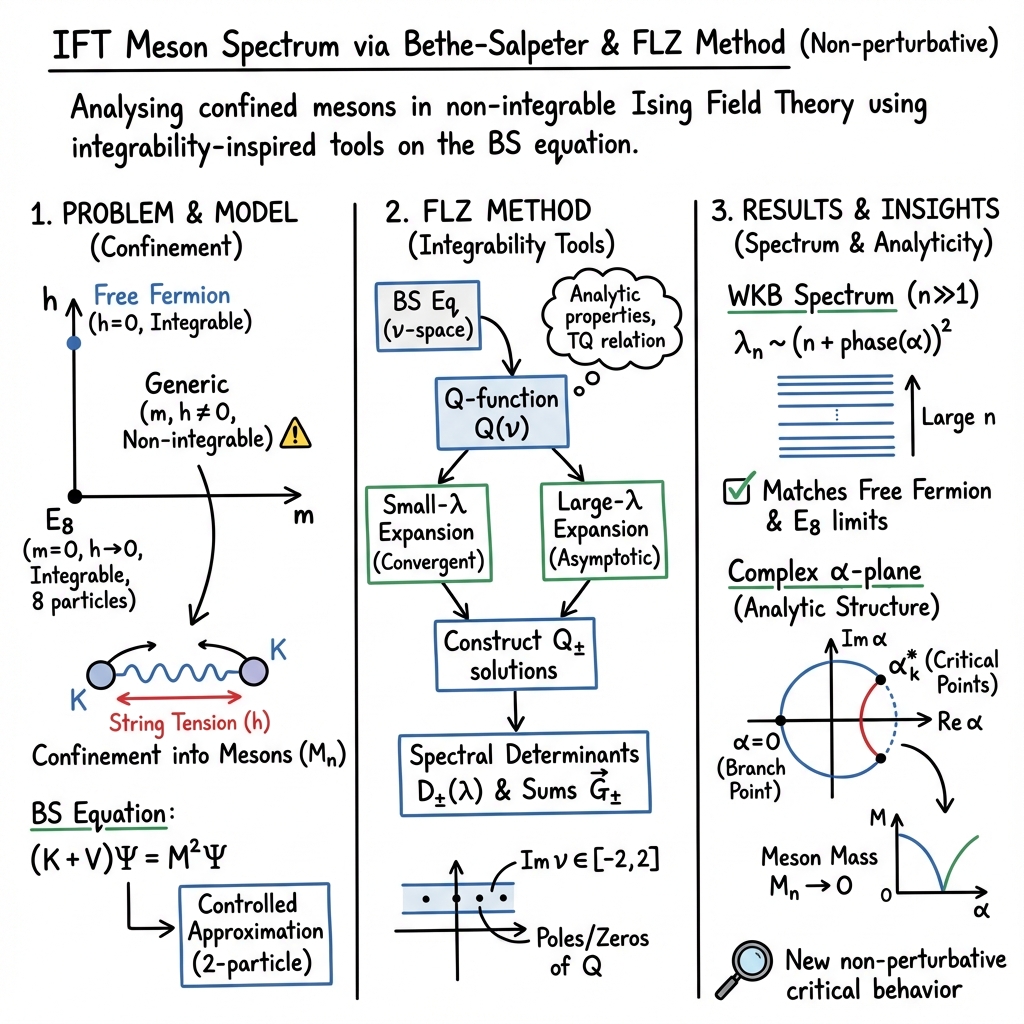
- The paper extends the Bethe–Salpeter formalism by mapping it to a Baxter-type TQ equation, yielding precise meson mass estimates in a non-integrable QFT.
- It introduces analytic continuation techniques that uncover an infinite sequence of critical points and branch structures in the meson spectrum.
- The study benchmarks non-perturbative WKB expansions and numerical data, unifying insights from 2D QCD and integrable models.
Meson Mass Spectrum in Ising Field Theory: Analytical Structure and Integrability
Introduction and Motivation
The manuscript "Meson mass spectrum in Ising Field Theory" (2507.15766) provides a comprehensive non-perturbative analysis of the meson spectrum in the scaling limit of the two-dimensional Ising model with a magnetic field—a paradigmatic non-integrable quantum field theory (QFT) hosting confinement-induced bound states analogous to mesons in QCD. The authors develop and extend recent analytical techniques inspired by integrability and spectral theory, focusing on the Bethe–Salpeter (BS) equation for two-particle bound states, with an explicit mapping to Baxter-type TQ relations reminiscent of the 't Hooft model in two-dimensional QCD.
The Ising Field Theory (IFT) is constructed as a minimal c=1/2 CFT perturbed by two relevant operators: energy density ε(x) and spin density σ(x), with couplings m and h, respectively. This deformation results in a parameter space (characterized by η=m/∣h∣8/15) interpolating between a free massive theory (large ∣η∣), the integrable E8 theory (η=0), and further into regimes with rich analytic structures in the complex plane. This allows exploration of confinement and nontrivial spectrum reorganization under analytic continuation.
The two-quark approximation—originally developed by Fonseca and Zamolodchikov—utilizes a Bethe–Salpeter integral equation for the meson bound states, directly capturing leading non-integrability/confinement effects:
$\left[m^2-\frac{M^2}{4\cosh^2\theta}\right]\psi(\theta) = f_0\ \fint \frac{d\theta'}{2\pi} K(\theta,\theta')\,\psi(\theta'),$
where M is the meson mass, f0 is the bare string tension, and K(θ,θ′) encodes the confining interactions. Through a series of transformations and a switch to Fourier (ν-space), this equation becomes structurally analogous to the 't Hooft equation for 2D QCD and is mapped to a Baxter-type TQ difference equation for the Q-function.
The authors exploit the resemblance to the integrable 't Hooft model, developing a hierarchy of analytic tools: spectral sums, spectral determinants, and explicit WKB expansions. The analytic continuation into the complex scaling parameter plane is central, enabling the identification and characterization of previously elusive critical points and spectra.
Through detailed spectral and analytic analysis, the Bethe–Salpeter equation is recast as a finite-difference TQ (Baxter-type) equation, extending the framework developed by Fateev–Lukyanov–Zamolodchikov (FLZ) for the 't Hooft model [Fateev et al., J. Phys. A 42 (2009)] to IFT. The Q-function is constructed with controlled analytic properties, and its solutions are systematically organized in both small and large λ (energy) expansions.
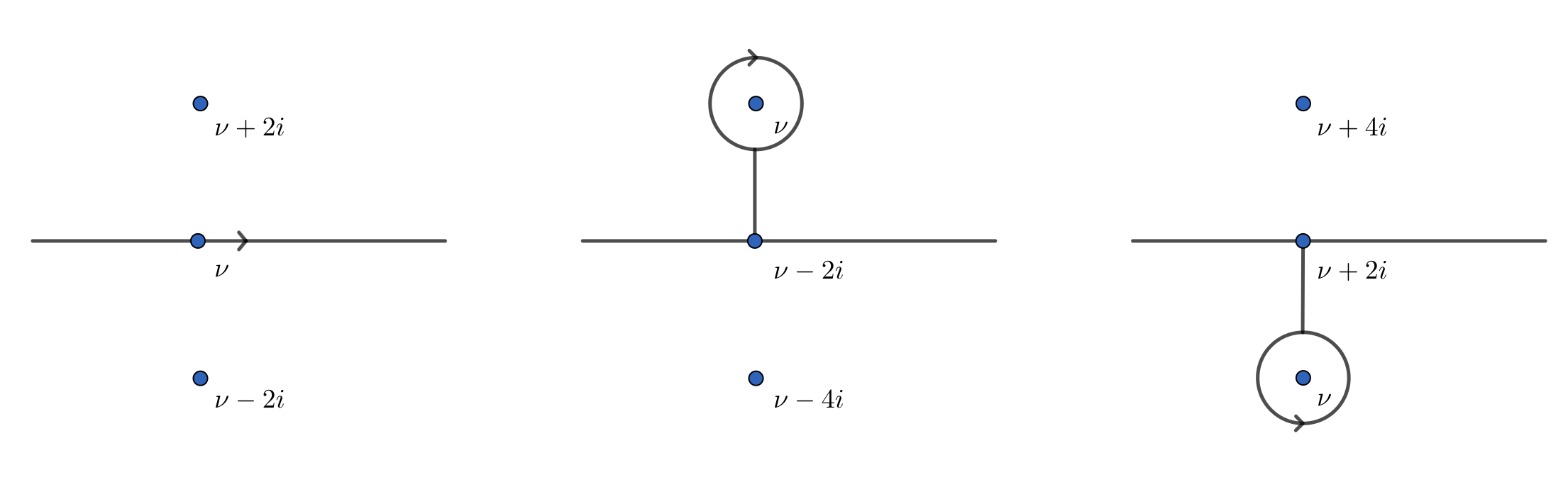
Figure 1: The analytical continuation of ν→ν±2i from the real axis leads to the appearance of additional terms, determined by half-residues of poles intersecting the integration contour.
The analytic extension to complex α reveals a lattice of branch points and criticalities, with poles in the Q-functions' kernel tracing complicated trajectories (see below).
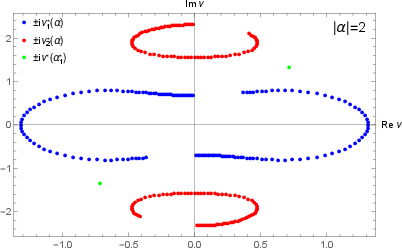
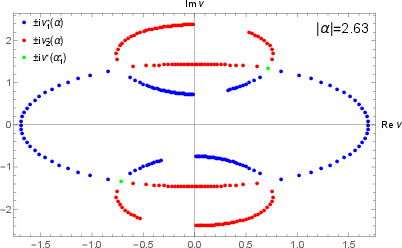
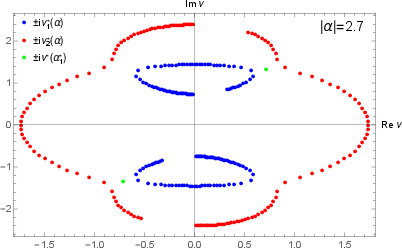
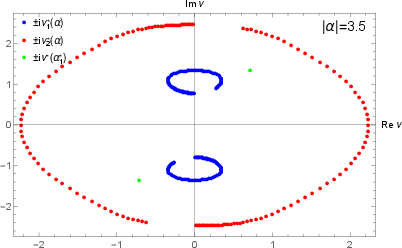
Figure 2: Trajectories of the first two pairs of poles of Ψ(ν) under the analytic continuation across different regions of the α-plane.
Spectral Sums, WKB Expansion, and Numerical Precision
Explicit non-perturbative expressions are derived for the spectral sums (traces of inverse powers of meson eigenvalues in the BS kernel), leveraging both integral representations and closed-form expansions in WKB and small/large coupling regimes. A key result is the derivation and validation of recursive relations connecting spectral determinants—key objects whose zeros correspond to meson masses—with solutions of the TQ equation, even in non-integrable regimes.
The large-n WKB expansions provide highly precise asymptotics for the meson spectrum, valid deep into non-integrable regimes, and importantly, agree with both numerical solutions of the TFFSA and the known exact results in the integrable E8 and free-fermion limits.
Branch Points, Critical Structure and Analytic Continuation
A central finding is the identification of an infinite sequence of critical points and associated branch structure for the meson spectrum under analytic continuation in the scaling parameter:
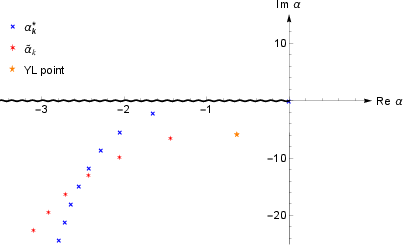
Figure 3: Critical points of λ on the second sheet of the α-plane correspond to the values αk∗; points where multiple mesons become massless.
The work shows that these critical points accumulate at infinity and are linked to the collision of complex-conjugate poles in the underlying transcendental equations for the wavefunctions. At each critical point, the theory exhibits multi-root branch behavior—interpreted as the vanishing of one or more meson masses and observed both in the analytic and numeric analysis.
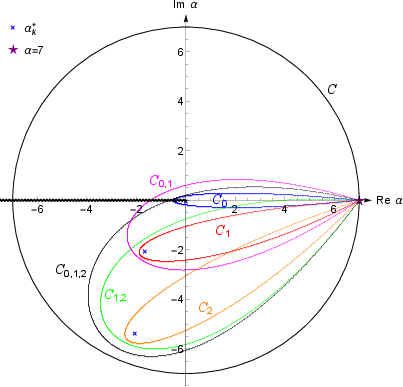
Figure 4: Various integration contours for analytic continuation into complex α, starting at a fixed real parameter value.
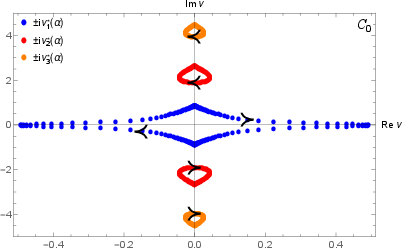
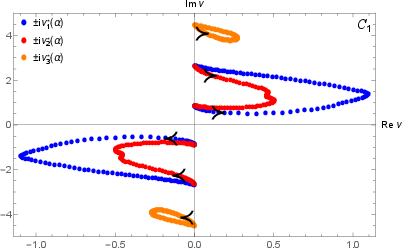
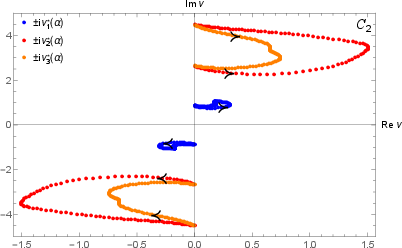
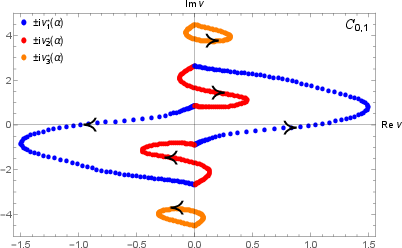
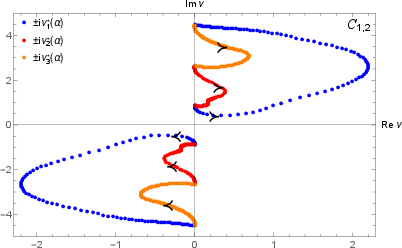
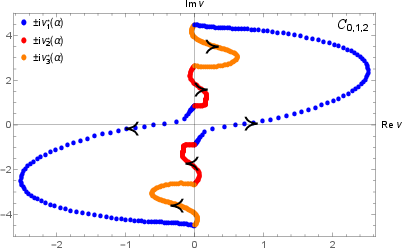
Figure 5: Evolution of the poles ±iνk∗(α), k=1,2,3, as the scaling parameter is continued along contours illustrating the emergence of nontrivial analytic structure.
The location of the Yang-Lee edge singularity—corresponding to the vanishing of the lightest meson and giving rise to non-unitary minimal CFTs in the field theory's IR—is specifically addressed, with the estimated location in the α-plane given and matched to known field-theoretic results.
Strong, Contradictory, and Benchmark Results
Several benchmark analytic results are provided and checked against integrable limits and numerical data:
- Accuracy of the two-quark BS approximation: The Bethe–Salpeter spectrum reproduces non-integrable Ising meson masses to high accuracy, except near η≲0.5 where multi-quark (string-breaking) effects become strong.
- Universal branch structure in the analytic continuation: The analytic continuation predicts an infinite sequence of critical points for vanishing meson masses—suggesting an underlying universal conformal structure in a class of non-integrable field theories. This is both a bold and potentially controversial claim, in contrast to lore that only very limited analytic structure could be probed with such equations.
- Explicit non-perturbative analytical WKB formulas: The authors provide closed formulas for spectral sums and large-n eigenvalue asymptotics, valid throughout the parameter space and benchmarked to earlier TCSA, TFFSA and integrable cases.
- Consistent extension to the 't Hooft model: The formalism unifies the analytic structure of the Ising BS equation with QCD2, contrasting and matching the location and nature of critical branches; in both settings, branch points for vanishing meson masses are seen.
These claims are substantiated by complete semi-analytic formulations, high-precision comparisons, and internal consistency checks via resolvents, quantum Wronskian relations, and recursive TQ/determinantal identities.
Implications and Future Directions
From a practical standpoint, this work establishes a blueprint for analytically probing non-integrable QFT mass spectra in regimes previously accessible only through numerics or perturbative expansions. The identification and characterization of analytic structure in the meson spectrum under complex parameter deformations suggest deep connections to universal properties such as conformal dualities and IR minimal models even in non-integrable and non-unitary domains. The freedom for analytic continuation—not typically present in lattice or TCSA computations—enables the extraction of previously inaccessible singularities and their classification.
Theoretically, the mapping of BS equations to TQ (Baxter) relations and the explicit construction of spectral sum hierarchies provide a framework that can be extended to multi-component, multi-flavor, or higher-dimensional generalizations. Notably, the analytic continuation methods sketched here could be leveraged to connect with string-theoretical or holographic correspondences where similar spectral analysis appears (e.g., QCD string duals, world-sheet quantum spectral curves).
These techniques appear scalable to:
- Multi-quark (beyond two-particle) kernels: Incorporation of TQ/determinantal methods to systematically access higher-order corrections.
- Models with unequal masses or coupled chains: Extension to non-equivalent Majorana fermion mass sectors or coupled field theories of Ising type.
- IR CFT limits: Explicit identification of non-unitary critical points—potentially revealing dual non-Lagrangian CFTs or new analytic structures (e.g., Yang-Lee model universality classes).
Conclusion
The paper provides a technically rigorous, highly detailed, and conceptually innovative treatment of the meson spectrum in the Ising Field Theory through the lens of integrable spectral theory, establishing analytic non-perturbative results across the physical and complexified parameter domains. The work's impact lies in both its advancement of calculational tools and its unveiling of universal analytic structures in non-integrable models, offering a foundation for further exploration in QFT and mathematical physics.