Calibration-free Rydberg Atomic Receiver for Sub-MHz Wireless Communications and Sensing
Abstract: The exploitation of sub-MHz (\textless 1 MHz) can be beneficial for a plethora of applications like underwater vehicular communication, subsurface exploration, low-frequency navigation etc. The traditional electrical receivers in this band are either hundreds of meters long or, when miniaturized, inefficient and bandwidth-limited, making them inapplicable for practical underwater implementations. Such obstacles can be circumvented by the emerging Rydberg atomic receiving technology, which is capable of detecting fields from DC up to the terahertz regime with compact structure. Against this background, we propose a method to detect sub-MHz electric fields without further calibration. Specifically, a physics-based model of the combined DC and AC-Stark response is established. Based on the model, we modulate the DC-Stark spectrum with the received signal and extract its amplitude by fitting the cycle-averaged, symmetric Stark-split peaks. Then we map this swing directly to the intrinsic atomic polarizability. By such operations, the proposed method can remove the dependence on electrode spacing or field-amplitude references. For performance evaluation, six-level Lindblad simulations and experiments are conducted at a low-frequency field of 30 kHz demonstrate a minimum detectable field of 5.3 \text{mV}/\text{cm}, with stable readout across practical optical-power variations. The approach manages to expand operating range of Rydberg atomic receivers below 1 MHz, and enables compact, calibration-free quantum front ends for underwater and subsurface receivers.
Paper Prompts
Sign up for free to create and run prompts on this paper using GPT-5.
Top Community Prompts
Explain it Like I'm 14
What this paper is about
This paper shows a new way to “listen” to very low‑frequency radio waves (below 1 MHz) using atoms instead of big metal antennas. The authors use special atoms called Rydberg atoms inside a tiny glass cell and read how these atoms react to electric fields. Their method works without needing extra calibration gear and can detect very weak signals, which is useful for things like underwater communication and sensing underground.
The main idea in simple terms
- Traditional antennas for very low frequencies have to be huge—sometimes hundreds of meters long—so they’re impractical for submarines or compact devices.
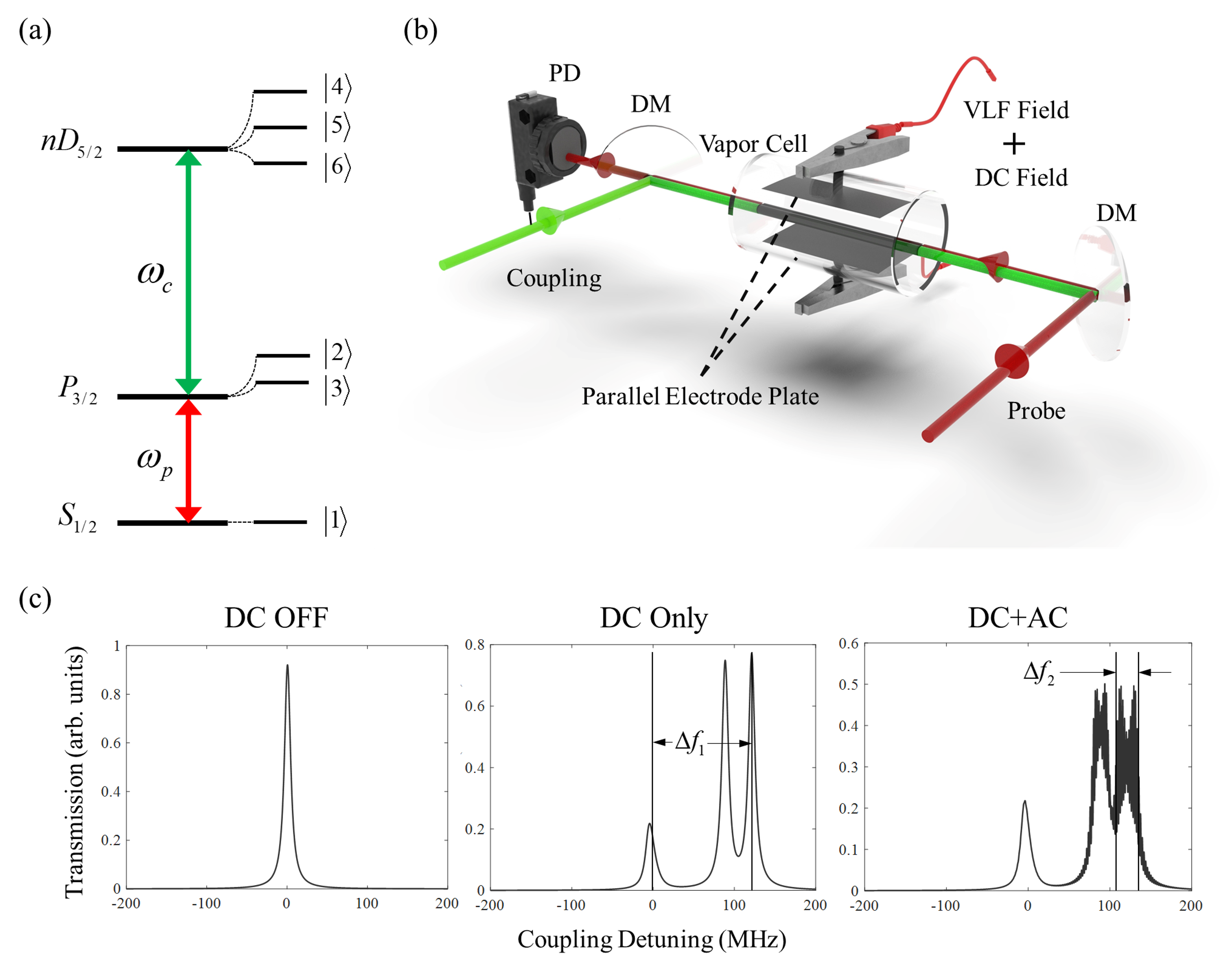
- Rydberg atoms act like ultra-sensitive, tiny antennas. When an electric field is present, the preferred color of light they absorb shifts slightly (this is called the Stark effect). By measuring that shift with lasers, you can figure out the electric field.
- The authors found a way to measure slow, sub‑MHz signals by combining a steady (DC) electric field with the signal (AC) and then reading a clean, averaged “fingerprint” in the atoms’ response. This lets them calculate the signal strength directly from atomic properties, so they don’t need to calibrate against external hardware.
What questions did they try to answer?
Before explaining the steps, here are the simple questions they tackled:
- How can we detect very low‑frequency electric fields (below 1 MHz) using atoms in a small device?
- Can we do it without relying on tricky calibrations (like exact electrode spacing or reference fields)?
- Can we make the reading stable even if laser power or other conditions change a bit?
How their approach works (in everyday language)
Think of the atoms like tiny, super‑precise tuning forks inside a glass cell:
- Two laser beams shine through the cell. Properly tuned, they make the atoms nearly transparent at a specific color—this is a “sweet spot” the system watches.
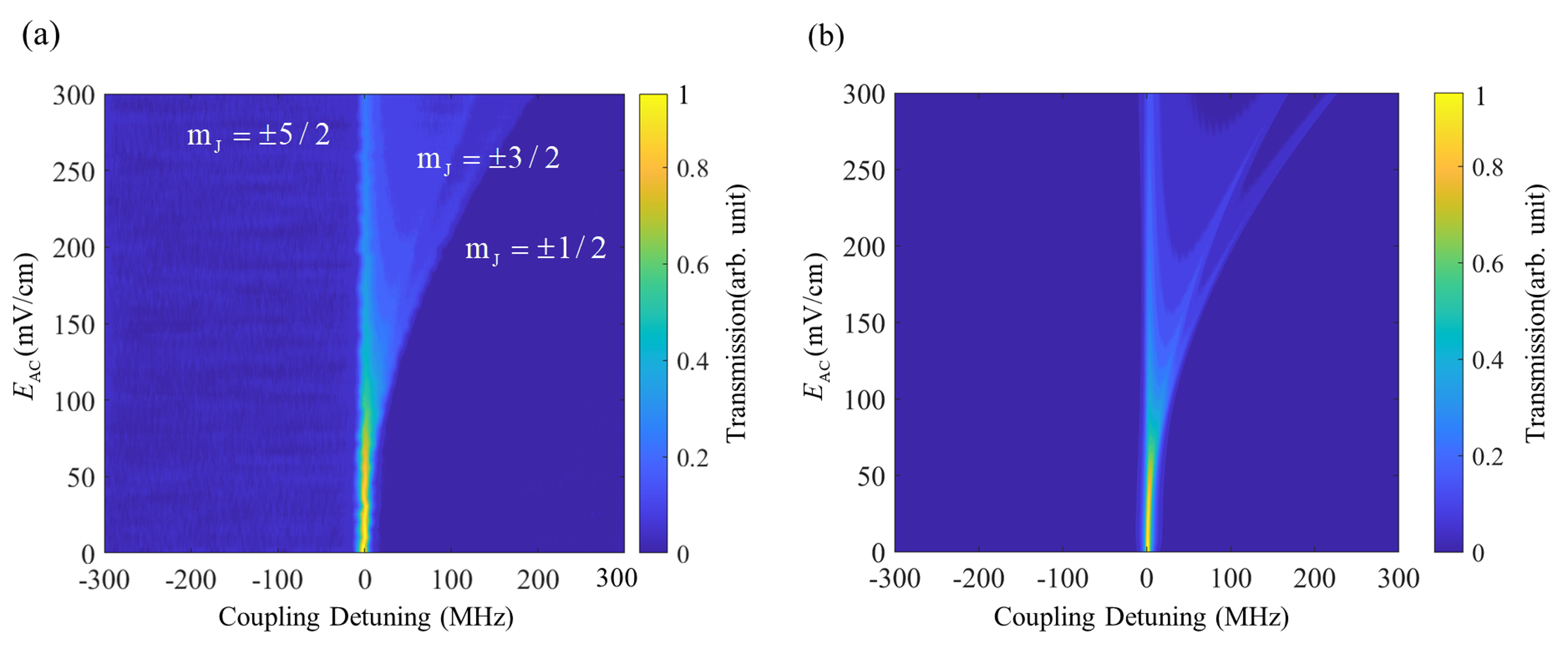
- An electric field nudges this sweet spot left or right in frequency. A steady field (DC) shifts it to a new center. A wiggly, slow field (AC, like a 30 kHz signal) makes it swing back and forth around that center—like gently pushing a swing.
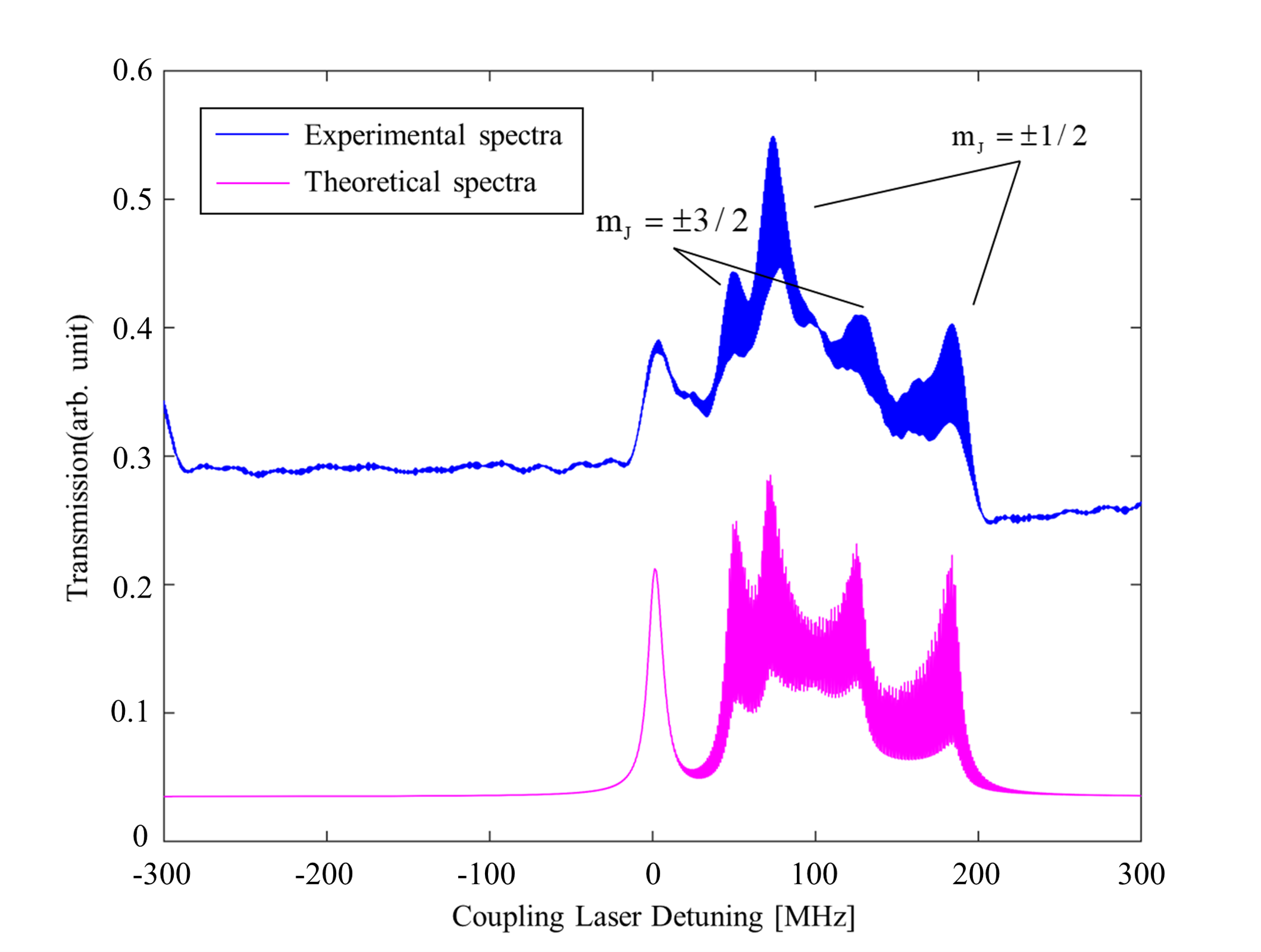
- Instead of trying to track the swing in real time, the team averages over many wiggles and fits a smooth curve to the whole pattern. From that curve, they get two clean numbers:
- The main shift caused by the DC field.
- The “swing size” caused by the AC field.
- Because both numbers come from the same atoms and depend on a built‑in property (the atoms’ polarizability—how easily the atom’s electrons are pulled by a field), they can compute the AC field strength directly. No tape measure, no external reference, no extra calibration.
To check and refine this idea, they used:
- A computer model that simulates how several atomic energy levels behave and relax over time (think of it as a physics‑based animation of the atoms responding to the fields).
- A lab setup with cesium vapor, two lasers, and carefully applied electric fields to compare with the model.
What they found and why it matters
Here are the key results:
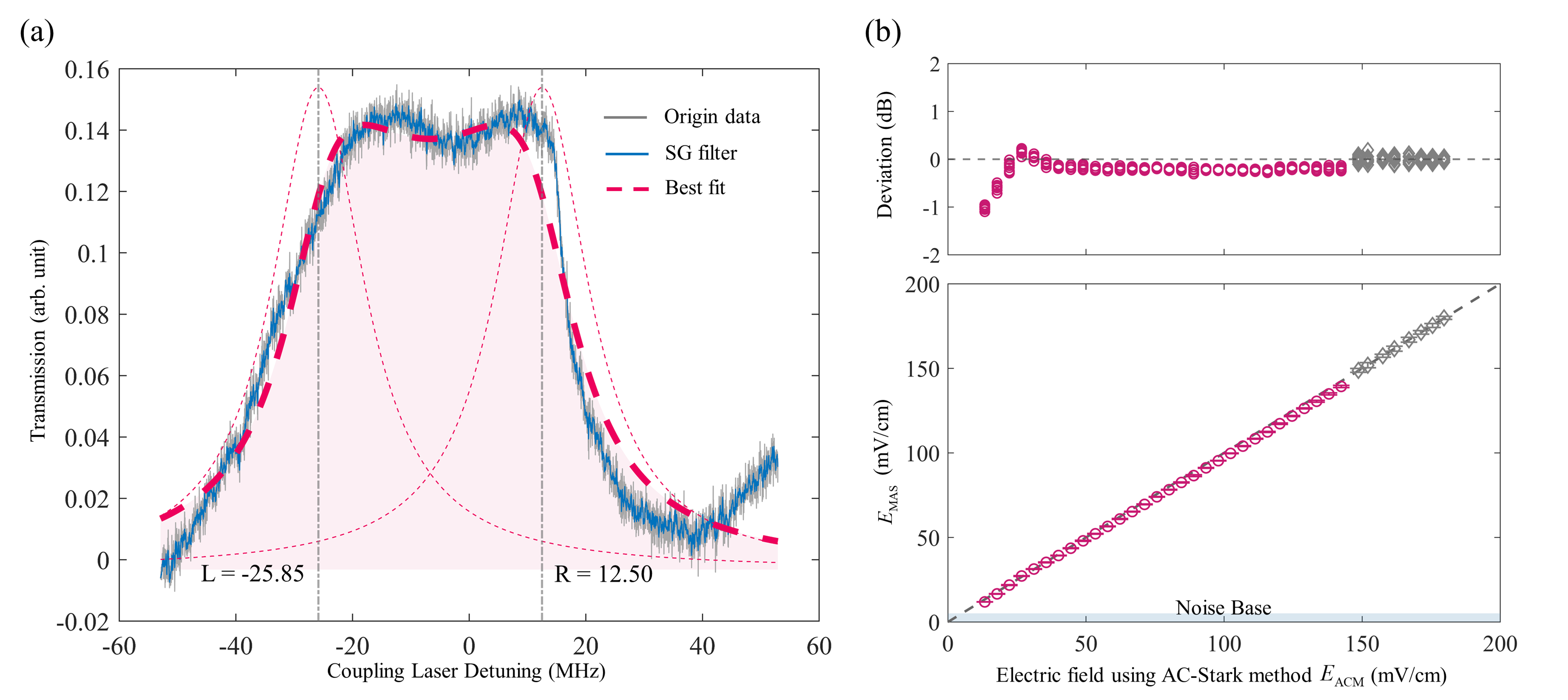
- They successfully measured a 30 kHz electric field using their averaging‑and‑fitting method.
- They could detect fields as small as about 5.3 millivolts per centimeter (mV/cm), which is quite weak.
- The measurement stayed accurate even when the laser powers changed within normal operating ranges. That means it’s practical and robust, not fussy.
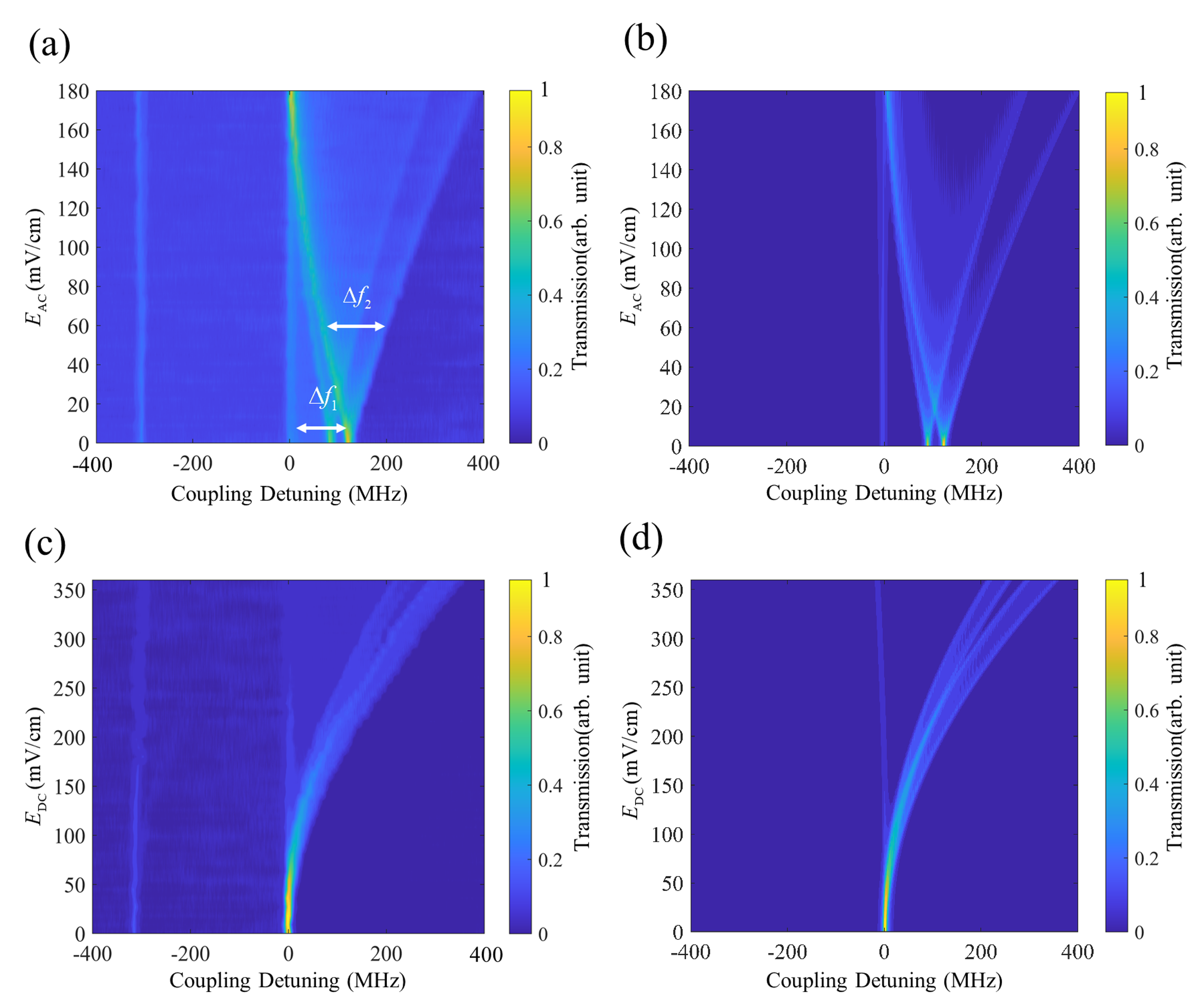
- The amount of splitting they measured grew exactly as expected: it was proportional to the DC field times the AC field. This confirmed their model and showed the DC field acts like a safe “amplifier” for the AC signal.
- The whole process didn’t require external calibration of the field strength, making the system simpler and more reliable.
Why this is important:
- It pushes atom‑based receivers to work well below 1 MHz, where many classic atomic methods struggle.
- It offers a small, calibration‑free “quantum front end” that could replace bulky antennas in places where size and payload matter—like underwater vehicles or subsurface sensors.
What this could lead to
- Underwater and underground communication: Sending and receiving low‑frequency signals with a compact sensor could be a game‑changer for submarines, robots, and exploration tools.
- Easier, more trustworthy measurements: Because the reading depends on intrinsic atomic behavior, it’s less sensitive to setup quirks and drift over time.
- Future improvements: The authors suggest working on even smaller cells, on‑chip integration, and real‑time decoding to widen the bandwidth and make the system more stable and portable.
In short, the paper shows a clever way to let atoms do the hard work of measuring slow, weak electric fields—accurately, stably, and without bulky antennas or fussy calibration.
Collections
Sign up for free to add this paper to one or more collections.