Electrometry of extremely-low frequencies from kHz to sub-Hz with a Rydberg-atom sensor
Abstract: Rydberg-atom electric field sensing has shown great potential from near-DC to THz with state-of-the-art measurement metrics realized in sensitivity, phase extraction, multi-band receptivity, etc. While Rydberg-atom sensors have shown exceptional performance in the GHz regime, low-frequency operation has remained challenging because of electric-field-screening in conventional vapor cells, which suppresses externally applied fields. We overcome this limitation by combining auxiliary modulation and lock-in detection with a paraffin-coated vapor cell, and demonstrate an electrode-free, wideband method for sensing frequencies, ranging from 0.5 Hz to 10 kHz. Our work extends Rydberg-atom sensor range to VLF, ULF, SLF, ELF and sub-ELF frequency bands. In our method, high state-of-the-art sensitivities have been achieved - 819 $μ$V/cm/$\sqrt{\text{Hz}}$ for 1 Hz, 33 $μ$V/cm/$\sqrt{\text{Hz}}$ for 10 Hz, 10 $μ$V/cm/$\sqrt{\text{Hz}}$ for 100 Hz and 2 $μ$V/cm/$\sqrt{\text{Hz}}$ for 1 kHz.

Paper Prompts
Sign up for free to create and run prompts on this paper using GPT-5.
Top Community Prompts
Explain it Like I'm 14
Easy-to-Understand Summary of the Paper
What is this paper about?
This paper shows how to build a tiny, super-sensitive “electric field microphone” using atoms. It can pick up very slow, low-frequency electric signals—from 0.5 times per second (0.5 Hz) up to 10,000 times per second (10 kHz)—without using big antennas or metal electrodes inside the sensor. The trick is to use special atoms called Rydberg atoms and a clever way of listening for signals that filters out noise.
What questions were the researchers trying to answer?
- Can a small, atom-based sensor detect very low-frequency electric fields (from sub-Hz to kHz) that usually need huge antennas?
- How can we stop a glass vapor cell from blocking (screening) slow electric fields so the atoms inside can sense them?
- Can this sensor work across a wide range of low frequencies with good sensitivity, and how does it compare to a normal antenna the same size?
How did they do it?
The basic idea (atoms as tiny antennas)
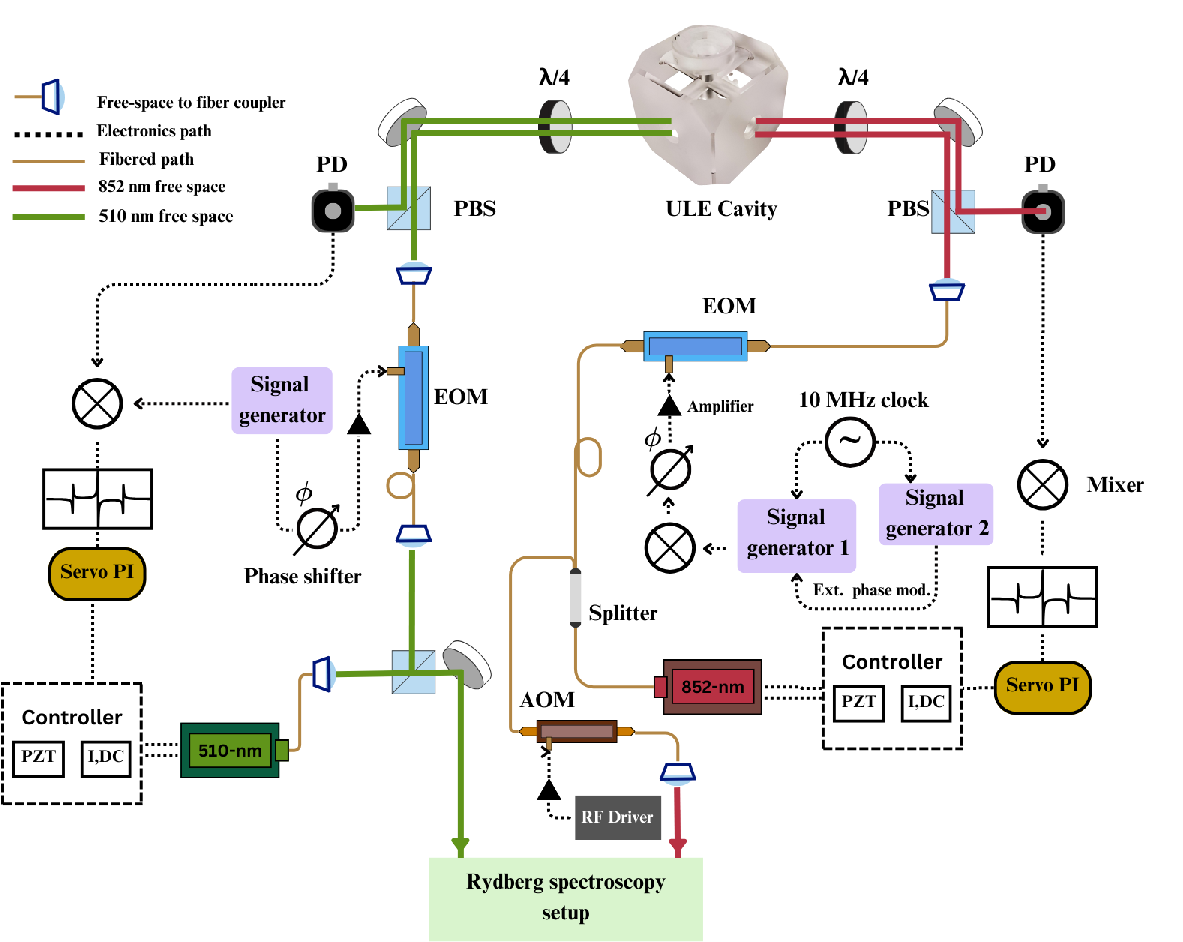
- The team used cesium atoms heated into a gas inside a small glass bulb (a “vapor cell”).
- With two lasers, they excited the atoms into high-energy “Rydberg” states. Rydberg atoms are extremely sensitive to electric fields—like tiny antennas that can feel even very faint fields.
- When an electric field is present, the atomic energy shifts a bit (this is called the Stark effect). That shift changes how much light passes through the vapor, letting the researchers “see” the electric field.
The problem (electric-field screening)
- In a normal glass vapor cell, slow electric fields get canceled out. That’s because a thin, slightly conductive layer forms on the inside of the glass and rearranges charges to block the field—like a mini Faraday cage.
- Result: the atoms don’t feel slow (low-frequency) fields, so the sensor can’t detect them.
The fix (a special coating and a smart listening trick)
- Paraffin coating on the cell:
- They used a cell coated with paraffin (a wax). This coating slows down how quickly charges move along the inner surface.
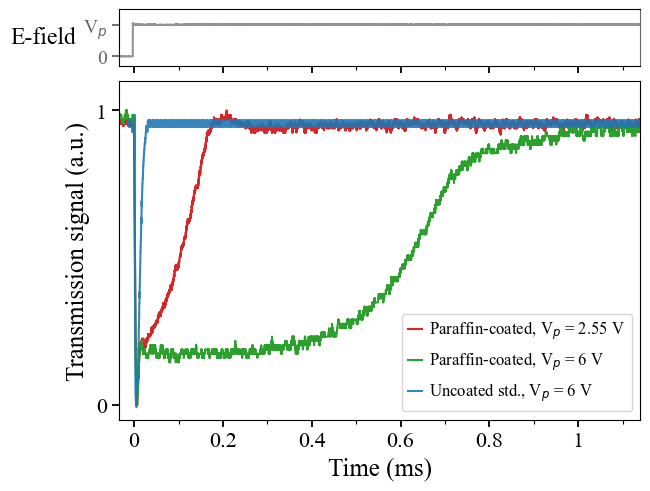
- In a normal (uncoated) cell, the field is canceled in about 10 microseconds (very fast).
- In the paraffin-coated cell, cancellation takes much longer—about 0.1 to 0.6 milliseconds—giving the atoms a brief “window” to feel the electric field before it’s screened.
- Auxiliary modulation + lock-in detection:
- Auxiliary modulation: The researchers added a small, fast-flipping electric field (like flicking a light switch on and off thousands of times per second). This keeps the atoms sensing in the “window” before screening fully develops.
- Lock-in detection: They used a lock-in amplifier, a tool that “listens” only at the flip frequency and filters out other noise—like noise-canceling headphones tuned to one beat.
- Together, these steps let the sensor measure very slow signals by mixing them with the fast flip and then extracting the real signal cleanly.
- Optimizing the “sweet spot” (operating point):
- The team carefully chose how far the laser was tuned (“probe detuning”) and how strong the auxiliary field was. This put the atoms at a point where a tiny change in field makes a big, easy-to-measure change in the signal (a steep slope = high sensitivity).
What did they find?
- The sensor could detect electric fields from 0.5 Hz up to 10 kHz using a small, electrode-free vapor cell.
- It achieved very strong sensitivities (smaller is better here, meaning it can detect very tiny fields):
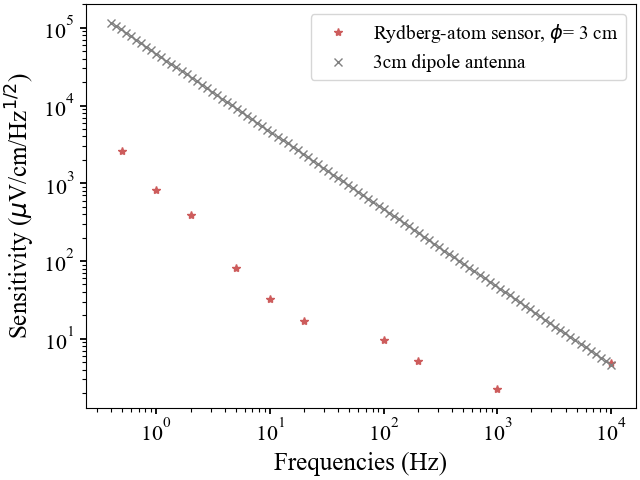
- 1 Hz: about 819 microvolts per centimeter per √Hz
- 10 Hz: about 33 μV/cm/√Hz
- 100 Hz: about 10 μV/cm/√Hz
- 1 kHz: about 2 μV/cm/√Hz
These numbers mean that, in one second of averaging, the sensor can detect field changes as small as a few to a few hundred millionths of a volt per centimeter, depending on frequency.
- Compared to a normal, same-size dipole antenna (about 3 cm), the atom sensor was about 10–100 times more sensitive at the lowest frequencies. Around 1 kHz and above, the two begin to match.
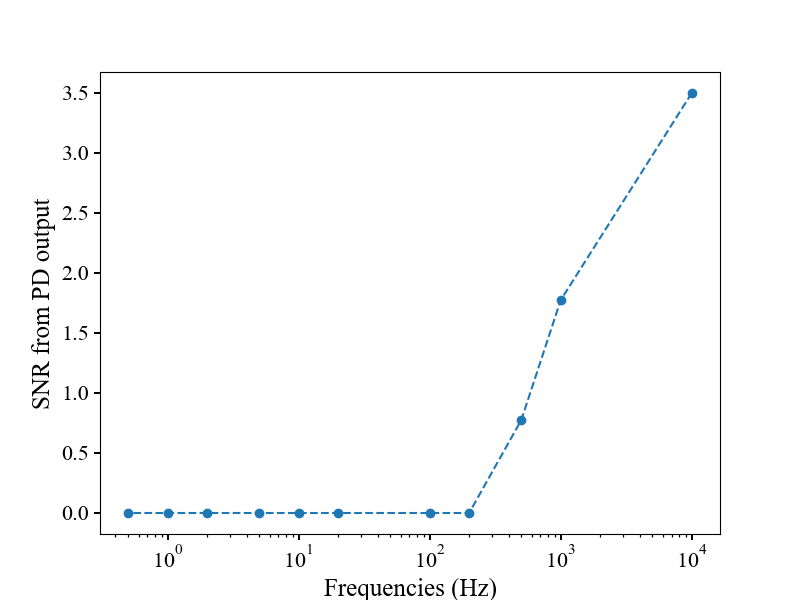
- Without the auxiliary modulation (the “flip”), direct sensing in the coated cell only worked well above ~500 Hz. With the modulation and lock-in method, the team pushed down to 0.5 Hz with high sensitivity.
Why is this important?
- Low-frequency signals travel very far and can pass through water and ground better than high-frequency signals. That makes them useful for:
- Underwater-to-air communication
- Finding buried cables or faults
- Non-invasive testing of batteries and electronics
- Studying the atmosphere and Earth’s electric environment
- Low-frequency radio astronomy
- Biological and geological field measurements
- Traditional low-frequency antennas are huge (meters to kilometers long). This tiny, atom-based sensor does similar or better jobs in a much smaller package.
- Because the same kind of sensor can work across many bands, it could simplify systems that normally need lots of different receivers.
How to picture it (simple analogies)
- Atoms as sensors: Imagine each atom as a tiny weather vane that swivels when an electric “wind” blows. The lasers let you watch the vane, and any small change tells you the wind (electric field) changed.
- Screening problem: The inside of the cell acts like a blanket that blocks the “wind” if it has time to settle. The paraffin blanket settles more slowly, so you get a short time to feel the wind.
- Lock-in trick: You waggle the wind source at a steady beat (the auxiliary modulation) and use a device that only listens to that beat. That way, random noise gets ignored, and the real signal stands out.
Final takeaway
This research shows a small, atom-based sensor can cleanly detect very slow electric fields (down to 0.5 Hz) with excellent sensitivity, without big antennas or internal electrodes. It outperforms a same-size classical antenna at the lowest frequencies and could be used in communications, environmental sensing, and science. With faster electronics, the same method could also be pushed to higher frequencies, making it a flexible, wideband tool for future technologies.
Collections
Sign up for free to add this paper to one or more collections.