Microwave electrometry with quantum-limited resolutions in a Rydberg atom array
Abstract: Microwave (MW) field sensing is foundational to modern technology, yet its evolution, reliant on classical antennas, is constrained by fundamental physical limits on field, temporal, and spatial resolutions. Here, we demonstrate an MW electrometry that simultaneously surpasses these constraints by using individual Rydberg atoms in an optical tweezer array as coherent sensors. This approach achieves a field sensitivity within 13% of the standard quantum limit, a response time that exceeds the Chu limit by more than 11 orders of magnitude, and in-situ near-field mapping with λ/3000 spatial resolution. This work establishes Rydberg-atom arrays as a powerful platform that unites quantum-limited sensitivity, nanosecond-scale response time, and sub-micrometer resolution, opening new avenues in quantum metrology and precision electromagnetic field imaging.
Paper Prompts
Sign up for free to create and run prompts on this paper using GPT-5.
Top Community Prompts
Explain it Like I'm 14
What is this paper about?
This paper shows a new kind of “microwave field meter” built from single atoms held in place by laser tweezers. These atoms are put into special “Rydberg” states that make them extremely sensitive to tiny electric fields. The researchers use many of these atoms as tiny, identical sensors to measure microwaves with three things at once: very high sensitivity (almost as good as quantum physics allows), extremely fast response (down to billionths of a second), and very fine spatial detail (much smaller than the microwave wavelength).
What are the big questions the paper asks?
- Can single atoms be used as tiny, precise microwave sensors that get close to the best possible accuracy allowed by quantum mechanics (the “standard quantum limit”)?
- Can these atomic sensors respond much faster than any normal microwave antenna of the same size (beating a classical size–speed limit called the “Chu limit”)?
- Can they map how microwave fields vary in space with details much smaller than the microwave wavelength?
How did they do it? (In everyday language)
Think of each atom as a microscopic “compass needle” for microwaves:
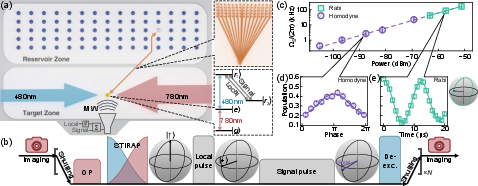
- Catching and placing atoms: The team traps individual rubidium atoms in tiny spots of laser light called optical tweezers (like very small optical “tongs”). They keep most of them in a “reservoir,” then move one atom at a time into a “target zone” where measurements happen. Moving one at a time avoids atoms disturbing each other.
- Making atoms ultra-sensitive: They “promote” each atom to a Rydberg state—this means one electron is very far from the nucleus. Because of that, the atom acts like a super-sensitive antenna for electric fields.
- Turning microwaves into a measurable signal: When the atom sits in a microwave field, the field makes the atom’s internal “pointer” rotate at a rate that depends on how strong the field is. This rotation rate is called the Rabi frequency. By timing how much the atom’s state changes, they work out the field strength. The simple rule they use is: rotation rate ∝ field strength.
- Measuring weak signals carefully (homodyne trick): To pick up very weak microwaves, they first give the atom a strong, well-controlled “reference” microwave kick (like setting a metronome), then let the weak unknown signal nudge the atom a little more. By scanning the relative phase (the timing difference) between the reference and the unknown signal, they read out how big the weak signal is. This is similar to how a radio mixes a weak station with a local oscillator to make it easier to detect—just done with a single atom instead of electronics.
- Checking speed and detail: To test time response, they send very short microwave pulses (about 10 nanoseconds long) and see if the atom can track them. To test spatial detail, they move the atoms around and map how the microwave field changes from place to place, looking for tiny differences.
Key ideas explained simply:
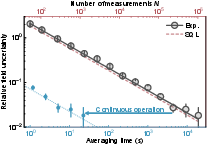
- Standard quantum limit (SQL): Even perfect measurements with quantum systems have a built-in “coin-flip” randomness when you read out the state. This sets a best-possible precision. They get within 13% of this limit.
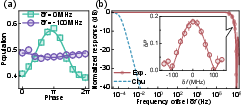
- Chu limit: For a normal antenna, if it’s very small compared to the wavelength, its bandwidth and response speed must be very narrow/slow. Single atoms, being quantum systems, don’t follow this classical rule in the same way—so they can respond much faster.
What did they find, and why does it matter?
- Near-quantum-limited sensitivity: Their single-atom sensor detects microwave fields with a precision only about 13% worse than the absolute quantum limit set by nature. With their current setup (about 53 measurements per second), they reach extremely small field levels; with faster operation (tens of thousands of measurements per second), they project even better sensitivity.
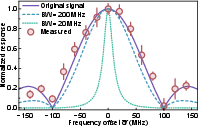
- Ultrafast response (beating classical limits by a huge margin): The atoms accurately detect 10-nanosecond microwave pulses and show a measurement bandwidth of over 200 megahertz. A classical antenna the size of the atom (hundreds of nanometers) would be limited to a bandwidth around a thousandth of a hertz—so the atom beats that by more than 11 orders of magnitude.
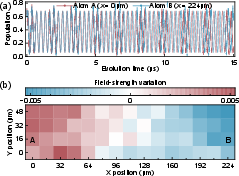
- Sub-wavelength spatial mapping: They map the microwave field with detail as fine as about one three-thousandth of the wavelength (for a 6.6 GHz microwave, that’s on the scale of ~15 micrometers across a 45 mm wavelength). Classical microwave receivers can’t normally “see” structure that fine. The atom can, because its sensing volume is tiny—set by the size of its electron cloud.
Why this matters:
- It combines three things that are hard to achieve together: almost quantum-limited sensitivity, nanosecond timing, and sub-wavelength spatial detail. That’s like having a microscope, a high-speed camera, and a very sensitive microphone all in one tiny device—just for microwaves.
What could this lead to?
- Better tools for engineering: High-resolution maps of microwave fields directly on chips or inside devices (like antennas, waveguides, or qubit circuits) to diagnose and improve designs.
- Faster, smarter communication: Capturing very short, information-rich microwave bursts with high fidelity may help future communication systems approach theoretical limits.
- Ultra-weak signal detection: Acting as a “quantum receiver” that’s quieter than classical electronics, opening possibilities in radio astronomy, low-noise sensing, or searches for new physics (for example, faint signals that could be linked to dark matter).
- Even beyond today’s limits: In the future, by entangling atoms (making them act in a coordinated quantum way), they could pass the standard quantum limit and measure even more precisely.
In short, this work shows that arrays of single atoms can function as powerful, flexible microwave sensors—pushing past classical limits in sensitivity, speed, and spatial detail—and could reshape how we measure and image electromagnetic fields.
Knowledge Gaps
Knowledge gaps, limitations, and open questions
- Absolute sensitivity versus SQL: identify the dominant technical noise sources responsible for the remaining 13% gap to the SQL (e.g., finite T2≈60 μs, STIRAP/readout infidelities A≈0.44, B≈0.68, LO phase/amplitude noise) and quantify their individual contributions with a full error budget and uncertainty analysis.
- Repetition rate bottlenecks: demonstrate the projected 45 kHz continuous-operation mode (currently 53 Hz) and characterize trade-offs with heating, atom loss, crosstalk, and state-preparation/readout fidelity at high duty cycles.
- Dynamic range characterization: map the full field dynamic range from the weakest detectable fields (nV/cm regime) up to strong-drive limits (MHz Rabi rates), including nonlinearity onset, AC Stark shifts, Autler–Townes splittings, and fine-structure mixing.
- Sensitivity–bandwidth trade-off for ultrafast pulses: quantify the minimum detectable field amplitude for nanosecond-scale pulses and how detection thresholds scale with pulse duration, detuning, and Rabi coupling, rather than demonstrating only with strong pulses.
- Single-shot transient capture: the homodyne reconstruction of amplitude/phase relies on scanning the relative phase φ over repeated trials; develop and test truly single-shot protocols for unknown transient pulses (e.g., multi-qubit tomography, parallel φ-sampling, or adaptive control).
- Vector and polarization sensing: validate the “atomic vector spectrometer” claim by experimentally extracting full vector field components and polarization (σ±, π) at each site, including sensitivity to polarization misalignment and Zeeman-state leakage.
- Broadband and multiband operation: demonstrate tunability across multiple Rydberg transitions to cover different MW bands and quantify instantaneous bandwidth limits set by multilevel structure, Zeeman splittings, and rotating-wave approximation breakdown.
- Intrinsic bandwidth limits: extend the frequency-response measurement well beyond ±200 MHz to determine the true roll-off and the role of off-resonant couplings, selection rules, and magnetic-field inhomogeneities.
- Parallelism and scaling: move beyond sequential, single-sensor operation; quantify performance (sensitivity, crosstalk, dephasing from dipolar interactions) when many atoms are interrogated simultaneously for faster, snapshot imaging.
- Spatial resolution versus positioning: although the interaction region is ~260 nm, the demonstrated mapping uses 16 μm steps (≈λ/3000); determine the practical limit set by tweezer positioning noise, pointing stability, and atom-wavefunction extent, and demonstrate sub-micron mapping.
- Absolute field metrology: current near-field images report relative variations ζ(x,y); establish traceable absolute field calibration in the near-field geometry (including antenna/fixture scattering and standing waves) with a rigorous uncertainty budget.
- Proximity to device surfaces: evaluate sensor performance (coherence, sensitivity, systematic shifts) at tens of micrometers from conducting/dielectric surfaces relevant to on-chip metrology, including effects of patch charges, adsorbates, and stray fields.
- Environmental robustness: quantify long-term stability without frequent daily calibrations (frequency, phase, amplitude), and develop active compensation for DC/AC Stark shifts from drifting surface charges to enable autonomous operation.
- Magnetic-field control: assess spatial inhomogeneity and drift of the bias field (10–30 G) across the imaging region and its impact on resonance frequency, selection rules, and spatial phase errors in vector and polarization measurements.
- Readout and state-preparation fidelity: improve and benchmark A and B (currently ~0.44 and ~0.68), including contributions from STIRAP inefficiency, optical pumping errors, and state-selective loss/readout errors, and quantify how these limit SQL and scaling.
- Coherence time limits: identify dominant dephasing channels (e.g., electric-field noise, blackbody radiation, laser phase noise) limiting T2≈60 μs and demonstrate techniques (e.g., cryogenic operation, electric-field shielding/feedback, dynamical decoupling) to extend T2 for longer interrogation times.
- LO-induced systematics: characterize sensitivity to LO amplitude/phase noise and timing jitter, especially in weak-signal and ultrafast regimes; evaluate common-mode rejection strategies and residual technical noise floors.
- Standing-wave and multipath artifacts: determine whether the combined MW field configuration (horn, structures) produces spatial interference that biases local Rabi-rate measurements, and develop methods to disentangle genuine near-field gradients from setup-induced fringes.
- Fair comparison to classical receivers: formalize the effective aperture and noise-equivalent power mapping used to claim −211 to −240 dBm/Hz sensitivity and “effective temperatures,” ensuring comparable metrics to state-of-the-art near-field probes and scanning MW microscopes.
- Chu-limit interpretation: clarify the scope of the Chu-limit comparison for an active, quantum-coherent sensor (with lasers and LO) versus passive antennas, and propose standardized metrics for “temporal fidelity” applicable across platforms.
- Frequency agility and multiplexing: move beyond single-frequency operation at f0≈6.6 GHz by demonstrating fast frequency hopping, simultaneous multi-tone readout, or array-based frequency multiplexing, and quantify cross-channel interference.
- Spatiotemporal imaging: develop true 2D/3D, time-resolved field mapping (snapshot acquisition across many sites) to avoid drift-induced artifacts inherent to sequential scans; validate with known test patterns.
- Near-field inversion: couple high-resolution measurements to electromagnetic inverse-modeling to reconstruct source distributions and currents on circuits, including confidence intervals, regularization, and resolution limits.
- Deployment constraints: assess size, power, and complexity for practical sensing systems (vacuum, lasers, MW control), explore integration/miniaturization pathways (e.g., microfabricated cells or portable tweezer systems), and quantify performance impacts.
- Entanglement-enabled metrology: provide a concrete protocol and feasibility analysis for surpassing SQL with entangled Rydberg arrays in the presence of MW driving (effects of interactions, decoherence, and control errors), including expected Fisher information gains and robustness.
Collections
Sign up for free to add this paper to one or more collections.