- The paper introduces the quad-process model, extending dual-process theory by incorporating morphological computation and collective predictive coding.
- It details System 0’s pre-cognitive embodied processes alongside Systems 1/2’s intuitive and deliberative cognition for adaptive behavior.
- The study highlights System 3’s role in emergent collective intelligence, linking symbol emergence and societal adaptation across temporal scales.
System 0/1/2/3: A Quad-Process Theory for Multi-Timescale Embodied Collective Cognitive Systems
Introduction
The paper "System 0/1/2/3: Quad-process theory for multi-timescale embodied collective cognitive systems" introduces an innovative framework extending dual-process theory by integrating Systems 0 and 3 with the traditional Systems 1 and 2. This quad-process model explores the diverse temporal dynamics of cognition across multiple timescales and abstraction levels, inspired by Bergson's philosophy. System 0 involves morphological computation and passive dynamics that enable adaptive behavior without explicit neural processing. System 3 includes collective predictive coding, which elucidates collective intelligence and symbol emergence spanning extended timescales.
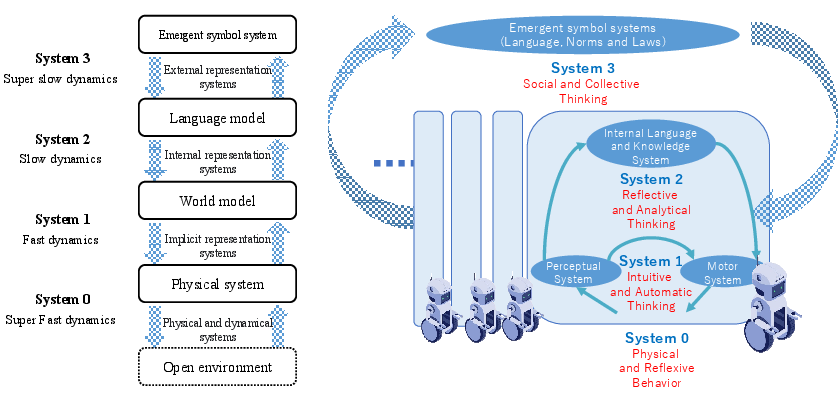
Figure 1: Hierarchical representation of System 0/1/2/3 cognitive framework.
System 0: Morphological Computation
System 0 constitutes pre-cognitive embodied processes at the foundational layer of cognition. It involves direct physical interactions between an agent's body and its environment, without explicit computation. Examples include passive dynamic walkers that rely solely on physical embodiment for adaptive behavior, demonstrating ultra-fast dynamics that often precede neural processing (Figure 2). This notion emphasizes the significance of embodiment in enabling intelligent behavior.
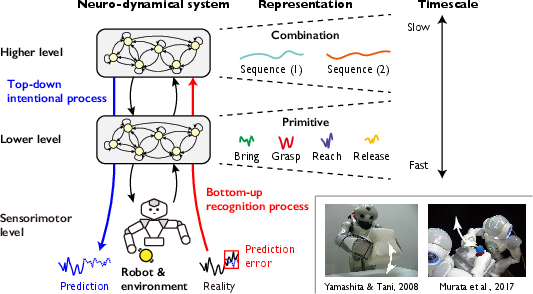
Figure 2: Neuro-dynamical system and examples of robotic tasks.
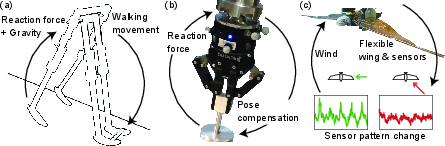
Figure 3: (a) Passive dynamic walker that walks without an actuator or computer. (b) Soft wrist that enables a robot arm to learn peg-insertion tasks using its passive dynamics. (c) Flapping-wing robot that computes the wind direction using the dynamics of its flexible wing movements.
Systems 1 and 2: Intuitive and Deliberative Cognition
Systems 1 and 2 align with conventional dual-process theory, where System 1 denotes intuitive, fast-thinking processes, and System 2 pertains to deliberate, reflective cognition. These systems incorporate neurodynamical, embodied AI elements and contribute to real-world adaptive behaviors through sensorimotor interactions. Recent advancements in AI showcase the potential for combining logical reasoning (System 2) with machine-learning approaches (System 1), facilitating enhanced generalization and abstraction capabilities.
System 3: Collective Predictive Coding and Symbol Emergence
At the highest level, System 3 encompasses collective intelligence, focusing on symbol emergence and societal-level adaptation. This system postulates that shared symbolic systems (e.g., languages, norms) emerge from interactions within social contexts and operate over extensive timescales. The collective predictive coding hypothesis provides a robust framework for understanding symbol emergence through Bayesian inference and communication processes among agents (Figure 4).
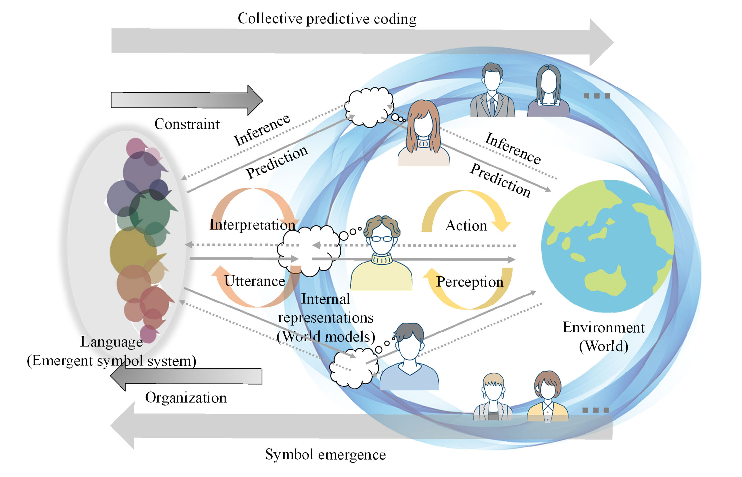
Figure 4: Overview of collective predictive coding hypothesis. \added{This figure is reused from ~\citet{taniguchi2024collective}.
Theoretical and Practical Implications
The System 0/1/2/3 framework establishes a novel theoretical foundation for interpreting the interplay between adaptive and cognitive processes from a multi-scale perspective. It elucidates the roles of morphological computation and collective intelligence in shaping cognition across individual and societal levels. By extending Bergsonian multi-timescale interpretations, this framework offers a unified view that bridges embodied intelligence, computational neuroscience, and societal adaptation. These insights are poised to drive forward research in AI, robotics, and cognitive science.
Conclusion
By expanding the dual-process theory into a quad-process framework, the paper provides a comprehensive perspective on cognitive systems that integrates pre-cognitive, individual, and collective processes across multiple temporal scales. This model emphasizes the indispensable role of morphological computation and symbol emergence, setting the stage for future exploration of multi-timescale, embodied cognitive systems. The implications span theoretical discourse and practical applications, promoting interdisciplinary research and enhancing our understanding of intelligence in both biological and artificial domains.