- The paper presents Times2D, which leverages multi-period decomposition and derivative mapping to significantly improve forecasting accuracy.
- It utilizes FFT to convert 1D data into 2D tensors, enabling efficient capture of both long-term dependencies and short-term fluctuations via convolutional operations.
- Experimental results show superior performance on both short-term and long-term forecasting tasks across multiple benchmark datasets.
Times2D: Multi-Period Decomposition and Derivative Mapping for General Time Series Forecasting
Introduction
The paper "Times2D: Multi-Period Decomposition and Derivative Mapping for General Time Series Forecasting" (2504.00118) presents a novel approach for addressing challenges inherent in time series forecasting. The authors develop a framework, termed Times2D, which transforms 1D time series data into a 2D space to better capture complex temporal variations, including multi-periodicity and sharp fluctuations.
Times2D consists of three core components: the Periodic Decomposition Block (PDB), First and Second Derivative Heatmaps (FSDH), and an Aggregation Forecasting Block (AFB). By converting time series data into 2D representations, Times2D enables the application of 2D convolutional operations that capture both long-term and short-term dependencies efficiently. This paper reports state-of-the-art performance on various large-scale datasets, demonstrating the framework's potential for both short-term and long-term forecasting.
Methodology
Times2D introduces a methodologically rigorous approach grounded in transforming time series into a two-dimensional framework for enhanced data analysis and prediction accuracy.
Periodic Decomposition Block (PDB)
The PDB component leverages the Fast Fourier Transform (FFT) to identify dominant periods and their corresponding frequencies within the time series. This transformation reshapes the series into 2D tensors, facilitating the efficient capture of temporal dependencies across different periods and frequencies.
First and Second Derivative Heatmaps (FSDH)
The FSDH module computes first and second derivatives of the time series to capture significant fluctuations and turning points. This approach helps in highlighting momentous changes within the data, which are subsequently represented as 2D heatmaps.
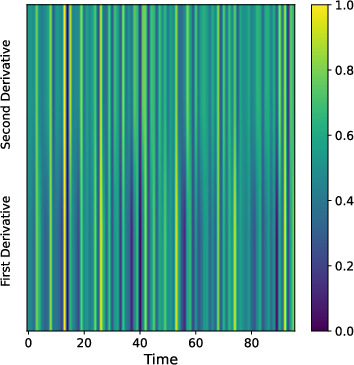
Figure 1: 2D heatmap representation of a 1D sequence with a length of 96.
Aggregation Forecasting Block (AFB)
The outputs from PDB and FSDH are integrated within the AFB to produce precise forecasts. The aggregation process effectively combines insights from both modules to address intricacies in temporal variations.
Experimental Results
The framework was rigorously tested across multiple datasets, demonstrating superior forecasting capabilities.
Short-Term Forecasting
In short-term forecasting tasks, Times2D achieved superior results on the M4 dataset, outperforming advanced models such as N-HITS and PatchTST in terms of SMAPE, MASE, and OWA metrics. This underscores Times2D's competence in capturing seasonal and non-linear trends effectively.
Long-Term Forecasting
In long-term forecasting scenarios, Times2D consistently outperformed state-of-the-art models across various datasets and prediction horizons, specifically in terms of reduced MSE and MAE metrics. The robust performance across ETTm1, ETTm2, and Weather datasets affirms Times2D's ability to manage extensive temporal dependencies.
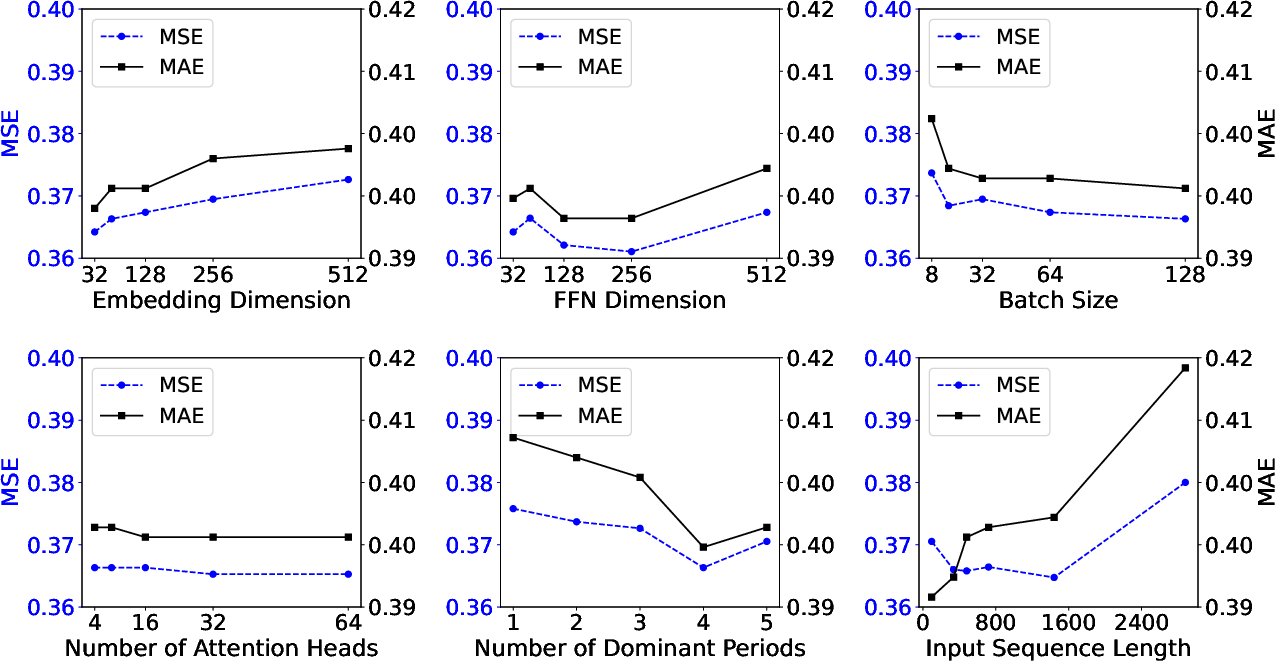
Figure 2: Sensitivity analysis of key hyperparameters for Times2D on the ETTh1 dataset with a prediction horizon of H=96.
Computational Efficiency
Times2D maintains a noteworthy balance between computational speed and resource efficiency. The model exhibits low variability in processing time and memory usage across different prediction lengths, ensuring scalability and suitability for large-scale data applications.
Sensitivity Analysis
A detailed sensitivity analysis highlights Times2D's optimal performance with specific configurations of key hyperparameters. Adjusting parameters such as embedding size, batch size, and the number of attention heads affects the model's accuracy, thus providing insights into effective hyperparameter tuning.
Conclusions
The Times2D framework offers an innovative approach to time series forecasting by utilizing a two-dimensional data transformation. The study demonstrates that Times2D is effective in capturing complex temporal patterns by leveraging multi-periodicity and derivative mapping within the frequency domain. Empirical validations exhibit its superiority over existing models in both forecasting precision and computational efficiency.
Future developments could extend Times2D to incorporate anomaly detection and further explore its performance across diverse forecasting scenarios. This work marks a significant advancement in the domain of time series analytics and predictive modeling.

