- The paper presents PRISM, a hierarchical multiscale forecasting method that uses binary tree-based segmentation and time-frequency decomposition to capture global trends and local fluctuations.
- The model employs a lightweight router for adaptive importance weighting, achieving superior MSE and MAE on benchmark datasets.
- Its interpretable design reveals significant time-frequency components, offering actionable insights for tuning and adapting forecasting models.
PRISM: A Hierarchical Multiscale Approach for Time Series Forecasting
Introduction
The paper "PRISM: A hierarchical multiscale approach for time series forecasting" (2512.24898) introduces a novel method, PRISM (Partitioned Representation for Iterative Sequence Modeling), designed to improve forecasting accuracy for multivariate time series data by capturing both global and local patterns in the data. Traditional time series forecasting techniques often struggle with balancing the capture of long-term trends against short-term fluctuations. PRISM addresses this challenge through a hierarchical, multiscale approach that integrates a learnable tree-based partitioning of input signals with time-frequency decomposition techniques such as wavelets or exponential moving averages.
Model Overview
PRISM constructs a hierarchical binary tree structure that partitions the input time series into segments to reveal contextual localities at multiple temporal scales (Figure 1). At each node of the tree, which represents a temporal segment, a time-frequency decomposition is applied, creating representations specific to different scales. This multiscale approach stands in contrast to conventional methods that might either focus solely on time or frequency domains, lacking in their ability to capture the interlinked hierarchical nature of real-world time series data.
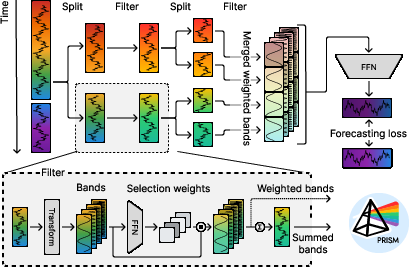
Figure 1: The PRISM model overview.
Methodology
PRISM employs a sequence of processing steps to transform and analyze the input time series:
- Time Decomposition: The input series is recursively partitioned into smaller temporal segments through binary splits, forming multiple hierarchical levels.
- Frequency Decomposition: Each segment undergoes a transformation using a time-frequency basis (e.g., Haar wavelets), which captures distinct frequency patterns relevant at each temporal level.
- Importance Weighting: A lightweight router module adaptively weights these transformed features by assessing their contribution to the forecasting task, enhancing interpretability and model robustness.
The resultant hierarchical representation thus captures a fine balance between long-range dependencies and local variations, facilitating improved forecasting accuracy on benchmark time series datasets.
Experimental Results
PRISM delivers superior performance across a variety of established benchmark datasets like ETT, Electricity, and Traffic datasets, demonstrating its versatility (Figure 2). Its hierarchical design allows for significant gains in accuracy compared to leading methods such as D-PAD and DLinear, particularly in handling irregular, aperiodic, incomplete, nonstationary, and drifting data that are often challenging for traditional models.
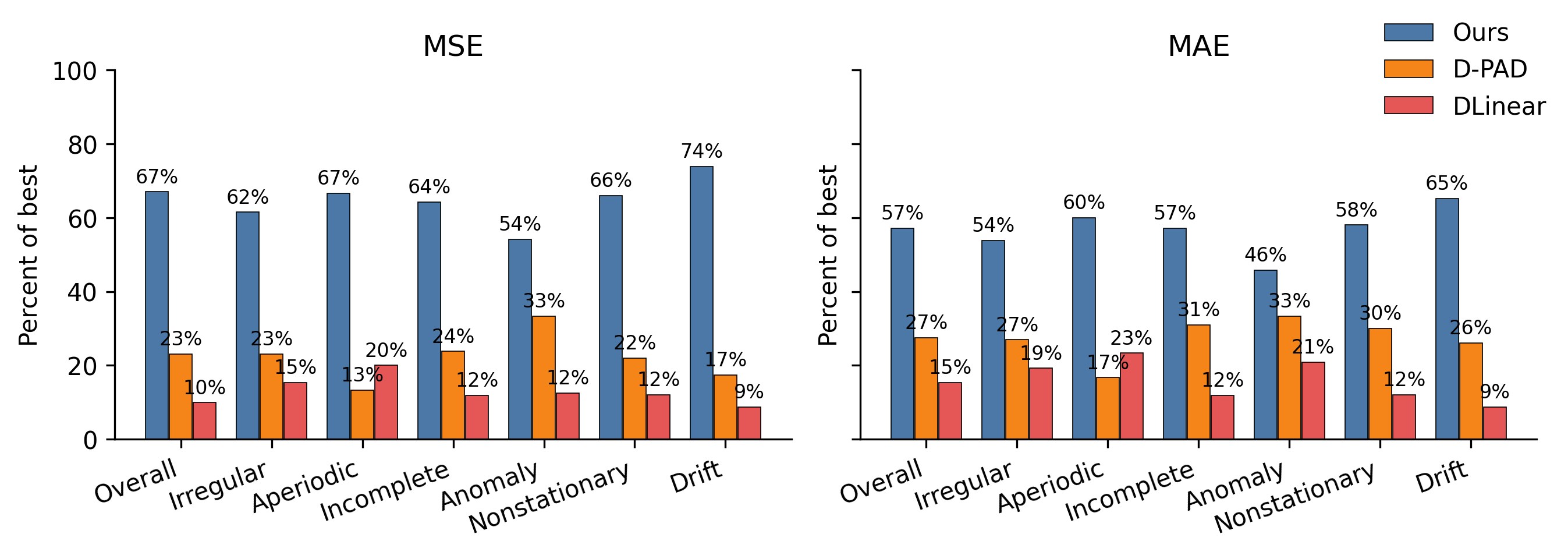
Figure 2: Forecasting performance across GIFT dataset property groups.
Notably, PRISM achieves the best mean squared error (MSE) and mean absolute error (MAE) across multiple experimental settings, underscoring its efficacy in processing complex signals with hierarchical dependencies (Figure 3).

Figure 3: Importance scores across ETT datasets.
Interpretability and Adaptation
One compelling feature of PRISM is its interpretability due to the mechanism of frequency weighting—revealing which time-frequency components most significantly impact predictions. This insight aids in understanding model behavior and guiding further tuning and adaptation to new datasets and domains. The importance scores, consistently high towards lower frequencies, suggest the model's capability in emphasizing globally informative components while disregarding noise.
Conclusion
PRISM presents a significant advancement in time series forecasting by systemically incorporating multiscale decomposition through a learnable framework that aligns with the intrinsic temporal and frequency characteristics of the data. This methodology not only enhances predictive accuracy but also maintains efficiency and interpretability, marking a step forward for applications in finance, biology, healthcare, and beyond. Future work might explore adaptive strategies for more personalized frequency bases or applications in more complex, multivariate forecasting tasks.