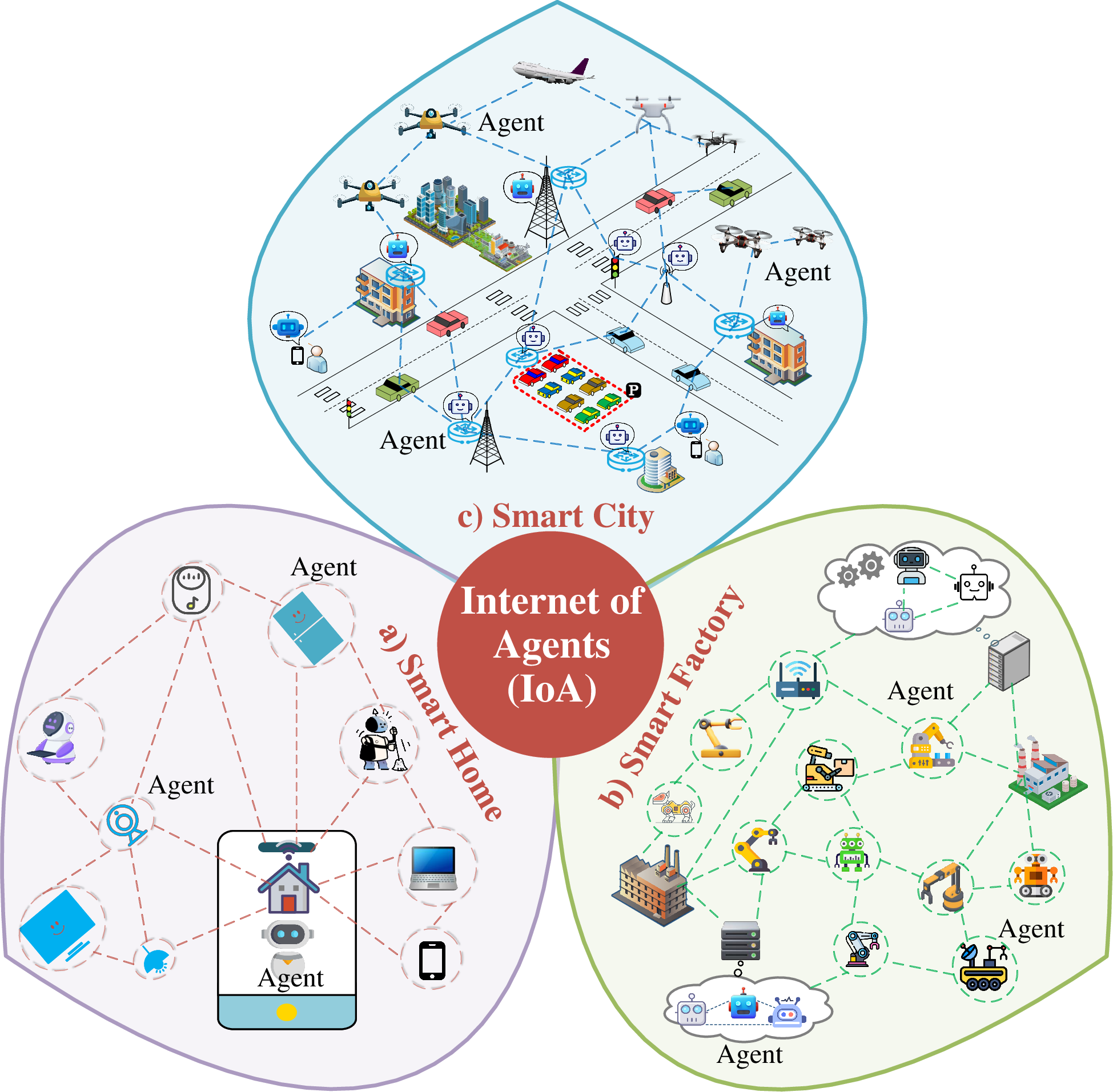
- The paper introduces a four-tier architecture for IoA, integrating infrastructure, management, coordination, and application layers.
- It demonstrates robust distributed task execution and dynamic agent collaboration using decentralized protocols and semantic models.
- The study addresses challenges including interconnectivity, efficient agent interfaces, and secure autonomous collaboration in real-world settings.
Internet of Agents: Fundamentals, Applications, and Challenges
The paper introduces the Internet of Agents (IoA) as a transformative framework that enables scalable and seamless interaction among heterogeneous autonomous agents. It explores the IoA's architecture, operational paradigms, and discusses the challenges in deploying resilient and trustworthy IoA ecosystems across various domains such as smart cities and factories.
IoA Architecture
The IoA is structured over a four-tier architecture enabling scalable and secure agent collaboration. This architecture includes:
- Infrastructure Layer: Provides computational resources, data storage, and connectivity. It integrates foundational AI models and diverse communication technologies, from 5G networks to cloud-based GPU clusters.
- Agent Management Layer: Handles identity, capabilities, discovery, and the lifecycle management of agents. It uses semantic models and decentralized identifiers (DIDs) for dynamic updates.
- Agent Coordination Layer: Supports distributed task execution, leveraging task decomposition, communication protocols, and consensus mechanisms. It ensures robust coordination through conflict resolution strategies.
- Agent Application Layer: Facilitates agent interoperability across various domains through standardized interfaces. It supports complex applications such as smart city management and healthcare systems.
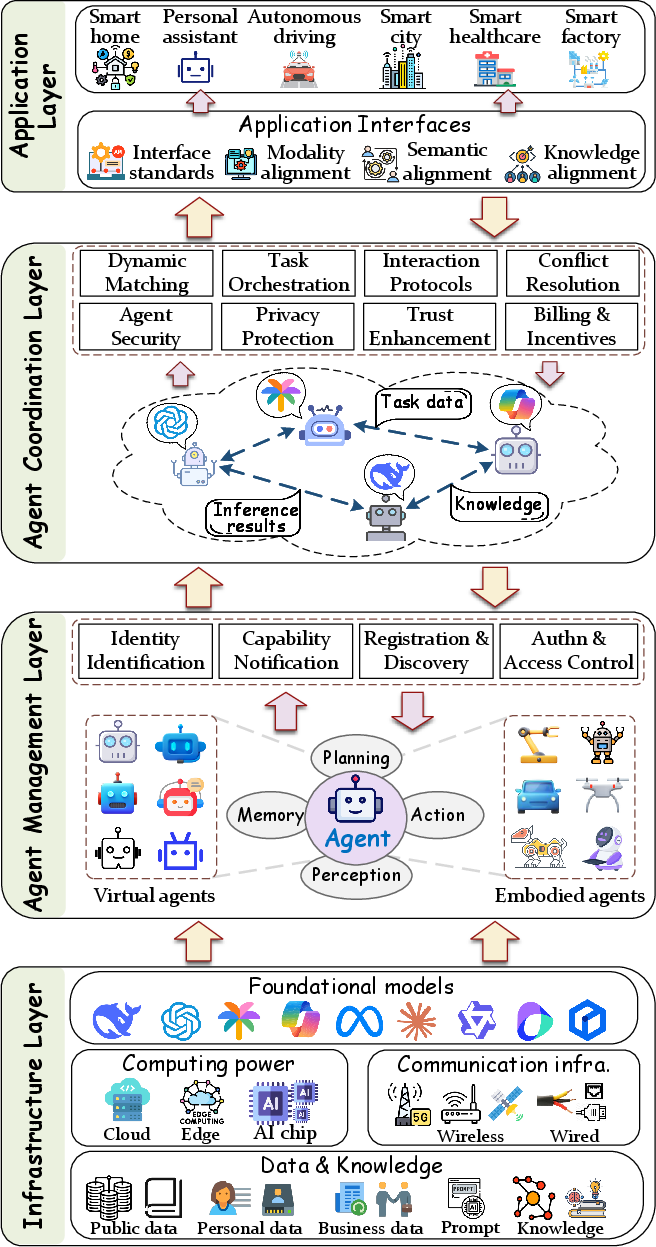
Figure 1: General architecture of IoA, comprising four tiers from bottom to top: the infrastructure layer, agent management layer, agent coordination layer, and agentic application layer.
Key Challenges in IoA
The deployment of IoA at scale presents several critical challenges:
- Interconnectivity: Unlike simulated environments, real-world IoA spans billions of distributed agents, each with unique profiles. This necessitates new architectures for heterogeneous agent interoperability.
- Agent-Native Interfaces: The current reliance on GUIs for interaction is inefficient. IoA should enable direct agent interactions using APIs and semantic communication protocols.
- Autonomous Collaboration: IoA agents operate in dynamic settings, requiring the capability to self-organize and collaborate effectively, leveraging large AI models for decision-making and negotiation.
Emerging Applications
IoA's impact spans various domains:
Communication Protocols
Several protocols have been developed to support IoA systems:
- MCP: Integrates AI models with external tools and data sources, enhancing contextual understanding and response accuracy.
- A2A: Facilitates direct communication and collaboration among diverse agents through a decentralized protocol.
These protocols enable agents to perform dynamic task negotiations and support real-time interaction across domains.
Future Research Directions
The paper identifies several future research avenues:
- Standardization: Developing unified frameworks that ensure interoperability across platforms.
- Security: Creating adaptive communication protocols that secure agent interactions while maintaining flexibility.
- Economic Models: Implementing incentive mechanisms to promote agent collaboration and deter malicious behavior.
- Privacy and Ethics: Addressing privacy concerns and ensuring ethical compliance in agent decision-making processes.
Conclusion
The IoA represents a critical evolution in AI infrastructure, promising enhanced connectivity and intelligence across diverse applications. As the framework matures, it will require continued innovation in networking architectures and security paradigms to fully realize its potential as the backbone for future intelligent ecosystems. The research presented provides a foundational understanding of IoA's multidisciplinary challenges and opportunities for advancing autonomous agent networks.