- The paper introduces the ST-TTC paradigm that leverages test-time computing to perform real-time bias correction in spatio-temporal forecasting.
- It employs a spectral-domain calibrator with phase-amplitude modulation and flash updating using a streaming memory queue to adjust predictions efficiently.
- The approach consistently reduced error metrics across benchmarks, proving its robustness, scalability, and effectiveness in few-shot and long-term scenarios.
Test-Time Computing in Spatio-Temporal Forecasting
Introduction
The focus of the paper titled "Learning with Calibration: Exploring Test-Time Computing of Spatio-Temporal Forecasting" (2506.00635) is to address challenges encountered in spatio-temporal forecasting (STF), such as signal anomalies and distributional shifts in real-world applications. The proposed solution, known as Test-Time Computing (TTC), offers a novel paradigm aimed at improving the robustness and accuracy of predictions without the computational overhead associated with traditional training-stage enhancements.
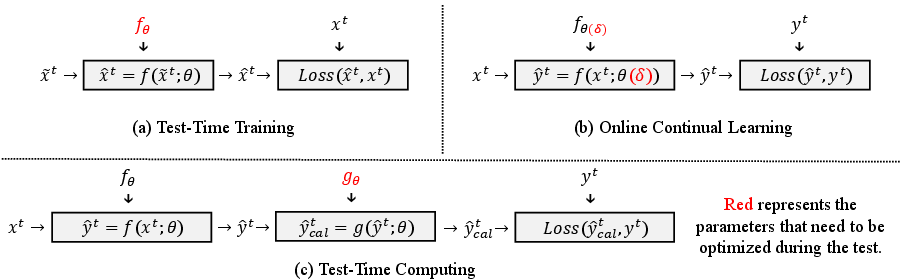
Figure 1: Conceptual visualization comparison of different spatio-temporal learning paradigms under test environment.
Methodology
The TTC paradigm focuses on utilizing test-time data to perform a real-time bias correction during inference, bypassing complex training regimens. Key innovations include:
- Spectral-Domain Calibrator with Phase-Amplitude Modulation: This component captures periodic structural biases and directly calibrates model predictions in the frequency domain. It uses a fast Fourier transform-based approach to adjust amplitude and phase at test time, facilitating adaptive error correction.
- Flash Updating Mechanism with Streaming Memory Queue: Designed for efficiency, this approach involves a streaming memory queue that enables fast gradient updates using historical test data, ensuring timely adaptation with minimal computational overhead.
The spectral calibrator and flash updating of model parameters ensure that the paradigm achieves efficient real-time processing, which is critical for applications requiring timely forecasts.

Figure 2: Relative improvements of different models w/ ST-TTC in the few-shot setting.
Experimental Setup
Experiments were conducted across various benchmark datasets representing different domains such as transportation and meteorology. These datasets were used to validate the generality and effectiveness of the ST-TTC approach under few-shot, long-term, and large-scale scenarios.
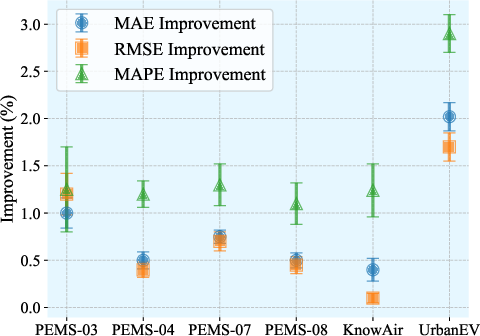
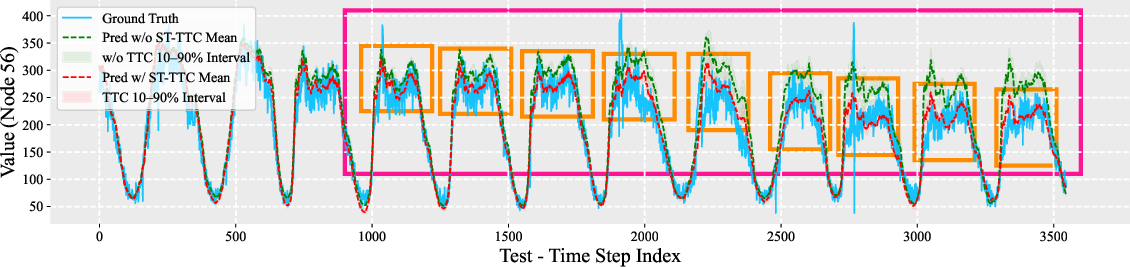
Figure 3: Left: relative improvement of long-term setting. Right: visualization study of PEMS-08.
Results
The experiments demonstrated that ST-TTC consistently improves performance compared to traditional methods, particularly in scenarios characterized by distribution shifts. Some salient observations include:
- Effectiveness: ST-TTC significantly reduced error metrics across all tested settings, demonstrating robustness in handling both systematic biases and non-stationarities inherent in spatio-temporal datasets.
- Universality: The paradigm's flexibility was validated in few-shot learning settings and long-term forecasting scenarios, where traditional methods struggle due to limited data and complex patterns.
- Scalability: In large-scale spatio-temporal domains, ST-TTC efficiently handled the increased complexity and volume of data while maintaining computational efficiency.
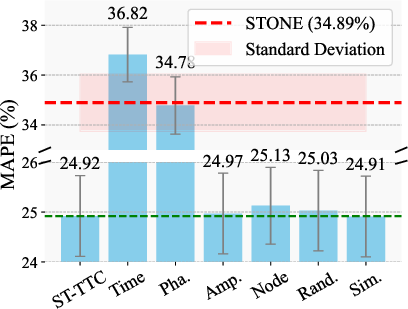
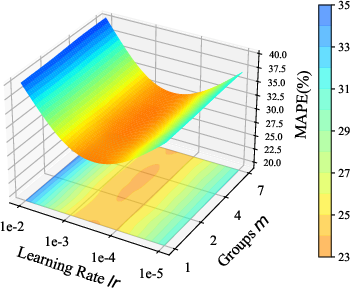
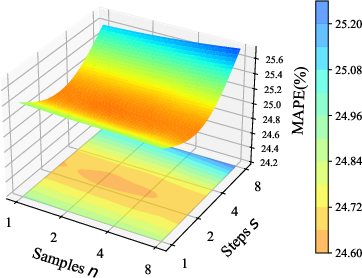
Figure 4: Left: Strategy comparison. Middle: Effect of lr w m . Right: Effect of n w s.
Implications and Future Work
Practically, the ST-TTC paradigm presents a scalable and efficient solution for real-time forecasting applications in dynamic environments. Theoretically, it opens new avenues for calibrating models dynamically, leveraging frequency-domain insights often absent in traditional settings.
Future work could expand on integrating more granular adjustments at the node level within sensor networks, further optimizing the balance between speed and accuracy. Additionally, exploring the integration of ST-TTC with emerging spatio-temporal foundation models could offer even broader applicability and performance enhancements.
Conclusion
In summary, the paper presents a robust, flexible, and computationally efficient methodology for spatio-temporal forecasting through test-time computing, establishing a new standard for dynamic environmental adaptation in machine learning models.
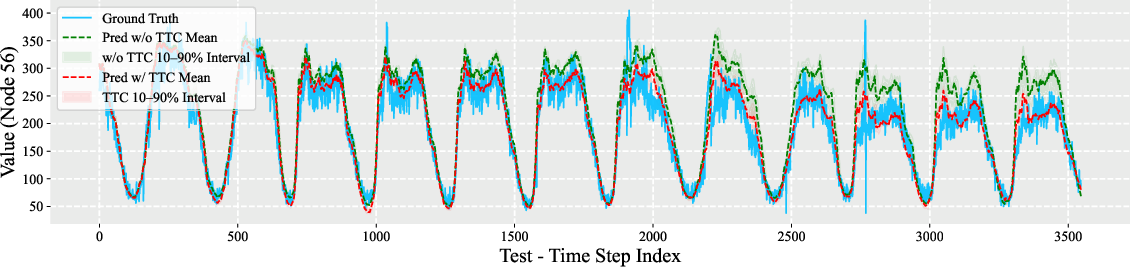
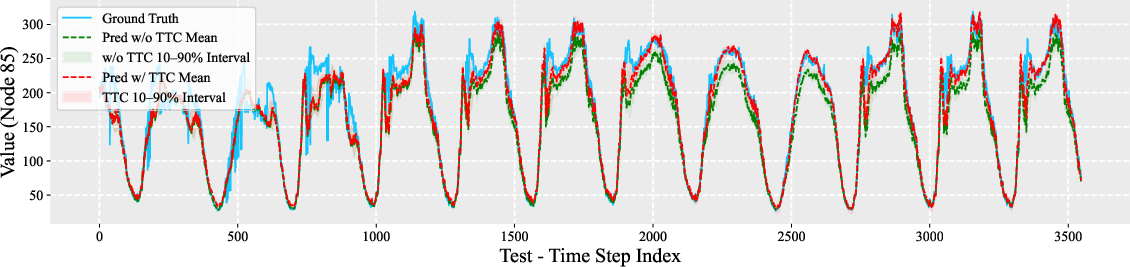
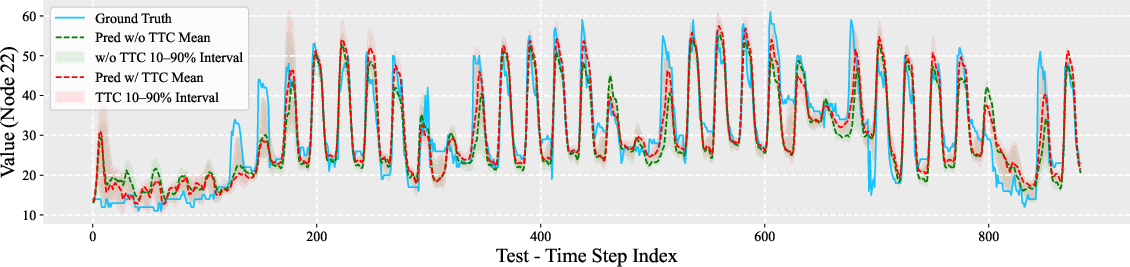
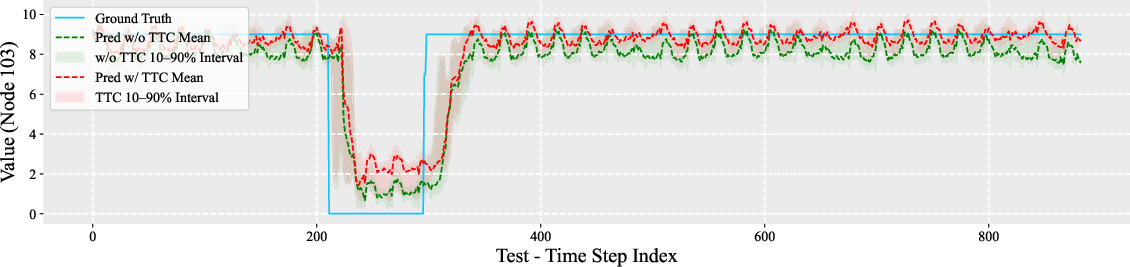
Figure 5: Showcase of improvement in spatio-temporal forecasting through our ST-TTC.

