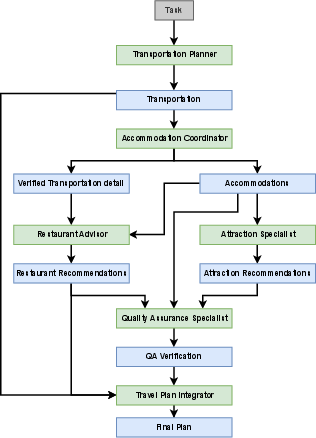
- The paper introduces a novel PSO-inspired framework that automatically generates and refines agentic systems via a structured language space.
- It employs language model-driven diagnostics and temperature-controlled sampling to iteratively improve agent collaboration, achieving a 261.8% performance boost on TravelPlanner tasks.
- The framework demonstrates significant cross-model transferability and highlights future research potential despite limitations in LLM-driven diagnostics.
SwarmAgentic: Towards Fully Automated Agentic System Generation via Swarm Intelligence
Introduction
"SwarmAgentic" presents a framework for fully automated agentic system generation utilizing swarm intelligence principles. It aims to construct agentic systems from scratch while optimizing agent functionality and collaboration without human intervention. Distinctively, SwarmAgentic operates within a language-driven exploration framework, catalyzing the journey toward scalable and autonomous agentic system design, as demonstrated by its substantial improvement over existing benchmarks, especially ADAS, on tasks like TravelPlanner.
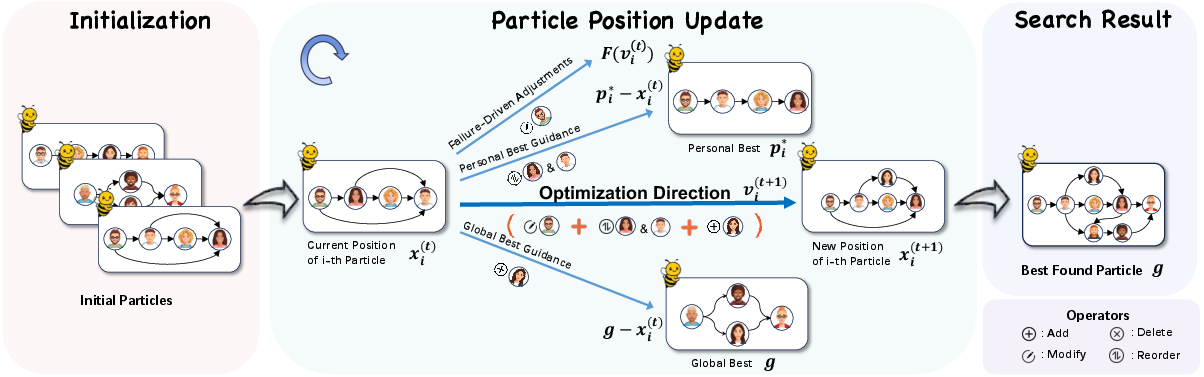
Figure 1: Overview of SwarmAgentic. (1) Initialization: Generates a diverse population of agentic systems, encoding agent sets, and collaboration structures in a structured language space. (2) Particle Position Update: Iteratively refines agentic systems through failure-aware velocity updates and position updates, incorporating failure-driven adjustments, personal best guidance, and global best guidance.
Core Methodology
SwarmAgentic's methodology draws inspiration from Particle Swarm Optimization (PSO). Each agentic system is modeled as a 'particle,' defined through structured language frameworks that encode agentic elements such as roles, responsibilities, and collaboration strategies. Unlike traditional PSO, SwarmAgentic operates in a non-differentiable language space, enabling symbolic transformations and interpretable updates through LLMs.
Search Process
- Initialization: Diverse agentic systems are initialized using a temperature-controlled sampling strategy to enhance structural diversity. Initial velocities are configured to drive particles toward promising regions while maintaining diversification.
- Flaw Identification: Utilizes LLM-driven diagnostics to detect agent and collaborative structure inefficiencies, crucial for targeted optimization.
- Velocity Update: Enhances traditional PSO through LLMs guiding velocity updates with failure-awareness, personal best optimization, and global best dissemination.
- Position Updates: Involve executing structured textual adjustments, refining systems iteratively until convergence, or iteration limits are met, achieving an optimal configuration.
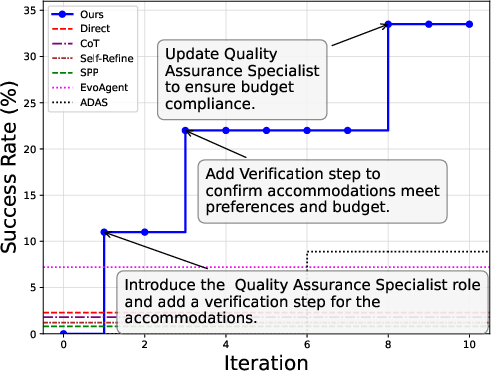
Figure 2: Search trajectory of SwarmAgentic on TravelPlanner. The Success Rate (SR) improves iteratively as specialized agents are introduced to refine constraint handling and enhance plan feasibility.
Experimental Evaluation
SwarmAgentic was subjected to a diverse set of six exploratory tasks, highlighting its efficacy across structurally unconstrained environments like TravelPlanner. Performance metrics demonstrated SwarmAgentic's superiority, notably achieving a +261.8% improvement over ADAS, indicating the framework's efficacy in fully autonomous agentic system generation.
Notable Results
Limitations and Future Directions
Despite the robust framework, SwarmAgentic inherently inherits limitations from the LLMs it relies on, notably factual inaccuracies and lack of grounded real-world interaction capabilities. Future research could explore integrating domain-specific constraints or multimodal capabilities to bridge these gaps, enhancing adaptability in dynamic environments.
Conclusion
SwarmAgentic establishes itself as a formidable step toward fully autonomous agentic systems. Its innovative language-driven PSO mechanism demonstrates remarkable adaptability and efficiency in real-world applications, marking a pivotal stride in bridging swarm intelligence with autonomous agent system design. Future exploration and potential enhancements can further solidify its utility in both structured and unstructured task environments, paving the way for even broader applicability in advancing autonomous systems.
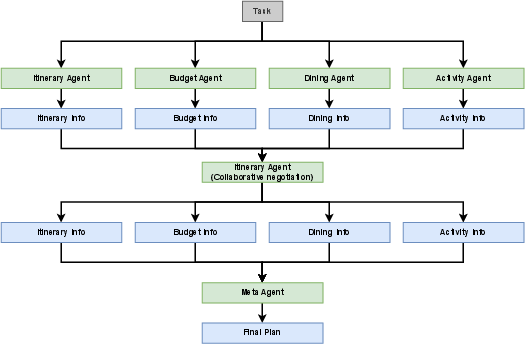
Figure 4: Final agentic system generated by ADAS for the TravelPlanner task, illustrating the optimized agent roles and coordination structure.