- The paper introduces a low-power system that uses differential temperature, humidity, and pressure data with a LightGBM classifier to detect queen bees in real time.
- Methodology combines sensor fusion and edge computing, reducing energy consumption to 44.5 mW per inference while maintaining over 99% recall in queen detection.
- Results demonstrate high classification accuracy and energy efficiency, offering a scalable, non-invasive solution for autonomous beehive monitoring.
Queen Detection in Beehives via Environmental Sensor Fusion
The paper "Queen Detection in Beehives via Environmental Sensor Fusion for Low-Power Edge Computing" introduces a system designed to monitor the presence of queen bees within hives using environmental sensors integrated into low-power edge computing platforms. This approach significantly enhances traditional methods, providing non-invasive, real-time monitoring capabilities while minimizing manual labor and resource consumption.
Introduction
Ensuring the presence of the queen bee is crucial for the stability of honeybee colonies. Manual inspections are disruptive and inefficient, prompting the development of automated monitoring systems. Previously, audio-based systems have been leveraged to detect bees within hives, though these systems can require high power consumption and face challenges related to environmental noise.
The proposed system embraces a fusion of environmental sensors—temperature, humidity, and pressure—to detect the queen bee's presence within a hive. This method facilitates low-power, edge-based real-time decision-making, effectively reducing energy consumption compared to audio-based systems. It capitalizes on a LightGBM classifier deployed on an STM32 microcontroller, achieving remarkable accuracy without the need for complex data processing.
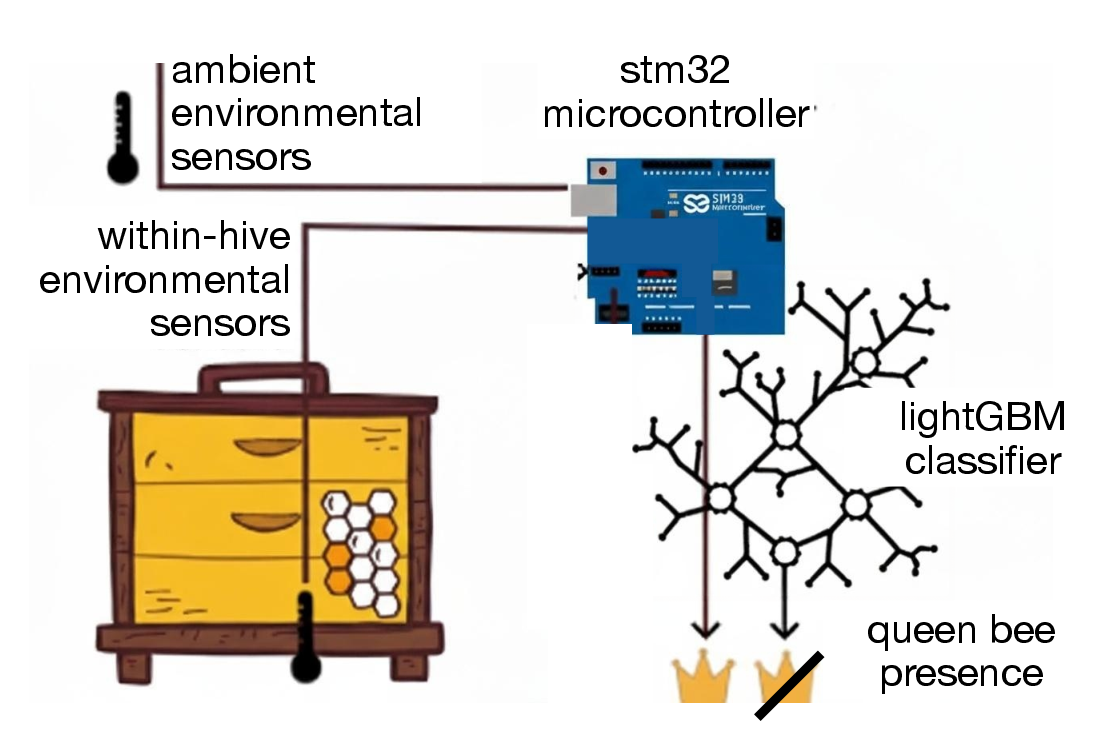
Figure 1: System overview: environmental data are acquired inside and outside the hive, processed on the edge by a LightGBM system on an STM32 to classify the presence of the queen bee within the hive.
Methodology
System Architecture
The system comprises a two-tier architecture: a Python-based component for data processing and model training, alongside a lightweight STM32 microcontroller-enabled deployment for real-time data acquisition and inference. Environmental sensor data drive the classification pipeline, capturing temperature, humidity, and pressure variations between the hive's interior and exterior. Such differential features are posited to provide vital insights into hive status, surpassing absolute sensor metrics.
The machine learning model uses LightGBM, trained on differential features to discern the presence of the queen. Hyperparameter tuning and cross-validation ensure the model's robustness, backed by data stratification to preserve class balance. Following this, decision trees from the model are seamlessly converted for deployment on the STM32 hardware platform, minimizing computational and memory overhead.
Real-Time Implementation
Technical advancements facilitate real-time execution on the STM32 microcontroller, which efficiently processes sensor inputs and performs model inference to output queen presence results. The STM32 system handles data as 32-bit floating-point sequences, maintaining synchronization via custom protocols.
Performance evaluations reveal stringent power optimization, with the system consuming approximately 44.5 mW per inference and achieving an energy cost of about 98 mJ, markedly lowering previous system requirements tied to audio processing approaches.
Results
When applied to environmental features only, the system consistently demonstrates high accuracy, achieving over 99% recall and true negative rates for detecting queen presence across tests (Figure 2).
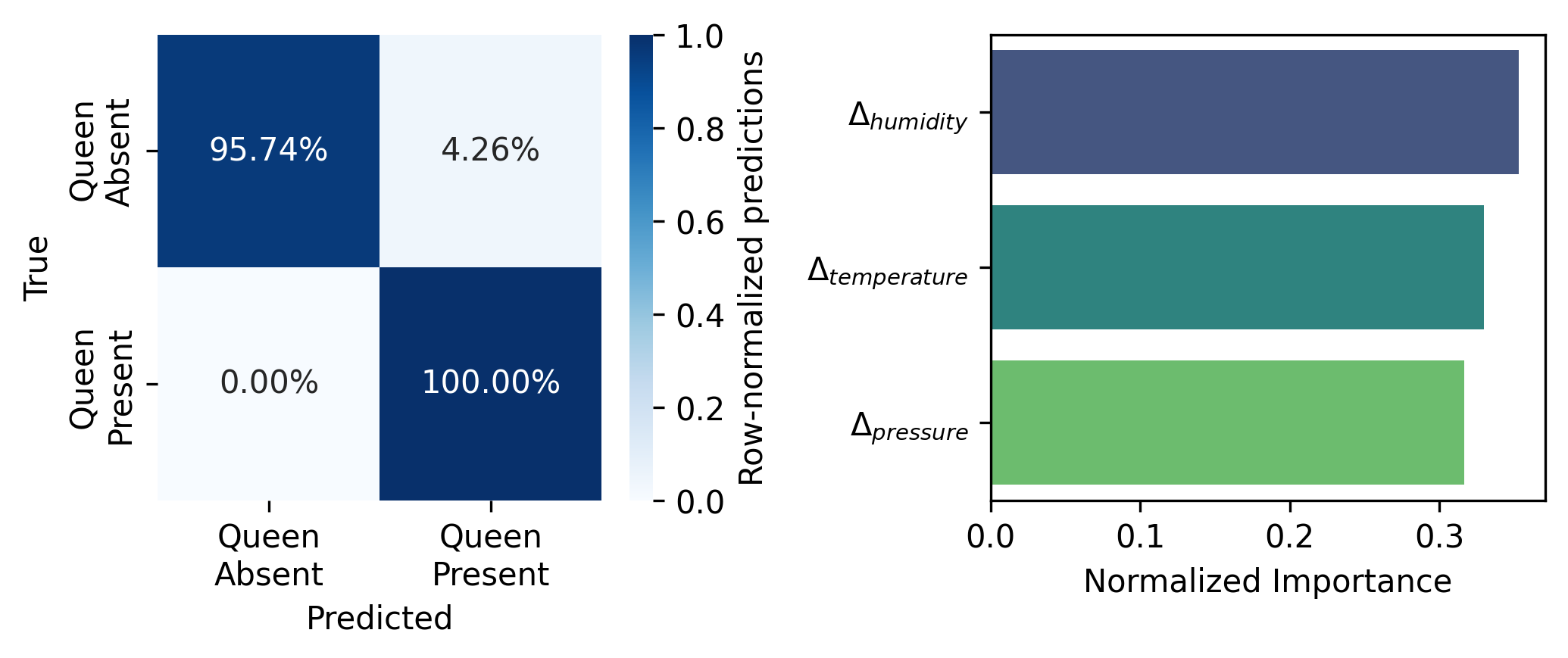
Figure 2: Classification performance of the trained model in full resolution using only environmental information as input features. (Left) Row-normalized confusion matrix showing classification results between the "Queen Present" and "Queen Absent" classes. The model achieves perfect recall for detecting the queen's presence and a high true negative rate for her absence. (Right) Feature importance plot showing the normalized contribution of sensor-derived features (Δhumidity, Δtemperature, Δpressure) to the classification decision. Humidity variation appears to be the most influential feature.
Notably, enhancements derived from the inclusion of audio features were minimal, further endorsing the viability of exclusive environmental sensor use for dependable, scalable edge device deployment.
Power Consumption and Accuracy
The STM32 platform upheld classification accuracy comparable to Python-based benchmarks, confirming its utility for cost-efficient monitoring applications. Power efficiency tests underscore the STM32's superiority over traditional audio-based systems, evidencing substantial potential for real-world hive monitoring integrations (Table 1).
Comparison with Existing Approaches
The system attains superior classification accuracy relative to prior efforts, leveraging minimal energy for inference. Notably, integration and scalability enable its operability within field conditions, surpassing more energy-intensive and complex alternatives. This comparison reaffirms the proposed system's practicality for autonomous hive management, blending accuracy with resource economy.
Conclusions
This paper establishes a foundation for sustainable hive monitoring methods through environmental sensor fusion. Its embedded application on STM32 microcontrollers is poised for widespread use in precision beekeeping, facilitating uninterrupted observation and minimizing manual interventions. Future directions may enhance data generalization to unseen hives, integrating adaptive sampling and expanding sensor modalities, contributing to the evolution of autonomous ecological sensing devices.