- The paper introduces an innovative AI pipeline that applies Deleuze and Guattari’s rhizomatic principles for non-linear literature review.
- The method employs 12 specialized agents in a seven-phase architecture, enabling multi-dimensional analysis and automated detection of paradigm ruptures.
- The pipeline demonstrates reproducible mapping with high-throughput semantic clustering, revealing overlooked research gaps and disciplinary silos.
Multi-Agent Rhizomatic Pipeline for Non-Linear Literature Analysis
Motivation and Epistemological Framework
Formalized literature reviews within social sciences remain dominated by hierarchical, path-dependent methodologies. These arborescent approaches—driven by linear query expansion, taxonomic classification, and keyword filtering—are structurally incapable of surfacing lateral, emergent, or paradigm-challenging formations within rapidly evolving research landscapes. The Rhizomatic Research Agent (RRA) directly addresses this systemic rigidity, operationalizing Deleuze and Guattari’s six principles of the rhizome—connection, heterogeneity, multiplicity, asignifying rupture, cartography, and decalcomania—within an agentic AI pipeline. The system’s theoretical foundation is process-relational ontology, enabling computational analogues to the lateral, performative, and multi-perspective inquiry previously realizable only through intensive manual researcher labor.
The RRA extends the methodology of Narayan (2023), automating the diffractive, embodied, and connective logic of her practice-led inquiry on sustainable energy system transitions. Where Narayan traced discursive entanglements across disciplinary, media, and community boundaries via labor-intensive manual exploration, the RRA enables high-throughput, multi-perspective, and reproducible literature analysis without collapsing the distinctive ontological commitments of rhizomatic inquiry.
System Architecture: Agent Roles and Computational Flow
The RRA pipeline is architected as a seven-phase system distributed across twelve specialized agents, each mapped to rhizomatic principles and coordinated via server-sent event (SSE) streaming. The full system mediates from epistemological destabilization to high-dimensional semantic topography, ensuring both depth and breadth of exploration.
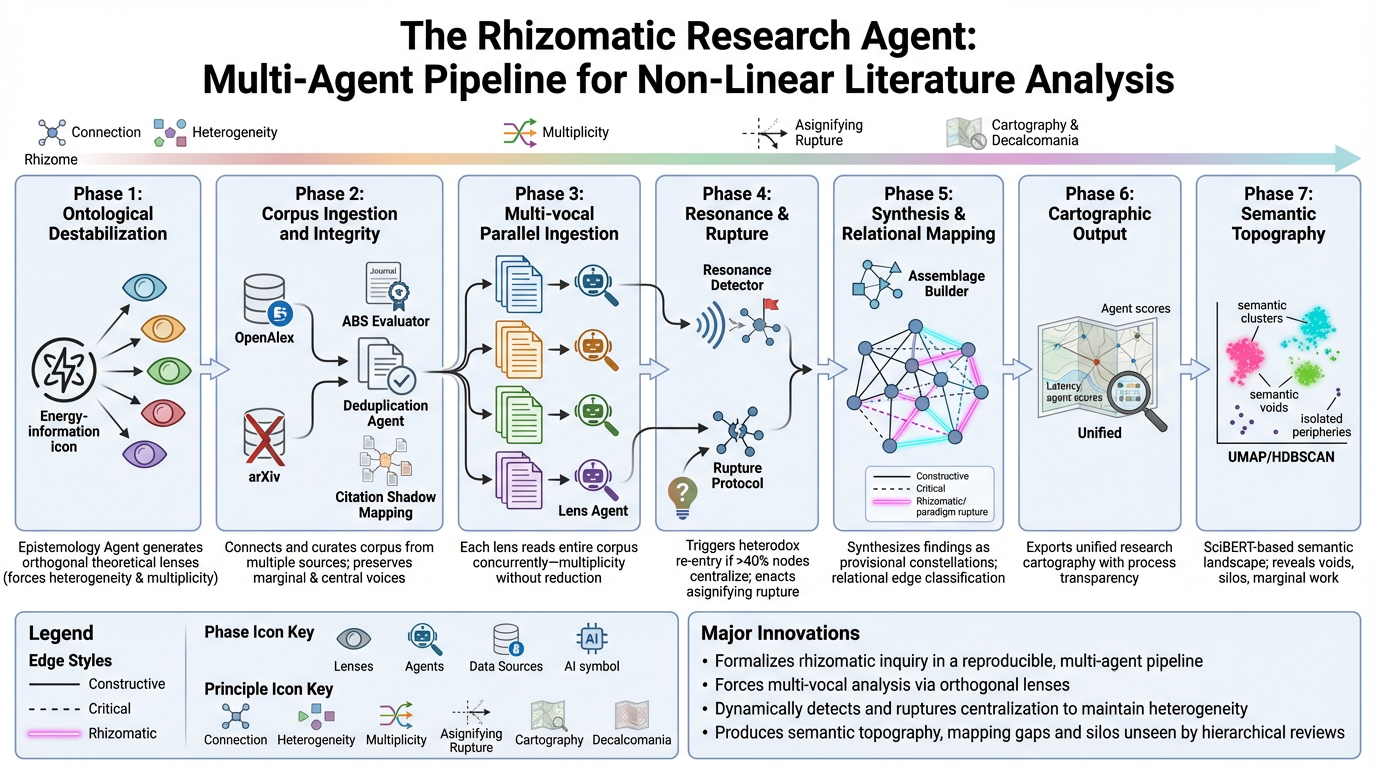
Figure 1: Rhisomatic research agent model structure.
The computational process commences with the Epistemology Agent, which, rather than seeding the pipeline with a single dominant search paradigm, emits 3–5 orthogonal theoretical lenses designed to destabilize the initial query and force multi-vocal entry points. These serve as the foundation for subsequent parallel corpus ingestion across OpenAlex and arXiv APIs, with DOI deduplication and journal ranking encoded for both rigor and inclusivity of heterodox sources.
Each theoretical lens is embodied as an autonomous agent performing corpus-level scans for lens-specific signals, leveraging asyncio concurrency for simultaneous multi-frame analysis. This enables plurality without subsequent synthesis or erasure, preserving theoretical incommensurability.
Central to the architecture is the Rupture Protocol—if a knowledge graph’s centralization exceeds 40% edge density on limited nodes, the system triggers re-entry via heterodox literature streams (e.g., degrowth, indigenous epistemologies). This computationally inscribes asignifying rupture, preventing paradigm capture and maintaining the ontological multiplicity foundational to the rhizome.
Synthesis occurs via the Assemblage Builder, which constructs present-continuous mappings of the literature and classifies all intertextual relationships as constructive, critical, or rhizomatic. Constructive links indicate extension or borrowing, critical links indicate contradictory or problematizing stances, while rhizomatic edges flag paradigm ruptures and heterodox innovations. The cartographic outputs offer methodological auditability, disclosing every analytical trajectory and agentic contribution.
The Semantic Topography phase is operationalized via SciBERT embeddings, UMAP dimensionality reduction, and HDBSCAN clustering, which collectively identify thematic clusters, semantic voids, and orthogonal isolations. Marginalization indices are computed to foreground peripherally situated work, surfacing potential research gaps invisible to taxonomically-driven reviews.
Empirical Observations and Claims
Preliminary deployment across energy-information nexus corpora has produced several salient findings:
- Epistemology Agent consistently selects analytical lenses outside the core disciplinary training of most human researchers.
- Rupture Protocol triggers in 30–40% of cases, indicating a high prevalence of paradigm centralization and the structural necessity of computational rupture for preserving multi-vocality.
- Orthogonal isolation detection via semantic topography consistently reveals clusters sharing surface vocabulary but separated in latent semantic space, empirically demonstrating the persistence of disciplinary silos even in nominally interdisciplinary domains.
These empirical results underscore the pipeline’s ability to reveal cross-disciplinary convergences, structural gaps, and epistemic outliers, performing a function traditional reviews are structurally incapable of by design. The pipeline thus augments, rather than substitutes, embodied researcher practice—radically expanding cognitive scope and auditability.
Limitations
Several limitations delimit the current RRA: analysis is constrained to metadata and abstracts rather than full texts; all agents inherit bias and hallucination risk from underlying LLMs; the centralization threshold in the Rupture Protocol is heuristically set with no empirical optimization; and transferability to domains beyond energy-information nexus remains underexplored. Human-expert validation and expansion to additional corpora (patents, policies, etc.) are identified as critical future directions.
Implications and Future Horizons
The RRA marks a methodological pivot in computational literature review. It demonstrates that epistemologies grounded in process-relational and performative logics—not only static arborescent hierarchies—can be robustly encoded in multi-agent AI systems. This reconfigures the space of possible experimental designs for field mapping, research gap detection, and horizon scanning in domains beset by disciplinary fragmentation or conceptual multiplicity.
Pragmatically, its open-source, extensible architecture invites field-specific adaptation, porting the rhizomatic analytic to any phenomenon zone demanding pluralistic cartography rather than taxonomic tracing. Future iterations integrating full-text mining, expanded heterogeneous sources, and formal comparative user studies will determine the durability and generalizability of the approach.
Conclusion
The Multi-Agent Rhizomatic Pipeline systematically embeds Deleuzian philosophy within computational literature analysis, bridging philosophical rigor and technical sophistication. By orchestrating process-relational principles via specialized agentic roles and explicitly incorporating rupture and multi-perspective synthesis, the RRA provides a scalable, transparent, and reproducible framework for non-linear literature analysis. It redefines the methodological limits of automated review, surfacing structural and theoretical features occluded by traditional arborescent models, and establishes a template for future work in computational epistemology.
Reference: "A Multi-Agent Rhizomatic Pipeline for Non-Linear Literature Analysis" (2603.28336)

