- The paper introduces ACE, a reversible and adaptive context management strategy for LLM agents that overcomes the limitations of fixed context windows.
- The methodology employs a two-layer architecture combining lossless message storage with dynamic context orchestration, achieving improved performance (e.g., score increase from 46.1 to 52.7 on GAIA).
- ACE’s plug-and-play design enables efficient handling of long-horizon tasks while preserving essential details through elastic selection of raw, abstract, or dropped information.
ACE: A Pluggable Adaptive Context Elasticizer for Agentic Systems
Escalating trajectory lengths in agentic workflows, driven by increasingly complex tasks, fundamentally challenge LLM-based agents limited by fixed context windows. Conventional context management strategies—primarily truncation and summarization—exhibit core deficiencies: they are inflexible and irreversible. When tokens are discarded or compressed, original context is typically irretrievable, which is problematic for tasks requiring episodic recall or late-relevant details. Moreover, traditional methods undermine semantic integrity by treating all historical steps uniformly, irrespective of their actual evolving importance to current decision points.
The ACE framework seeks to resolve these deficits by proposing a lossless, reversible, and adaptive strategy to context orchestration, decoupling raw message storage from dynamic context construction and ensuring the main LLM consistently receives a maximally informative and succinct state representation for each decision step.
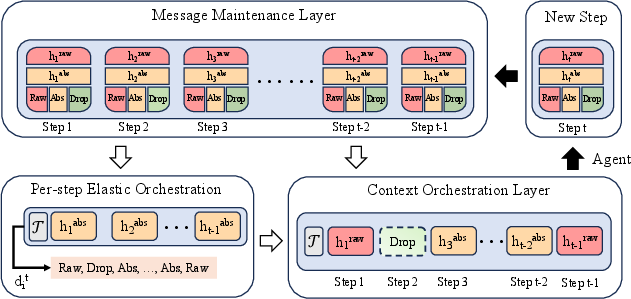
Figure 1: The ACE framework encapsulates raw message preservation and per-step elastic orchestration, enabling reversible selection of historical information as raw, abstract, or dropped at each decision step.
Methodology: Adaptive Context Elasticizer (ACE)
Two-Layer Architecture
The ACE framework introduces two key architectural layers:
- Message Maintenance Layer (M): Losslessly stores for each historical agentic step both the raw message and a compressed abstraction. These representations are immutable, allowing for complete traceability and future reversibility.
- Context Orchestration Layer (C): Dynamically constructs the context actually provided to the main LLM at each decision step. For every historical step, ACE assigns one of three elastic types: \textbf{Raw}, \textbf{Abstract}, or \textbf{Drop}. This assignment is adaptively determined by an "elasticizer" component—a separate LLM that considers the current task state and all abstraction summaries—to maximize information density and relevance.
Consequently, historical steps can have their presentation modulated per-step: previously compressed or omitted information can be restored to full fidelity, or details surfaced as needed without irreversible loss.
Reversible Elastic Orchestration
At each decision point, ACE consults the message maintenance layer, applies the LLM-based elasticizer E to predict optimal inclusion forms, and re-constructs the orchestration layer. The presence of both raw and abstracted stepwise states enables context to be fully reconstructed as demands change, ensuring adaptability and lossless retrieval. Notably, the latest step is always presented in raw form, preserving the most recent task state information.
Integration is fully external and training-free, supporting drop-in adoption across agentic frameworks without architectural or action space changes.
Experimental Analysis
Multiple benchmarks, including GAIA, HLE, WebShop, WebWalkerQA, xBench-DS, and BrowseComp-ZH, were used for quantitative and qualitative validation. ACE was evaluated against standard baselines—vanilla ReAct, truncation, and summarization—using both GPT-4.1 and Gemini-3.1-flash-lite-preview as main LLMs.
ACE consistently outperforms existing context management techniques across all frameworks and LLM settings. For instance, on GAIA with Gemini-3.1-flash-lite-preview, ACE increased the overall score from 46.1 (vanilla ReAct) or 43.0 (truncation) to 52.7. The performance improvement is attributed to ACE's adaptive, information-sensitive context construction. Both truncation and summarization are shown to degrade results on tasks where earlier-step evidence is critical, as they causally and irreversibly omit information.
ACE's plug-and-play nature supports integration with a range of frameworks (e.g., DeepAgent, WebThinker, MiroFlow), consistently yielding significant performance gains in all cases.
Token Efficiency and Dynamic Contextualization
ACE's adaptive orchestration produces input token lengths comparable to or below those of summarization/truncation at early steps but increases adaptively as the task progresses, reflecting its context-sensitivity.


Figure 2: ACE's per-step input token length remains low and adapts with trajectory length, unlike vanilla ReAct, which suffers linear token growth and redundancy.
Visualization of the "elastic type" evolution shows that ACE reassigns historical steps' representations between raw, abstract, and drop, adjusting presentation meshing with current task focus. The elasticity allows non-monotonic fluctuation, reducing redundancy without endangering essential details.
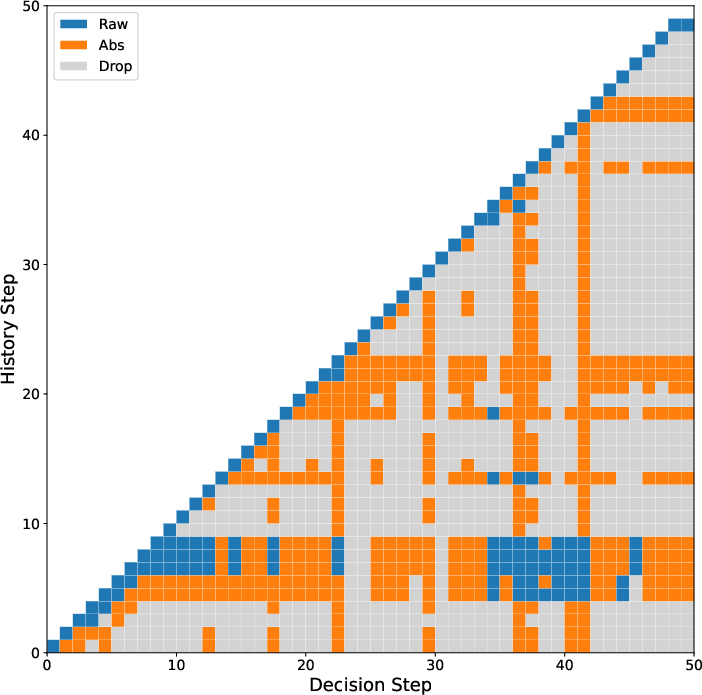
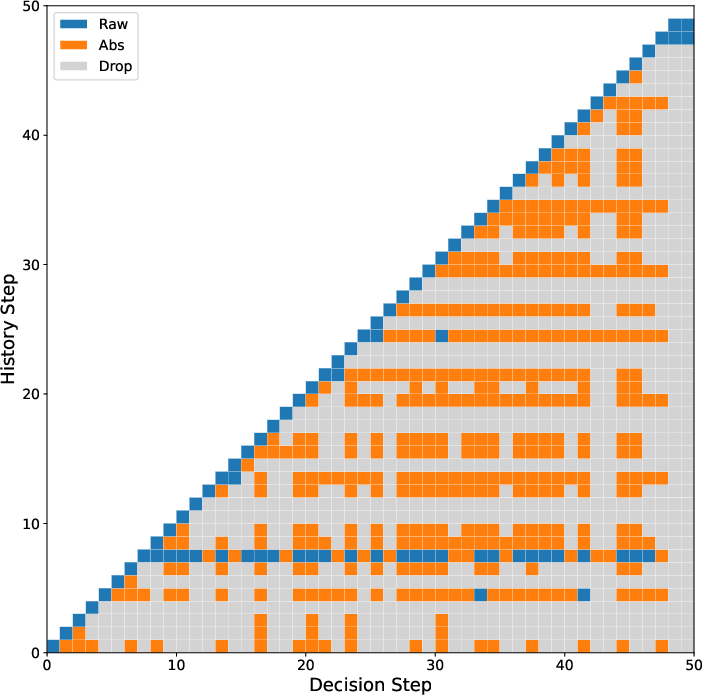
Figure 3: The representation form of historical steps (raw, abstract, drop) is dynamically revised per-decision, shown here for representative tasks from GAIA and HLE.
Ablation studies demonstrate that omitting any of the three elastic types reduces performance: {Raw,Drop} reverts to truncation-like behavior; {Abs,Drop} severely impairs detail and decision quality. Additionally, always including the last step as raw is empirically validated as essential for optimal agentic operations.
Practical and Theoretical Implications
ACE's context management formalism provides a robust solution to the context length and information density bottleneck in scaling agentic LLMs. By separating storage from orchestration and implementing per-step adaptive, reversible selection, ACE enables agents to maintain both operational efficiency and epistemic integrity across long-horizon tasks. This design allows downstream systems to circumvent the classic trade-off between computational tractability and semantic preservation, without imposing retraining or complex engineering.
For future agent architectures, ACE's approach offers a model for modular memory augmentation and dynamic context curation, making it relevant for the development of increasingly autonomous, multi-agent, and long-duration reasoning systems. In constrained or edge deployment conditions, the elastic orchestration paradigm may further facilitate efficient resource utilization.
Conclusion
ACE proposes a lossless, reversible, and adaptive method for context management in agentic LLM systems, superseding inflexible and destructive strategies such as truncation or fixed summarization. The demonstrated empirical gains, along with its plug-and-play deployment capability, position ACE as a widely applicable enhancement for existing and emerging LLM-based agents. Its architectural separation of memory and context enables both efficient scaling and sustained reasoning quality in long-horizon, complex environments (2606.31564).