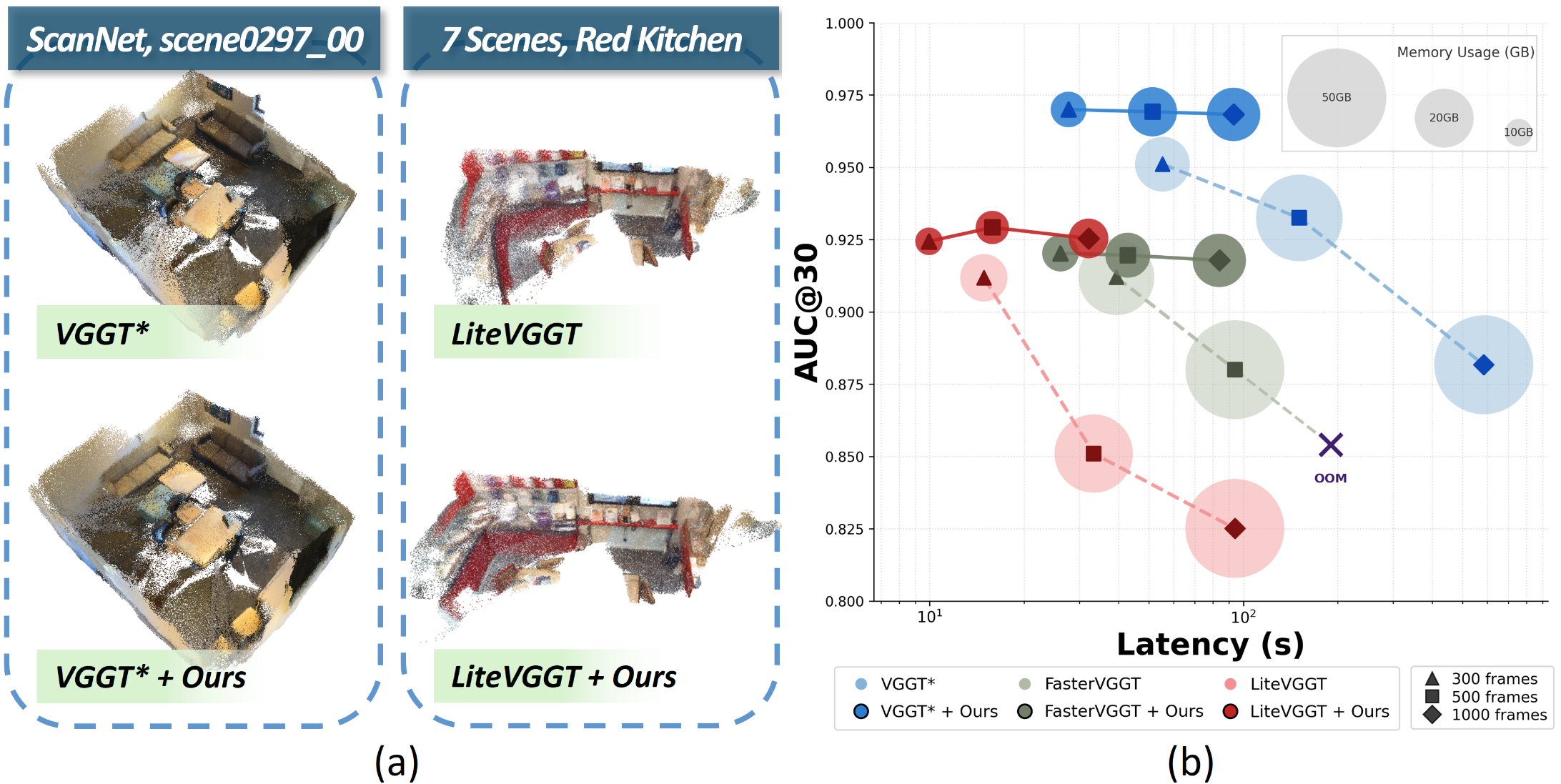
- The paper introduces a diversity-aware view partitioning approach that mitigates attention dilution in VGGT by optimizing input diversity.
- It employs a combinatorial graph optimization combining visual dissimilarity and soft pose propagation to construct balanced, informative view chunks.
- Quantitative results demonstrate enhanced camera pose estimation and 3D reconstruction while reducing VRAM usage and latency by up to 4x and 6x respectively.
Diversity-Aware View Partitioning for Scalable VGGT: An Expert Analysis
Introduction and Context
Feed-forward multi-view geometry transformers (notably VGGT) represent a paradigm shift in 3D scene understanding, providing unified, end-to-end approaches to camera pose estimation, depth prediction, and 3D reconstruction. While their joint global attention mechanisms enable strong geometric reasoning across multiple frames, these architectures are severely bottlenecked by quadratic scaling in computation and memory. Scaling VGGT to long sequences is thus fundamentally constrained; naive increases in view count can even degrade geometric performance due to attention dilution arising from redundant viewpoints. The paper "Diversity-aware View Partitioning for Scalable VGGT" (2607.01885) addresses this core issue by introducing a training-free, plug-and-play inference framework that explicitly optimizes the spatial and visual diversity of the input to VGGT.
Viewpoint Redundancy and Attention Dilution in VGGT
Existing works on efficient VGGT variants (e.g., LiteVGGT, FasterVGGT) primarily focus on architectural optimizations such as token reduction, sparse attention, or hierarchical processing to mitigate memory/computation costs. However, these methods do not address the implicit geometric information collapse that occurs when input views are densely sampled and highly redundant. Empirical analysis in the paper demonstrates that increasing view count without managing viewpoint diversity leads to performance degradation, as redundant tokens diffuse the model’s attention and drown out informative parallax and occlusion cues. This issue is apparent both in absolute reconstruction error and in attention entropy measurements.
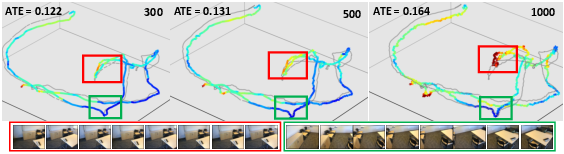
Figure 1: Visual regions with high frame redundancy correspond to high-error reconstruction; only segments with greater viewpoint diversity enable robust geometric reasoning.
Method: Diversity-Aware Chunking via Combinatorial Graph Optimization
The central contribution is a combinatorial, diversity-driven partitioning method that organizes the full input sequence into balanced, geometrically informative "chunks". Key components are:
- Initial Visual Dissimilarity Partitioning: Leveraging the backbone’s frozen feature extractor (e.g., DINOv2), global image embeddings are generated for each frame. Pairwise visual dissimilarity (1 - cosine similarity) is used to create an initial partition via a balanced k-way local-swap procedure, inspired by the Kernighan–Lin algorithm, that maximizes within-chunk diversity.
- Soft Pose Propagation for Spatial Dispersion: To approximate spatial relationships without full pose estimation, poses for a small reference chunk are estimated via VGGT, then pseudo-poses for remaining frames are assigned by weighted averaging reference poses according to visual similarities.
- Partition Refinement: Both visual and spatial diversity scores are fused (with a tunable mixing parameter) in a refined chunk assignment using additional local swaps, producing diversity-aware and spatially scattered yet balanced view groups.
- Per-Chunk VGGT Inference and Alignment: Each chunk, augmented with a shared anchor frame for coordination, is processed independently via VGGT. A single SE(3) alignment per chunk (using the anchor) suffices to merge predictions into a globally consistent result.
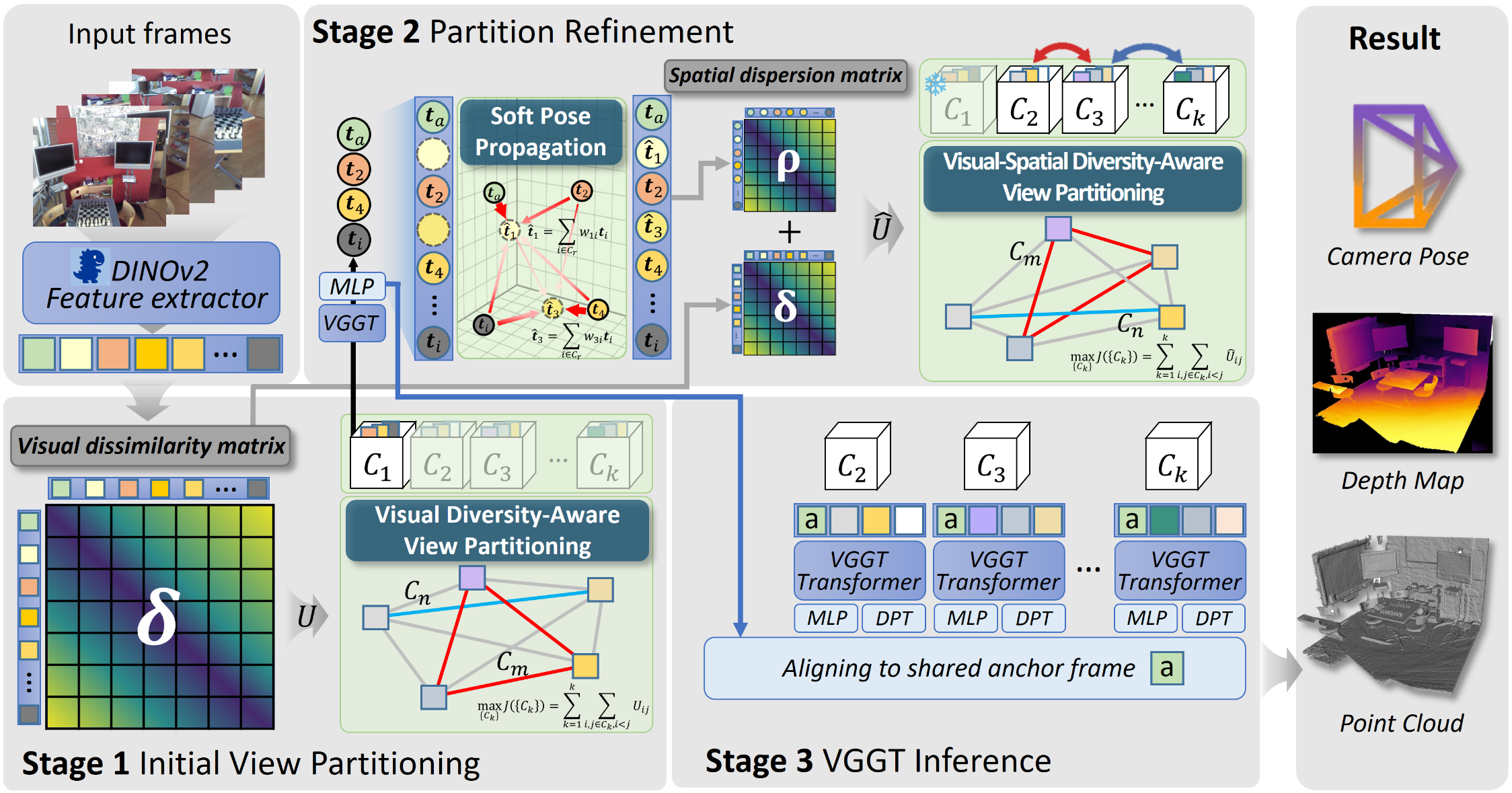
Figure 2: Pipeline for diversity-aware view partitioning: initial partitioning by appearance, soft pose estimation, spatially-consistent partition refinement, and independent per-chunk inference/alignment.
Quantitative Results
Strong numerical results are consistently observed across camera pose estimation, depth prediction, and 3D reconstruction benchmarks (7Scenes, NRGBD, ScanNet-50, TUM-RGBD, Tanks & Temples):
Qualitative and Theoretical Implications
- Resilience to Order and Scale: Unlike temporal chunking (e.g., VGGT-Long), partitioning is order-agnostic and effective on unordered Internet photo collections; single-anchor SE(3) alignment suffices for global consistency, maintaining scale-uniformity across large scenes.
- Normalized Attention Entropy Analysis: Higher entropy correlates directly with redundant sampling. Explicit diversity promotion leads to lower entropy and increased model geometric focus.
- Chunk Size/Trade-Offs: The method exposes a diversity–sparsity trade-off regulated by chunk capacity. Extremely small chunks are too sparse for stable reasoning, while large (dense) chunks revert to the original OOM/attention dilution crisis. Default settings robustly balance these effects for standard datasets.
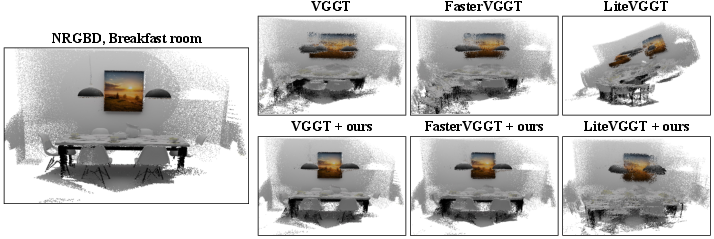
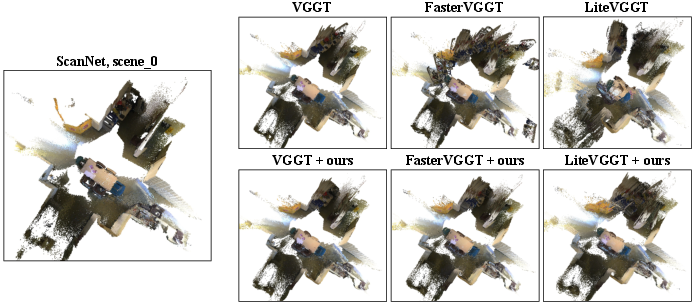
Figure 4: 3D point cloud reconstructions on NRGBD show that partitioned inference yields more complete and accurate geometry compared to baseline models.
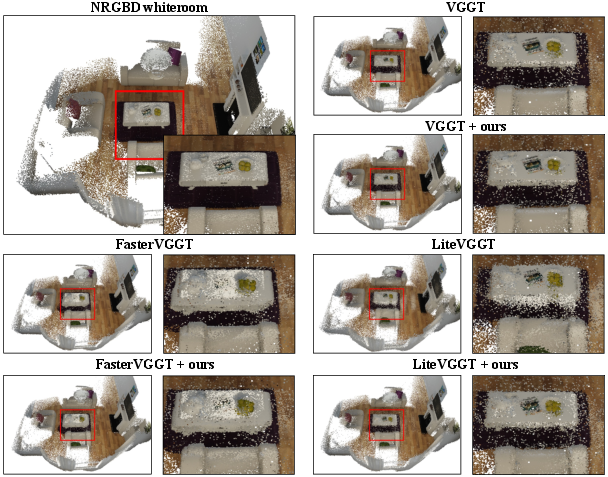
Figure 5: Additional qualitative evaluation on NRGBD reconstructions confirms preservation of fine structural details.
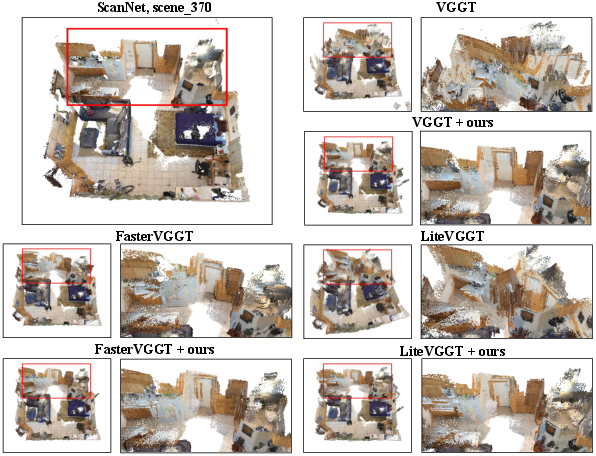
Figure 6: ScanNet-50 reconstructions: the method generalizes across large-scale, real-world, indoor environments without loss of fidelity.
Broader Implications and Future Directions
From a theoretical perspective, the results underscore that in token-based neural multi-view geometry, input distribution is as critical as scaling model architecture. The approach defines a new direction—input-level task-aware organization—that can be extended to other transformer-based multi-frame vision models. Practically, the plug-and-play partitioning paradigm enables memory-bounded inference for arbitrarily long or unordered image collections while actually improving performance over OOM-susceptible batched processing.
Potential avenues for advancement include dynamic, data-driven partitioning schemes tailored to scene topology, joint optimization with learned chunk selection policies, or explicit scale harmonization protocols for datasets requiring cross-chunk global metric precision. Additionally, transfer to other domains—such as video-language or multi-view segmentation—is a plausible future extension.
Conclusion
Diversity-aware view partitioning offers a principled, efficient, and generalizable solution for scalable transformer-based multi-view 3D reconstruction. By shifting the focus from purely architectural scaling to judicious input organization that balances visual and spatial diversity, the method outperforms existing efficient VGGT variants in accuracy, VRAM utilization, and inference time, while being orthogonal and complementary to model-level optimizations. The results invite a reevaluation of how viewpoint organization, not just view volume, determines the upper limits of feed-forward multi-view geometric reasoning.
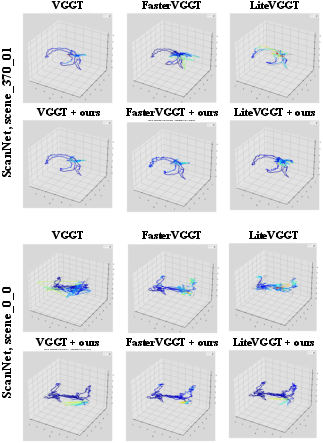
Figure 7: Estimated 3D trajectories on ScanNet-50 demonstrate reduced drift and improved alignment with ground truth when using diversity-aware partitioning.
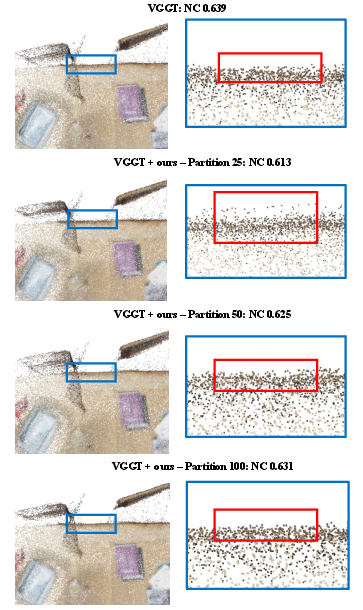
Figure 8: Normal consistency on 7Scenes highlights that the method preserves surface orientation coherence across partitions, evidencing the boundary-preserving nature of the approach.