- The paper introduces a deferred software rasterization pipeline that uses adaptive LOD to dynamically adjust strand complexity.
- It leverages cooperative SIMD strand assembly and a compact 64-bit per-pixel G-buffer to achieve 4.4× to 11× speedup over mesh shader baselines.
- Robust filtering with orientation-aware bilateral filtering and statistical depth correction ensures MSAA-equivalent visual quality and precise opacity estimation.
Introduction and Motivation
The rendering of strand-based hair in real-time remains a computationally intensive challenge due to the volumetric complexity, significant overdraw, aliasing artifacts, and the need for transparency in subpixel structures. Traditional graphics pipelines often resort to geometry simplification or impostor techniques (textured surfaces or card-based hair) to mitigate these costs, limiting strand-based approaches to high-end GPUs and restricting the number of complex, hero-quality grooms per scene. The hair mesh representation has facilitated efficient, flexible, and artist-directed hair modeling, but mesh shader-based rendering pipelines still encounter bottlenecks in platform support and performance scalability.
This work introduces a deferred software rasterization pipeline for implicit strand-based hair rendering, targeting real-time efficiency, broad hardware compatibility, high scalability, and preservation of visual fidelity even at a single sample per pixel. The key contributions include: a SIMD-parallel, LOD-enabled software rasterization pipeline; a statistically grounded depth correction for LOD-induced visibility loss; a robust filtering/reconstruction stage for anti-aliasing and opacity estimation; and an efficient volumetric ambient occlusion scheme directly encoded into mesh proxies.
Pipeline Architecture
The proposed pipeline begins with a hair mesh that encodes the groom as bundles with multiple polygonal layers. The process comprises a level-of-detail (LOD) pre-pass, strand assembly and rasterization, deferred per-pixel shading, and an explicit filtering/reconstruction phase:
- LOD Pre-pass: For each bundle, an adaptive computation determines the number of strands and their control points, based on the bundle’s projected screen-space footprint, enabling aggressive reduction of far-field workload with no appreciable visual penalty.
- Cooperative SIMD Strand Assembly: Workgroups exploit register communication and shared memory to assemble splines and apply style functions. Contrary to naive parallelization, data dependencies across control points are efficiently managed using subgroup shuffles and shared memory, resulting in minimal recomputation and bandwidth demand.

Figure 1: The software rasterization pipeline consumes hair meshes as input, applies an LOD pre-pass, performs rasterization with deferred shading and filtering, and outputs the composed image.
- Compressed Deferred G-Buffer: The rasterizer writes strand data into a 64-bit per-pixel G-buffer, encoding quantized styling coordinates, tangent vectors (octahedral encode), and depth, avoiding redundant geometry or appearance recomputation. The use of atomics ensures safety and parallel performance.
- Filtering and Reconstruction: Due to the limited coverage of single-sample rasterization, an orientation-aware bilateral filter—augmented by a conservative rasterization pass—reconstructs lost strand continuity, suppresses aliasing, and enables robust opacity estimation using per-pixel hit ratios across center and conservative samples.

Figure 2: Workgroups parallelize strand assembly, optimizing memory and compute through shared vertex/tangent data.
Level-of-Detail and Visibility Correction
The LOD scheme procedurally attenuates both strand count and control point resolution in each bundle based on projected area, leveraging stochastic simplification to avoid popping. The resulting strand count NLOD and control points C are dynamically calculated, with random per-bundle offsets to stagger transitions.
Stochastic strand pruning, however, introduces visibility inconsistencies, especially in shadowing or deep opacity maps: culled front strands can render shadow volumes "stale" and lead to incorrect inner strand shading. The authors present an analytic depth correction based on the Beer-Lambert Law, offsetting surviving strands during depth testing according to the proportion of retained geometry, ensuring statistically correct visibility and preventing visual popping.

Figure 3: LOD-based stochastic strand pruning induces shadow artifacts (Naive), corrected by moving remaining strands forward by a density-proportional offset (Depth Correction).
Anti-Aliasing and Strand/Opacity Reconstruction
Given strict per-pixel memory constraints and the high cost of MSAA, the pipeline reconstructs strand continuity and opacity using a two-stage method:
- Strand Reconnection: Conservative rasterization identifies all pixels intersected by a strand, even if missed by the center sample. Disconnected strand pixels are promoted by borrowing color from neighboring center-hit pixels along the estimated tangent, obviating explicit strand connection with per-strand indices.
- Orientation-Aware Bilateral Filter: The filter applies a directional, elliptical kernel aligned to strand tangents, combining spatial and color similarity. This procedure restores sub-pixel strand continuity and detail at performance comparable to single-sample rasterization.
Opacity (α) per pixel is estimated using the ratio of center-hit to conservative-hit pixels along a tangent-aligned strip, providing accurate local transparency for compositing.
(Figure 4)
Figure 4: The reconstruction filter synthesizes high-quality sub-pixel hair structure from minimal sampling, leveraging strand reconnection and directional bilateral blur.
Shading and Ambient Occlusion
Deferred per-pixel shading employs a physically-based fiber BRDF (inspired by Chiang et al. and Pekelis et al.) with explicit parameters reconstructed from compressed G-buffer data. The approach accommodates both direct lighting (point sources, deep-opacity maps) and probe-based indirection, with the pre-baked ambient occlusion term interpolated per-vertex from the hair mesh. This yields plausible volumetric shading robust to view and lighting changes, far exceeding the efficacy of screen-space approximations for such geometric complexity.
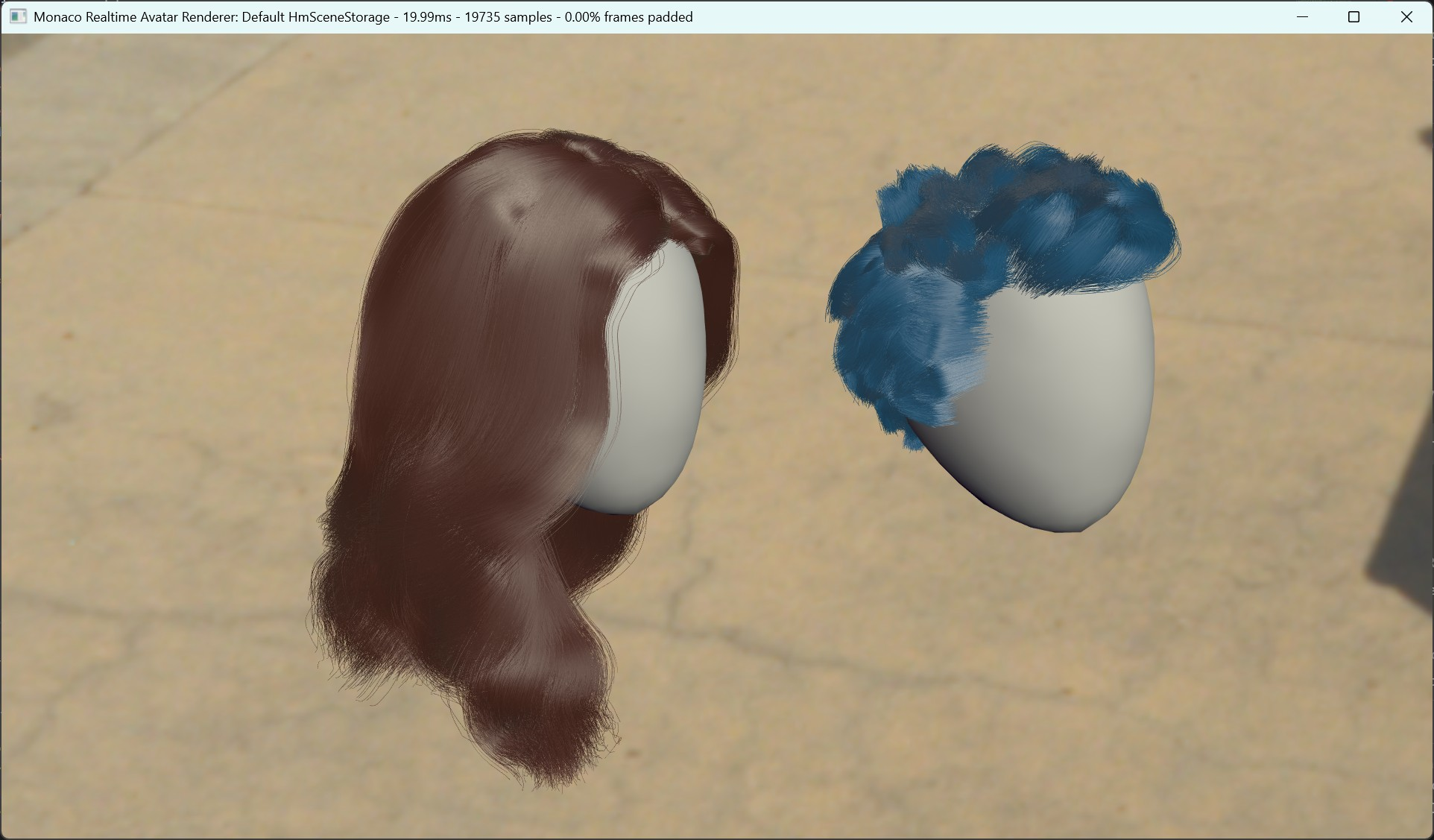
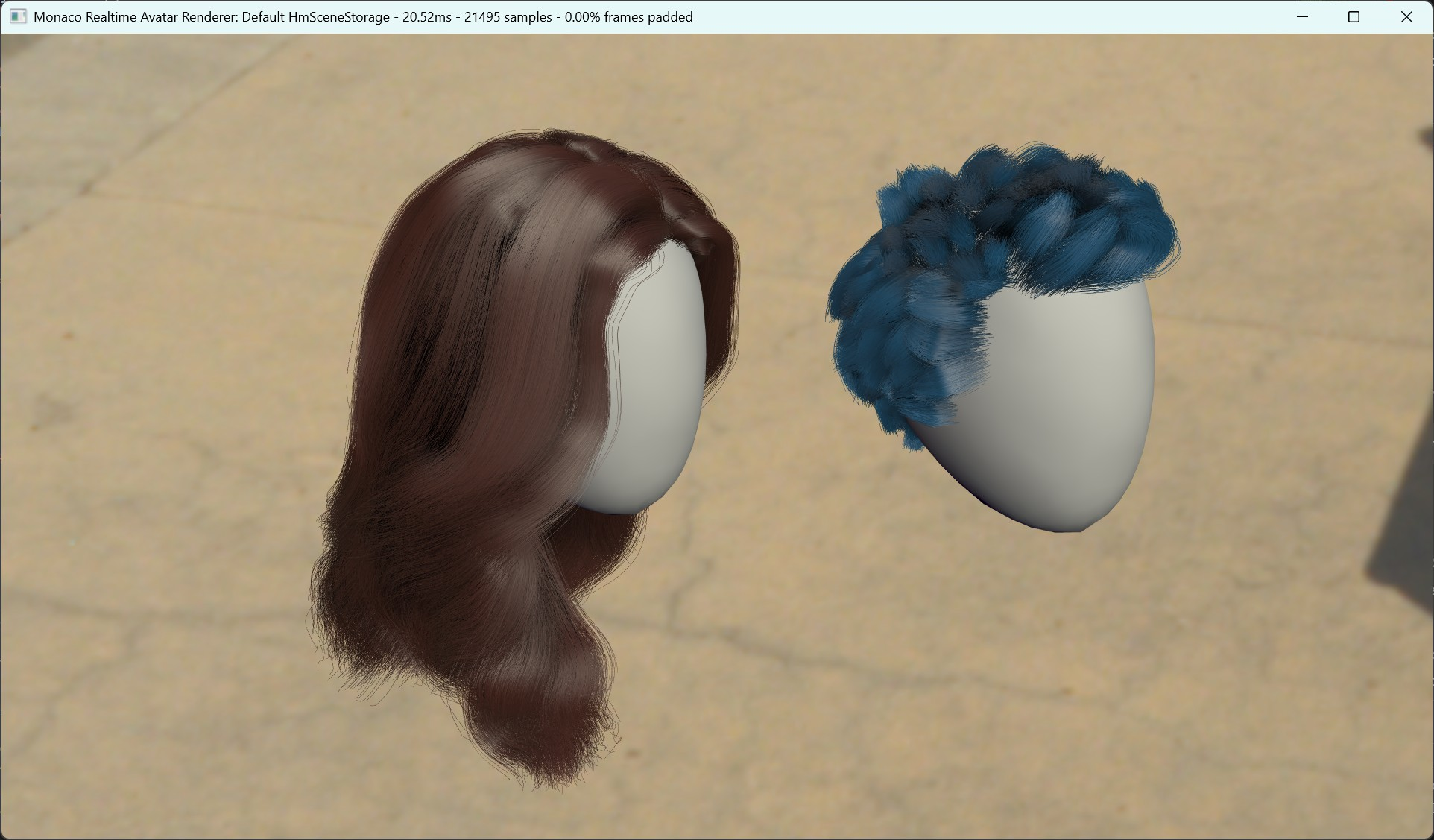
Figure 5: Comparison of rendering with and without pre-baked ambient occlusion; volume and depth are significantly enhanced by AO.
Quantitative Results
The software rasterizer with LOD and filtering achieves 4.4× to 11× speedup over mesh shader baselines on contemporary hardware (RTX 5080 at 1080p), with far-field grooming reducing frame times from 4.5 ms (no LOD) to 0.4 ms (with LOD and filter) for 127k strands. Notably, mesh shader LOD degrades performance at close and medium distances due to granularity constraints of task shaders, while the compute pre-pass in the new pipeline maintains strict per-bundle adaptivity without such penalties.
Visual quality is preserved or exceeds that of 4–8x MSAA hardware references, recovering subpixel detail without blurring or strand dropouts, especially in challenging high-density/far-field scenarios.
Implications, Applications, and Limitations
Broad Hardware Support and Scalability: The method targets only core compute shader and 64-bit atomic capabilities, ensuring compatibility across a wide range of current and future GPUs. Strong SIMD utilization, minimal bandwidth, and deferred shading with tight G-buffer encoding enable rendering of large crowds or scenes with numerous diverse grooms.
Interactive and Flexible Workflows: The on-the-fly strand generation and styling allow run-time modification, supporting authoring, animation, and simulation tasks without asset reprocessing.
Multiview and VR Readiness: Shared strand assembly amortizes cost across many views/cameras, with deferred stages efficiently duplicated per target.
Limitations: For strands projecting wider than a pixel (extreme closeups), the deferred software approach is less efficient due to increased overdraw and imbalance in rasterizer thread workloads. Hybridization with hardware rasterization for near-field views or more efficient workgroup parallelization for low-control-point strands is proposed as future work. The current filter is spatial only; temporal extensions to further mitigate flickering are a straightforward extension.
Conclusion
This work establishes a high-performance, broad-spectrum solution for real-time strand-based hair rendering, mitigating previous constraints of platform support, performance, and aliasing. The pipeline’s combination of adaptive on-the-fly LOD, cooperative SIMD strand assembly, compact deferred shading, robust filtering/reconstruction, and volumetric AO directly encoded onto mesh proxies delivers substantial improvements in both numerical performance and perceptual quality relative to mesh shaders and previous approaches. The claimed 4–11× speedup and MSAA-equivalent image quality, supported by extensive numeric benchmarking, set a new technical baseline for interactive and scalable rendering of complex hair grooms in real-time applications.
References:
"High-Performance Real-Time Implicit Strand-Based Hair Rendering via Software Rasterization" (2607.04230)

