- The paper demonstrates that execution harness design induces immediate belief divergence, directly affecting multi-step agent decision-making.
- It introduces a BIWM protocol that systematically measures structured belief rollouts across various harness interfaces.
- Empirical findings reveal that context-specific harness mechanisms drive divergence dynamics, linking belief shifts to subsequent action choices.
Measuring Harness-Induced Belief Divergence in Multi-Step LLM Agents
Introduction and Motivations
This work introduces a principled framework for quantifying how the design of the execution harness—the interface mediating observation, action, repair, verification, and logging—systematically alters the multi-step belief trajectories of LLM agents, even when task, environment, and model remain fixed (2607.04528). Traditionally, software-agent benchmarks and broader LLM agent evaluations report only outcome-based success or failure; this approach leaves the interface architecture an unexamined source of confound. The authors argue, and demonstrate with rigorous diagnostics, that harness design is not a neutral implementation choice but a first-order variable that modifies agent world-model beliefs, influences agent action selection, and propagates divergences through multi-step reasoning.
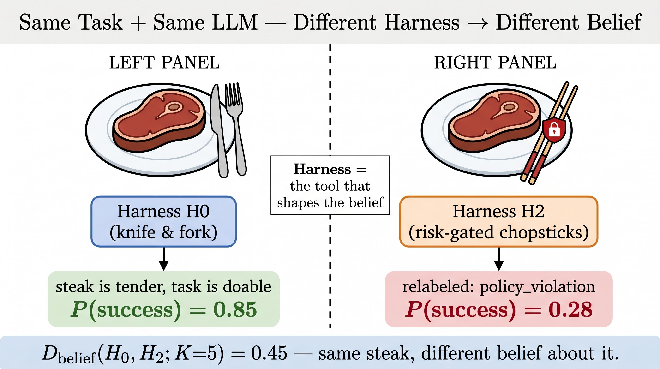
Figure 1: The task and LLM remain fixed, but different harnesses (e.g., raw vs. risk-gated) induce divergent beliefs due to changes in the agent's observed evidence.
Problem Definition and Measurement Framework
The authors formalize the harness as a six-tuple mapping, parameterizing observation abstraction, action gating, risk mediation, repair policy, verification, and logging. This abstraction enables systematic exploration of harness mechanisms (e.g., risk gating, repair compression, selective verification) within a unified analytic protocol. Rather than restricting attention to scalar outputs or single-step beliefs, the analysis constructs structured K-step belief rollouts, eliciting, at each step, predictions of task progress, risk, recoverability, forecasted success, failure mode, and recommended next action.
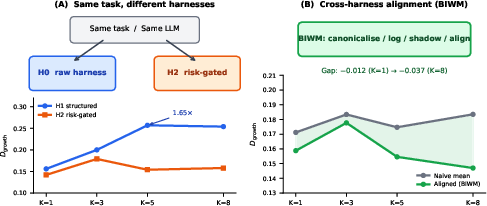
Figure 2: Experimental overview: holding fixed the task, LLM, and schema, with only the harness varying, influences the multi-step evidence stream and thus belief trajectories; the diagnostic separates immediate interface effects ("arrival") from horizon-dependent "growth".
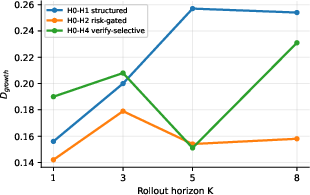
The diagnostic is built atop a composite divergence metric Dbelief, which compares, for each task/harness pair, the structured belief trajectory output by the LLM. Critically, the metric decomposes divergence into an "arrival" component (immediate differences arising from interface mismatch in action formatting and constraints) and a "growth" component (aggregated differences in categorical, failure-mode, and numeric belief fields that evolve over the rollout horizon).
Instrumentation Pipeline and Belief-Invariant World Modeling (BIWM)
The harness-to-belief instrumentation pipeline consists of: (i) instantiating multiple harnesses (raw, structured, risk-gated, repair-heavy, verification-selective, cost-aware), (ii) generating per-harness, per-horizon belief rollouts, and (iii) applying the BIWM protocol—a no-training stack that canonicalizes observations, logs censored actions, unrolls repairs, instrument verification states, executes shadow branches, and aligns trajectory ensembles to expose and control for harness-induced belief distortion.
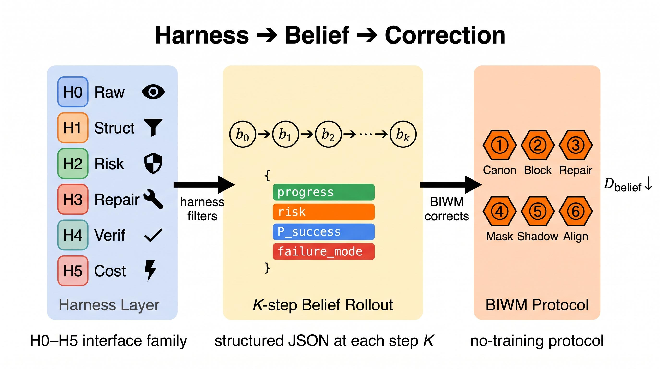
Figure 3: The full pipeline induces structured belief rollouts per harness and applies BIWM instrumentation to extricate protocol-induced distortion.
Empirical Analysis and Key Results
Controlled Mechanism Study
In controlled coding environments (HIBench-Code), empirical evaluation reveals:
Long-Horizon Dynamics
Extending rollouts to K=20 steps shows overall divergence stabilizes after early horizons, but component-level analysis demonstrates continued, nontrivial variations in numeric and failure forecast fields, underscoring the necessity of separation between scalar and structured diagnostics.
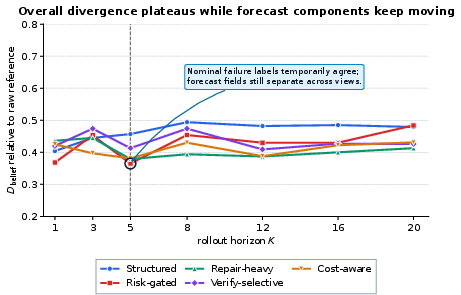
Figure 5: Overall divergence stabilizes quickly, but individual belief components (e.g., numeric forecasts, failure modes) remain sensitive to horizon and harness.
Harness-Induced Belief Effects Across Public Benchmarks
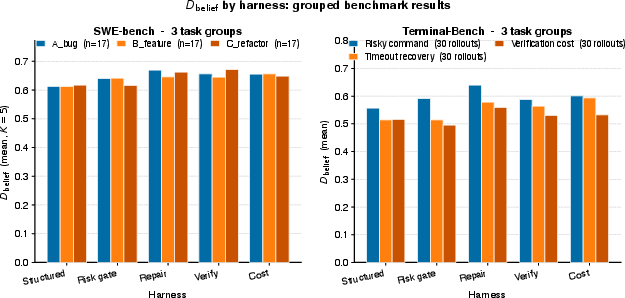
Grouped evaluations on SWE-bench Verified and Terminal-Bench confirm the external validity of the harness effect:
Harness Effects on Agent Control Policies
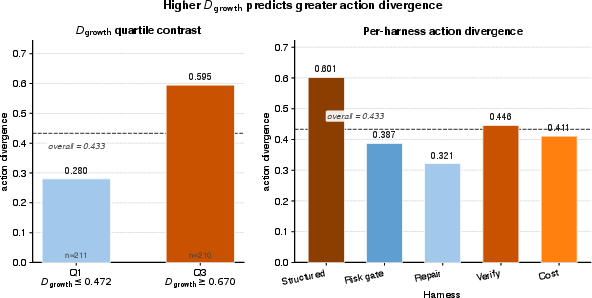
Crucially, belief divergence propagates robustly to control-layer action selection:
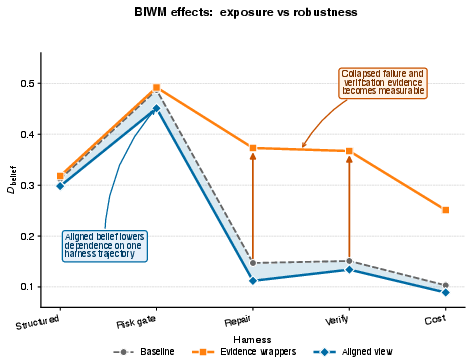
BIWM instrumentation serves two roles:
Metric Sensitivity and Diagnostic Robustness
Metric weight sensitivity analysis illustrates that while the absolute scale and rank order can shift by reweighting arrival- vs. growth-heavy components, qualitative conclusions regarding which harness mechanisms induce the largest shifts remain stable under all reasonable diagnostic settings.
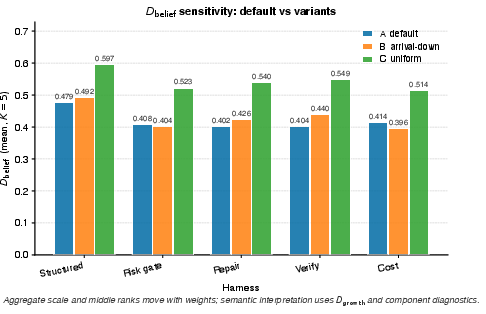
Figure 9: Metric-weight sensitivity: structured harness remains reliably top-divergence, with middle rank order reflecting metric emphasis.
Theoretical Contributions
The paper establishes the conditions under which censoring-induced growth divergence is expected to accumulate over the rollout horizon, formalizing a monotonicity result under context sensitivity and propagation assumptions. Analytic lower bounds on arrival divergence, interpreted through disjoint constraint set representations, provide explicit measures of harness-induced interface floor.
Implications and Future Directions
Practical Implications: This work mandates that agent evaluation must treat harness specification as an explicit experimental variable; unexamined interface design can mask, erase, or manufacture agentic progress, risk, or recoverability signals. For benchmarking, this directly implies that comparing agent outcome rates across studies that do not report or standardize harness implementations is ill-posed. In production, risk gating and verification strategies should be protocol-transparent—belief-aware auditing is required to identify when an agent is laboring under obsolete, censored, or compressed world-model views.
Theoretical Implications: The emergence of substantial, horizon-sensitive belief divergence in fixed-task/fixed-LLM settings underscores the need for inference-time, protocol-level world model auditing, not just parametric model calibration. This work bridges the gap between single-step uncertainty diagnostics and structured agentic self-model analysis.
Future Directions: This framework paves the way for generalized, protocol-auditable evaluation of LLM-based agents in arbitrarily complex, multi-interface deployment regimes (code, web, API, tool-use). Integrating automated harness-instrumentation in agent orchestration systems, and developing adaptive harness strategies that expose or mitigate evidence suppression in safety-critical settings, are logical, high-impact extensions.
Conclusion
This paper rigorously demonstrates that the execution harness is an experimental variable that decisively shapes multi-step LLM agent beliefs, decision trajectories, and control actions. Standardizing, auditing, and instrumenting harness protocols are preconditions for meaningful agent evaluation. The proposed belief-rollout diagnostic and BIWM protocol offer both precise measurements of harness-induced divergence and actionable strategies for information exposure and control. These results recalibrate the methodological foundation for agentic LLM assessment and point to harness design as a central target for future study and engineering (2607.04528).