LLM-as-a-Verifier: A General-Purpose Verification Framework
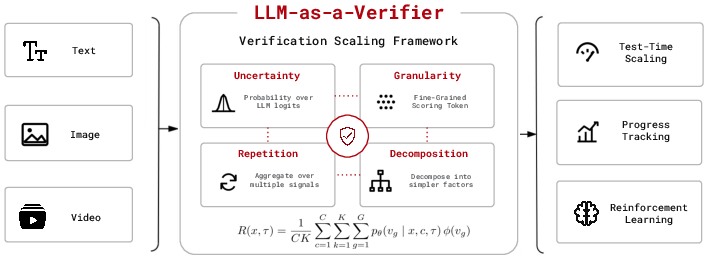
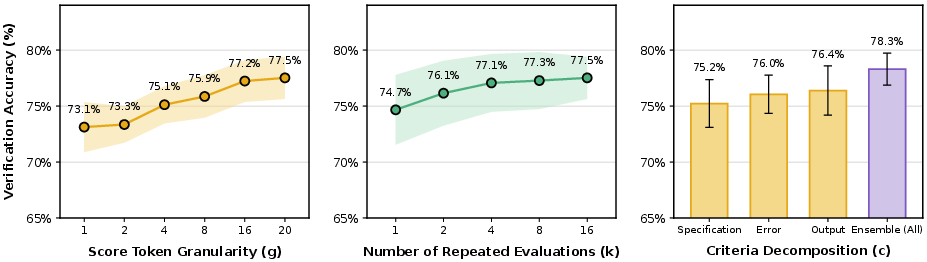
Abstract: Scaling pre-training, post-training, and test-time compute have become the central paradigms for improving the capabilities of LLMs. In this work, we identify verification, the ability to determine the correctness of a solution, as a new scaling axis. To unlock this and demonstrate its effectiveness, we introduce LLM-as-a-Verifier, a general-purpose verification framework that provides fine-grained feedback for agentic tasks without requiring additional training. Unlike standard LM judges that prompt LLMs to produce discrete scores for candidate solutions, LLM-as-a-Verifier computes the expectation over the distribution of scoring token logits to generate continuous scores. This probabilistic formulation enables verification to scale along multiple dimensions: (1) score granularity, (2) repeated evaluation, and (3) criteria decomposition. In particular, we show that scaling the scoring granularity leads to better separation between positive and negative solutions, resulting in more calibrated comparisons. Moreover, scaling repeated evaluation and criteria decomposition consistently lead to additional gains in verification accuracy through variance and complexity reduction. We further introduce a cost-efficient ranking algorithm for selecting the best solution among candidates using the verifier's continuous scores. LLM-as-a-Verifier achieves state-of-the-art performance on Terminal-Bench V2 (86.5%), SWE-Bench Verified (78.2%), RoboRewardBench (87.4%), and MedAgentBench (73.3%). Beyond verification, the fine-grained signals from LLM-as-a-Verifier can also serve as a proxy for estimating task progress. We build an extension for Claude Code, enabling developers to monitor and improve their own agentic systems. Finally, we show that LLM-as-a-Verifier can provide dense feedback for RL, improving the sample efficiency of SAC and GRPO on robotics and mathematical reasoning benchmarks.
Paper Prompts
Sign up for free to create and run prompts on this paper using GPT-5.
Top Community Prompts
Explain it Like I'm 14
Overview
This paper introduces a new way to use LLMs like smart assistants—not just to write or generate answers, but to check whether those answers are correct. The authors call this idea “LLM-as-a-Verifier.” Think of it like having a careful referee who grades solutions with a fine-tuned ruler instead of a simple yes/no stamp. The paper shows how to make this referee more reliable and how to use it to pick the best solution from many attempts, track progress on long tasks, and even speed up training for robots and math solvers.
Key Objectives
The paper asks a few simple but important questions:
- Can we turn an LLM into a good checker (verifier) without training it further?
- If we look at the model’s full “confidence” spread instead of a single score, do we judge better?
- Does making scores more detailed, repeating evaluations, and breaking criteria into parts improve accuracy?
- Can we pick the best solution from many candidates efficiently (without comparing every possible pair)?
- Does this approach work across very different areas like coding, robotics, and medicine?
- Can the verifier’s score act like a “progress meter” and help reinforcement learning (RL) learn faster?
Methods Explained Simply
Here’s how the approach works, in everyday terms:
- Judge vs. Verifier:
- A “judge” gives a single, simple score (like 1–5 stars).
- A “verifier” looks at all the evidence and gives a more nuanced score. This paper turns an LLM into a verifier by using the full range of the model’s confidence in different score options, not just the top one.
- Using the model’s confidence (logits) as a continuous score:
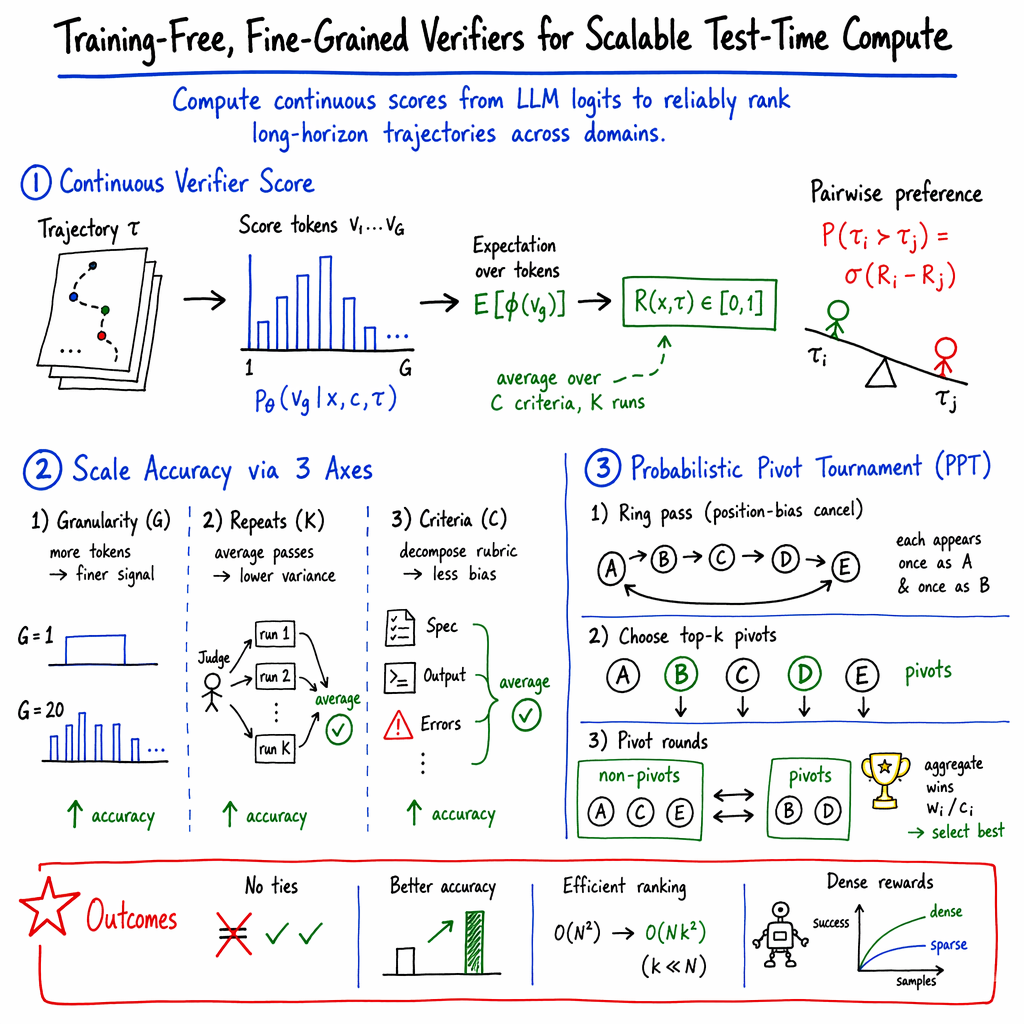
- Inside an LLM, each possible answer (like a score token “12” or “17” on a 1–20 scale) has a confidence level before it’s turned into a final pick. Instead of keeping only the highest one, the authors average across all the possible scores weighted by how confident the model is about each. This creates a smooth, continuous score rather than a chunky, discrete one.
- Analogy: Instead of rounding your test score to the nearest letter grade, you keep the exact percentage. You lose fewer details, so ties are rarer and small differences matter.
- Three “scaling knobs” that make verification more reliable:
- Score granularity: Use more possible score levels (like a 1–20 scale instead of 1–5). Analogy: A ruler with more tiny marks measures more precisely.
- Repeated evaluation: Ask the verifier several times and average the results. Analogy: Ask multiple referees and combine their opinions to cancel out randomness.
- Criteria decomposition: Break “Is this good?” into simpler parts (e.g., “follows the rules,” “output looks right,” “no errors in logs”), then combine those part-scores. Analogy: A school rubric with separate points for content, structure, and grammar.
- Picking the best solution from many attempts efficiently:
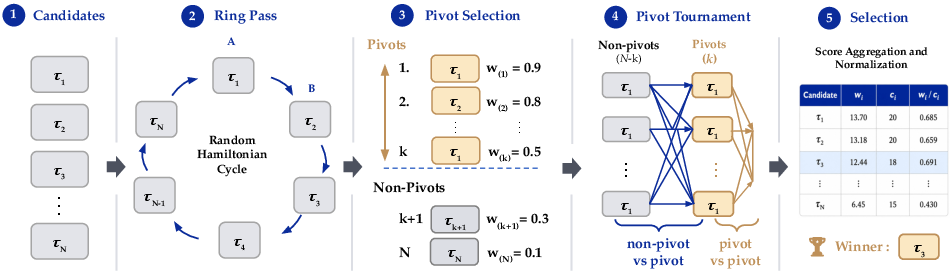
- Probabilistic Pivot Tournament (PPT): If you have many candidate solutions, comparing every pair is slow. Instead, the method:
- 1) Quickly does a light pass to get a rough ranking.
- 2) Chooses a few “pivot” candidates near the top.
- 3) Compares everyone mostly against those pivots and among the pivots themselves.
- Analogy: A sports qualifier where only top seeds play more matches to save time, but you still figure out the true winner.
- Pairwise preferences:
- The verifier compares A vs. B and estimates the chance A is better than B. Repeating this across candidates gives a principled way to pick the best one.
Main Findings and Why They Matter
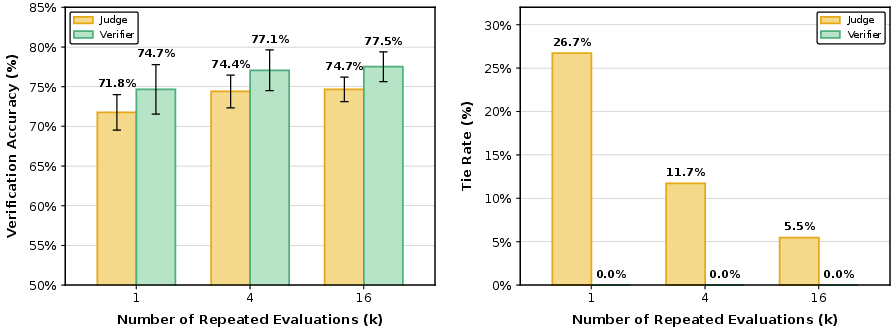
- Better judging with fewer ties:
- Using continuous scores (averaging across score options) sharply reduces ties versus simple judges that pick a single score. This makes it easier to tell close solutions apart and pick the truly best one.
- Scaling along three axes improves accuracy:
- More granular scores (e.g., 1–20) separate good and bad solutions better than coarse scales.
- Repeating evaluations and averaging reduces random noise.
- Breaking the rubric into clear criteria avoids confusion and bias.
- Together, these boosts lead to more calibrated and dependable verification.
- A faster, cost-effective way to choose the best attempt:
- The Probabilistic Pivot Tournament finds the top solution without comparing every pair, saving time and money while improving accuracy.
- Strong results across different domains:
- Coding benchmarks: State-of-the-art performance on Terminal-Bench V2 (86.5%) and SWE-Bench Verified (78.2%).
- Robotics: Preference accuracy of 87.4% on RoboRewardBench, beating trained robotics reward models—even without extra training.
- Medical tasks: 73.3% on MedAgentBench, outperforming strong baselines.
- Progress tracking:
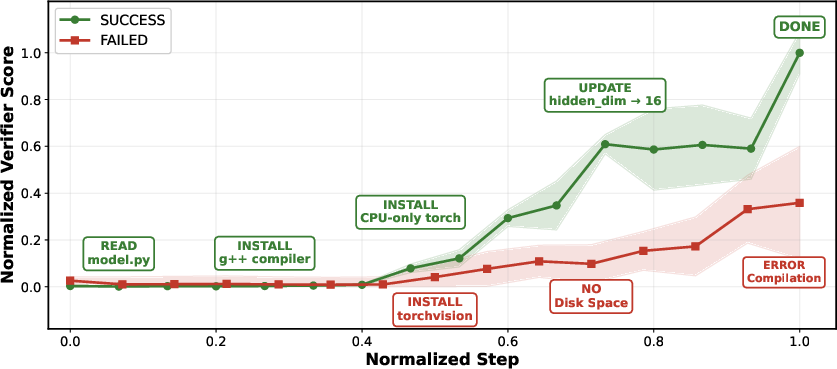
- The verifier’s score rises as a task gets closer to completion on successful runs and stays low on failing runs. This means the score can act like a progress bar for agents working step-by-step, helping catch problems earlier.
- Helps reinforcement learning learn faster:
- Using the verifier’s continuous score as “dense reward” (many small guidance signals rather than rare pass/fail) improves training efficiency:
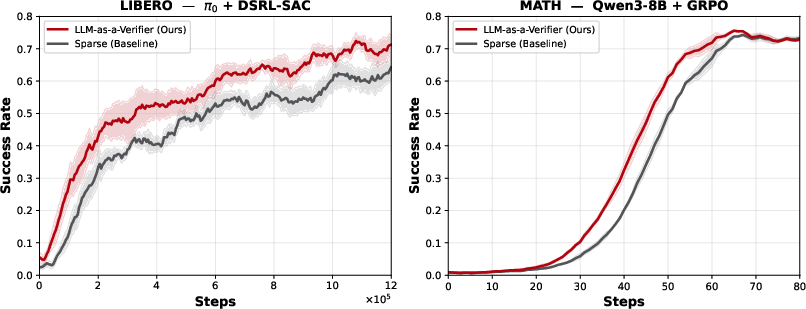
- About 1.8× fewer steps to reach the same success on a robotics task (LIBERO) with SAC, and higher final success.
- About 1.1× more sample-efficient fine-tuning on a MATH benchmark with GRPO.
Implications and Potential Impact
This work suggests a new, practical way to make AI systems more reliable and useful:
- Better decision-making at test time: When an agent tries multiple strategies, LLM-as-a-Verifier can reliably choose the best one, lifting overall success without retraining models.
- Safer, clearer monitoring: The verifier’s fine-grained score can serve as a live progress meter for long tasks, allowing developers to spot stalls or errors early.
- Works across many tasks: Because it doesn’t need extra training and leans on a general LLM, this approach can be plugged into coding, robotics, medical agents, and beyond.
- Faster learning: In RL, continuous feedback helps models improve more quickly than pass/fail signals, saving time and compute.
In short, LLM-as-a-Verifier turns LLMs into precise, scalable checkers that can evaluate complex work more fairly and efficiently—helping AI agents perform better, learn faster, and operate more safely in real-world tasks.
Knowledge Gaps
Knowledge gaps, limitations, and open questions
Below is a single, concrete list of what remains missing, uncertain, or unexplored in the paper, framed to inform actionable future research.
- Logit access and closed-API models: The main results rely on token-level logprobs; the two-stage workaround for frontier models without logprob access is relegated to the appendix and not benchmarked head-to-head for accuracy, cost, and latency. How much performance is lost with the workaround, and can verification be made practical on strictly black-box APIs?
- Sensitivity to the choice of score-token mapping φ: The framework assumes an ordinal mapping (e.g., 1–20) but does not analyze how different φ choices (linear vs. nonlinear spacing, re-anchoring, or model-specific calibrations) affect ranking accuracy, preference probabilities, and robustness.
- Tokenization and language effects in score granularity: The “letter-based scale” hack to enable granularity may interact with tokenizer idiosyncrasies, languages, or model families. It is unclear whether the gains persist in non-English settings, across different tokenizers, or when score tokens collide with subword boundaries.
- Approximation from top‑k logprob extraction: Experiments use up to the top‑20 logprobs to compute expectations, implicitly truncating the tail mass. The resulting bias, sensitivity to k, and renormalization choices are not quantified.
- Calibration of probabilistic scores: Using expectations over logit-derived token probabilities assumes the verifier’s token-space probabilities are calibrated for the evaluation task. There is no assessment using calibration metrics (e.g., ECE, Brier score) or temperature/decoding dependence.
- From continuous scores to preferences (Bradley–Terry): The logistic conversion of score differences to pairwise preference probabilities is not calibrated to human judgments or ground truth. Do alternative link functions (Thurstone, Plackett–Luce, Bayesian models) or learned calibrations yield better fidelity and transitivity?
- Intransitivity and cycles in pairwise comparisons: The presence of preference cycles and their impact on downstream selection is not measured. How often do cycles occur in practice, and can cycle-resolving aggregation or listwise models reduce selection error?
- Theoretical guarantees for Probabilistic Pivot Tournament (PPT): PPT provides cost reductions but lacks theoretical regret/sample complexity bounds or worst-case guarantees relative to full round-robin, especially under noisy, non-transitive preferences.
- Residual positional/prompt bias after ring pass: The ring pass cancels slot bias “in expectation,” but the residual bias in finite-sample settings is not reported. How sensitive is PPT to prompt templates, instruction order, or instruction wording?
- Adaptive budgeting and early stopping: K (repeats), G (granularity), and C (criteria) are fixed a priori. The paper does not explore adaptive query allocation (e.g., uncertainty-based stopping, progressive widening) to minimize cost while meeting accuracy targets.
- Cost, latency, and energy analysis: End-to-end cost/latency under different N, K, C, and k (pivots) is not reported. Practitioners need $/task, seconds/task, and GPU-hour estimates to plan deployments and compare to learned reward models.
- Criteria decomposition design and weighting: The paper averages across a hand-crafted set of criteria. There is no analysis of weighting strategies, inter-criterion dependence, potential double-counting, or methods to learn criteria and weights from data.
- Robustness to adversarial or strategic inputs: It remains unknown whether agents can “Goodhart” the verifier by producing trajectories that exploit prompt regularities, score-token priors, or criteria heuristics to get high scores without being correct.
- Domain transfer and modality scaling: Results are shown for coding, robotics (video), and medical tasks; performance under other modalities (audio, multimodal documents), longer-horizon planning (multi-hour workflows), or highly dynamic environments is untested.
- Verifier strength and cross-model bias: Most results use specific strong verifiers (e.g., Gemini 2.5 Flash, Qwen 3.6 VLM). There is no systematic study of how verifier capability affects accuracy, whether “family bias” favors similar generators, or how smaller/cheaper verifiers perform.
- Generator–verifier entanglement: The effects of verifying outputs from the same model family (or same provider) are not isolated. Are there favoritism or overfitting patterns when the generator and verifier share training data or inductive biases?
- Generalization across updates and model drift: Stability under model updates (API changes) and across time is not assessed. Do verification decisions remain consistent as providers silently update their models or tokenizers?
- Ground-truth labeling for verification accuracy: Pairwise verification accuracy is reported using “ground-truth successful” vs. failed trajectories on Terminal-Bench, but the labeling pipeline (and its potential noise) is not analyzed. How sensitive are results to ground-truth inaccuracies?
- Comparison to learned code/clinical reward models: While robotics compares against trained reward models, analogous comparisons are missing for code (e.g., PRMs/ORMS, learned execution-based judges) and medical (domain-specific reward/consistency models).
- Robustness on heterogeneous candidate pools at larger N: PPT is evaluated with moderate candidate counts (e.g., N=5, 20 in curated setups). Scaling behavior, error rates, and cost with much larger or more heterogeneous candidate sets remain open.
- Score normalization across tasks: Linear min–max normalization using global φ bounds may miscalibrate across tasks of different difficulty. Task-conditional or adaptive normalization strategies are not explored.
- Ties and near-ties under continuous scoring: The claim of “zero ties” for continuous scoring is reported in a case study, but tie/near-tie behavior across benchmarks and its impact on selection confidence is not quantified.
- RL reward shaping risks and non-Markov feedback: Using trajectory-level verifier rewards in RL introduces non-Markov and delayed signals. The paper does not analyze credit assignment, potential reward hacking, policy–verifier feedback loops, or stability under long-horizon training.
- RL generality and benchmarks: RL results are limited to LIBERO ketchup and MATH GRPO with modest gains. It remains unclear whether the approach scales to more complex tasks, larger policies, or longer horizons without degrading stability.
- Progress proxy validity and causal interpretation: High Value-Order Correlation (VOC) indicates monotonicity but not causal progress tracking. Does the score increase reflect true task advancement or superficial temporal patterns? Stress tests against counterfactuals and adversarial “busywork” are missing.
- Video verifier details for robotics: Frame selection, temporal aggregation, and visual context handling are not detailed. Sensitivity to frame rate, occlusions, and visually similar yet semantically different states remains untested.
- Multilingual and non-English tasks: The score-token scheme and prompts are English-centric. Robustness in multilingual settings and across locales/character sets is not evaluated.
- Safety and clinical validity in medical settings: Although higher task accuracy is reported, there is no analysis of safety-critical failure modes, harm-aware criteria, or human-in-the-loop safeguards for clinical verification.
- Dataset contamination and training exposure: Zero-shot claims do not rule out implicit exposure of benchmarks in verifier pretraining. Audits for data leakage or indirect contamination are not presented.
- Reproducibility and hyperparameter sensitivity: Many critical choices (prompt templates, φ, G/K/C, temperature, k pivots) may affect outcomes. A systematic sensitivity analysis and seeds-to-seeds variability study are not provided.
- Uncertainty quantification for decisions: The framework yields continuous scores and pairwise probabilities, but task-level uncertainty estimates (e.g., confidence intervals for selection, abstain/deferral policies) are not developed.
- Integrating execution-based signals: For code, combining probabilistic verification with execution results (tests, linters, sandboxes) is not studied. Can hybrid verifiers leverage both to improve accuracy and reduce costs?
- Privacy and compliance in real deployments: Verifying real medical or enterprise code/data may raise privacy/PII concerns. The paper does not discuss privacy-preserving verification or on-prem deployment constraints.
- Fairness and bias across tasks and populations: No fairness analysis is presented. Do verification decisions vary with content style, author identity markers, or task domains in ways that could introduce systematic bias?
- Failure analysis: The paper reports aggregate gains but does not provide an error taxonomy for when the verifier fails (e.g., hallucinated correctness, overlooking critical errors), limiting targeted improvements.
- Open-sourcing and replicability: Claims about public extensions (e.g., TurboAgent, code extensions) are noted but not paired with full experimental artifacts for exact replication across all benchmarks.
Practical Applications
Immediate Applications
The items below translate the paper’s methods—continuous, probabilistic verification from scoring-token logits; the three scaling axes (granularity G, repeated evaluations K, criteria decomposition C); and the Probabilistic Pivot Tournament (PPT)—into deployable, real-world uses. Each bullet lists sector(s), what to deploy, how it leverages the paper’s findings, and key dependencies/assumptions.
- Coding agents: inference-time reranking of candidate patches and actions
- Sectors: software, developer tools
- What: Add a “verifier node” after code generation in IDEs/agentic scaffolds (e.g., Capy, OpenHands, mini-swe-agent) to select the best patch/command among N candidates using PPT + continuous scoring.
- How (paper link): Use continuous scores from token-logit expectations to break ties and improve discrimination; scale via higher G, modest K, and C=spec/output/errors; use PPT to cut pairwise costs from O(N²) to O(Nk²).
- Tools/workflows: “TurboAgent” proxy (from the paper) as a drop-in reranker for Claude Code/OpenAI-compatible clients; CI/CD “Verifier Gate” that promotes only top-ranked patches; PR-bot that posts verifier-backed rationales.
- Assumptions/dependencies: Access to logprobs or the paper’s two-stage workaround; domain-specific rubrics (criteria); budget for repeated evaluations; privacy-compliant handling of code.
- Real-time agent monitoring and early stopping with progress scores
- Sectors: software, operations
- What: Dashboard that streams the verifier’s fine-grained score over time (Value-Order Correlation) to detect stalls/regressions and trigger rollback/handoff.
- How: Use the verifier’s prefix-wise scores as a progress proxy (VOC near 1 for good runs), as shown in the paper’s code and robotics examples.
- Tools/workflows: AgentOps-style console plug-in showing VOC traces; automatic “pause/handoff” thresholds; incident runbook execution with live progress telemetry.
- Assumptions/dependencies: Stable correlation between score and task progress in the target domain; latency budget for intermittent verification.
- RAG and tool-use answer selection with budgeted pairwise comparisons
- Sectors: software, knowledge management, customer support
- What: Generate multiple candidates (answers, tool plans, citations), then select the best using PPT to minimize verification calls while focusing on likely winners.
- How: Apply the Bradley–Terry preference from continuous scores; run a ring pass to debias position effects; select k pivots; compare non-pivots to pivots.
- Tools/workflows: “Pivot Tournament Reranker” microservice sitting after generation; add criteria such as grounding, faithfulness, and completeness.
- Assumptions/dependencies: Criteria decomposition tuned to the domain; moderate N and k to meet latency/cost targets.
- Robotics evaluation and data curation without training domain-specific reward models
- Sectors: robotics, manufacturing QA, autonomy labs
- What: Use the verifier to score or prefer rollouts (videos) for QA gates, dataset filtering, and policy selection across candidate controllers.
- How: Multimodal verifier (VLM) with continuous scoring improves preference accuracy and MAE vs trained reward models; repeated evaluations (K) stabilize estimates.
- Tools/workflows: Batch rollout scoring pipeline; “best-of-N” policy selection; triage of teleop sessions by progress score.
- Assumptions/dependencies: VLM with robust vision logprobs; careful criteria for physical progress and safety; video pre-processing to fit context limits.
- Healthcare agent auditing and deployment gating in simulated/EHR-like settings
- Sectors: healthcare IT, clinical decision support
- What: Verifier-backed selection and monitoring of agent trajectories for literature lookup, order sets, and EHR navigation; automatic gating to human review if verifier confidence low.
- How: Criteria decomposition tailored to clinical correctness and guideline compliance; continuous scores reduce ties and surface borderline cases.
- Tools/workflows: Clinician-facing “Audit Panel” that shows trajectory, criteria scores, and pivot comparisons; nightly batch audits of agent logs.
- Assumptions/dependencies: HIPAA/privacy compliance; domain rubrics curated by clinicians; conservative thresholds; human-in-the-loop requirements.
- Dense, training-free reward signals to speed RL experiments
- Sectors: academia, robotics RL, reasoning RL
- What: Use verifier scores as dense rewards for SAC/GRPO loops to improve sample efficiency on robotics and math reasoning tasks.
- How: Treat Eq. (1) reward as trajectory reward; schedule K repetitions modestly; optionally normalize and shape progress-based rewards.
- Tools/workflows: Plug-in “VerifierCritic” wrapper for RL frameworks; offline batch relabeling of datasets with verifier rewards.
- Assumptions/dependencies: Avoid reward hacking by holding out criteria text; periodic human spot-checks; cost budget for repeated queries.
- Safer automation in enterprise operations (RPA, workflows)
- Sectors: finance ops, back-office automation, ITSM
- What: Verify multi-step scripts (e.g., invoice processing, entitlement updates) before execution; re-rank candidate plans and rollback when progress stagnates.
- How: Criteria for compliance, side-effect risk, and output format; PPT for plan selection; progress score for stop conditions.
- Tools/workflows: “Verifier Node” in orchestration graphs (e.g., LangGraph, Airflow) with allow/deny and quorum policies.
- Assumptions/dependencies: Access to logs/state; auditability; latency acceptable for the business process.
- Education: step-wise tutoring feedback and auto-grading with finer granularity
- Sectors: education technology
- What: Grade and give targeted feedback on step-by-step solutions (math, coding) with low tie rates; track student progress within a session.
- How: Continuous scoring on decomposed criteria (correctness, justification, format); VOC as a proxy for learning progression.
- Tools/workflows: LMS plugins; teacher dashboards surfacing per-criterion deltas; formative feedback generator.
- Assumptions/dependencies: Clear rubrics; safeguards against hallucinated scoring; bias audits.
- Content and marketing: multi-draft selection with groundedness checks
- Sectors: marketing, publishing, legal ops
- What: Generate several drafts and verify constraints (brand, claims, citations, clause coverage) before selection.
- How: Criteria decomposition for style/compliance/grounding; PPT for efficient top-1 selection; continuous scores to differentiate near-ties.
- Tools/workflows: CMS-integrated verifier; red-team checklist sourced as criteria.
- Assumptions/dependencies: Domain-specific rubrics; reference materials/citations accessible to the verifier.
Long-Term Applications
These rely on further research, scaling, or integration work (e.g., stronger VLMs, standardized APIs, governance), but are natural extensions of the paper’s framework.
- Verification-as-a-Service (VaaS) for agent platforms
- Sectors: software, cloud platforms
- Vision: Managed service that exposes continuous verification, criteria libraries, and PPT-based reranking across modalities.
- Emergent tools: Hosted rubric catalogs; autoscaling K/G/C based on latency budgets; streaming VOC endpoints.
- Dependencies: Standardized logprob access or robust closed-API workarounds; cost control; SLAs for safety-critical domains.
- Cross-domain standardized verifiers/certifications for AI procurement
- Sectors: policy, public sector, regulated industries
- Vision: Government/industry bodies adopt verifier-backed test suites for vendor agents (coding, EHR, claims processing), with auditable continuous scores.
- Emergent tools: Certified rubric packs; benchmark governance portals; audit logs with ring-pass debiasing.
- Dependencies: Consensus rubrics; fairness/bias validation; legal and privacy frameworks.
- Verifier-guided training at scale (beyond test-time)
- Sectors: academia, foundation model training, RLHF-alternatives
- Vision: Replace or augment learned reward models with general-purpose verifiers during training (actor–critic setups, dataset relabeling, DPO-style pipelines).
- Emergent tools: “VerifierCritic” components in training stacks; active-learning loops that request higher K only for uncertain samples.
- Dependencies: Robustness to reward gaming; rubric randomization; theoretical guarantees or empirical controls on overfitting to the verifier.
- Safety controllers for autonomous robots and embodied agents
- Sectors: robotics, logistics, assistive tech
- Vision: Online gating that verifies goal progress and safety constraints mid-trajectory; escalate to fail-safe states upon low progress or high risk.
- Emergent tools: Edge-friendly VLM verifiers; hierarchical criteria (task, safety, compliance); hybrid with classical monitors.
- Dependencies: Real-time constraints; multimodal reliability; adversarial robustness; on-device compute.
- Formal-methods hybrids: verifier + program checkers
- Sectors: software verification, safety-critical systems
- Vision: Combine continuous verifier signals (broad coverage) with symbolic checks/tests (soundness) to reduce false positives/negatives in code and configuration changes.
- Emergent tools: Auto-test generation guided by low-scoring criteria; concolic execution prioritized by verifier uncertainty.
- Dependencies: Toolchain integration; proof obligations; handling of large, polyglot codebases.
- Finance and compliance: continuous, verifier-driven risk gates for AI-RPA and trading assistants
- Sectors: finance, compliance
- Vision: Verify policy adherence and risk constraints on agent proposals; gradual rollout with live VOC to monitor drift.
- Emergent tools: Compliance rubric packs mapped to internal policies; temporal VOC alerts for misuse/escalation.
- Dependencies: Data governance; audit trails; regulatory acceptance of probabilistic scoring.
- Healthcare-grade verification and certification of clinical agents
- Sectors: healthcare, medtech regulation
- Vision: Verifier-based pre-certification and post-market surveillance of agent systems using clinical rubrics and multi-criteria safety checks.
- Emergent tools: Verifier dashboards for quality committees; harmonized rubrics with guideline updates; drift detection via VOC gaps.
- Dependencies: Clinical validation studies; bias/safety audits; integration with EHR vendors; strict PHI controls.
- Marketplace-wide content integrity and grounding checks
- Sectors: search, social, advertising
- Vision: Platform-level verifier to score groundedness, safety, and policy compliance for AI-generated content; triage for human review.
- Emergent tools: Multi-criteria verifiers for fact-checking and harm policies; PPT-based sampling for scale.
- Dependencies: Access to authoritative knowledge sources; adversarial robustness; scalable moderation ops.
- Autonomy in household/industrial settings with verifier-mediated planning
- Sectors: smart home, manufacturing, warehousing
- Vision: Agents propose multiple plans; verifier selects and continually tracks progress; automatic replanning on low VOC.
- Emergent tools: Planner–verifier loops with budgeted K; safety interlocks expressed as criteria.
- Dependencies: Reliable perception; latency bounds; integration with physical controllers and safety standards.
Cross-cutting assumptions and dependencies
- Model access/primitives: Token-level logprobs or a robust two-stage workaround; multimodal logprobs for video/images in robotics.
- Cost/latency budgets: Scaling along G, K, and C improves accuracy but increases compute; PPT mitigates O(N²) costs but requires careful k selection.
- Rubric quality: Criteria decomposition must be domain-specific and maintained; poor rubrics cap performance.
- Bias and debiasing: Positional and prompt biases exist; ring-pass and repeated evaluations reduce but don’t eliminate them.
- Privacy and compliance: Sensitive data (codebases, PHI, financial logs) requires on-prem or compliant routes; redaction may degrade verification.
- Robustness and gaming: Agents trained against the verifier may overfit/reward-hack; use held-out criteria, randomization, and human audits.
- Multimodal reliability: Video/image understanding quality limits robotics and UI-agent use; requires strong VLMs and careful preprocessing.
- Governance: For high-stakes domains, human-in-the-loop, audit logs, and conservative thresholds are essential until calibration is proven.
Glossary
- Bradley–Terry model: A probabilistic model for pairwise comparisons that converts scalar “strengths” into win probabilities. "Then, we convert these continuous rewards into a pairwise preference using the Bradley--Terry model, treating as the latent strength of trajectory :"
- criteria decomposition: Splitting a complex evaluation rubric into multiple simpler criteria to reduce bias and capture complementary aspects of quality. "Moreover, scaling repeated evaluation and criteria decomposition consistently leads to additional gains in verification accuracy through variance and complexity reduction."
- dense reward: A feedback signal provided at many steps (or continuously) rather than only at episode completion, aiding learning and optimization. "Finally, we show that LLM-as-a-Verifier can be used as a dense reward signal for RL, improving the sample efficiency of SAC and GRPO on robotics and mathematical reasoning benchmarks."
- Hamiltonian cycle: A cycle in a graph that visits each node exactly once before returning to the start. "We sample a uniformly random Hamiltonian cycle over "
- LLM-as-a-Judge: A baseline approach where an LLM outputs discrete scores for evaluation, typically leading to coarse judgments. "LLM-as-a-Judge (Discrete)"
- LLM-as-a-Verifier: The paper’s proposed framework that uses the full distribution over scoring tokens to yield continuous, fine-grained evaluation signals. "We present LLM-as-a-Verifier, a general-purpose framework that provides fine-grained feedback for any modality without requiring additional training."
- log-probabilities: Logarithms of token probabilities output by a LLM; often used for more stable numerical handling of likelihoods. "our framework is also compatible with frontier models that do not expose token-level log-probabilities via a simple two-stage workaround."
- Markov Decision Process (MDP): A formal framework for sequential decision-making defined by states, actions, transition dynamics, rewards, and horizon. "We model an agent interacting with an environment as a finite-horizon Markov Decision Process (MDP) "
- Mean Absolute Error (MAE): An evaluation metric measuring the average absolute difference between predicted and true values. "We report Mean Absolute Error (MAE; lower is better) between human labels and predicted rewards."
- Monte Carlo estimator: An estimator based on averaging random samples to approximate an expectation. "Averaging independent evaluations is a Monte Carlo estimator of the underlying expected reward;"
- off-policy reinforcement learning: RL methods that learn from data generated by a different policy than the one being optimized. "improves the sample efficiency of both off-policy and on-policy reinforcement learning algorithms."
- on-policy reinforcement learning: RL methods that learn from data generated by the current policy being optimized. "improves the sample efficiency of both off-policy and on-policy reinforcement learning algorithms."
- oracle verifier: A hypothetical perfect evaluator that always selects the correct or optimal solution among candidates. "assuming access to an oracle verifier that always picks the optimal trajectory."
- pairwise verification accuracy: The accuracy of a verifier when deciding which of two candidate solutions is better. "We measure the pairwise verification accuracy over 200 randomly sampled trajectories from Terminal-Bench"
- Pass@K: The probability that at least one of K generated candidates solves the task. "Oracle Pass@ reaches 98.9\% on Terminal-Bench~V2."
- pivot rounds: The stage in the proposed tournament where candidates are compared against selected pivot items to save evaluation budget. "3) Pivot rounds. With the pivot set fixed, we score (i) every non-pivot vs.\ pivot pair with , and (ii) every pivot vs.\ pivot pair within $\binom{\mathcal{P}{2}$."
- pivot selection: Choosing a small set of top candidates (pivots) to focus comparisons and reduce overall verification cost. "2) Pivot selection. We rank candidates by their ring-pass mean preference and choose the top- as the pivot set ."
- positional bias: Systematic preference for items based on their position or slot in a prompt or list. "We therefore introduce a ring-based pivot selection step that both removes the verifier's positional bias and concentrates the remaining budget on uncertain top candidates."
- preference probability: The probabilistic estimate that one candidate is preferred over another according to the verifier. "using the preference probability of Eq.~\ref{eq:pref},"
- Probabilistic Pivot Tournament (PPT): A budget-efficient ranking algorithm that compares candidates against a small pivot set using probabilistic preferences. "We propose a budget-efficient alternative, Probabilistic Pivot Tournament (PPT), illustrated in Fig.~\ref{fig:pivot_tournament}, in which every candidate is compared only against a small set of pivots"
- ring pass: An initial comparison stage using a Hamiltonian cycle so each candidate appears in each prompt position once, mitigating positional bias. "1) Ring pass. We sample a uniformly random Hamiltonian cycle over and score the adjacent pairs"
- round-robin tournament: A comparison scheme where every pair of candidates is evaluated against each other. "we can run a round-robin tournament that scores all pairs"
- sample efficiency: How quickly a method improves performance relative to the number of training or evaluation samples used. "improving the sample efficiency of SAC and GRPO on robotics and mathematical reasoning benchmarks."
- scoring token granularity: The resolution of the scoring scale (number of distinct score tokens), which affects how finely a model can express evaluation judgments. "Scoring Token Granularity"
- scoring token logits: The raw pre-softmax scores for scoring tokens, used to compute continuous evaluation signals. "the distribution of scoring token logits to generate continuous scores."
- Signal-to-Noise Ratio (SNR): A measure comparing the strength of the desired signal to the variability (noise) in that signal. "Signal-to-noise ratio (SNR). (Left) The SNR measures how reliably the verifier separates correct () from incorrect () trajectories"
- Spearman rank correlation: A nonparametric measure of monotonic association between two ranked variables. "We quantify this using the Value-Order Correlation (VOC), the Spearman rank correlation between the chronological index of a step and the verifier's predicted value"
- tie rate: The frequency with which a judge assigns equal scores to different candidates, indicating inability to discriminate. "coarse scoring induces a high tie rate (27\%) on Terminal-Bench"
- trajectory reward model (TRM): A model that assigns scalar scores to entire action trajectories rather than single actions or final outcomes. "We evaluate LLM-as-a-Verifier as a trajectory reward model (TRM) for test-time scaling across four benchmarks"
- Value-Order Correlation (VOC): A metric measuring how well predicted values track the chronological progress of a task. "We quantify this using the Value-Order Correlation (VOC), the Spearman rank correlation between the chronological index of a step and the verifier's predicted value for the prefix ending at that step"
Collections
Sign up for free to add this paper to one or more collections.