Geometric Self-Distillation for Reasoning Generalization
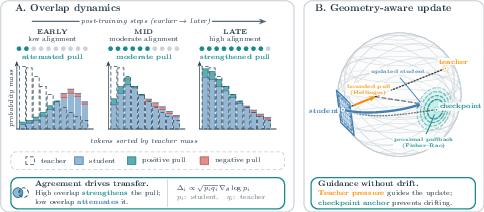
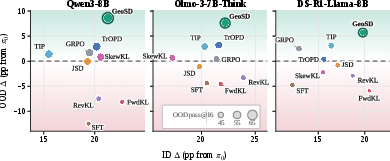
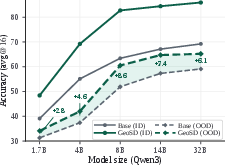
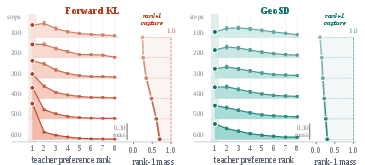
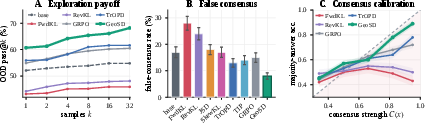
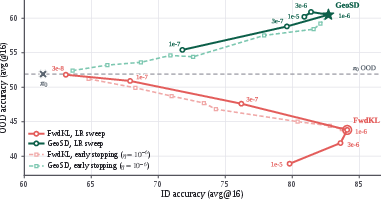
Abstract: On-policy distillation is a practical post-training recipe for LLMs, supplying dense teacher supervision on the student's own trajectories. In privileged-context self-distillation, teacher and student are the same model conditioned on the same prefix, but the teacher also sees a hint or the full solution trace. This makes supervision abundant but harder to trust: the teacher can be confident about continuations its privileged view makes obvious but the student cannot yet justify. The distillation pull is strongest where teacher and student disagree most, and over many updates it accumulates into drift that degrades out-of-distribution (OOD) reasoning. We introduce GeoSD, a geometric self-distillation objective that treats this drift as movement in the student's predictive behavior and counters it in two complementary ways. A Hellinger loss scales each teacher preference by the overlap the student already shares with it, attenuating the pull on tokens the student cannot yet support. Since these pulls still compound over training, a proximal term penalizes how far the student's predictions drift from a recent checkpoint, measured as a Fisher-Rao distance. Both are distances in the same geometry of next-token distributions, and a natural-gradient update takes its steps in that geometry rather than in parameter space. Across mathematical reasoning benchmarks and three model families, GeoSD preserves the in-distribution gains of self-distillation while improving average OOD accuracy by 5.7-8.6 points over the base model, with gains holding across model scales from 1.7B to 32B. Analyzing why standard matching fails out of distribution, we find it wins agreement with the teacher by draining mass from alternatives at high-entropy states, resulting in confident agreement on wrong answers, whereas GeoSD keeps those alternatives in reach.
Paper Prompts
Sign up for free to create and run prompts on this paper using GPT-5.
Top Community Prompts
Explain it Like I'm 14
Geometric Self-Distillation for Reasoning Generalization — A Simple Explanation
1) What is this paper about?
This paper looks at a way to help LLMs get better at solving math problems by “teaching themselves.” The twist: during training, the “teacher” version of the model is allowed to peek at extra information (like a full solution), but the “student” version will not have that help when solving problems for real. The authors show that if you copy the teacher too eagerly, the model can become overconfident and do worse on new, unfamiliar problems. They introduce a new method, called GeoSD, that teaches more gently and more carefully so the model stays good both on familiar and new types of problems.
2) What questions are they trying to answer?
They focus on three easy-to-understand questions:
- How can a model learn from a “teacher” that sees the solution, without becoming overconfident or brittle?
- How can we stop the model from drifting too far from its original, reliable behavior while still improving?
- Can we keep the in-distribution gains (doing better on the training-style problems) and also improve out-of-distribution performance (doing better on different, harder problems)?
3) How does their method work? (With simple analogies)
First, a few key ideas in everyday language:
- Student vs teacher: Imagine you’re solving a math problem (student), while your friend (teacher) secretly has the full answer key. The teacher suggests what the next step should be, but you won’t have the answer key during a real test. If you copy too strongly, you might learn to jump to specific steps you can’t justify yourself later.
- On-policy: This just means the teacher gives feedback on the exact steps the student is currently taking, not on some prewritten perfect solution.
- Drift: Think of drift like slowly wandering off the correct path because you kept taking small but one-sided nudges. Even if each nudge seems okay, they add up.
GeoSD prevents harmful drift using two ideas that work together:
- Overlap-aware pull (gentle agreement)
- Normally, a model tries hard to match the teacher’s top choice for the next token (word or symbol). But if the student doesn’t yet believe that top choice is likely, this creates a harsh yank.
- GeoSD uses a different way to measure the difference between teacher and student (called Hellinger distance). In plain terms, it only pulls strongly where student and teacher already somewhat agree. If the student currently thinks a token is very unlikely, the teacher can’t yank hard on it.
- Analogy: Instead of the teacher shouting “Pick this!” no matter what, the teacher speaks more softly when the student isn’t ready—and raises their voice only as the two start to agree.
- Stay-close rule (don’t wander too far)
- Even gentle pulls can accumulate into drift over many steps. GeoSD adds a “stay-close” penalty that measures how far the current student is from a recent checkpoint (a recent saved version of itself).
- They measure “how far” using a geometry that fits probability distributions (think “distance on a globe” rather than a straight line on a flat map). This distance is called the Fisher–Rao distance.
- Analogy: Picture an elastic band connecting you to your last safe spot. You can move, but if you stray too far, the elastic pulls you back.
- Walk smart, not just fast (natural gradient)
- When updating the model, GeoSD uses a “natural gradient” step. Instead of measuring step size in raw parameters (which can be misleading), it measures how much the step actually changes the model’s predictions.
- Analogy: If you’re navigating hills and valleys, you don’t count steps in meters—you care about how much your view changes. Natural gradient takes steps that are small in how they affect predictions, keeping learning stable.
In short, GeoSD:
- scales down the teacher’s influence where the student isn’t ready,
- limits total drift with a “stay-close” rule,
- and takes steps that are careful in prediction space, not just parameter space.
4) What did they do to test this?
The authors trained and evaluated on math reasoning:
- In-distribution (ID): a held-out split of their training-style math problems.
- Out-of-distribution (OOD): different math benchmarks like AIME 2024/2025, AMC 2023, and MATH-500.
- They tried this across several model families and sizes (from about 1.7 billion to 32 billion parameters).
- They compared GeoSD to common imitation methods (like KL-based distillation) and to filtering methods that try to pick only “trustworthy” teacher hints.
They measured:
- Accuracy when sampling multiple solutions (avg@k and pass@k),
- How often models become overconfident on wrong answers (false consensus),
- And whether learning kept useful alternatives open rather than collapsing too quickly on one path.
5) What did they find, and why does it matter?
Main results:
- GeoSD keeps the in-distribution improvements from self-distillation.
- More importantly, it boosts out-of-distribution accuracy by about 5.7 to 8.6 percentage points (avg@16) compared to the base models—across different model families and sizes.
- Standard methods that copy the teacher strongly often do worse on OOD problems because they become overconfident and “collapse” onto a single wrong answer.
- GeoSD avoids this by keeping other reasonable options alive while still moving toward the teacher’s top choice. That means the model is less likely to be confidently wrong and more likely to find a correct solution when you sample multiple attempts.
Why it matters:
- The whole point of improving reasoning is to generalize—to solve new problems, not just ones that look like training. GeoSD helps models learn from privileged hints without overfitting to them.
- It reduces “false consensus” (many samples agreeing on a wrong answer) and keeps self-consistency useful (agreement is more likely to mean correctness).
- The gains hold even as models get bigger, so this isn’t just a small-model trick.
6) What’s the big picture impact?
- Safer use of hints: We can now give models powerful training-time hints (like full solutions) without teaching them to be overconfident. That means we can use rich data more effectively and still get robust, general reasoning.
- Better generalization: GeoSD shows that how you absorb teacher signals matters. It’s not just which hints you use, but how strongly and how far you let them move the student.
- Broader potential: These geometric ideas—gentle, overlap-aware pulls; stay-close penalties; and natural gradient steps—could help in other training settings where models risk drifting or collapsing, like reinforcement learning or other types of knowledge distillation.
In one sentence: GeoSD helps models learn from “answer-key teachers” without picking up bad habits, leading to stronger and more reliable reasoning on new, unseen problems.
Knowledge Gaps
Knowledge gaps, limitations, and open questions
Below is a single, concrete list of what remains uncertain or unexplored, to guide follow-up research.
- Domain generality beyond math reasoning: The study evaluates only competition-style math with verifiable integer answers (DAPO-Math, AIME/AMC/MATH-500). It is unknown whether GeoSD’s gains transfer to other domains (code, multi-hop QA, scientific reasoning, planning, tool use, dialogue), multilingual settings, or tasks without automatic verification.
- Dependence on verifiable supervision: Training relies on problems with offline-verified solutions; instances with no verified solution are excluded. This selection likely biases the training distribution toward easier or solvable items. How performance changes when verified traces are scarce, noisy, or unavailable remains untested.
- Robustness to noisy or partially incorrect privileged context: The teacher traces are correct by construction (verified). It is unknown how GeoSD behaves when privileged information contains errors, omissions, misleading steps, or stylistic variance, or when hints are short, weak, or adversarial.
- Teacher source and scheduling: Although the teacher is instantiated as the same network with privileged context, the paper does not systematically compare alternatives (frozen base model, EMA teacher, delayed copy, stronger external teacher) or scheduling strategies for updating the teacher. The impact of teacher freshness and stability on OOD generalization is unclear.
- Inference-time performance at low sample budgets: Most headline gains are reported as avg@16 and pass@16. The effect on single-sample accuracy (k=1), calibration of top-1 predictions, and practical deployment regimes with constrained sampling budgets is not thoroughly quantified.
- Calibration and uncertainty metrics: While the paper analyzes “false consensus,” it does not report standard calibration metrics (ECE, Brier score), token-level calibration, or confidence–accuracy curves. Whether GeoSD improves probabilistic calibration in- and out-of-distribution remains open.
- Sensitivity to proximal regularization hyperparameters: The strength λ of the Fisher–Rao proximal term, checkpoint refresh interval K_ckpt, and any schedules were not deeply explored. A principled or adaptive way to set λ and K_ckpt (e.g., trust-region target, curvature-aware scheduling) is an open design question.
- Alternative trust-region formulations: The proximal term uses squared Fisher–Rao distance to a recent checkpoint. It is unknown whether other trust-region constraints (e.g., KL/TRPO-style constraints per state, adaptive penalty to both a recent and the base model, or non-squared FR) yield better stability–plasticity trade-offs.
- Natural-gradient approximation details: The method uses a K-FAC approximation to the Fisher. The fidelity of this approximation in Transformers, its stability across batch sizes, sequence lengths, optimizer damping, and very large models (70B+) is not characterized. Comparisons to alternative curvature approximations (Shampoo, Adafactor with GGT, diagonal NG) are missing.
- Scaling beyond 32B and architecture diversity: Results are reported up to 32B on dense LLMs. Behavior on larger models, mixture-of-experts architectures, instruction-tuned baselines, and models trained with RLHF remains untested.
- Interaction with decoding strategies: The analysis does not systematically vary temperature, nucleus/top-k sampling, or self-consistency protocols. Whether GeoSD’s “keeping alternatives in reach” depends on specific decoding hyperparameters is unclear.
- Combination with filtering/selection methods: Although the paper positions GeoSD as complementary to signal selection (e.g., TIP, TrOPD), it does not evaluate combining overlap-aware geometry with token-selection or agreement-based filtering. Potential synergies are unexplored.
- Choice of divergence and geometry: Hellinger/FR is one specific information-geometric choice. Comparative studies against other f-divergences (α-divergence continuum, Rényi, Power EP), optimal transport/Wasserstein distances, or learned metric geometries could reveal stronger objectives or failure modes.
- Per-state versus sequence-level credit assignment: The objective averages per-token losses with uniform weighting across timesteps. Whether step-importance weighting (e.g., via saliency, uncertainty, or value estimates) improves transfer, or whether sequence-level constraints (e.g., on solution validity) interact beneficially with the geometry is unknown.
- Bias from treating on-policy trajectories as fixed: Gradients do not backpropagate through the sampling distribution (score-function term dropped). The bias–variance trade-off of this choice, and whether augmenting with REINFORCE/control variates or DICE-style estimators helps, remains unexamined.
- Retention of non-reasoning capabilities: The study focuses on math reasoning; potential forgetting or degradation on general language modeling, instruction following, safety, or factuality tasks is not measured.
- Data efficiency and coverage: The pipeline depends on precomputing verified solution traces using the base model. The compute/data efficiency trade-offs, failure rates when base models cannot produce correct traces, and strategies for selective trace generation (active selection, curriculum) are not addressed.
- Trust-region reference choice: The proximal term anchors to a recent checkpoint, not the base model. The trade-off between anchoring to the initial model (retention) versus a moving reference (plasticity), and possible multi-anchor schemes, are not systematically evaluated.
- Granularity of overlap weighting: Overlap is computed token-wise via sqrt(p_i q_i). It is unknown whether subword-level comparisons are the right granularity for reasoning steps, or whether phrase/chunk/action-level overlap (e.g., via semantic units or intermediate tool actions) would better align with reasoning behaviors.
- Long-context and step-length effects: The impact of context length, very long chains of thought, and memory constraints on the stability of the geometry (and K-FAC state) is not analyzed.
- Theoretical guarantees: The paper provides intuition that Hellinger attenuation plus FR proximal control reduces drift, but offers no formal convergence or generalization guarantees, nor analysis of when overlap-aware gradients might impede necessary exploration or slow learning of truly novel continuations.
- Robustness to distribution shift types: OOD sets are all math benchmarks similar in style to the ID data. Stress tests under qualitatively different shifts (adversarial perturbations, compositional split, domain shift to word problems with linguistic variability) are absent.
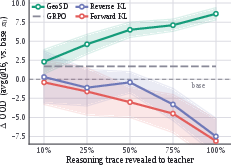
- Effect of privileged information granularity and quality: The privilege sweep reveals monotonic gains for GeoSD with more of the solution revealed, but does not dissect which kinds of privileged content (key lemmas vs. final answers vs. misleading intermediate steps) are most beneficial or harmful.
- Checkpoint cadence and stale references: The frequency for refreshing θ_ckpt and the risk of “creeping drift” (slow but steady movement that evades the proximal constraint) are not quantified; adaptive cadence or change-point detection could be explored.
- Objective component interactions: Ablations show each component is “load-bearing,” but the mechanism of interaction (e.g., whether FR proximal mainly curbs rare large moves or cumulative small moves; whether NG chiefly rebalances layer-wise updates) is not deeply analyzed.
- Evaluation granularity of errors: The paper links high-entropy token-level mass retention to better OOD answers, but lacks fine-grained error taxonomy (algebraic slips vs. conceptual mistakes) to verify which error types are mitigated by GeoSD.
- Practical deployment costs: Although compute overhead is modest in the reported setting, the operational impact in large-scale training (multi-node, pipeline parallelism, mixed precision constraints, optimizer state sharding) and inference latency (if any) remains to be validated.
- Safety and alignment implications: Privileged traces can encode stylistic or heuristic biases. How GeoSD affects safety behaviors, refusal rates, and adherence to instructions in ambiguous scenarios has not been assessed.
- Reproducibility and open resources: Details on code, exact K-FAC implementation choices for Transformers, and seeds are referenced to appendices; public releases would enable independent verification and stress-testing across labs and hardware.
Practical Applications
Immediate Applications
Below are concrete ways the paper’s findings, methods, and measurements can be used now, with sector links, suggested tools/workflows, and feasibility notes.
- Healthcare — safer reasoning post-training for clinical decision support
- What to do: Apply GeoSD in privileged-context self-distillation where the teacher sees full clinical guidelines or retrospective outcomes while the student only sees intake notes. Use Hellinger loss with a Fisher–Rao (FR) proximal penalty to transfer reasoning patterns without overconfident collapse on OOD cases.
- Tools/workflows: Fine-tuning pipeline that (i) collects guideline-aligned rationales or outcome summaries as privileged context, (ii) runs on-policy rollouts with the student, (iii) trains with Hellinger + FR proximal, (iv) monitors FR drift, overlap, and false-consensus metrics.
- Assumptions/dependencies: Availability of high-quality, de-identified guideline traces or outcome summaries as privileged context; strict offline evaluation; clinical safety review; compute for K-FAC natural-gradient preconditioning.
- Education — robust math and STEM tutoring models
- What to do: Fine-tune existing tutoring LLMs with GeoSD using verified solution traces as privileged context; deploy to handle novel competition-style questions and atypical student errors without OOD collapse.
- Tools/workflows: Solution-trace generation and verification (as in DAPO-Math-style pipelines), GeoSD trainer with checkpoint refresh, dashboards for pass@k slope and false-consensus rate to ensure self-consistency remains informative.
- Assumptions/dependencies: Access to verifiable tasks or auto-checkers (e.g., math answer validators); modest training overhead (~1.1× wall-clock with K-FAC); content policy for CoT usage.
- Software engineering — code assistants resilient to new APIs and frameworks
- What to do: Distill from a teacher that sees API documentation/snippets/tests (privileged context) while the student only sees the problem prompt. GeoSD reduces mode collapse when APIs shift or are unfamiliar.
- Tools/workflows: CI harness to auto-generate unit tests as verification, “docs+examples” as privileged context, GeoSD training replacing forward-KL distillation, evaluation via pass@k on held-out repos.
- Assumptions/dependencies: High-quality test generation for verification; curated, current docs; safeguards to avoid copying proprietary code.
- Finance — analysis and policy drafting assistants with better OOD calibration
- What to do: Train compliance or risk-summary LLMs where the teacher sees full historical filings or internal templates; student only receives public text. GeoSD preserves alternative interpretations at high-uncertainty points, improving robustness to regime shifts.
- Tools/workflows: Privileged corpora curation under access controls; overlap-aware training; FR drift guardrails; OOD audit sets (new filers, novel instruments).
- Assumptions/dependencies: Data-governance approval for privileged access; representative OOD benchmarks; careful calibration checks.
- Legal — contract and memo drafting with calibrated self-consistency
- What to do: Distill from a teacher that sees authoritative clauses or precedent extracts as privileged hints. Use GeoSD to prevent overconfident wrong consensus in majority-vote decoding.
- Tools/workflows: Clause libraries as privileged context; false-consensus monitoring on adversarial prompts; human-in-the-loop review workflows.
- Assumptions/dependencies: Curated, jurisdiction-specific precedent; confidentiality controls; acceptance testing for edge cases.
- Robotics and operations research — plan distillation with privileged sensors/sim
- What to do: Distill high-level plan generation where the teacher sees privileged simulation states or future waypoints; student sees partial observations. GeoSD keeps alternative plan branches reachable under uncertainty.
- Tools/workflows: Simulator logs as privileged traces; trajectory rollouts on student; Hellinger + FR proximal; evaluation on sim-to-real OOD scenarios.
- Assumptions/dependencies: High-fidelity simulation; alignment between privileged and deploy-time observations; compute budget for on-policy rollouts.
- Government and policy — robustness auditing and procurement criteria
- What to do: Adopt the paper’s metrics (FR drift to checkpoint, teacher–student overlap, false-consensus rate, pass@k slope) in model evaluation rubrics for public-sector LLM procurements.
- Tools/workflows: OOD benchmark suites and dashboards reporting drift and consensus reliability; minimum thresholds for robustness.
- Assumptions/dependencies: Access to relevant OOD datasets in civic domains (benefits, tax, grants); evaluation governance.
- MLOps — safer post-training recipe for enterprise copilots
- What to do: Replace forward-KL privileged self-distillation with GeoSD to preserve ID gains without OOD degradation; integrate a moving trust region via periodic checkpoints and FR proximal.
- Tools/workflows: Drop-in loss switch to Hellinger, add FR proximal to recent checkpoint refreshed every K steps, enable K-FAC preconditioning, enable drift/overlap monitoring. Hyperparameters: λ (proximal weight), checkpoint cadence K, rollout budget.
- Assumptions/dependencies: Implementation of K-FAC (layerwise, damped) in the training stack; backward-compatibility with distributed training; modest extra memory (~1.21×).
- Research and academia — methodology and benchmarking upgrades
- What to do: Use GeoSD as a baseline when studying reasoning generalization; add high-entropy token analyses, overlap-conditioned gradients, and consensus diagnostics to experimental protocols.
- Tools/workflows: Open-source scripts to compute Hellinger/FR metrics per token and per step; ablation templates for loss, proximal, and optimizer geometry.
- Assumptions/dependencies: Availability of open checkpoints and reproducible evaluation harnesses.
- Safety — decoding policies that avoid confident agreement on wrong answers
- What to do: Inference-time guardrails: when consensus strength is high but derived from low-overlap/high-drift regions, trigger fallback (more samples, tool-use, or human review).
- Tools/workflows: Train-time logging of overlap and drift features; inference-time thresholds tied to those signals; explainability reports.
- Assumptions/dependencies: Telemetry access; calibrated mapping from train-time metrics to inference-time triggers.
Long-Term Applications
These opportunities likely need further research, scaling, or domain adaptation before deployment.
- Healthcare — decision support with learned uncertainty and regulatory validation
- Concept: Extend GeoSD beyond math and text-only tasks to multimodal clinical reasoning (EHR + imaging), leveraging privileged context (expert rationales, longitudinal outcomes).
- Potential products: Calibrated triage assistants that can demonstrate bounded predictive drift across updates.
- Dependencies: Prospective clinical trials; bias and safety audits; adapting verification (math-style checkers don’t exist—need surrogate validators).
- Scientific discovery — robust chain-of-thought distillation
- Concept: Distill reasoning from lab notebooks or simulation ground truth as privileged context; keep alternative hypotheses reachable under OOD experimental setups.
- Potential tools: “GeoSD Lab Agent” that proposes experiments without collapsing to a single hypothesis; FR-drift-based early stopping for scientific model updates.
- Dependencies: Reliable provenance and verification of scientific traces; domain-specific reward/verification signals.
- Multimodal agents and robotics — privileged-to-partial transfer at scale
- Concept: Use privileged sensors/maps during training (e.g., full state in sim) and distill to a policy operating with partial observations, maintaining flexibility under novel layouts or lighting conditions.
- Potential tools: GeoSD-enhanced sim-to-real transfer toolkit with automatic drift monitoring and adaptive trust regions.
- Dependencies: Scalable K-FAC/natural-gradient approximations for vision–language–action models; tight sim–real gap control.
- Finance and macro — regime-shift–aware modeling
- Concept: Train analysis models where the teacher conditions on comprehensive historical context (privileged) and the student generalizes to unseen regimes without overconfident collapse.
- Potential products: Risk copilots that surface alternative scenarios rather than single-story consensus; drift-aware change-point detectors tied to FR metrics.
- Dependencies: Stress-testing frameworks; legal/compliance constraints; synthetic OOD datasets faithful to market shifts.
- Public policy — standards for “predictive drift” and OOD certification
- Concept: Institutionalize FR drift, overlap, and false-consensus metrics as part of certification of AI systems used in public services.
- Potential tools: NIST-like test suites and reporting formats for geometric drift and consensus reliability under distribution shifts.
- Dependencies: Broad stakeholder input; sector-specific benchmarks; harmonization with existing AI risk management frameworks.
- Platform tooling — geometry-native optimizers and hardware support
- Concept: First-class support for natural-gradient updates (e.g., K-FAC variants) in major DL frameworks and accelerators; geometry-aware schedulers that adapt λ and checkpoint cadence to live drift signals.
- Potential products: “Geo-Optim” libraries, telemetry-backed trust-region controllers, hardware kernels for efficient curvature estimation.
- Dependencies: Systems research for scalability; memory-efficient curvature approximations for 70B+ models.
- Data and training curriculum — dynamic privilege shaping
- Concept: Curriculum that gradually increases privileged information exposure as overlap grows, guided by the paper’s overlap-weighted gradient insights.
- Potential tools: Auto-curriculum controller that gates hint length or solution fraction to maximize OOD gains without inducing drift.
- Dependencies: Robust heuristics for overlap estimation online; reliable proxies when verification is absent.
- Safety and alignment — uncertainty-preserving RLHF hybrids
- Concept: Combine GeoSD with RLHF, using FR proximal and Hellinger-based objectives to prevent reward-driven overconfidence and collapse in reasoning diversity.
- Potential tools: Hybrid trainers where preference learning is constrained by geometric drift bounds; decoding policies that condition on overlap-derived uncertainty.
- Dependencies: Joint objective tuning; human preference data quality; evaluation of trade-offs between helpfulness and diversity.
- Evaluation science — beyond accuracy to consensus reliability
- Concept: Make “consensus reliability curves” standard, relating consensus strength to correctness, and track how objectives change these curves.
- Potential products: Leaderboards that include false-consensus rates and pass@k slope under OOD settings.
- Dependencies: Community adoption; well-specified OOD testbeds across domains beyond math.
Notes on general feasibility and assumptions across applications:
- Privileged context availability: The strongest gains assume access to hints/solutions/rationales or richer sensors that are not available at inference. Where such context is scarce, gains may diminish; semi-privileged or teacher-ensemble variants could help.
- Verification or proxies: Math tasks benefit from exact-checking; other domains will need validated proxies (oracle models, simulators, domain rules).
- Compute and systems: Natural-gradient preconditioning (e.g., K-FAC) adds modest overhead in the paper’s setup, but scaling to very large models requires efficient approximations and engineering.
- Generalization beyond math: Results are strongest in mathematical reasoning; cross-domain validation is needed to confirm effects and tune hyperparameters.
- Governance: For regulated sectors (healthcare, finance, government), deployment must follow domain-specific risk management, data governance, and human oversight.
Glossary
- AdamW: An optimization algorithm that decouples weight decay from the gradient-based update in Adam to improve generalization. "replacing the natural-gradient update with AdamW"
- avg@: An evaluation metric reporting the average accuracy when taking samples per problem. "We report accuracy using avg@ (average accuracy over samples) and pass@ (whether any of the samples is correct)."
- elastic weight consolidation: A continual-learning regularizer that anchors parameters to a prior solution using a Fisher-weighted quadratic penalty. "elastic weight consolidation anchors parameters with a diagonal-Fisher quadratic penalty at a fixed past solution"
- empirical Fisher: An approximation to the Fisher information matrix computed from model outputs on data, often used for curvature-aware optimization. "a damped Kronecker-factored approximation of the empirical Fisher (K-FAC; \citealp{martens2015kfac})"
- false consensus: A failure mode where multiple samples from a model strongly agree on an incorrect answer. "We call a false-consensus case when the samples agree strongly on a wrong answer"
- Fisher information: A matrix measuring the sensitivity of a model’s output distribution to parameter changes, used to define the natural gradient. "preconditioning with the Fisher information of the current policy"
- Fisher--Rao distance: A geodesic distance between probability distributions induced by information geometry, corresponding to the arc length on the statistical manifold. "The arc is the Fisher--Rao distance, which we use for cumulative drift"
- forward KL: The Kullback–Leibler divergence D_KL(q||p) used as a loss to match a teacher distribution q, weighting tokens by teacher probability. "forward KL (FwdKL; \citealp{hinton2015kd, zhao2026selfdistilled})"
- GRPO: A reinforcement learning post-training method using verifiable rewards, used here as a baseline. "GRPO~\citep{shao2024deepseekmath} with verifiable rewards on the same training prompts."
- Hellinger loss: A loss based on the Hellinger divergence that weights the teacher’s influence by teacher–student overlap, attenuating pulls on unsupported tokens. "A Hellinger loss scales each teacher preference by the overlap the student already shares with it"
- high-entropy states: Decision points where the model’s next-token distribution is uncertain (high entropy), often where teacher and student disagree. "at high-entropy states, resulting in confident agreement on wrong answers"
- hypersphere: The geometric manifold on which square-root-embedded probability distributions lie, enabling Euclidean measurements of statistical distance. "under the square-root embedding , next-token distributions live on a hypersphere"
- information geometry: A framework that studies the differential-geometric structure of families of probability distributions. "Information geometry supplies such a distance"
- Jensen--Shannon divergence: A symmetric divergence based on the average of forward and reverse KL, often used for softer distribution matching. "Jensen--Shannon (JSD, ; \citealp{agarwal2024gkd})"
- K-FAC (Kronecker-factored Approximate Curvature): A practical approximation to the Fisher information that captures layerwise curvature via Kronecker-factored blocks. "we precondition with a damped Kronecker-factored approximation of the empirical Fisher (K-FAC; \citealp{martens2015kfac})"
- moving trust region: A dynamic constraint that penalizes deviations from a recent reference policy to stabilize updates during training. "a recent $\theta_{\mathrm{ckpt}$ instead acts as a moving trust region"
- natural gradient: An optimization method that scales parameter updates by the inverse Fisher information to move minimally in distribution space for a given objective improvement. "A natural gradient asks, of all parameter updates that change the student's predictions by a fixed amount, which one most improves the objective."
- next-token distributions: The probability distributions over the next token given the current context in autoregressive LLMs. "Both are distances in the same geometry of next-token distributions"
- on-policy distillation (OPD): Distillation where the teacher provides targets on trajectories generated by the current student policy. "On-policy distillation (OPD) has emerged as a practical post-training recipe for LLMs"
- on-policy self-distillation (OPSD): A form of OPD where the student serves as its own teacher, often with the teacher given additional context. "In on-policy self-distillation (OPSD), the student acts as its own teacher, supervising the prefixes it generates."
- out-of-distribution (OOD): Data or tasks that differ from the training distribution, used here to assess generalization. "degrades out-of-distribution (OOD) reasoning."
- pass@: An evaluation metric indicating whether any of k sampled solutions is correct for a given problem. "We report accuracy using avg@ (average accuracy over samples) and pass@ (whether any of the samples is correct)."
- privileged-context self-distillation: Self-distillation where the teacher has access to additional information (e.g., hints or full solutions) unavailable to the student at test time. "In privileged-context self-distillation, teacher and student are the same model conditioned on the same prefix, but the teacher also sees a hint or the full solution trace."
- proximal term: A regularization term that penalizes the model for drifting too far from a reference (e.g., a recent checkpoint) in distribution space. "a proximal term penalizes how far the student's predictions drift from a recent checkpoint"
- rank-1 collapse: Premature concentration of probability mass on the top-ranked token, suppressing viable alternatives. "This premature concentration on the top choice, i.e., rank-1 collapse, removes alternatives"
- reverse KL: The Kullback–Leibler divergence D_KL(p||q), often mode-seeking, which can suppress alternative modes. "reverse KL (RevKL; \citealp{gu2024minillm})"
- score-function term: The REINFORCE-style gradient term arising from differentiating through sampling; often omitted when treating trajectories as fixed. "dropping the score-function term of the outer expectation."
- self-consistency: An evaluation perspective where agreement among multiple sampled solutions is used as a signal of correctness. "This separates productive self-consistency, where agreement tracks correctness, from collapsed self-consistency"
- square-root embedding: The mapping p → sqrt(p) that embeds probability distributions onto a hypersphere, simplifying distance computations. "under the square-root embedding "
- trust-region methods: Optimization techniques that constrain policy updates to a region where model behavior is reliable, improving stability. "trust-region methods bound per-update policy change"
Collections
Sign up for free to add this paper to one or more collections.