From Observation to Insight: Mechanistic World Models and the Quest for Autonomous Discovery
Abstract: Recent advances in foundation models have transformed AI for Science, enabling remarkably accurate predictive performance across domains ranging from protein folding to weather forecasting. Yet prediction alone does not constitute scientific discovery. Scientific understanding depends on uncovering the reusable explanatory mechanisms that generate observations, whereas contemporary machine learning remains fundamentally organised around predictive mappings rather than explanatory structure. In this paper, we argue that scientific discovery is fundamentally a problem of knowledge organisation. To this end, we introduce Mechanistic World Models, a new design paradigm that places reusable mechanisms at the centre of representation, computation and learning. Drawing on insights from the philosophy of science, we derive the computational capabilities required for discovery, identify the design principles and inductive pressures that encourage explanatory knowledge to emerge, and formalise the anatomy of a mechanism-centric world model. Finally, we show how diverse research directions including mechanistic interpretability, causal representation learning, equation discovery and modular architectures capture complementary ingredients of this paradigm while lacking a unified framework. We propose Mechanistic World Models as a conceptual foundation and computational blueprint for moving AI beyond predictive forecasting towards autonomous scientific discovery.
Paper Prompts
Sign up for free to create and run prompts on this paper using GPT-5.
Top Community Prompts
Explain it Like I'm 14
Overview: What this paper is about
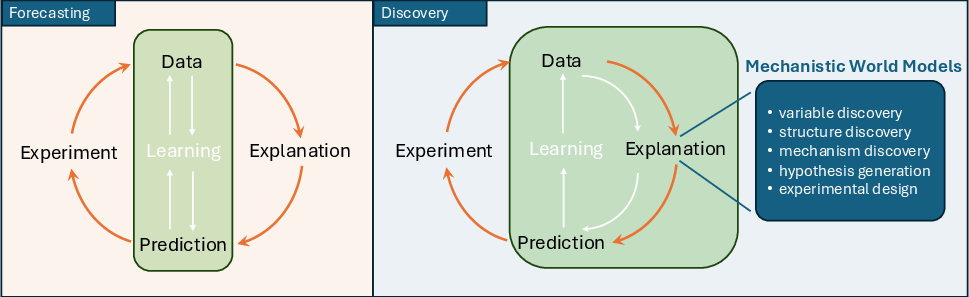
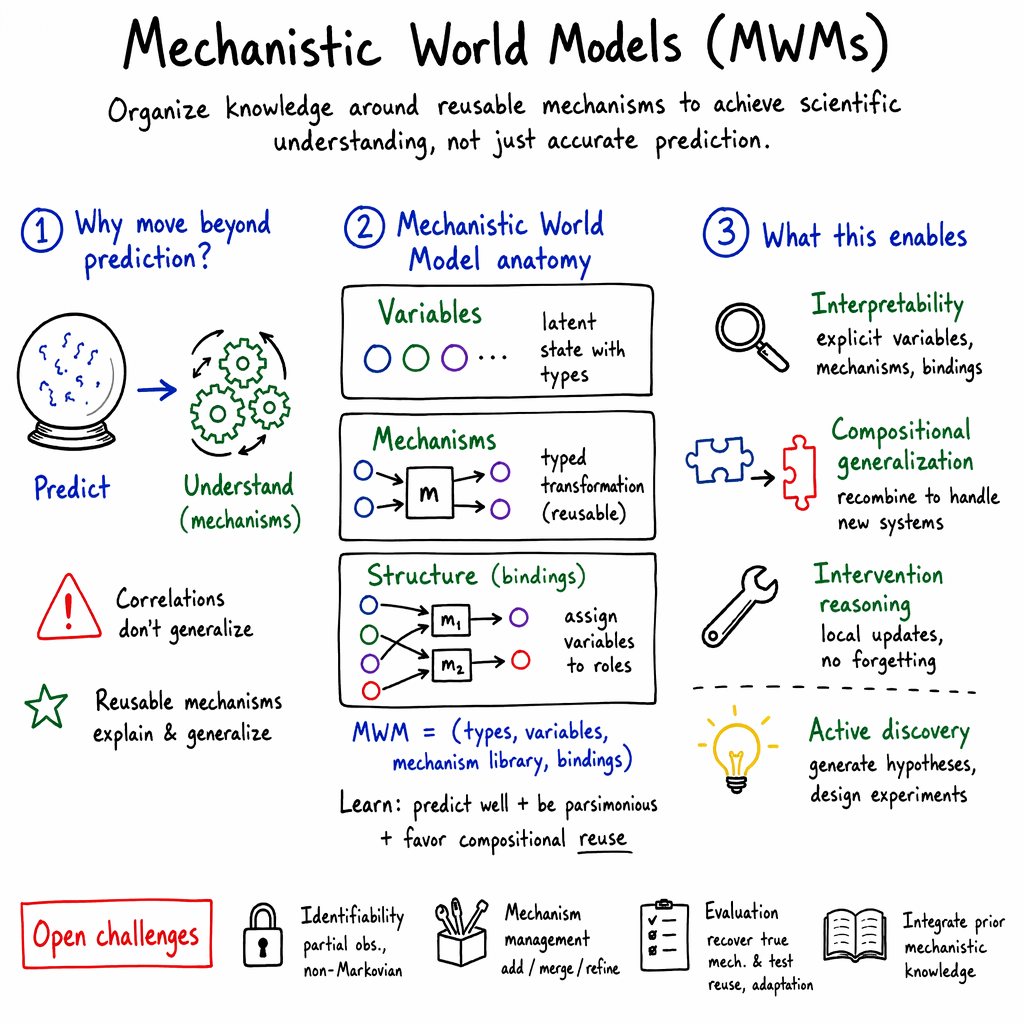
This paper argues that today’s AI is great at predicting things (like the weather or protein shapes) but not so good at explaining why those things happen. The authors propose a new way to build AI called Mechanistic World Models (MWMs). Instead of just mapping inputs to outputs, MWMs try to discover and reuse the underlying “mechanisms” (the rules and processes) that make the world work. The goal is to help AI move from “forecasting” to “understanding,” so it can make new scientific discoveries on its own.
The big questions the paper asks
- How can we design AI that doesn’t just predict, but also explains why things happen?
- What does it take for an AI system to uncover hidden rules, variables, and structures—like a real scientist would?
- How should knowledge be organized inside AI so that it is reusable, understandable, and useful across different problems?
How the authors approach the problem
The paper is mainly a vision and framework, not a single experiment. It combines ideas from the philosophy of science and modern machine learning to outline how an AI that discovers mechanisms should work.
Here are the key ideas, explained with everyday analogies:
- Prediction vs. explanation: A weather app that says “It will rain tomorrow” is predicting. A science teacher who shows how temperature, pressure, and wind patterns cause rain is explaining. The paper says AI needs to do both—and organize its knowledge around explanations, not just predictions.
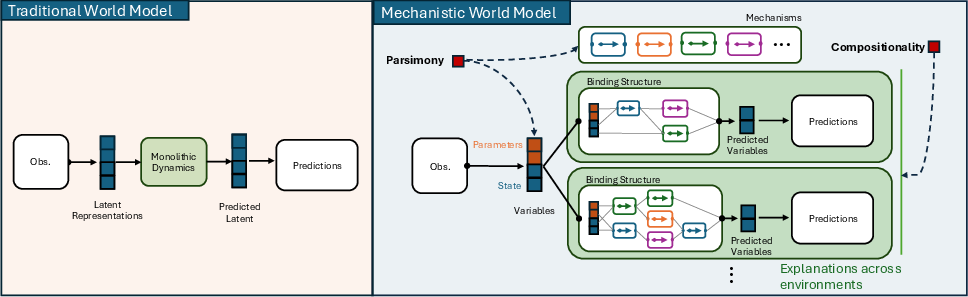
- Mechanisms are like recipes or Lego pieces: Think of a mechanism as a small, reusable “recipe” that transforms some ingredients (variables) into an outcome. For example, the rule “force = mass × acceleration” is a mechanism in physics; a biochemical pathway that converts one substance into another is a mechanism in biology. These pieces can be reused and combined to explain many different situations.
- World models with mechanisms:
- Variables: the quantities that matter (like position, speed, temperature—whatever is useful to explain what’s going on).
- Mechanisms: the reusable rules that change those variables.
- Structure: how particular variables and mechanisms are connected for a specific system (like how gears fit together in a machine).
- Two kinds of abilities the AI needs:
- Knowledge organization: discovering the right variables, mechanisms, and how they fit together, and reusing them across different tasks.
- Active inquiry: acting like a scientist—forming testable hypotheses and proposing experiments or interventions to learn which explanation is right.
- Design principles to make this happen: The authors argue AI should be trained so that: 1) Prediction and explanation are learned together (don’t bolt “explanations” on after training). 2) Mechanisms are the basic building blocks. 3) The same mechanisms get reused across different problems. 4) Mechanisms are organized in a hierarchy (small pieces build bigger explanations).
Two helpful pressures guide learning: - Parsimony: prefer the simplest set of mechanisms that explains the most things (like choosing a neat, short recipe that works for many dishes). - Compositionality: build new explanations by combining existing mechanisms (like snapping Lego bricks together).
- How this connects to current AI research:
- Mechanistic interpretability: tries to look inside big models to find understandable “circuits,” but often after training. The paper argues explanation should be built in during training.
- Causal representation learning: focuses on discovering cause-and-effect variables and rules; the paper embraces these ideas but wants a more flexible, practical framework.
- Equation discovery: tries to find neat math formulas from data—great where laws are clear, but limited in complex, messy systems. MWMs aim to capture mechanisms even when there isn’t a single neat formula.
- Mixture-of-experts models: split a big model into specialist parts for efficiency. MWMs want the parts to reflect real-world mechanisms, not just prediction shortcuts.
Main takeaways and why they matter
- Organize AI around mechanisms, not just predictions. This could make AI’s knowledge more like a scientist’s: reusable, testable, and understandable.
- Discover variables and structures that matter. Instead of working only with raw pixels or tokens, the AI learns the right “knobs and dials” (variables) and the rules that move them.
- Reuse and compose mechanisms. Like building with Lego, the same rule can help in many places, which improves generalization to new situations.
- Built-in interpretability. Because the model stores explicit variables and mechanisms, its reasoning is easier to understand and debug than a giant black box.
- Better experiments and interventions. An AI that understands mechanisms can propose the most informative tests (e.g., “Change this variable and see what happens”), speeding up discovery.
What this could mean for the future
If AI models adopt Mechanistic World Models:
- Scientists could get AI partners that suggest explanations, not just predictions—pointing to new experiments and speeding up discovery in fields like biology, physics, and climate science.
- AI systems may become more reliable under change, because mechanisms tend to stay valid across different situations.
- Education and communication could improve, since mechanism-centered models can explain their reasoning in human-friendly terms.
- We might move closer to truly autonomous discovery: AI that doesn’t just forecast the world, but figures out why the world works the way it does and uses that insight to learn even more.
Knowledge Gaps
Knowledge gaps, limitations, and open questions
Below is a concise list of concrete gaps and open problems that remain unresolved and would enable future researchers to operationalize and validate Mechanistic World Models (MWMs).
- Learning objective: No concrete joint loss that balances predictive accuracy with explanatory pressures (parsimony, compositionality, reuse); how to weight/anneal these terms during training.
- Identifiability: Conditions under which latent variables, semantic types, mechanisms, and structure are identifiable (up to equivalence) from observational/interventional data are not specified.
- Variable/type discovery: How to discover semantic variable types T and their cardinality without supervision; how to prevent type proliferation or collapse; priors/constraints to make types meaningful.
- Binding inference: Scalable, stable algorithms for inferring bindings b that instantiate mechanism signatures on specific variables; handling discrete assignment within gradient-based training.
- Structure learning at scale: Efficient search/inference over compositional structure (which mechanisms, in what arrangement) without combinatorial blow-up.
- Library management: Criteria and algorithms for when to create, split, merge, or retire mechanisms; mechanisms versioning and drift detection.
- Reuse guarantees: Formal conditions and training procedures that make mechanism reuse emerge rather than ad hoc specialisation (e.g., preventing overfitting experts to datasets).
- Invariance and context: How to model context-dependent or nonstationary mechanisms while preserving reuse (e.g., conditioning vs mechanism replacement).
- Hierarchy: Concrete formalisms and learning procedures for multi-level, hierarchical mechanisms; how credit assignment works across levels.
- Causal integration: A precise mapping between MWMs and structural causal models (SCMs) for interventions and counterfactuals; how to perform do-calculus-like queries in MWMs.
- Uncertainty: Bayesian or probabilistic treatment of uncertainty over variables, mechanisms, and structures; posterior over explanatory hypotheses and model averaging.
- Active inquiry: Practical algorithms for explanatory hypothesis generation and experimental design (utilities, budgets, constraints, risk), including intervention selection under uncertainty.
- Benchmarks: Lack of standardized datasets with ground-truth variables, mechanisms, and structures spanning multiple domains and scales; need tasks for compositional generalisation and counterfactual accuracy.
- Metrics: Operational metrics for explanation quality (parsimony, scope, reuse, invariance), beyond predictive error; how to measure interpretability by design.
- Empirical validation: End-to-end case studies in real scientific domains (e.g., gene regulation, climate, materials) demonstrating mechanism discovery, reuse, and improved insight over strong predictive baselines.
- Data regimes: Clarify what kinds of interventional vs observational data are required; sample complexity and data collection protocols for mechanism discovery.
- Robustness: Handling partial observability, measurement noise, confounding, and missing interventions; sensitivity analyses and stress tests.
- Degeneracy safeguards: Preventing collapse to monolithic predictors or trivial pseudo-mechanisms; regularizers/constraints and diagnostics for failure modes.
- Optimisation methods: Stable training with discrete/combinatorial choices (e.g., routing, structure), including REINFORCE/relaxations/EM and their convergence–variance trade-offs.
- Parsimony objectives: Which formulations (MDL, sparsity, Bayesian evidence, complexity penalties) best induce compact mechanism libraries without underfitting.
- Stochasticity: Learning probabilistic mechanisms and noise models; disentangling aleatoric vs epistemic uncertainty in mechanisms and structure.
- Temporal aspects: Assigning temporal credit to mechanisms; coping with non-Markovian dynamics, delays, memory, and history-dependent mechanisms.
- Cycles and feedback: Representing and learning cyclic causal structure and feedback loops without violating tractable inference.
- Units and symmetries: Encoding dimensional analysis, invariances, and conservation laws; ensuring reparameterisation invariance and physically meaningful transformations.
- Cross-system alignment: Mapping types/variables across disparate systems and datasets; ontology alignment and transfer without supervision.
- Interaction with MoE: How to align MoE-like expert specialisation with mechanism semantics; routing objectives that prefer reuse/invariance over mere predictive specialization.
- Symbolic distillation: When/how to distill learned mechanisms into human-readable equations or programs; fidelity and stability of distillation.
- Multiscale structure: Learning and composing mechanisms across spatial/temporal scales; binding across resolutions and aggregations.
- Continual learning: Protocols that empirically demonstrate localised adaptation, reduced interference, and knowledge accumulation via mechanism reuse.
- Negative transfer: Diagnosing and mitigating harmful reuse when mechanisms conflict across domains; gating, context conditioning, or isolation strategies.
- Safety/ethics: Guardrails for autonomous experimental design in high-stakes domains (wet labs, clinical, environmental); integrating cost, safety, and compliance constraints.
- Tooling: Need for software frameworks to specify mechanism signatures, bindings, structure learning, and visualization for human-in-the-loop analysis.
- Interface to FMs: Architectures and training recipes for coupling perceptual front-ends (e.g., foundation models) to mechanism-centric cores; maintaining end-to-end trainability.
- Scaling and efficiency: Compute/memory costs for maintaining and searching mechanism libraries; caching, sparsity, and compilation strategies for fast inference.
- Curriculum: Data/task curricula that promote mechanism emergence (e.g., intervention-rich phases, domain shifts); ablations on curriculum design.
- Evaluation of interpretability: Human studies and domain-expert validation that discovered mechanisms/types correspond to real scientific concepts and improve scientific workflows.
Practical Applications
Below is an overview of practical, real-world applications implied by the paper’s findings and design paradigm for Mechanistic World Models (MWMs). Each item highlights target sectors, possible tools/workflows/products, and key assumptions or dependencies.
Immediate Applications
The following applications can be piloted today by layering mechanism-centric organization, parsimony, and compositionality into existing world models, foundation models, and scientific workflows.
- Mechanism-aware interpretability overlays for foundation models
- Sectors: software/AI, healthcare/biomed, climate, materials
- What: Integrate sparse autoencoders (SAEs), MDL-regularized probes, and cross-layer transcoders to expose latent “mechanism candidates” (e.g., typed variables and transformation circuits) in existing foundation models; produce “mechanism cards” analogous to model cards describing discovered structures.
- Tools/products/workflows: Mechanism-card generators for model audits; JAX/PyTorch libraries for MDL/sparsity penalties; dashboards that link latent features to hypothesized entities/activities.
- Assumptions/dependencies: Quality and diversity of training data; alignment between discovered features and meaningful scientific variables is not guaranteed; requires domain expert validation.
- Parsimony-regularized training recipes to promote reusable sub-computations
- Sectors: software/AI, finance, healthcare, robotics
- What: Add MDL, L0/L1 sparsity, and structured regularization to encourage compact, reusable mechanisms in predictive models (e.g., pruning to reveal invariant modules that generalize across tasks).
- Tools/products/workflows: Training “recipes” packaged for common frameworks; CI hooks that enforce sparsity/complexity budgets; modular ablation tests for mechanism reuse.
- Assumptions/dependencies: Tradeoffs with raw accuracy; careful hyperparameter tuning; requires benchmarks that reward explanatory structure, not just predictive loss.
- Mechanism-aligned mixtures of experts (MoE) for localized adaptation and reduced forgetting
- Sectors: software/AI, MLOps, robotics, manufacturing
- What: Re-route MoE gating to cluster by hypothesized mechanisms (entity–activity pairs), enabling targeted updates to only relevant experts when new data arrives; supports continual learning and compositional reuse.
- Tools/products/workflows: “Mechanism routing” gates; expert-local training loops; MLOps playbooks for mechanism-local rollback/rollforward.
- Assumptions/dependencies: Requires proxy signals for mechanism boundaries; potential overhead from monitoring and expert diagnostics.
- Intervention-aware forecasting and scenario analysis
- Sectors: finance, energy, climate/weather, supply chain
- What: Augment predictive models with intervention channels tied to localized variable/mechanism slots, enabling robust “what-if” and stress tests under regime shifts (e.g., shock to interest rates, policy change, equipment outage).
- Tools/products/workflows: Counterfactual query modules; scenario libraries tied to mechanism bindings; dashboards for sensitivity to mechanism perturbations.
- Assumptions/dependencies: Requires identification of actionable variables; interventional data or realistic simulators improve calibration.
- Active learning and experimental design assistants in labs
- Sectors: biotech, materials, chemistry
- What: Use current Bayesian/causal active learning to select interventions that maximally discriminate between competing mechanism hypotheses (e.g., gene regulation hypotheses, reaction pathways).
- Tools/products/workflows: Lab-in-the-loop “experiment pickers” integrated with ELNs/LIMS and lab automation; hypothesis repositories with mechanism signatures.
- Assumptions/dependencies: Need structured hypothesis encoding; lab cycle times; initial mechanism hypotheses may be weak and need iterative refinement.
- Mechanism-centric root-cause analysis for AIOps and manufacturing
- Sectors: software reliability, cloud, Industry 4.0
- What: Map incidents to candidate mechanism failures (e.g., queueing dynamics, cache invalidation, component interactions) to improve RCA speed and reduce spurious fixes.
- Tools/products/workflows: Failure mechanism libraries; incident-to-mechanism matching; postmortem templates that link metrics to mechanistic explanations.
- Assumptions/dependencies: Requires instrumentation aligned with hypothesized mechanisms; ongoing curation of mechanism libraries.
- Compliance-oriented explainability in regulated domains
- Sectors: healthcare, finance, public sector
- What: Provide mechanism-level rationales (variables impacted, activities triggered) alongside predictions to support audits and justification (e.g., why a model recommends diagnostic imaging or flags fraud).
- Tools/products/workflows: “Mechanism cards” and lineage trackers; interfaces that surface affected mechanisms under counterfactuals.
- Assumptions/dependencies: Regulatory acceptance of mechanism-centric explanations; validation that explanations are faithful, not post-hoc stories.
- Curriculum design and tutoring that emphasize mechanisms over correlations
- Sectors: education/edtech
- What: Adapt current tutors to present reusable mechanisms (e.g., Newtonian dynamics vs. curve-fit) and test students with intervention-based questions that probe understanding of variable–mechanism relationships.
- Tools/products/workflows: Mechanism libraries aligned to curricula; item banks with counterfactual tasks; analytics on misconception mechanisms.
- Assumptions/dependencies: Pedagogical content alignment; evaluation to ensure improved transfer and understanding.
Long-Term Applications
These applications require advances in variable/mechanism discovery, scalable mechanism libraries, robust binding/structure learning, and tighter integration with experimental/operational systems.
- Cross-domain mechanism libraries and registries
- Sectors: software/AI, science/academia, standards bodies
- What: Curate reusable, typed mechanisms (signatures + mappings) validated across datasets and domains (e.g., transport processes, reaction kinetics, queuing, epidemiological dynamics) for plug-and-play use.
- Tools/products/workflows: Community “mechanism registries”; versioned mechanism cards with provenance and performance under interventions; composability APIs.
- Assumptions/dependencies: Consensus on typing schemes and metadata; governance for updates; benchmarks that reward reuse and invariance.
- Autonomous MWMs for hypothesis generation and closed-loop science
- Sectors: biotech, materials, neuroscience, physics
- What: Agents that discover variables and mechanisms, propose explanatory hypotheses, design discriminative experiments, and update mechanism libraries in a virtuous cycle.
- Tools/products/workflows: MWM stacks with variable typing, mechanism discovery, structure binding, and experiment designers; integration with lab robotics and measurement pipelines.
- Assumptions/dependencies: High-quality interventional data; robust structure learning at scale; safety and oversight mechanisms for automated experimentation.
- Mechanistic digital twins for personalized medicine
- Sectors: healthcare
- What: Patient-centric MWMs that encode individualized variables (e.g., pharmacokinetics parameters, pathway sensitivities), simulate interventions, and explain predicted outcomes through explicit mechanisms.
- Tools/products/workflows: EHR-integrated twins; therapy planning with interpretable mechanism deltas; continuous learning from outcomes.
- Assumptions/dependencies: Data access, privacy, and security; clinical validation and regulatory approval; reliability under distribution shift.
- Self-explaining robotic control and sim-to-real generalization
- Sectors: robotics, autonomous systems
- What: Controllers structured as reusable mechanisms (dynamics, contact, perception modules) that explain behaviors and adapt locally to new contexts (e.g., new tools, materials) without catastrophic forgetting.
- Tools/products/workflows: Mechanism-aligned policy architectures; on-robot experiment designers for identifying unknown dynamics; safety layers grounded in mechanism boundaries.
- Assumptions/dependencies: Accurate perception-to-variable mapping; robust mechanism identification in unstructured environments; safety certification.
- Mechanism-grounded climate and energy planning
- Sectors: climate/weather, energy grids, policy
- What: MWMs that combine data-driven forecasting with mechanistic modules for atmospheric processes or grid dynamics, enabling targeted sensing campaigns and policy impact analysis with causal explanations.
- Tools/products/workflows: Observation network planners; grid “what-if” dashboards that localize impacts to mechanisms (e.g., inertia, congestion); policy-scenario evaluators.
- Assumptions/dependencies: High-fidelity assimilation of physical variables; coordination with observational infrastructure; acceptance of hybrid models in operational pipelines.
- Robust financial risk and policy analysis under regime change
- Sectors: finance, macro-policy
- What: Mechanism-centric scenario engines that simulate shocks through explicit channels (credit creation, liquidity, behavioral feedbacks) and explain divergences from historical correlations.
- Tools/products/workflows: Stress-testing suites with mechanism-level levers; explainable hedging/portfolio adjustments grounded in identified causal pathways.
- Assumptions/dependencies: Access to reliable interventional proxies; validation against historical policy episodes; governance for model risk.
- Software reliability and cyber-physical safety certification via mechanistic audits
- Sectors: automotive, aerospace, healthcare devices
- What: Certification regimes that assess mechanism invariance, independence, and parsimony rather than aggregate accuracy alone; audits that probe system responses to targeted interventions at mechanism boundaries.
- Tools/products/workflows: Mechanism-invariance test batteries; certification rubrics; red-teaming focused on mechanism failures.
- Assumptions/dependencies: Regulatory frameworks updating to recognize mechanism-centric evidence; standardized test suites.
- Mechanistic assistants for everyday decision-making
- Sectors: consumer tech, personal health/finance
- What: Personal assistants that give “why” answers and simulate interventions using learned mechanisms (e.g., how sleep/exercise changes downstream fatigue; budget changes impact goals) rather than surface correlations.
- Tools/products/workflows: User-facing “what-if” planners with adjustable mechanism assumptions; personalized variable discovery from wearables/transactions.
- Assumptions/dependencies: Privacy, consent, and on-device computation; trustworthy variable/mechanism discovery from noisy data; clear UX for uncertainty and model limits.
- Education: mechanism-first learning and assessment at scale
- Sectors: education/edtech, workforce upskilling
- What: AI tutors that build and assess mechanism-level understanding (variable identification, intervention reasoning, composition) and transfer across problems/domains.
- Tools/products/workflows: Banks of mechanism-centric tasks; progression maps tied to mechanism mastery; teacher dashboards for misconception mechanisms.
- Assumptions/dependencies: Evidence of improved learning outcomes; alignment with standards and assessments; teacher training and acceptance.
- Institutional policy for mechanism-oriented AI research and infrastructure
- Sectors: academia, funding agencies, standards
- What: Incentivize open benchmarks for variable/mechanism/structure discovery, fund mechanism registries, and require “mechanism cards” for high-stakes models.
- Tools/products/workflows: Calls for mechanism-centric datasets; repositories and governance; evaluation suites measuring reuse, invariance, compositional generalization.
- Assumptions/dependencies: Community buy-in; sustained funding; consensus on metrics and data sharing norms.
Notes on feasibility across all applications
- Core dependencies: access to interventional or richly varied data; algorithms for reliable variable typing and mechanism discovery; scalable architectures that support binding and structure learning; evaluation metrics beyond predictive accuracy (e.g., invariance, reuse, parsimony).
- Tradeoffs: potential short-term accuracy costs when imposing parsimony/modularity; higher upfront engineering to curate mechanism libraries; need for domain expert oversight.
- Risks: spurious “mechanisms” that reflect artifacts; overconfident explanations; misuse in high-stakes contexts without sufficient validation.
- Enablers: hybrid modeling (data + physics/causal priors), lab/ops integration for active inquiry, community standards for mechanism representation and reporting.
Glossary
- Active Inquiry: The process of proposing and testing explanations via targeted observations or interventions in order to refine knowledge. Example: "Active Inquiry"
- AI Feynman: A symbolic regression approach that combines neural and symbolic methods to recover analytic equations from data. Example: "AI Feynman"
- Bitter Lesson: The thesis that general methods leveraging computation and data tend to outperform hand-crafted domain knowledge over time. Example: "Bitter Lesson"
- Binding: The assignment that instantiates a reusable mechanism by mapping its typed roles to specific variables in a system. Example: "A mechanism is instantiated through a binding"
- Catastrophic forgetting: The tendency of a model to lose previously learned knowledge when adapted to new data. Example: "thereby mitigating catastrophic forgetting"
- Causal discovery: Methods for inferring cause–effect relationships from data, often using both observations and interventions. Example: "causal discovery provides principled methods for inferring causal relationships from observational and interventional data."
- Causal representation learning (CRL): Learning latent variables and structures that correspond to underlying causal factors. Example: "Causal representation learning (CRL)"
- Causal variables: Abstract variables that represent causally meaningful factors in a system. Example: "pre-defined set of causal variables"
- Compositional generalisation: The ability to solve new tasks or explain new systems by recombining known components or mechanisms. Example: "compositional generalisation"
- Compositionality: An inductive pressure or design principle that favours building explanations by composing reusable parts. Example: "parsimony and compositionality"
- Deductive-nomological (DN) model: A view of explanation as deductive inference from general laws and initial conditions. Example: "The deductive-nomological (DN) model of Hempel and Oppenheim"
- Equation discovery: The search for compact, closed-form mathematical expressions that explain observed data. Example: "Equation discovery provides perhaps the clearest computational realisation"
- Explanatory scope: The breadth of phenomena a set of principles can account for. Example: "broad explanatory scope"
- Independent Causal Mechanisms principle: The assumption that different causal mechanisms operate independently and can be modified locally. Example: "consistent with the Independent Causal Mechanisms principle"
- Invariance: The requirement that mechanisms remain valid across different domains or interventions. Example: "invariance demands that the same mechanisms remain valid across domains"
- Interventional data: Data obtained when variables are actively manipulated to probe causal structure. Example: "observational and interventional data"
- Mechanism: An organised process (mapping) acting over entities/variables that produces regular changes; the basic explanatory unit. Example: "Mechanisms are consequently the fundamental building blocks of both prediction and explanation."
- Mechanism reuse: Preferring to apply existing mechanisms across different systems, refining them only when necessary. Example: "Mechanism reuse."
- Mechanistic Interpretability: The study of reverse-engineering model internals to identify human-understandable circuits, features, or computations. Example: "Mechanistic Interpretability"
- Mechanistic World Models (MWMs): A paradigm that organises knowledge around reusable mechanisms—rather than raw observations—to support discovery and explanation. Example: "Mechanistic World Models (MWMs)"
- Mixture of Experts (MoE): Architectures that route inputs to specialised sub-networks (experts) for sparse, modular computation. Example: "Mixture of Experts (MoE) models"
- Minimum description length principle: A formalisation of parsimony that prefers explanations with the shortest overall description. Example: "minimum description length principle"
- Nearly decomposable: A property of complex systems that can be understood as weakly interacting subsystems, enabling modular analysis. Example: "nearly decomposable"
- Parsimony: Preferring simpler explanations with fewer components while retaining explanatory power. Example: "The principle of parsimony breaks the symmetry"
- Post-hoc analysis: Interpreting a trained model after the fact, without constraining learning to produce interpretable structure. Example: "post-hoc analysis methods"
- Semantic variable types: Learned categories that specify the functional roles of variables (e.g., position, mass) independent of specific instances. Example: "semantic variable types"
- SINDy: Sparse Identification of Nonlinear Dynamics; a method that selects a few terms from a candidate library to model dynamics. Example: "SINDy"
- Sparse Autoencoders (SAEs): Autoencoders with sparsity constraints that help isolate interpretable features. Example: "sparse autoencoders (SAEs)"
- Sparse Mechanism Shift hypothesis: The idea that only a few mechanisms change across environments, aiding identifiability and transfer. Example: "Sparse Mechanism Shift hypothesis"
- State-space models: Models that represent system dynamics through latent states and transitions over time. Example: "state-space models"
- Structural assignments: Mappings in structural causal models that specify how each variable is generated from its parents and noise. Example: "structural assignments"
- Structural causal models: Formal causal models defined via structural equations and exogenous noise, supporting interventions. Example: "Structural causal models illustrate one probabilistic instantiation"
- Structural priors: Inductive biases that encode assumptions about the structure of the underlying system or model. Example: "structural priors"
- Symbolic regression: Searching over symbolic expressions to fit data, often aiming to recover human-readable equations. Example: "symbolic regression faces an underdetermination challenge"
- Typed variable signature: The specification of input and output variable roles a mechanism expects, defined over semantic types. Example: "typed variable signature"
- Underdetermination challenge: The issue that many different models or equations can fit the same data equally well. Example: "underdetermination challenge"
- Unificationist theories: Accounts of explanation that value deriving many phenomena from a small set of principles. Example: "unificationist theories"
- Variable discovery: Identifying the quantities that constitute an appropriate state representation for explanation. Example: "Variable discovery requires identifying quantities"
- World Models (WMs): Models that learn environment dynamics to predict future states and observations. Example: "World Models (WMs)"
Collections
Sign up for free to add this paper to one or more collections.