- The paper demonstrates a cascaded cavity QED framework that reduces ultrahigh Q-factor requirements while achieving high photon indistinguishability and efficiency.
- The methodology leverages strong emitter-cavity couplings and controlled dephasing to navigate between regimes of optimal indistinguishability and collection efficiency.
- Numerical and analytical models confirm that the setup robustly suppresses spectral diffusion, offering a scalable platform for on-chip quantum photonics.
Indistinguishable Single-Photon Sources via Dissipative Emitter Coupling to Cascaded Cavities
Introduction
The realization of single-photon sources that exhibit high indistinguishability I and collection efficiency η is a critical requirement for quantum information processing, linear-optics quantum computing, and photonic quantum networks. The generation of such photons at room temperature is fundamentally limited by strong dephasing and spectral diffusion in realistic solid-state emitters, necessitating advanced photonic engineering for effective emission control. The paper "Indistinguishable Single-Photon Sources with Dissipative Emitter Coupled to Cascaded Cavities" (1809.01645) introduces and analyzes a cascaded-cavity quantum electrodynamics (CQED) framework that overcomes the Q-factor and Veff bottlenecks present in conventional single-cavity approaches, thereby enabling the generation of high-quality single photons with feasible nanofabrication requirements.
Physical Model and Device Architecture
The emission properties of a quantum emitter are severely degraded at room temperature due to multiple linewidth broadening mechanisms, including natural radiative linewidth (γ), Markovian pure dephasing (γ∗), and slow spectral diffusion (Gaussian width Δδ), yielding total emitter linewidth Γ=γ+γ∗+Δδ. For color centers in diamond, pure dephasing dominates at room temperature, rendering I∼10−4 for bare emission.
To address this, the paper investigates a room-temperature photonic quantum emitter coupled sequentially to two distinct cavities, C1 and C2 (cascaded-cavity system). The emitter couples strongly to C1 (low Q, ultrasmall Veff for efficient emission) and C1 is then coupled to C2 (potentially higher Q but not ultrahigh), which acts as a spectral and temporal funnel for emission. The physical realization leverages dielectric photonic crystal nanocavities with concentrator tips to maximize g1, and inter-cavity coupling g2 is tuned by spatial separation.
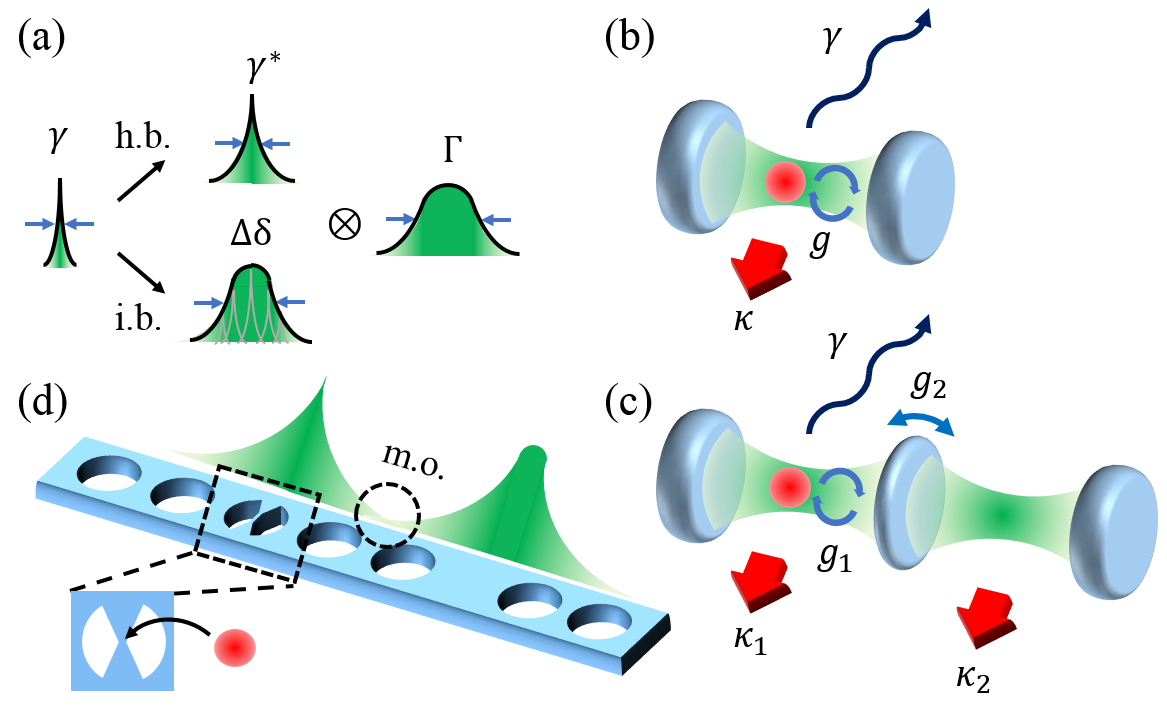
Figure 1: Cascaded-cavity architecture for high-efficiency, indistinguishable photon emission at room temperature, with photonic crystal implementation of the emitter-cavity system.
Analytical and Numerical Framework
The formalism treats the emitter-C1 (g1) and C1-C2 (g2) couplings under strong dephasing (γ∗≫γ). Population transfer rates are analytically derived as
R1=Γ+κ14g12,R2=R1+κ1+κ24g22
The photon indistinguishability and efficiency at the output of C2 are calculated using master equation simulations and confirmed by closed-form analytical solutions, demonstrating high fidelity with numerical results. Two operational regimes emerge: Reg. 1 (high I, moderate η) where R2,κ2≪κ1, and Reg. 2 (large η, moderate I) where R2,κ2≫κ1.
Device Parameter Optimization
The cascaded-cavity configuration provides increased degrees of freedom for simultaneous optimization of I and η, as visualized in the parameter space of g2 and κ2.
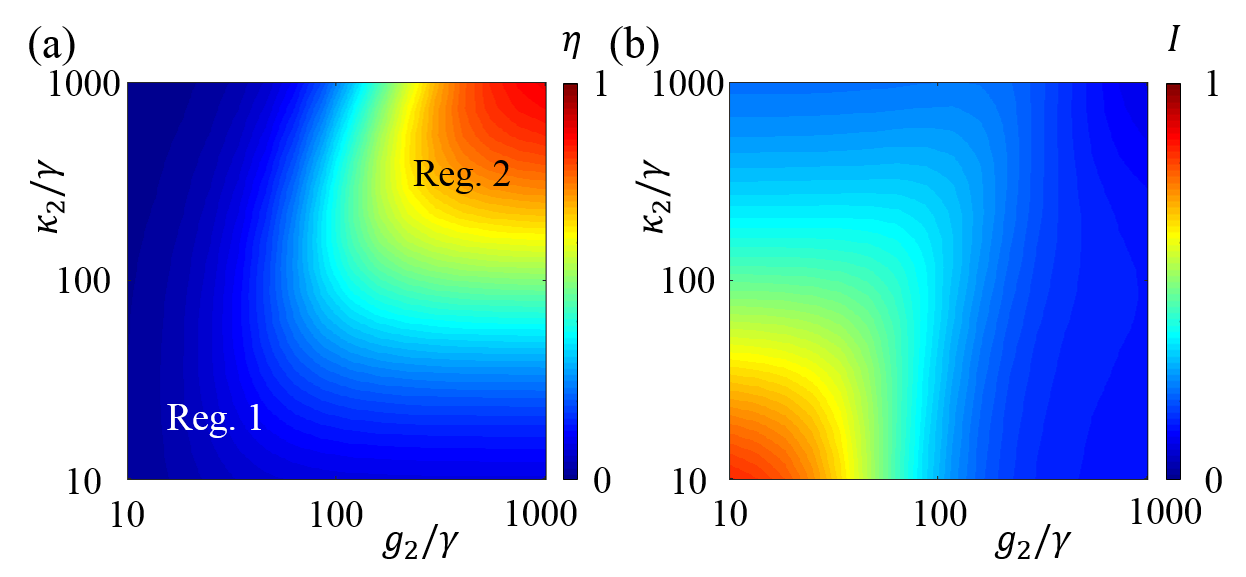
Figure 2: Efficiency (η) and indistinguishability (I) of the cascaded-cavity system shown as functions of g2 and κ2, illustrating two operational regimes.
In Reg. 1, the emitter and C1 act as a composite high-dephasing quasi-emitter feeding C2, so I can reach ∼0.95 with a first-cavity Q1 of only 7×10³ and a second-cavity Q2 of 5×10⁵, representing a two-orders-of-magnitude reduction in required Q-factor for fixed indistinguishability compared to single-cavity CQED. In regimes targeted for high η, the system still demonstrates a 17% improvement in the ηI product over single-cavity designs.
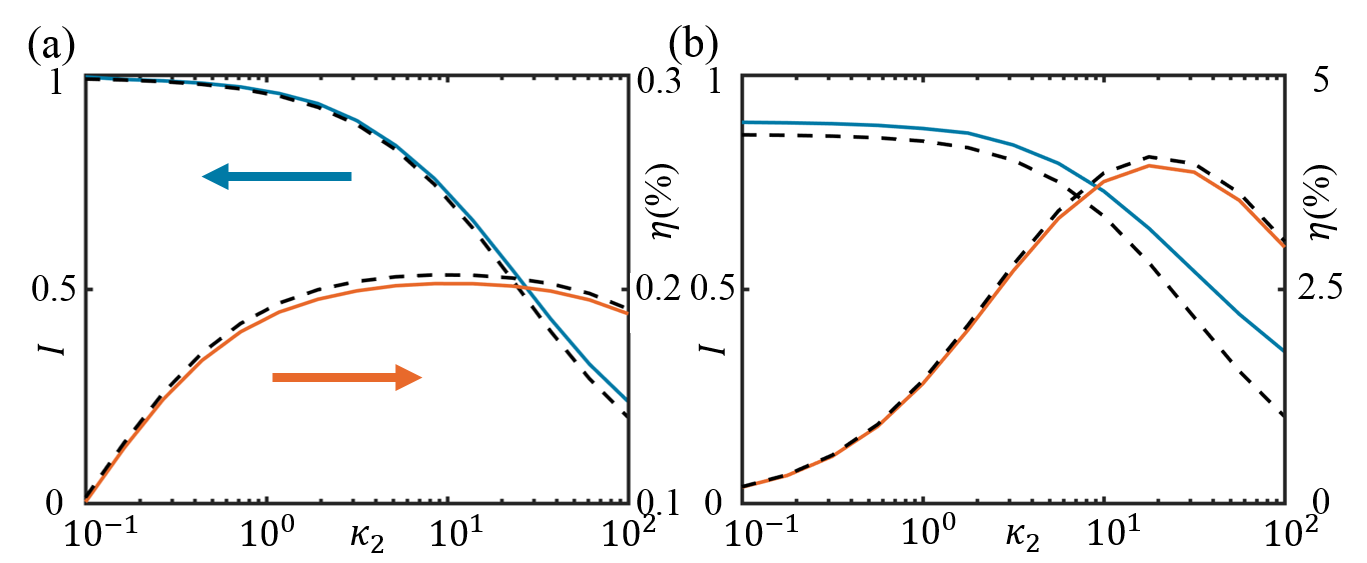
Figure 3: Numerical and analytical comparison of I and η versus κ2 in the regime optimized for indistinguishability; non-trivial agreement is shown except in limits where cavity-cavity coherence is non-negligible.
By tuning κ2 and g2, the device transitions from acting as a “photon filter” with maximal indistinguishability to a “photon router” with maximum collection efficiency, always outperforming analogous single-cavity designs at equivalent total photonic quality factors.
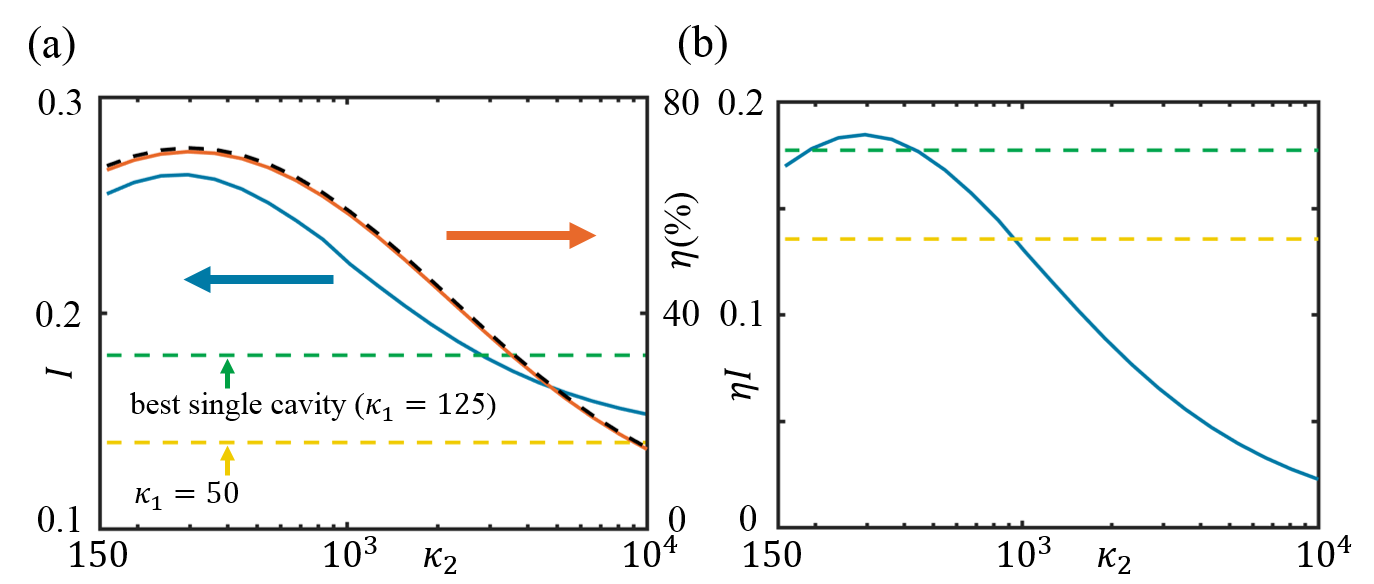
Figure 4: Regime with maximal ηI product; cascaded-cavity architecture outperforms the best single-cavity system throughout the parameter sweep of κ2.
Robustness to Spectral Diffusion
The influence of spectral diffusion on emission statistics is analyzed by statistical averaging over Gaussian detuning distributions. Both I and η are found to be notably insensitive to moderate Δδ as long as Δδ≪γ∗, a regime naturally realized at room temperature for solid-state color centers.
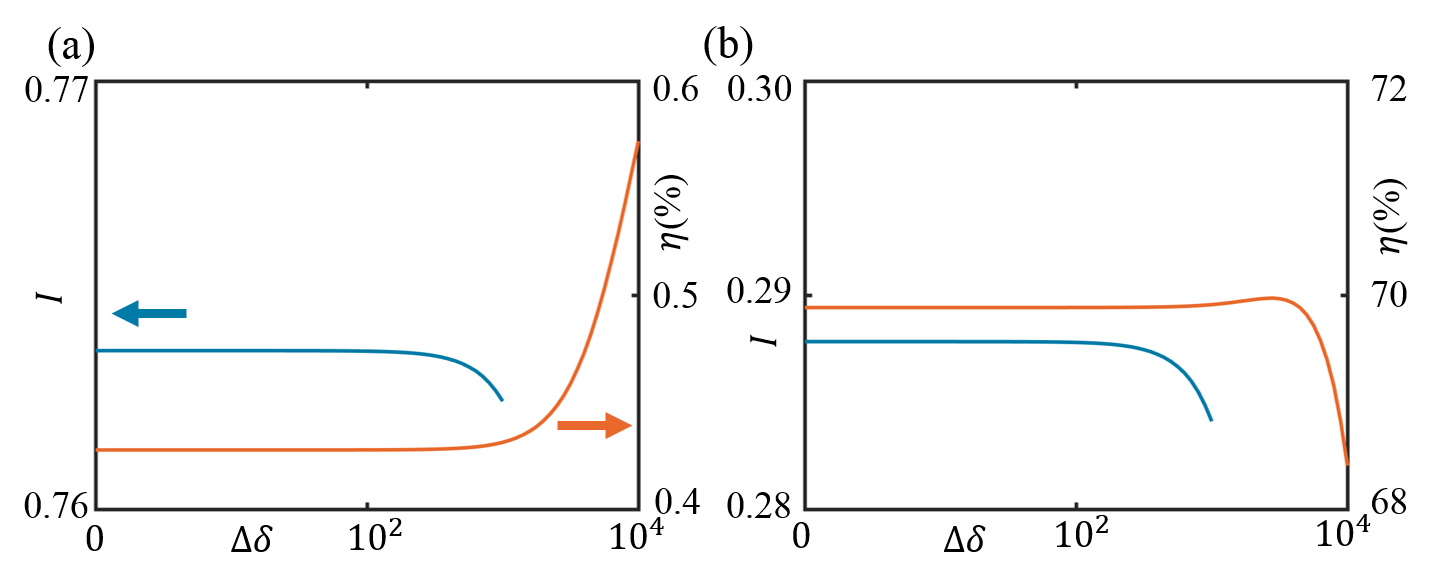
Figure 5: I and η versus Δδ for the two main regimes, demonstrating stability of system performance despite inhomogeneous broadening.
This robustness arises as pure dephasing acts as a resource, enforcing population transfer via the cavity funnel and suppressing spectral wandering effects, a result not paralleled by single-cavity or bare-emitter scenarios.
Comparison to Other Multi-Mode and Hybrid CQED Architectures
The paper distinguishes the cascaded system from photonic molecule and hybrid-cavity approaches. In the present protocol, weak C1-C2 coupling maintains spectrally isolated cavity modes, and photon emission only passes through C1 to C2 without forming delocalized supermodes. The resulting emission statistics and tunability offer significant practical benefits for scalable on-chip quantum photonic devices.
Implications and Future Directions
The cascaded-cavity architecture removes the major technological barrier—the ultrahigh Q-factor requirement—for room-temperature indistinguishable single-photon emission from solid-state centers. The framework generalizes to other dissipative quantum emitters and may be implemented with existing photonic crystal and nanofabrication techniques. Extension to low-temperature operation or integration with deterministic photon sources and photonic quantum gates is direct.
Potential future developments include:
- Monolithic integration of cascaded-CQED with heralded photon sources for fault-tolerant quantum communication.
- Dynamical control of cavity parameters for real-time adjusting of emission statistics.
- Extension to multi-cavity and waveguide-coupled superstructures for multiplexed quantum networks.
- Application of similar funneling models for microwave or mid-infrared quantum photonics.
Conclusion
This work establishes a comprehensive theoretical and numerical foundation for high-indistinguishability, high-efficiency single-photon generation using cascaded cavity QED systems with dissipative solid-state emitters. By leveraging enhanced emitter-cavity coupling and funneling through an auxiliary cavity, the system achieves strong performance improvements—particularly a dramatic reduction in Q-factor requirements and robust suppression of spectral diffusion effects. The proposed architecture constitutes a scalable, fabrication-compatible platform for room-temperature quantum light sources and provides valuable insight into dissipative quantum optics in nanostructures (1809.01645).

