- The paper demonstrates that while PBS adoption surged from 20% to over 85%, centralized control among builders and relays undermines its decentralization promise.
- It reveals that PBS blocks yield higher block values due to sophisticated builder strategies, indicating significant imbalances in profit distribution.
- The study highlights that relay accountability issues and censorship inconsistencies challenge PBS’s ability to deliver true censorship resistance.
Detailed Analysis of "Ethereum's Proposer-Builder Separation: Promises and Realities"
Introduction
The paper "Ethereum's Proposer-Builder Separation: Promises and Realities" (2305.19037) investigates the Proposer-Builder Separation (PBS) mechanism introduced to Ethereum with its transition from Proof-of-Work (PoW) to Proof-of-Stake (PoS) in September 2022. PBS was designed to decouple transaction ordering and block validation tasks, providing opportunities for decentralized block validation and theoretically mitigating censorship. This essay provides a comprehensive analysis of the paper, focusing on the adoption of PBS, its implications on decentralization, censorship resistance, profit distribution, and the trust dynamics within the Ethereum ecosystem.
Proposer-Builder Separation: Adoption and Centralization
The adoption of PBS has been significant since Ethereum's transition to PoS. The study reveals that the fraction of PBS blocks increased from 20% at the merge to over 85% within a few months (Figure 1). However, the research highlights an alarming centralization within the builder and relay landscapes, with a few dominant players such as Flashbots and bloXroute maintaining a substantial market share (Figure 2). This centralization raises concerns about PBS's ability to fulfill its promise to decentralize transaction validation.
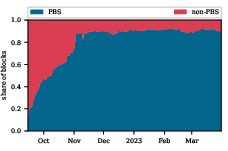
Figure 1: Daily share of blocks built with PBS on Ethereum since the merge.
Censorship Resistance: A Flawed Promise
A critical design goal of PBS was to prevent censorship. Despite this intent, the paper demonstrates that PBS falls short, as evidenced by a significant proportion of PBS blocks excluding transactions from sanctioned addresses compared to non-PBS blocks (Figure 3). Additionally, relays self-reporting as OFAC-compliant (e.g., Flashbots) do not always adhere to their censorship promises, further undermining the censorship resistance of the system.
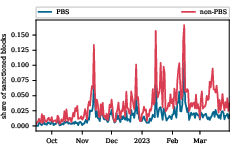
Figure 3: Daily share of PBS and non-PBS blocks that include transactions that do not comply with OFAC sanctions.
Profit Distribution and Builder Advantages
The study analyzes profit distribution within the PBS framework, revealing that professionalized builders have a clear advantage in extracting maximal value from blocks. PBS blocks generally exhibit higher block value than their non-PBS counterparts, attributed to the sophisticated strategies deployed by specialist builders (Figure 4). Despite providing hobbyist validators access to competitive blocks, the landscape is inclined towards builder centralization, with builders capturing a significant share of block value.
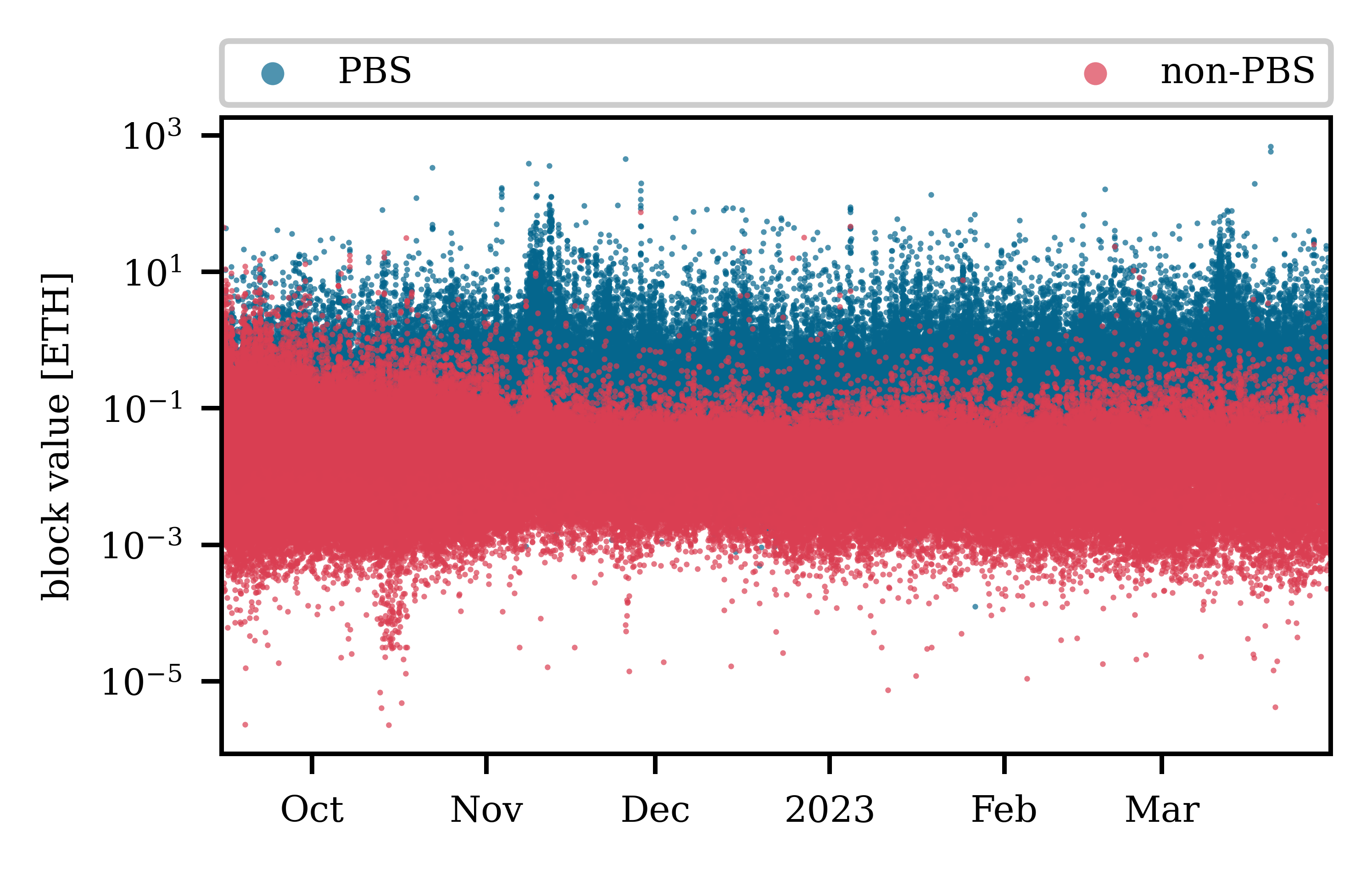
Figure 4: Block value, i.e., priority fees and direct transfers, across time with PBS blocks often showing higher values.
Trust Dynamics and Relay Accountability
An analysis of relay behaviors shows relay trustworthiness to be a critical concern in the current PBS architecture. The paper reports instances where relays deliver less than the promised value to proposers, essentially breaching trust. Other issues include gaps in MEV filtering and censorship promises. For instance, the Manifold relay showed a significant deficit in delivered value versus promised value, delivering only 19.9% of what was promised (Table).
Implications and Future Prospects
The findings of this study have profound implications for Ethereum's ongoing evolution. While PBS aims to enhance decentralization and reduce censorship, the realization of these goals is complicated by factors like builder centralization and imperfect relay trust structures. This highlights the importance of designing mechanisms that can manage or eliminate the centralization potential without compromising the security and efficiency of the network. Furthermore, the study suggests that comprehensive incentive structures are necessary to ensure that relays remain accountable and trustworthy.
Conclusion
The paper presents a critical evaluation of the PBS in Ethereum, raising important concerns about centralization, censorship resistance, and relay accountability. While PBS presents theoretical benefits, the realities indicate significant room for improvement in achieving true decentralization and resistance to censorship. As Ethereum advances, addressing these challenges will be crucial in ensuring PBS fulfills its foundational promises.