- The paper introduces a role-selection game under PBS, demonstrating how agent strategies adapt via genetic algorithms and reinforcement learning.
- It employs co-evolutionary simulations to analyze trade-offs between block building and bundle sharing amid varying bundle conflict probabilities.
- The study reveals that increased bundle conflict intensifies competition, posing challenges to decentralization and guiding future blockchain designs.
Role-Selection Game in Block Production under Proposer-Builder Separation
The paper "Role-Selection Game in Block Production under Proposer-Builder Separation" (2503.15184) explores the strategic dynamics within the Proposer-Builder Separation (PBS) framework, a novel mechanism introduced to mitigate the centralization risks faced by validators in the Ethereum network. By segregating the roles of block building and block proposing, PBS creates a two-sided market where agents strategically navigate their roles to optimize payoffs.
Introduction to Proposer-Builder Separation (PBS)
PBS was introduced as a countermeasure against validator centralization in Ethereum by dividing block production tasks into two roles: proposers and builders. In PBS:
- Searchers submit transaction bundles along with bids to builders, who then optimize these for block inclusion.
- Builders participate in the block-building auction, aiming to outbid their competitors and propose the block with the highest bid.
The paper models this environment as a complex agent-based system, analyzing the strategic choices of participants through co-evolutionary simulations utilizing genetic algorithms and reinforcement learning principles.
Co-evolutionary Framework in PBS
The authors propose a co-evolutionary framework where agents self-optimize their strategies using genetic algorithms. This approach is facilitated by agent-based simulations, which provide insight into how agents adapt to market conditions and bundle interactions to maximize their payoffs.
Agent Strategy Dynamics
Agents can choose to act as searchers, sharing their profit opportunities, or as builders, competing in block-building auctions. The strategy choice impacts their payoffs significantly, influencing the market dynamics:
- Bundle Sharing: Agents submit bundles to builders and are rewarded based on rebates offered by builders.
- Block Building: Builders retain surplus after competing in auctions and refund a portion to searchers.
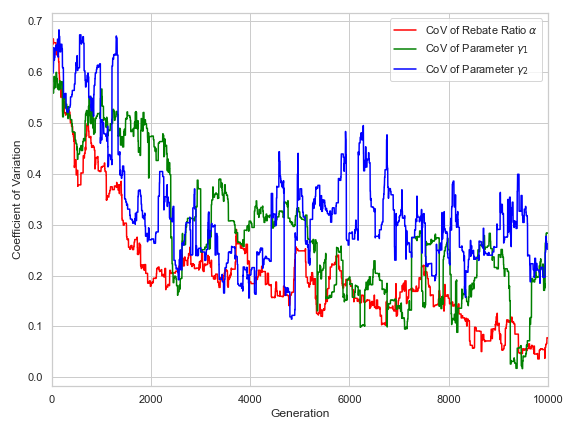
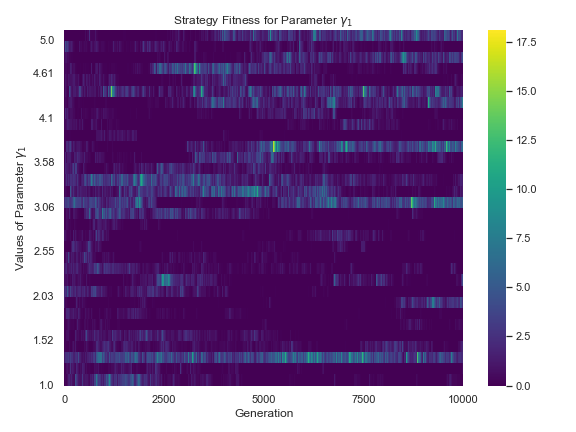
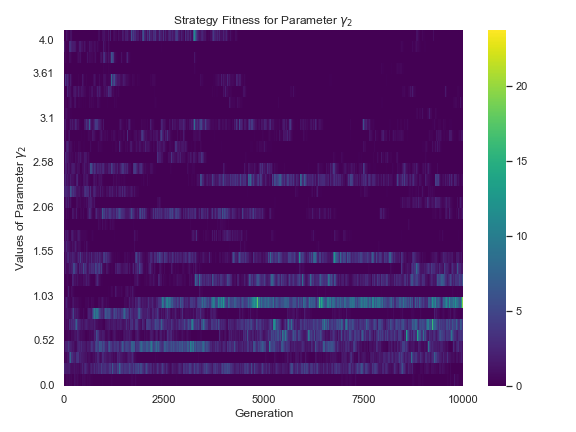
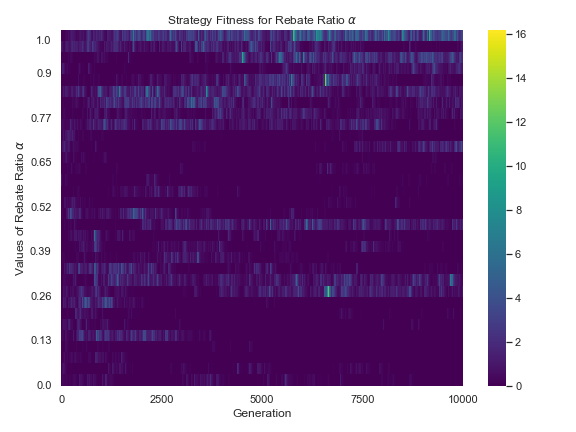
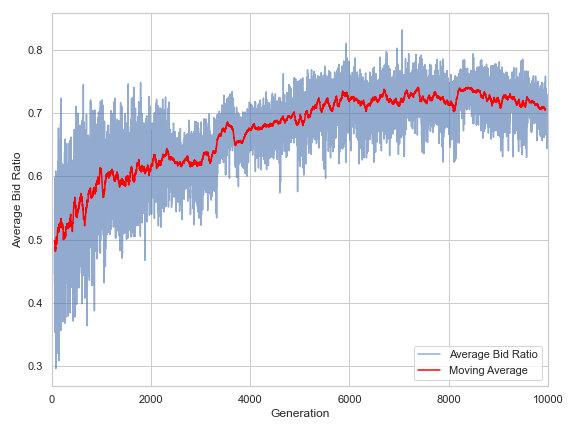
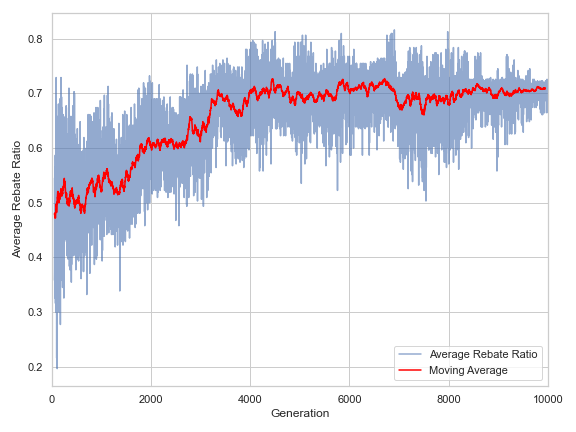
Figure 1: Co-evolution of agent strategies showcasing strategy convergence and strategic diversity as agents optimize their actions.
Impact of Bundle Interactions
The interactions between bundles introduce complexities that affect agent strategies and market outcomes. The presence of bundle conflicts and complementarities substantially impacts agent decisions:
- Conflict Probability: Introduced as a critical variable, it affects bid ratios and subsequently, the payoff distributions among participants.
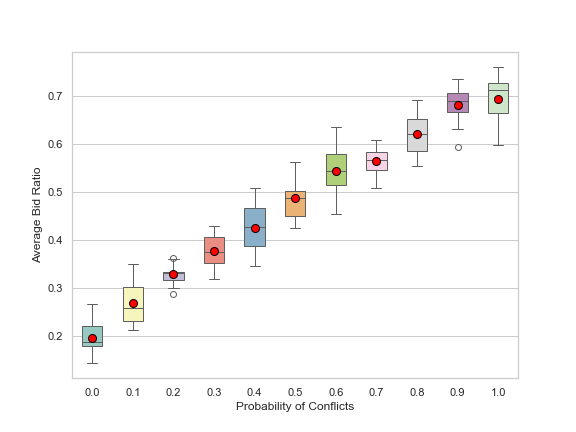
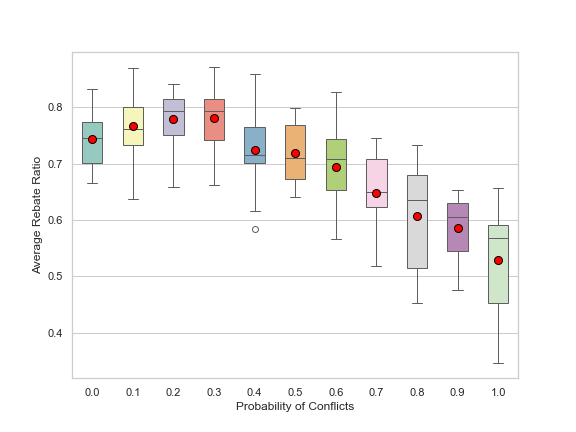
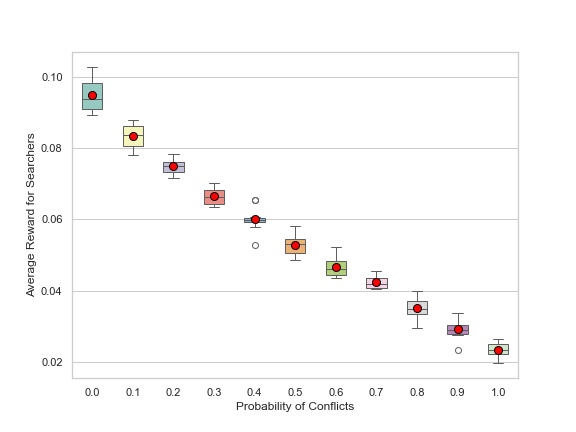
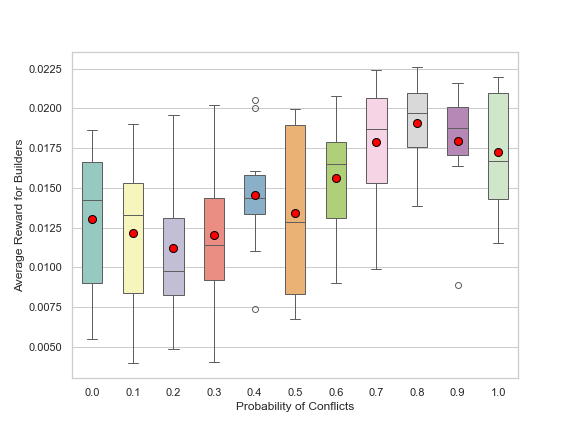
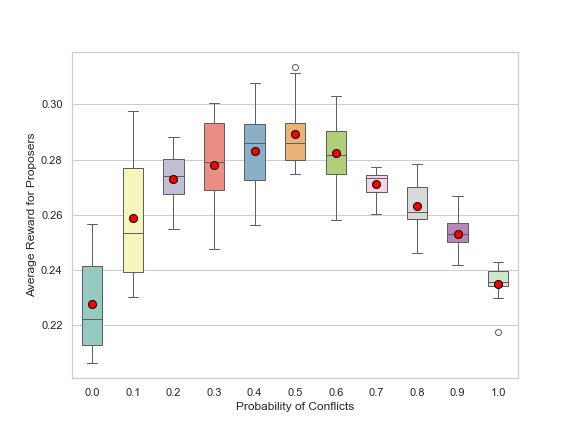
Figure 2: Impact of conflict probability illustrating changes in bid ratios and rebate decisions under varying conflict probabilities.
Empirical Game-Theoretic Analysis
Using the α-Rank algorithm, the authors perform an empirical game-theoretic analysis to deduce the dynamic equilibrium of agent strategies. This analysis predicts the frequency of role selection between block building and bundle sharing, essential for understanding strategic adaptation in response to market conditions.
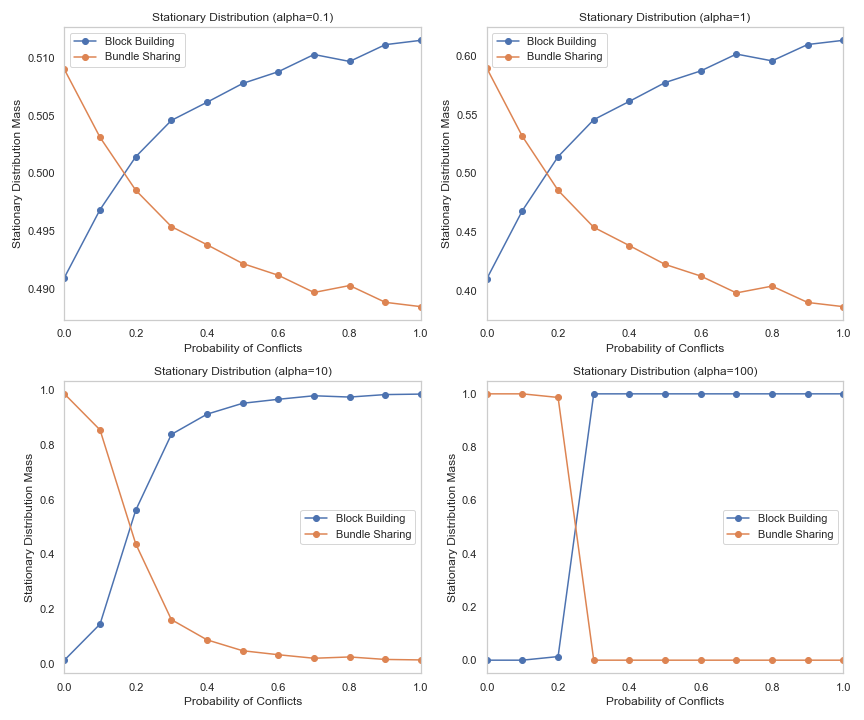
Figure 3: Stationary distribution of block building and bundle sharing highlighting critical transition points in strategy adoption.
Discussion and Implications
The study reveals notable insights into the strategic behavior within PBS:
- Competition vs. Collaboration: Increased bundle conflict probability shifts agent preference from bundle sharing to block building, highlighting the competitive pressures in PBS.
- Decentralization Challenges: Despite the PBS framework, block builder centralization remains a hurdle, particularly due to exclusive order flow access.
The findings advocate for further research into network science approaches to elucidate the complex bundle interactions and address emerging centralization issues.
Conclusion
This paper contributes significantly to understanding strategic behaviors in PBS systems by employing agent-based models and genetic algorithms to simulate evolutionary strategies. Future explorations could enhance bundling strategies and address centralization barriers, fostering a more decentralized, competitive landscape. The methodologies adopted provide a promising direction for tackling complexities in blockchain economics and validating decentralized finance mechanisms.

