- The paper introduces the enshrinement of PBS in Ethereum to integrate direct consensus-layer auctioning and address MEV fairness.
- It examines the MEV-Boost mechanism and its role in democratizing MEV access while mitigating validator reward disparities.
- The study outlines ePBS enhancements, including redistributive MEV smoothing and burn auction models, to curb collusion and centralization risks.
Overview of Ethereum's Proposer Builder Separation
Ethereum's Proposer-Builder Separation (PBS) is a major innovation aimed at optimizing block proposal mechanisms and ensuring validator reward equity. It enables proposers to auction block space to builders who can optimize transaction order for maximum profit. The PBS initiative, initially implemented by Flashbots' MEV-boost, is a cornerstone of Ethereum's transaction processing ecosystem, potentially mitigating Maximal Extractable Value (MEV). The PBS system leverages a market-driven approach for rewarding validators while addressing drawbacks like relay dependency, multiparty collusion, and chain stagnation.
Ethereum validators receive protocol-sponsored rewards through proposal, attestation, and sync committee activities. While attestation accounts for approximately 85% of these rewards, block proposition has distinct implications due to MEV and priority fees. MEV enables validators to reorder transactions for extra profit but is often deemed harmful due to its extractive nature. Priority fees, on the other hand, reward rapid transaction processing via tips. While MEV varies with network conditions, it poses fairness issues related to validator resources, leading to community calls for management and mitigation.
Mechanisms of MEV-Boost
MEV-Boost by Flashbots facilitates third-party outsourcing for block generation, democratizing MEV access for weaker validators. It aggregates relays which connect validators to transaction orderer markets led by builders. Builders prepare optimal blocks from transactions, offering economic efficiency by raising blockspace value and throughput. However, independence from Ethereum's core protocol introduces risks of collusion, corruption, and network reliance, highlighting the need for enshrinement.
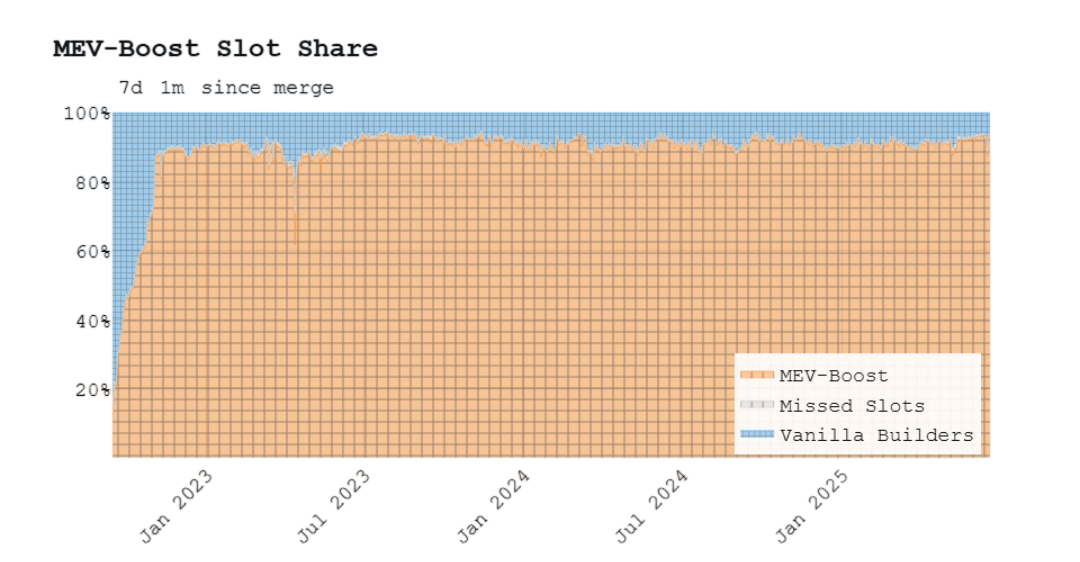
Figure 1: MEV-boost slot prominence since the merge (light orange)
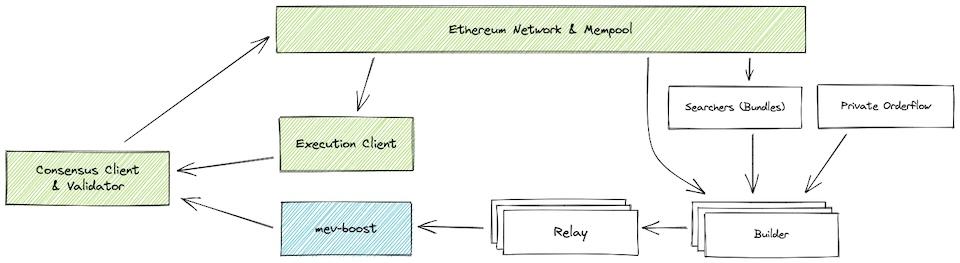
Figure 2: MEV-boost orderflow
Commit-Boost and Network Standardization
Commit-Boost standardizes the commitment process, relieving validators from client fragmentation and enabling easier management of pre-confirmation requests. This modular approach helps prevent vendor lock-in and network reliance, offering a uniform framework for validators to negotiate blockspace inclusion efficiently.
Concept of PBS Enshrinement
The enshrinement of PBS into the Ethereum protocol, as proposed in EIP-7732, removes the reliance on third-party relays by embedding transaction order processes directly into the network. This implementation promises trustless proposer-builder exchanges, reduces computational demands, enhances network propagation, and mitigates centralization risks. Notably, it incorporates a committee system to enforce builder accountability, fostering fair and efficient builder selection.
ePBS Enhancements
ePBS expands on PBS enshrinement by introducing redistributive mechanisms like committee-driven MEV smoothing, which equalizes rewards within attestation committees. Additionally, burn auction models propose burning extracted MEV to benefit Ether holders, though they necessitate rigorous builder enforcement to prevent collusion. These enhancements seek to stabilize MEV dynamics and incentivize decentralized validator operations.
Conclusion
The progression towards enshrined Proposer-Builder Separation represents a significant milestone in achieving fair validator rewards and enhancing Ethereum's decentralized architecture. By integrating direct consensus-layer auctioning and addressing MEV management, ePBS paves the way for stronger client protection and lasting cryptoeconomic impacts. While hurdles like collusion and centralization remain, ePBS lifts PBS from an experimental middleware closer to a foundational protocol component, highlighting its potential to reshape Ethereum's transaction economy and governance framework.

