- The paper presents a comprehensive framework that distinguishes standalone AI agents from collaborative agentic systems.
- It details distinct architectures, including foundation model integration for agents and coordination protocols for agentic systems.
- The analysis highlights practical applications such as customer service automation for agents and collaborative diagnostics in healthcare for agentic systems.
Distinguishing Autonomous AI Agents from Collaborative Agentic Systems: A Comprehensive Framework
Introduction to AI Agents and Agentic AI Systems
The paper provides a comprehensive framework for distinguishing between AI Agents and Agentic AI systems. AI Agents are defined as standalone, tool-enhanced systems utilizing foundation models for specific tasks in constrained environments. These agents excel in applications that benefit from specialized knowledge and consistent execution. Conversely, Agentic AI systems represent collaborative frameworks where multiple agents interact to achieve collective intelligence. These systems are necessary where complex, multi-domain tasks exceed the capabilities of individual agents.
Global interest in AI Agents has surged following advancements in foundation models, exemplified by developments in LLMs that enable AI Agents to autonomously act within specific domains.
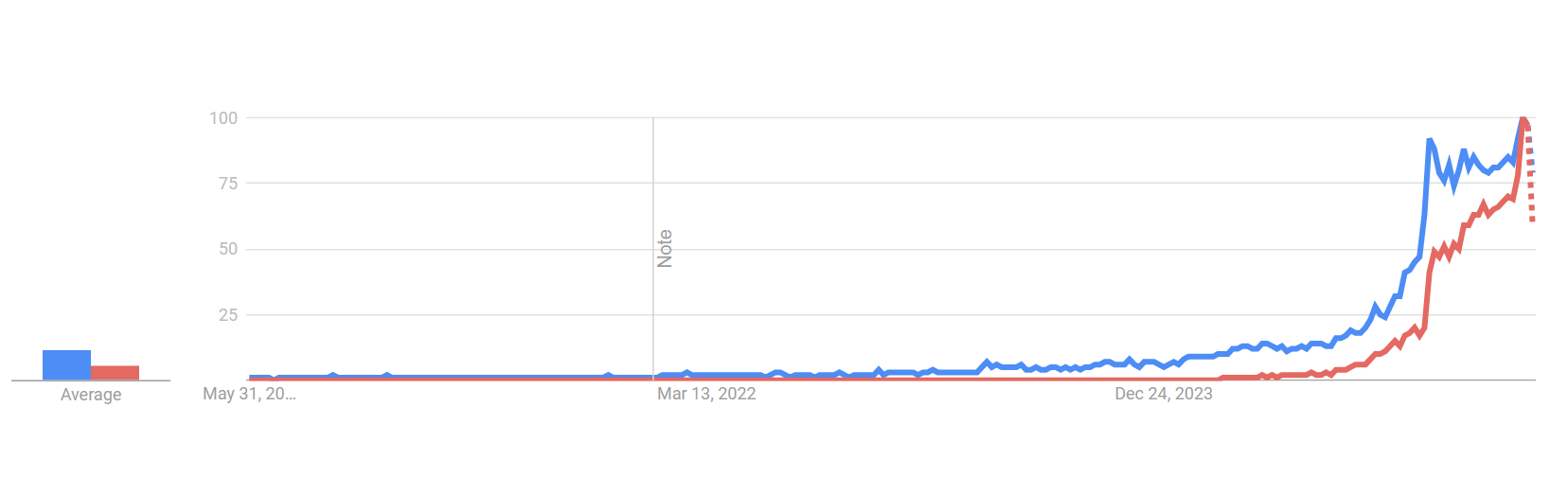
Figure 1: Analysis of global search interest patterns for "AI Agents" and "Agentic AI" technologies, demonstrating accelerated adoption following breakthrough developments in foundation models during late 2022.
Architectural Distinctions
AI Agents
AI Agents integrate natural language processing, reasoning, and planning capabilities within streamlined, efficient frameworks. They function autonomously with minimal external intervention, handling tasks like customer service automation and email classification. Their architectures typically include:
- Foundation Model Integration: Utilizing LLMs for reasoning and decision-making.
- Memory Systems: Handling context through both short-term and long-term memory structures.
- Tool Integration: Employing APIs for real-time data, calculations, and external interactions.
Agentic AI Systems
Agentic AI systems require sophisticated coordination to manage interactions among multiple agents. Key architectural components include:
- Coordination Mechanisms: Synchronicity among agents to ensure cohesive task execution.
- Communication Protocols: Such as the Google A2A protocol, allowing seamless interaction.
- Memory and Knowledge Sharing: Distributed systems that enable agents to share insights and decisions.
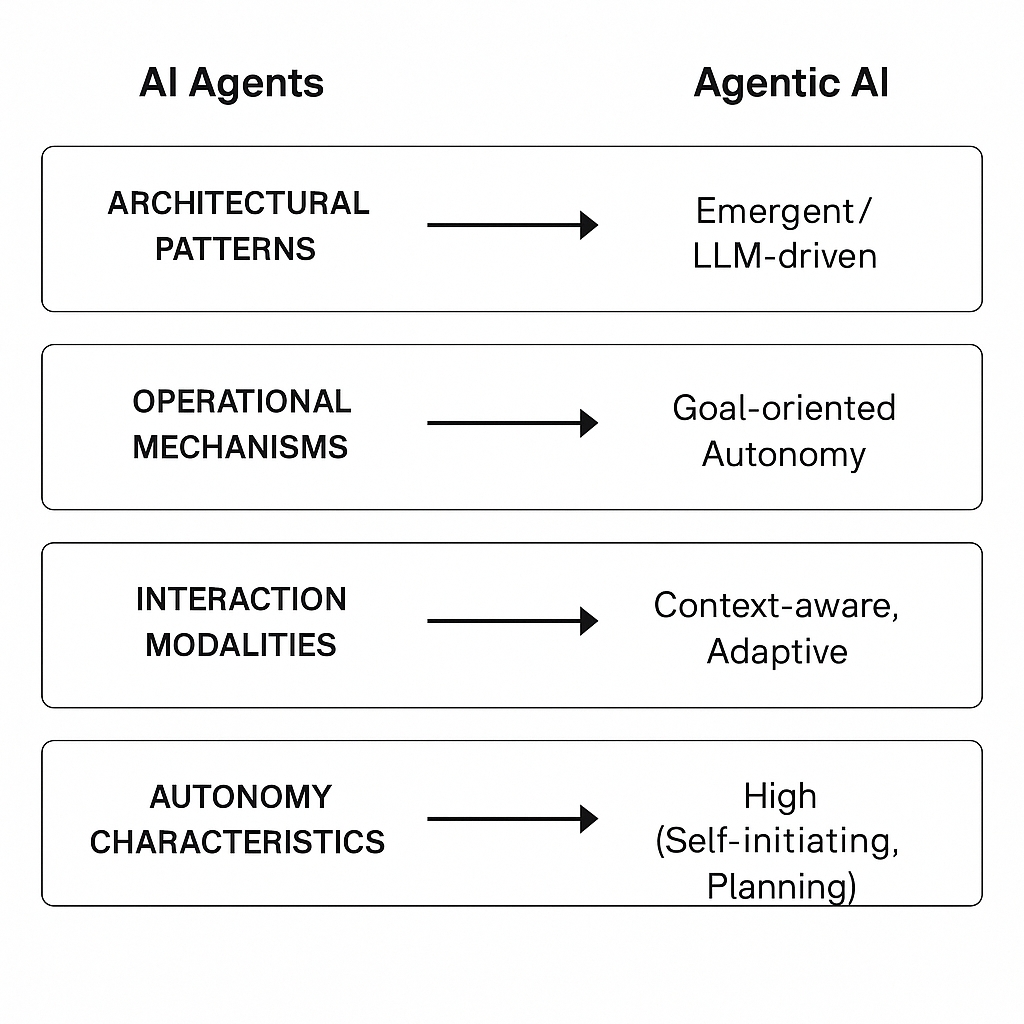
Figure 2: Comprehensive conceptual framework illustrating the key dimensions of analysis for distinguishing AI Agents from Agentic AI systems, including architectural patterns, operational mechanisms, interaction modalities, and autonomy characteristics.
Operational and Application Differences
Suitable Applications
AI Agents are optimally deployed in environments requiring specialized, singular task execution:
- Customer Service: Automating inquiries with natural language understanding.
- Knowledge Management: Structuring and retrieving enterprise information efficiently.
- Content Recommendation: Personalizing user experiences through learned preferences.
Agentic AI systems address applications necessitating complex task decomposition and multi-domain collaboration:
- Research Automation: Integrating diverse expertise across scientific domains.
- Healthcare Support: Collaborative diagnostics and treatment planning.
- Robotics and Automation: Coordinating multiple physical agents in dynamic environments.
Challenges and Solutions
The paper identifies key challenges faced by both AI paradigms:
- AI Agents: Confronting limitations in memory retention and tool integration. These issues are mitigated with enhanced memory systems and robust API interaction strategies.
- Agentic AI: Dealing with coordination complexity and emergent behavior unpredictability. Advanced protocols and distributed learning frameworks are proposed as solutions.
Conclusion
This framework provides critical insights for selecting and deploying AI technologies across varied domains. The clear taxonomic delineation allows for effective decision-making in aligning AI capabilities with specific operational needs. Future advancements will focus on hybrid models that leverage both individual efficiency and collaborative intelligence, promising enhanced scalability and adaptability in increasingly complex scenarios. Addressing limitations related to memory, coordination, and emergent behavior will be crucial as AI continues to advance and integrate into mission-critical applications.