- The paper introduces a dual-paradigm framework that distinguishes deterministic symbolic architectures from stochastic neural models in agentic AI.
- It details methodologies and key applications, contrasting rule-based planning in healthcare and compliance with prompt-driven systems in finance and education.
- The survey identifies future research directions focused on hybrid architectures and tailored evaluation metrics to ensure both reliability and adaptability.
Agentic AI: A Comprehensive Survey of Architectures, Applications, and Future Directions
Introduction to Agentic AI
Agentic AI represents a transformative shift from traditional artificial intelligence by engineering systems with genuine agency. These systems exhibit capabilities such as proactive planning, contextual memory, and sophisticated tool use, distinguishing themselves from passive AI models. The evolution towards Agentic AI has led to a fragmented understanding, often conflating modern neural systems with the outdated symbolic models. This survey addresses the confusion by introducing a dual-paradigm framework that distinguishes two lineages of agentic systems: Symbolic/Classical, which relies on algorithmic planning and persistent state, and Neural/Generative, which leverages stochastic generation and prompt-driven orchestration.
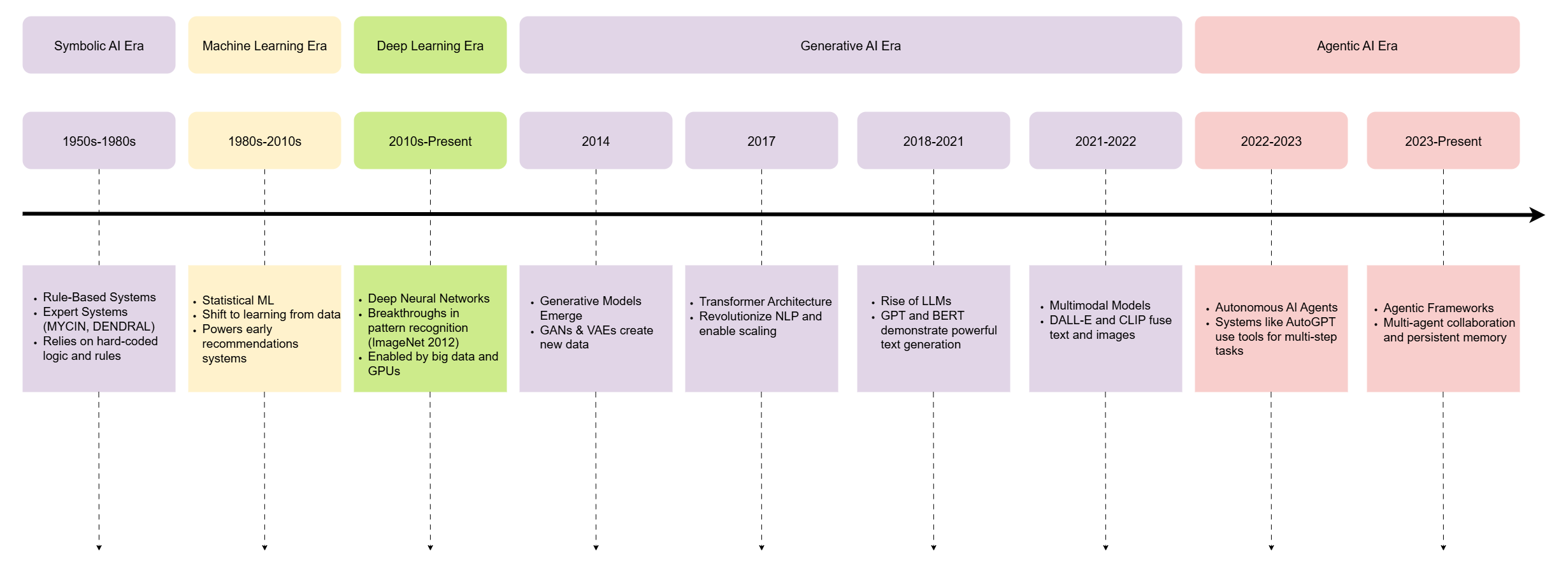
Figure 1: Historical Evolution of AI Paradigms from early symbolic systems to the modern agentic era, highlighting the Transformer architecture's pivotal role.
Dual Lineages of Agentic AI
To establish a precise conceptual foundation, the paper introduces a novel framework distinguishing the Symbolic/Classical and Neural/Generative paradigms.
Symbolic/Classical Paradigm
The Symbolic/Classical lineage is characterized by systems based on explicit rules and deterministic decisions, employing frameworks like Markov Decision Processes (MDPs) or Partially Observable MDPs (POMDPs). These models provide a structured environment for reasoning in complete and incomplete information scenarios, respectively. They excel in domains where precision and reliability are paramount, such as healthcare and regulatory compliance.
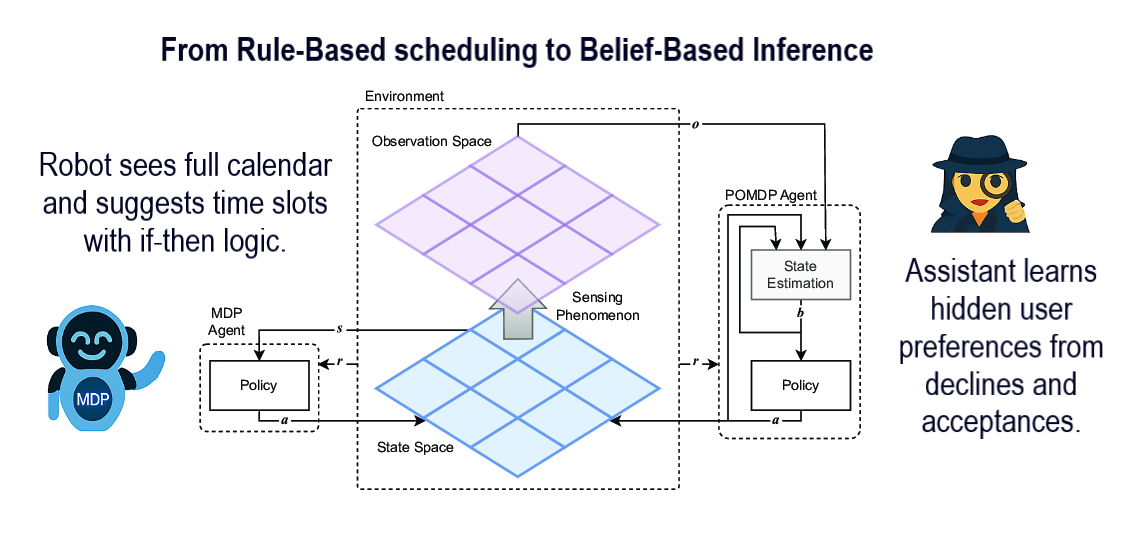
Figure 2: Classical symbolic reasoning illustrated by a rule-based MDP and a belief-based POMDP for decision-making.
Neural/Generative Paradigm
Conversely, the Neural/Generative lineage is embodied by systems utilizing stochastic processes for decision-making and task execution. These systems are powered by LLMs like GPT-3, which enable complex orchestration through prompt-driven interactions. This paradigm is more suited to environments rich in unstructured data, requiring adaptive and real-time responses, such as finance and dynamic market analyses.
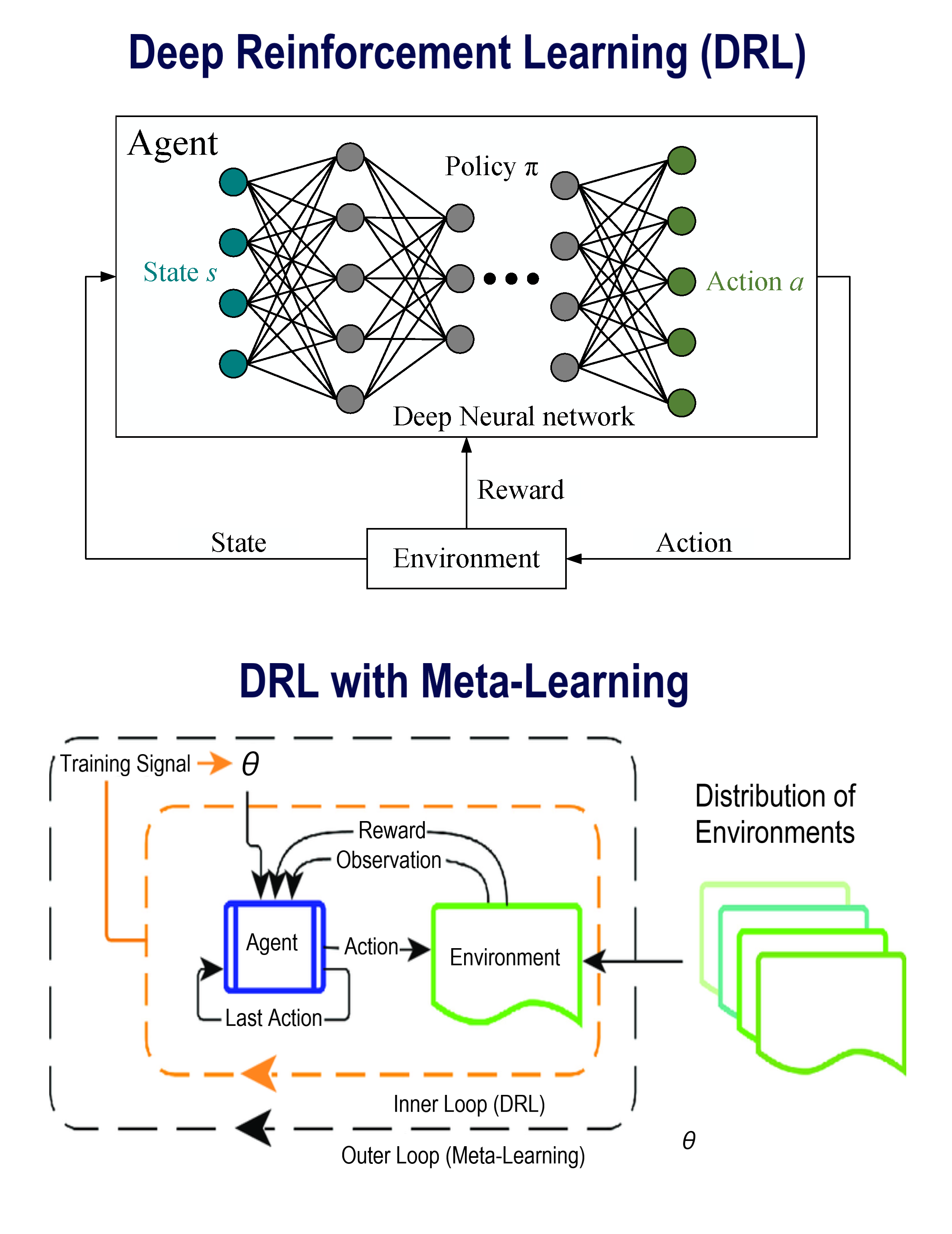
Figure 3: The progression towards learned behavior from vanilla DRL to meta-DRL for improved adaptability.
Applications Across Domains
A strategic choice between paradigms is often determined by domain-specific requirements.
- Healthcare: Symbolic architectures dominate, focusing on decision support systems where accountability and predictability are crucial.
- Finance: Neural paradigms excel by integrating real-time data analysis, providing adaptive market strategies but still requiring symbolic checks for regulatory compliance.
- Education: Neural agents deliver personalized learning experiences through dynamic content generation, enhancing engagement and efficacy.
Multi-agent systems that blend both paradigms are emerging, particularly in robotics, where they manage coordinated tasks with robustness and adaptability.
Ethical and Governance Implications
Agentic AI introduces unique ethical challenges that differ by paradigm. For symbolic systems, transparency and verifiability are central, with deterministic logic providing accountability. Neural systems, however, face challenges in interpretability and bias due to their stochastic nature. Effective governance must therefore be paradigm-aware, combining formal verification for symbolic systems with robust red-teaming and adversarial training for neural systems to ensure alignment and safety.
Research Gaps and Future Directions
There is a pressing need for dedicated research into hybrid architectures that integrate symbolic reasoning with neural adaptability to create systems that are both reliable and flexible. Future research should also focus on creating standardized evaluation metrics suited to each paradigm's capabilities and limitations.
Conclusion
The future of Agentic AI lies not in the competition between paradigms but in their synthesis. By leveraging the strengths of both symbolic and neural approaches, we can develop hybrid systems capable of robust, adaptive, and trustworthy decision-making. Such systems will not only advance AI capabilities but also ensure they align with human values and ethical considerations, paving the way for AI systems that are truly agentic.