- The paper introduces a unified narrative that traces the evolution from Semantic Web and MAS to LLM-powered agentic AI.
- The study employs a four-dimensional taxonomy to compare legacy and modern architectures, emphasizing the shift from formal semantics to implicit, model-based intelligence.
- The paper highlights new protocols like MCP and A2A that enable scalable interoperability, while addressing socio-technical challenges in agent systems.
From Semantic Web and MAS to Agentic AI: A Unified Narrative of the Web of Agents
Introduction and Historical Context
The paper presents a comprehensive synthesis of the evolution of the Web of Agents (WoA), tracing its intellectual lineage from the early visions of the Semantic Web and Multi-Agent Systems (MAS) to the current paradigm of LLM-powered agentic AI. The authors argue that the WoA concept, which envisions a dynamic, interoperable ecosystem of autonomous agents acting on users’ behalf, has been shaped by both the successes and limitations of its predecessors. The analysis is grounded in a four-dimensional functional taxonomy—semantic foundation, communication paradigm, locus of intelligence, and discovery mechanism—enabling a unified comparison across generations of agent architectures.
The historical review highlights the persistent research interest in agent technologies (Figure 1), with the Semantic Web and MAS forming the foundational pillars. The Semantic Web aimed to encode meaning explicitly in data via ontologies (RDF, OWL), while MAS research focused on decentralized, autonomous entities capable of negotiation and coordination. However, both approaches encountered significant barriers: the Semantic Web suffered from the high cost and complexity of large-scale ontology agreement and annotation, while MAS frameworks like FIPA struggled with practical interoperability and integration with the web’s resource-oriented architecture.
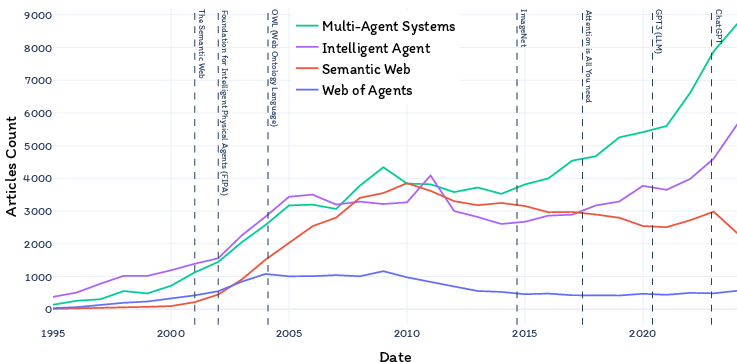
Figure 1: Publication trends in agent-related research, showing the rise of "Intelligent Agent" and the plateau of "Semantic Web" and "Multi-Agent System".
Paradigm Shift: From Semantics in Data to Semantics in Models
A central thesis of the paper is the paradigm shift in the locus of intelligence from external data and platforms to the agent’s core model, enabled by advances in deep learning and LLMs (Figure 2). Early systems required a pre-existing, semantically rich infrastructure, with intelligence distributed across ontologies and inference engines. In contrast, modern LLM-based agents internalize semantic understanding, leveraging vast pre-trained models to interpret and act upon unstructured data and natural language instructions. This shift has decoupled agent intelligence from the need for brittle, formal semantic infrastructures, facilitating more scalable and adaptable agent systems.
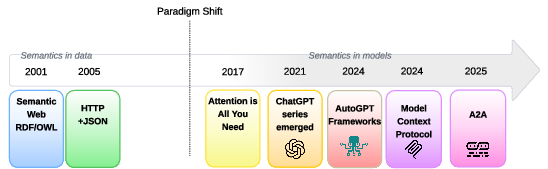
Figure 2: Timeline illustrating the shift from "semantics in data" (RDF/OWL) to "semantics in models" (LLMs), catalyzing the modern Web of Agents.
Functional Taxonomy of Web of Agents Architectures
The authors introduce a multi-dimensional taxonomy to systematically compare WoA architectures (Figure 3):
- Semantic Foundation: Ranges from formal/explicit semantics (ontologies) to procedural (protocol-driven) and implicit/emergent (LLM-internal) semantics.
- Communication Paradigm: Evolves from performative-based (FIPA ACL) to lightweight RPC/resource-oriented (MCP, A2A).
- Locus of Intelligence: Shifts from data-centric and platform-centric to model-centric (LLM-powered agents).
- Discovery Mechanism: Moves from centralized registries (Directory Facilitator) to decentralized, metadata-driven discovery (agent.json, P2P).
This taxonomy enables a precise classification of both legacy and modern systems, clarifying architectural trade-offs and the direct lineage from FIPA/OWL to MCP/A2A.
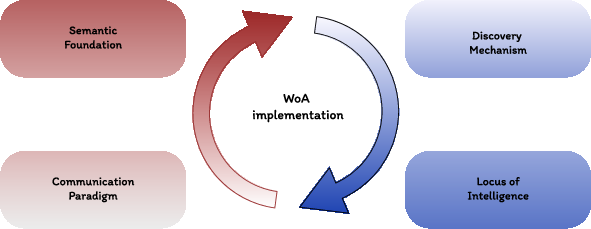
Figure 3: Multi-dimensional taxonomy for classifying Web of Agents architectures across semantic, communication, intelligence, and discovery axes.
Modern Agent Stack and Protocols
The paper details the emergence of pragmatic, web-native protocols that address the limitations of earlier standards:
- Model Context Protocol (MCP): Standardizes model-to-tool and model-to-data interactions using JSON-RPC, enabling LLM agents to access external resources and tools through a unified interface. MCP eschews formal ontologies in favor of natural language and structured JSON, prioritizing developer accessibility and rapid integration.
- Agent-to-Agent (A2A) Protocol: Standardizes inter-agent communication, discovery, and coordination, leveraging HTTP, JSON-RPC, and Server-Sent Events. A2A introduces the Agent Card (agent.json) for decentralized capability advertisement and supports long-running, asynchronous task management.
These protocols are designed to be complementary, with MCP handling tool invocation and A2A enabling agent collaboration. The adoption of these standards is evidenced by the rapid growth of open-source agent frameworks (Figure 4), such as LangChain, Auto-GPT, MetaGPT, LlamaIndex, and SuperAGI.
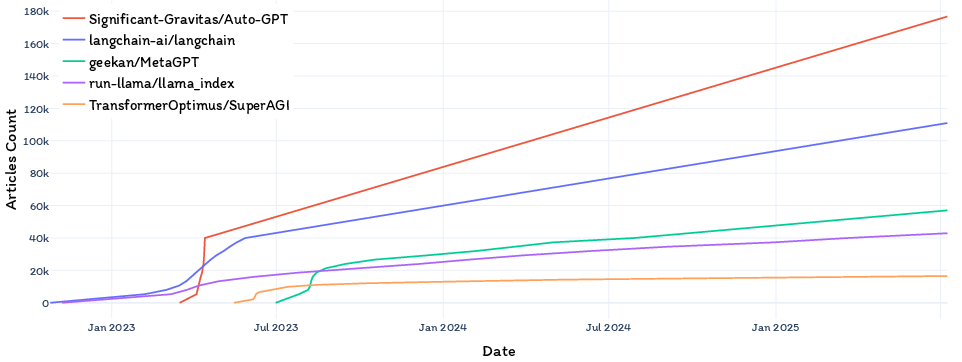
Figure 4: GitHub stars growth for major agent frameworks, highlighting LangChain's dominance and the post-GPT-4 acceleration.
Evolution of the Web of Agents Vision
The authors contrast the early Semantic Web vision—where agents reasoned over machine-readable, formally annotated data—with the modern approach, where LLMs interpret and act upon unstructured content using implicit semantics. The shift from "semantics in data" to "semantics in models" is not merely technical but fundamentally alters the requirements for interoperability, discovery, and economic viability.
The paper provides a conceptual map of the WoA ecosystem (Figure 5), distinguishing between well-established components (LLMs, cloud infrastructure, orchestration, protocols) and persistent socio-technical challenges (decentralized identity, economic models, security, governance).
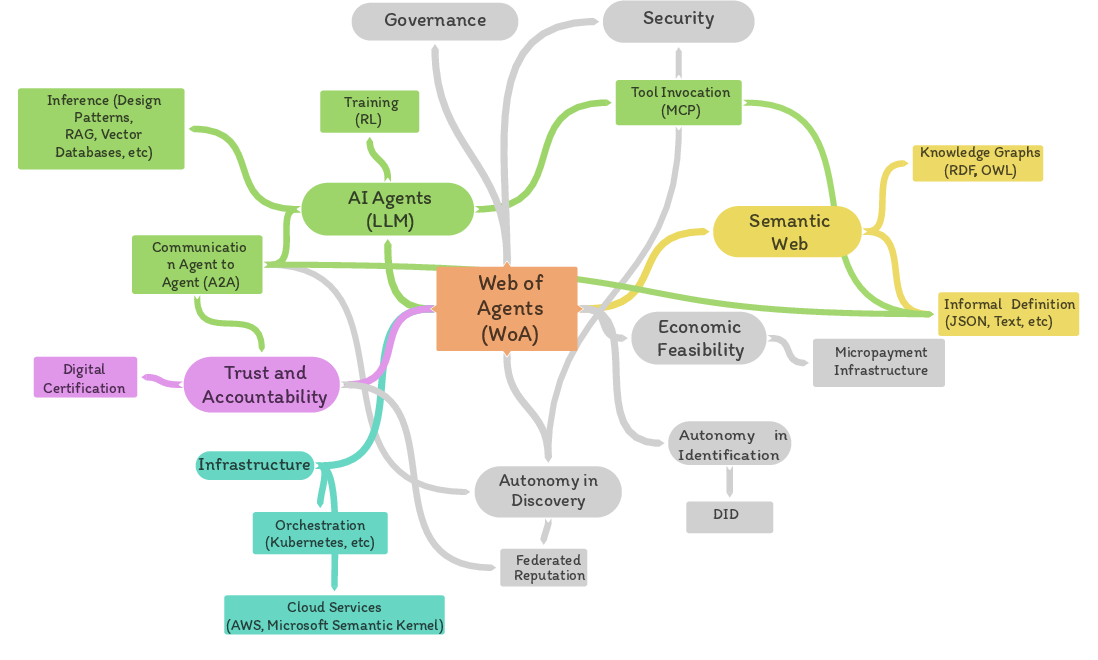
Figure 5: Conceptual map of the WoA ecosystem, highlighting established components and unsolved challenges at the research frontier.
Persistent Challenges and Research Frontier
Despite technical progress, the paper identifies several unsolved challenges that define the next research frontier:
- Decentralized Identity and Trust: The need for robust, self-sovereign identity systems (DIDs, VCs) and federated reputation networks to enable secure, trustworthy agent discovery and interaction.
- Economic Models and Incentives: The requirement for frictionless micropayment infrastructures and incentive alignment to ensure ecosystem sustainability and prevent market failures (e.g., "market for lemons").
- Security and Governance: The emergence of new attack vectors (e.g., indirect prompt injection, excessive agency), the necessity for formal accountability frameworks, and the integration of cryptographic techniques (ZKPs) for privacy-preserving authentication and compliance.
- Legal and Ethical Alignment: The challenge of establishing liability, legal personality for agents, and decentralized governance (e.g., DAOs, ETHOS framework) in a landscape where agents can autonomously enter into binding agreements.
The authors argue that these challenges are deeply interdependent, requiring multi-disciplinary solutions that span computer science, economics, law, and ethics.
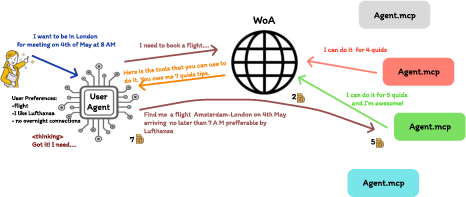
Figure 6: Example workflow of autonomous agent interaction in the WoA, illustrating task delegation, service discovery, economic exchange, and competitive bidding.
Implications and Future Directions
The unified narrative presented in the paper has several key implications:
- Architectural Simplicity and Web-Nativeness: The success of MCP and A2A demonstrates that pragmatic, developer-friendly protocols built on ubiquitous web standards are more likely to achieve broad adoption than complex, formal systems.
- Shift in Business Models: The rise of agentic AI will disrupt traditional web business models, shifting value creation from consumer-facing interfaces to API-first, agent-oriented services, and necessitating new approaches to monetization and competition.
- Socio-Technical Risk Management: The realization of an open, robust WoA depends not only on technical protocols but on the co-design of economic, trust, and governance infrastructures. The risk of centralization and balkanization is acute, as evidenced by the proliferation of proprietary agent marketplaces.
- Hybrid Planning and Reasoning: Future agent systems will likely combine LLM-native planning with formal, verifiable execution layers, leveraging the strengths of both paradigms for reliability and adaptability.
Conclusion
The paper provides an authoritative, integrative account of the Web of Agents, situating modern LLM-powered agentic AI within a clear evolutionary trajectory from the Semantic Web and MAS. The shift from "semantics in data" to "semantics in models" has enabled practical, scalable agent systems, but has also surfaced a new class of socio-technical challenges. The next decade of research must focus on building the trust, economic, and governance foundations necessary for a truly open, resilient, and trustworthy Web of Agents. The work serves as a roadmap for both researchers and practitioners, emphasizing that the future of agentic AI will be determined as much by advances in socio-technical infrastructure as by improvements in model capabilities.