Papers
Topics
Authors
Recent
Search
2000 character limit reached

BlockA2A: Towards Secure and Verifiable Agent-to-Agent Interoperability

Published 2 Aug 2025 in cs.CR and cs.AI | (2508.01332v3)

Abstract: The rapid adoption of agentic AI, powered by LLMs, is transforming enterprise ecosystems with autonomous agents that execute complex workflows. Yet we observe several key security vulnerabilities in LLM-driven multi-agent systems (MASes): fragmented identity frameworks, insecure communication channels, and inadequate defenses against Byzantine agents or adversarial prompts. In this paper, we present the first systematic analysis of these emerging multi-agent risks and explain why the legacy security strategies cannot effectively address these risks. Afterwards, we propose BlockA2A, the first unified multi-agent trust framework that enables secure and verifiable and agent-to-agent interoperability. At a high level, BlockA2A adopts decentralized identifiers (DIDs) to enable fine-grained cross-domain agent authentication, blockchain-anchored ledgers to enable immutable auditability, and smart contracts to dynamically enforce context-aware access control policies. BlockA2A eliminates centralized trust bottlenecks, ensures message authenticity and execution integrity, and guarantees accountability across agent interactions. Furthermore, we propose a Defense Orchestration Engine (DOE) that actively neutralizes attacks through real-time mechanisms, including Byzantine agent flagging, reactive execution halting, and instant permission revocation. Empirical evaluations demonstrate BlockA2A's effectiveness in neutralizing prompt-based, communication-based, behavioral and systemic MAS attacks. We formalize its integration into existing MAS and showcase a practical implementation for Google's A2A protocol. Experiments confirm that BlockA2A and DOE operate with sub-second overhead, enabling scalable deployment in production LLM-based MAS environments.
Summary

  • The paper introduces BlockA2A, a framework that secures agent-to-agent interactions using decentralized identifiers, immutable ledgers, and smart contracts.
  • It employs a Defense Orchestration Engine to dynamically detect and mitigate Byzantine agents and adversarial prompt attacks.
  • Empirical evaluations demonstrate sub-second response times and minimal overhead, confirming its scalability and practical integration in multi-agent systems.

BlockA2A: Enhancing Secure and Verifiable Agent-to-Agent Interoperability

The paper "BlockA2A: Towards Secure and Verifiable Agent-to-Agent Interoperability" introduces BlockA2A, a trust framework designed to address security vulnerabilities in multi-agent systems (MASes) driven by LLMs. As autonomous agents transform enterprise ecosystems, numerous security risks arise, including fragmented identities, insecure communication channels, and threats from Byzantine agents. BlockA2A proposes a comprehensive solution employing decentralized identifiers, blockchain-ledgers, and smart contracts to enable secure, verifiable interactions among agents.

BlockA2A Framework Components

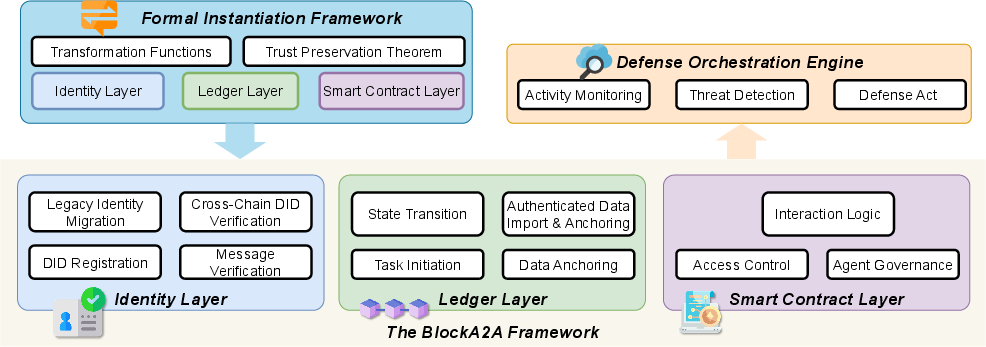
BlockA2A comprises three core architectural pillars:

  1. Decentralized Identity (DID) Layer: This layer eliminates centralized authentication bottlenecks by using decentralized identifiers for seamless cross-domain agent verification. DID documents containing cryptographic public keys and service endpoints ensure secure identity management.
  2. Immutable Ledger Layer: Transactions and interactions are anchored on a blockchain, providing a tamper-proof audit trail. Utilizing Merkle proofs and BLS multi-signatures, this layer ensures data integrity and non-repudiation, essential for verifying historical interactions.
  3. Smart Contract Layer: By defining fine-grained, context-aware access control policies and automating workflows, smart contracts ensure compliance with predefined rules, enhancing security and process integrity. Figure 1

    Figure 1: The BlockA2A Framework

Integration and Defense Mechanisms

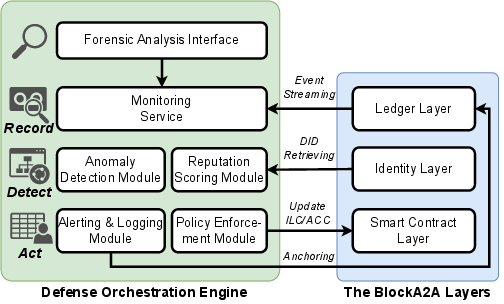
The Defense Orchestration Engine (DOE) complements BlockA2A by dynamically mitigating attacks through Byzantine agent flagging, execution halting upon prompt tampering, and real-time permission revocation. By analyzing abnormal behaviors and updating agent statuses based on reputation scores, DOE fortifies the framework against diverse threats, such as adversarial prompts, communication disruptions, and behavioral manipulations. Figure 2

Figure 2: Defense Orchestration Engine Architecture

Moreover, the paper provides a methodology for integrating BlockA2A within existing MASes. This involves mapping legacy identity systems to DIDs and transforming protocol-specific metadata into BlockA2A-compatible formats. By ensuring cross-MAS trust and maintaining operational continuity, BlockA2A scales securely across diverse environments.

Evaluation and Performance

Empirical evaluations demonstrate BlockA2A's effectiveness in neutralizing MAS attacks with minimal operational overhead and maintaining sub-second response times. For instance, task state transitions and prompt verification benefit from blockchain's immutability while allowing real-time interactions. Integrating BlockA2A within Google's A2A protocol confirms its practical applicability and enhances existing protocols with robust security mechanisms.

Conclusion

BlockA2A establishes a foundational framework for secure and verifiable agent-to-agent interoperability, aligning security protocols with the dynamic needs of modern enterprises. By leveraging decentralized identities, immutable ledgers, and programmable smart contracts, BlockA2A addresses MAS vulnerabilities while supporting scalable and resilient autonomous systems. This positions BlockA2A as a vital component for future-proofing agentic AI collaborations across various application domains. As the deployment of MASes continues to expand, frameworks like BlockA2A will be crucial for ensuring the secure and reliable operation of interconnected autonomous agents in complex, multi-domain environments.

Paper to Video (Beta)

No one has generated a video about this paper yet.

Whiteboard

No one has generated a whiteboard explanation for this paper yet.

Open Problems

We haven't generated a list of open problems mentioned in this paper yet.

Collections

Sign up for free to add this paper to one or more collections.