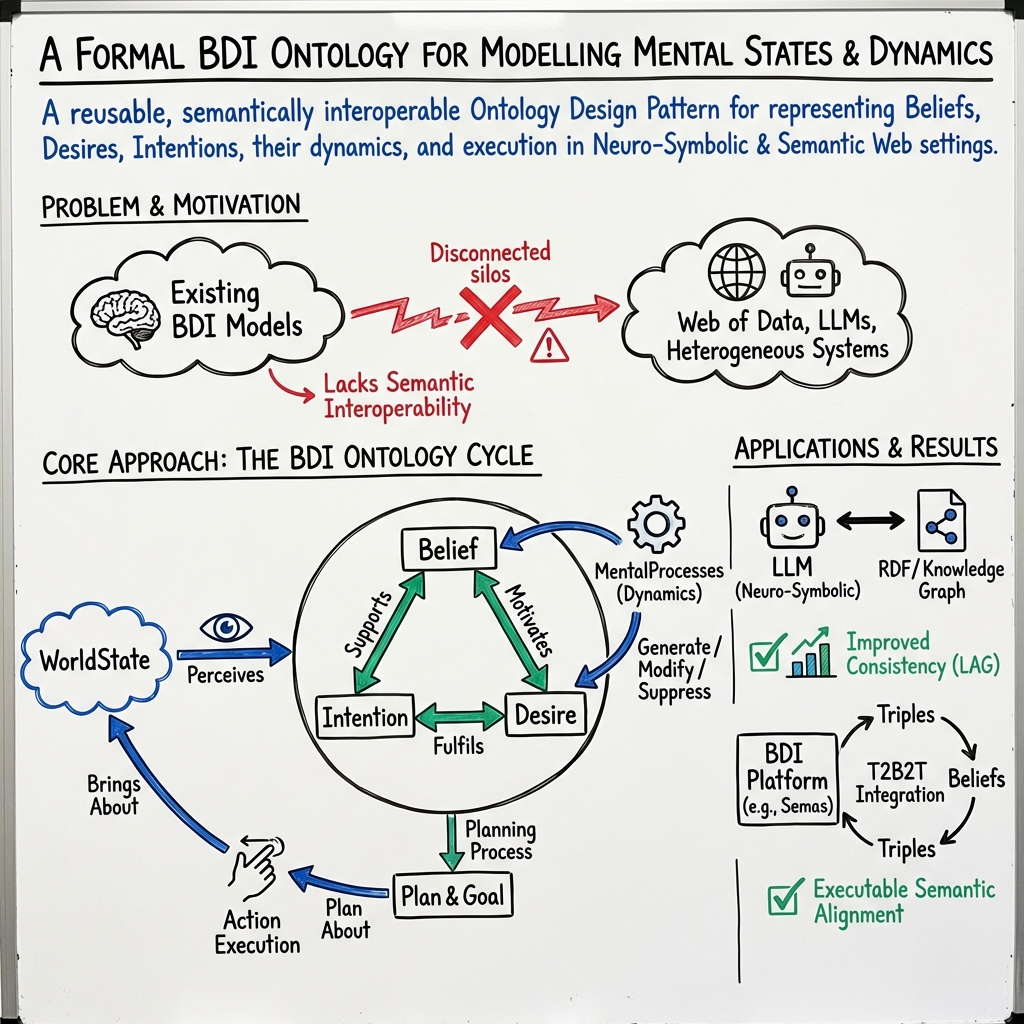
- The paper presents a formal BDI ontology that models agents' beliefs, desires, and intentions with semantic precision.
- It employs Logic Augmented Generation with LLMs to improve inference accuracy and identify logical inconsistencies.
- It integrates with BDI systems like Semas, transforming agent mental states into RDF triples for interoperable reasoning.
The Belief-Desire-Intention Ontology for Modelling Mental Reality and Agency
Abstract
The Belief-Desire-Intention (BDI) model is seminal in capturing rational agency for AI and cognitive sciences but has struggled to find structured, semantically interoperable integration. This work introduces a formal BDI Ontology, serving as a modular Ontology Design Pattern (ODP) that models agents' cognitive architectures using beliefs, desires, and intentions and their interrelations. By aligning with foundational ontologies and modular design principles, the ontology ensures semantic precision and reusability. Applied through two lines of experimentation—coupling with LLMs using Logic Augmented Generation (LAG) and integration into the Semas reasoning platform implementing the Triples-to-Beliefs-to-Triples (T2B2T) paradigm—this ontology acts as a bridge between declarative and procedural intelligence, facilitating cognitively grounded, explainable, and interoperable multi-agent systems.
Introduction
The BDI model provides a coherent framework for reasoning about agency in dynamic environments and has been influential in the evolution of agent-based systems. Despite these strengths, its deployment in structured knowledge representation formats has been limited. Addressing this shortfall, the BDI Ontology integrates these models with Semantic Web standards, supporting interoperable conceptual vocabularies for mental states and agent deliberative processes. The ontology delineates explicit modeling of agents' beliefs, desires, and intentions, thus underscoring deliberation and logical consistency across AI frameworks. This approach resonates with the growing emphasis on hybrid AI systems that merge symbolic and neural approaches to facilitate explainable and human-aligned AI.
Ontology Structure
Ontology Design and Requirements
The ontology addresses the mental reality of agents using detailed representations of mental states and processes. Ontological competency questions (CQs) are used to define key requirements, guiding the adoption of established Ontology Design Patterns (ODPs) such as EventCore and Situation for modeling agent dynamics. These patterns enable explicit representations of cognitive activities, delineating components like world states, mental entities, and their interactions, and providing a nuanced foundation for agentive reasoning.
The BDI Ontology formalizes the basic constituents of the BDI paradigm—beliefs, desires, intentions—and represents their dynamic generation and interaction processes. It captures cognitive chains of dependencies across mental states, ensuring comprehensive modeling of rational agent behaviors and causal cognitive structures via relationships such as motivates, supports, and fulfills. This formal structure enables consistency and semantic alignment with foundational ontologies like DOLCE and facilitates integration with existing semantic frameworks.
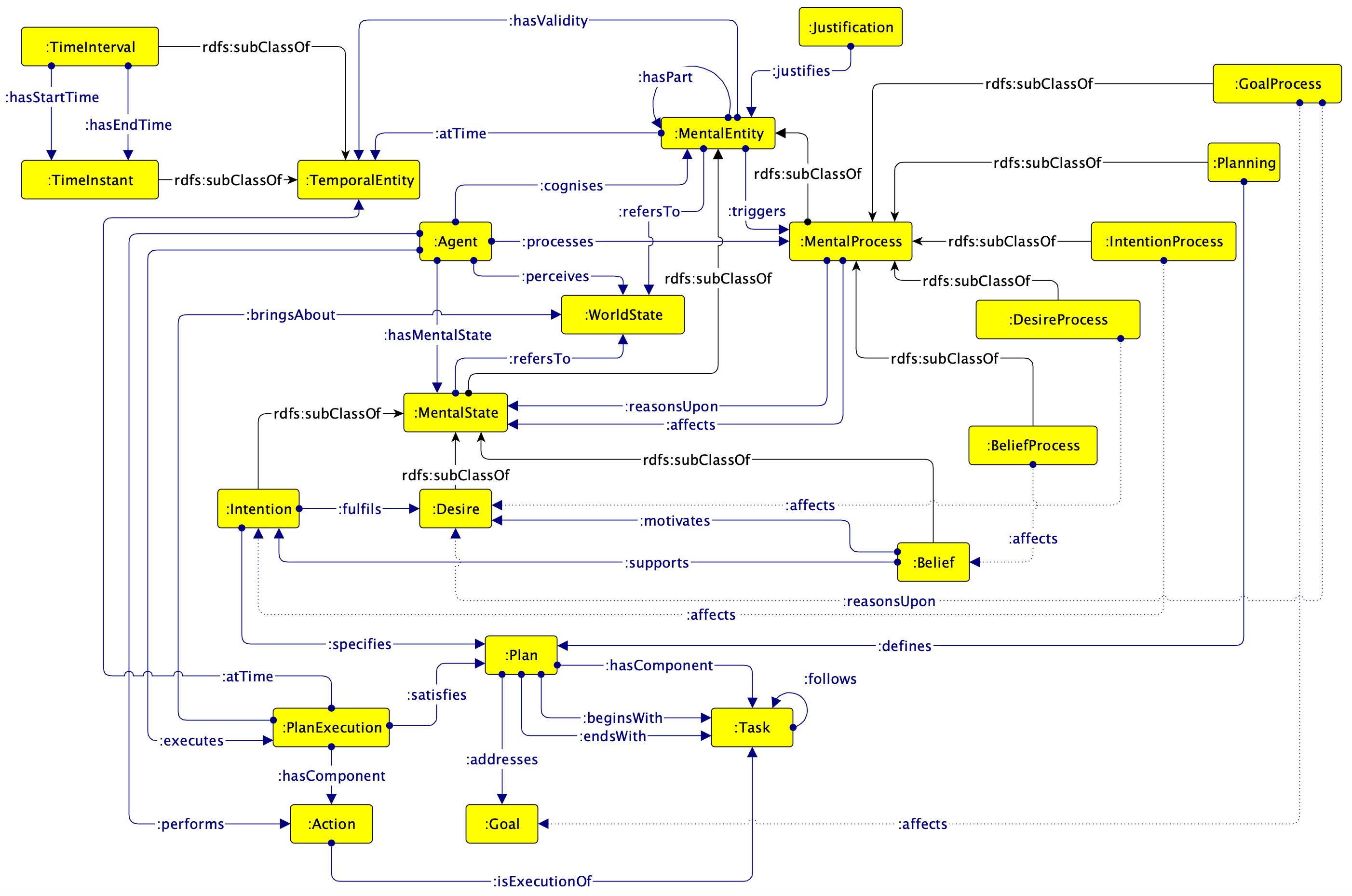
Figure 1: The bdi ontology.
Applications and Experiments
The practical efficacy of the BDI Ontology is showcased in two experimental frameworks:
Logic Augmented Generation with LLMs
The BDI Ontology's utility is evaluated in enhancing LLM inference and modeling through the Logic Augmented Generation (LAG) methodology. By integrating ontological knowledge, the BDI Ontology augments LLM capabilities in logical consistency checking, enabling rigorous cognitive modeling of agent mental states against domain-specific to-do tasks. The approach demonstrates notable improvements in inference accuracy, identifying logical inconsistencies missed by non-ontology augmented systems, thereby reinforcing agent rationality and logical coherence.
Integration into BDI Frameworks
Integration of the BDI Ontology into the Semas system, embodying the Triples-to-Beliefs-to-Triples (T2B2T) paradigm, exemplifies its application to real-world BDI frameworks. This integration supports seamless transformation between agent mental attitudes and RDF triples, ensuring interoperable reasoning across Semantic Web environments. The ontology provides the schema for declarative semantics, with procedural implementation via executable reasoning paradigms like Semas, reinforcing the link between symbolic knowledge representation and agentive action.
Conclusion
The BDI Ontology offers a robust semantic framework for rational agent modeling, advancing integration capabilities across multi-agent systems and the Semantic Web. While already enhancing LLM modeling completeness and logic inference, future work could extend support for agent intention conflicts, implement deeper integration with dynamic reasoning systems, and explore broader application domains. Ultimately, this ontology serves as a pivotal resource for developing cognitively sound, explainable, and interoperable AI systems in diverse environments.